
Veni Madhav Temple, Daraganj — The Presiding Deity of Prayagraj
Shri Veni Madhav Temple at Daraganj, about a kilometre from the Triveni Sangam, is the chief of the twelve Dwadash Madhav and is widely regarded as the presiding deity of Prayagraj itself. The deity is a shaligram vigraha of Lord Vishnu, worshipped here as Madhav. Tradition holds firmly that a Prayag yatra is incomplete without Veni Madhav darshan after the Sangam snan — the bath purifies, and Madhav completes it. Darshan is free, with morning and evening sessions, and it is the easiest of all the Madhav temples to reach from the confluence.
- Timings
- ~5 AM–12 PM & 4 PM–9 PM
- Significance
- Chief of the 12 Dwadash Madhav
- Deity
- Vishnu as Veni Madhav (shaligram)
- Distance
- ~1 km from the Triveni Sangam
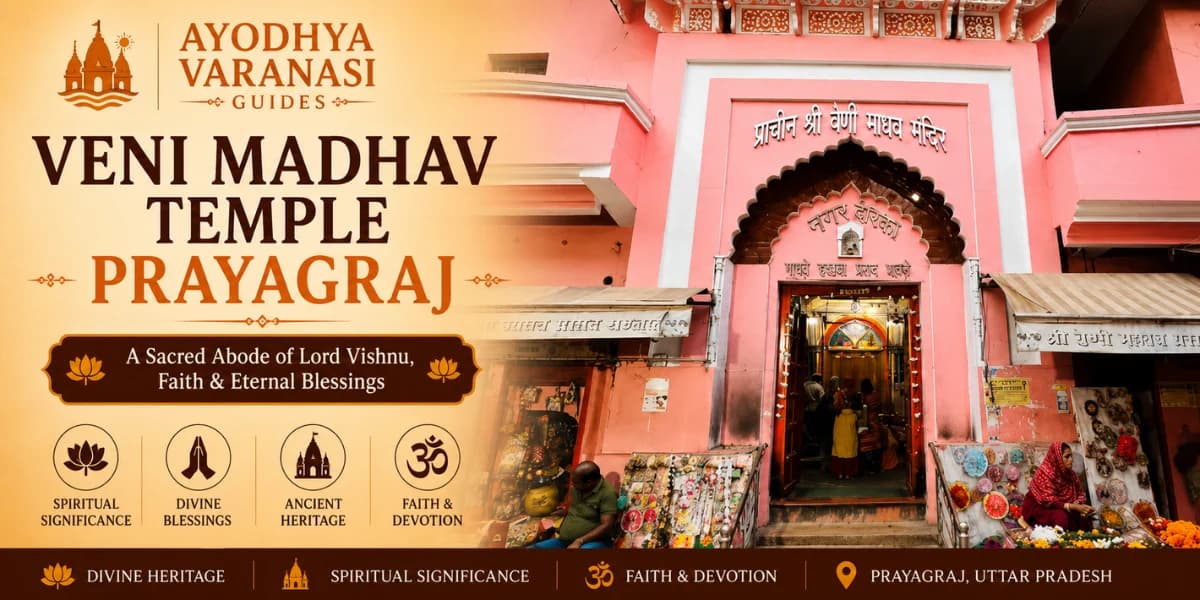
Veni Madhav Temple
Daraganj, Prayagraj · Lord of the Confluence
4.9 / 5 · Prayagraj Darshan Help
Sangam · Dwadash Madhav
- Timings
- ~5:00 AM–12:00 PM & 4:00 PM–9:00 PM
- Deity
- Lord Vishnu as Veni Madhav
- Significance
- Chief of the Dwadash Madhav; presiding deity of Prayag
- The Vigraha
- A shaligram form of Lord Vishnu
- Entry
- Free · no ticket required
- Location
- Nirala Marg, Daraganj, Prayagraj 211006
What Are the Veni Madhav Temple Timings?
Veni Madhav opens in two sessions — morning and evening — with a break through the middle of the day, roughly 5:00 AM to 12:00 PM and 4:00 PM to 9:00 PM. Darshan is free. The temple is busiest immediately after the morning snan hours, when pilgrims come straight up from the Sangam to complete their yatra. Hours extend sharply during Magh Mela and Kumbh.
Early Morning (Best)
Quiet, before the snan crowds arrive
Post-Snan Rush
Busiest; pilgrims arriving from the Sangam
Midday Break
Temple usually closed
Evening Session
Calmer; aarti in the evening
Morning Aarti
Shringar of the deity
Evening Aarti
The most atmospheric hour
Tulsi Offering
The traditional offering to Madhav
Ekadashi & Kartik
Especially auspicious for Vishnu darshan
Tip: the traditional sequence is snan first, then Veni Madhav darshan — bathe at the Sangam and come straight here. It is only a kilometre, and it is the one Madhav temple you should not leave Prayagraj without visiting. WhatsApp us and we will build it into your Sangam morning.
When Is the Best Month to Visit Veni Madhav Temple? (2026)
Prayagraj’s pilgrimage calendar drives everything here. October to March is comfortable throughout, while Magh Mela (January–February) and the month of Kartik are when the Prayag yatra — and therefore Veni Madhav darshan — is traditionally performed.
Kartik and Magh are the traditional months for the Prayag yatra. During Magh Mela and Kumbh this becomes one of the busiest temples in the city.
Why Is Veni Madhav Called the Presiding Deity of Prayagraj?
What Is Veni Madhav Temple?
Shri Veni Madhav Temple stands on Nirala Marg in Daraganj, the old riverside quarter of Prayagraj, about a kilometre from the Triveni Sangam. The deity is a shaligram vigraha of Lord Vishnu, worshipped as Madhav — and this is not simply one temple among many. It is regarded as the presiding deity of Prayagraj itself.
What Does “Veni” Mean?
Veni means a braid — and the braid in question is the Triveni, the plaiting together of the Ganga, the Yamuna and the invisible Saraswati at the confluence. Veni Madhav is the Madhav of that braid, the Lord who presides over the meeting of the three rivers. The name binds the deity to the confluence itself.
Why Is He the Chief of the Twelve Madhavs?
The Dwadash Madhav are the twelve ancient Vishnu temples that stand guard around Prayag, the king of pilgrimage places. Among all twelve, Veni Madhav — also called Adi Venimadhav — is the foremost. Tradition holds that Lord Vishnu manifested here at the very waters where the three rivers meet, and that he has protected Prayagraj and the Sangam ever since.
Why Is Darshan Here Essential After the Snan?
This is the point most visitors are never told. In the traditional understanding, the Sangam snan alone does not complete a Prayag yatra — the holy dip must be followed by darshan of Madhav, and above all of Veni Madhav. Millions bathe at the confluence every year and go home without it. It is a kilometre away, it is free, and it takes twenty minutes.
What Is the Connection With Veni Daan?
At the Sangam, pilgrims perform Veni Daan — an offering made at the confluence, traditionally by married women, taking its name from the same root: the braid. Devotees who perform Veni Daan at the water customarily come on to Veni Madhav for darshan afterwards, completing at the temple what was begun at the river.
What Is Daraganj?
Daraganj is the old riverside neighbourhood between the city and the Sangam — a quarter of pandas, priests, dharamshalas and temples that has served Prayag pilgrims for centuries. It is where the ritual life of the confluence actually lives, and Veni Madhav sits at its heart.
Did you know? Of the millions who take the Sangam snan each year, only a small fraction go on to Veni Madhav — even though tradition holds that without Madhav darshan the yatra is unfinished. It is a kilometre from the water.
How Do You Have Darshan at Veni Madhav Temple?
A simple darshan with a traditional order to it. Doing it in sequence after the snan is what gives it meaning.
- 1
Take the Sangam Snan First
The traditional order is the holy dip at the confluence first, then Madhav darshan. Do not reverse it if you can help it.
- 2
Come Up to Daraganj
The temple is about a kilometre from the Sangam on Nirala Marg. Autos and e-rickshaws run constantly; many pilgrims walk it.
- 3
Buy Tulsi and Flowers
Tulsi is the traditional offering to Madhav, and stalls near the temple sell it along with flowers and prasad.
- 4
Leave Footwear and Enter
Footwear comes off outside. The temple is compact and the queue moves quickly outside mela season.
- 5
Have Darshan of Veni Madhav
Stand before the shaligram vigraha of Lord Vishnu as Veni Madhav — the presiding deity of Prayagraj and chief of the twelve Madhavs.
- 6
Complete Your Prayag Yatra
This is the moment the tradition points to: the snan purifies, and Madhav darshan completes. Take a minute over it.
- 7
Ask About the Other Madhavs
The priests can tell you which of the remaining eleven Madhav temples are within reach if you want to go further.
- 8
Walk Through Daraganj
The old riverside quarter around the temple is full of dharamshalas, small shrines and the working life of the Sangam.
When Should You Visit Veni Madhav Temple?
The temple is open all year and free. What matters is the session timing, the season and where it falls in your Sangam morning.
Best Time of Day — Right After the Snan
Bathe at the Sangam at sunrise and come straight here. That is the traditional sequence, and arriving by 7 or 8 AM means you beat the post-snan rush that builds through the morning.
Best Season — October to March
Comfortable weather for the whole Sangam circuit. Kartik (October–November) is the traditional month for the Prayag yatra and carries particular merit for Vishnu darshan.
Most Special — Magh Mela, Kartik Purnima & Ekadashi
Magh Mela brings enormous crowds and an extraordinary atmosphere. Kartik Purnima, Dev Uthani Ekadashi and Janmashtami are the great individual days at a Madhav temple.
What Can You See at Veni Madhav Temple?
A working temple at the heart of Prayag's ritual quarter. Here is what to take in.
The Veni Madhav Vigraha
Top PickThe Main Darshan
The shaligram form of Lord Vishnu worshipped as Veni Madhav — the presiding deity of Prayagraj and chief among the twelve Madhavs.
The Dwadash Madhav Tradition
Top PickChief of the Twelve
The temple's place at the head of the twelve Vishnu shrines that guard Tirtharaj Prayag — a Puranic circuit most visitors never encounter.
The Daraganj Quarter
Prayag's Ritual Heart
The old riverside neighbourhood of pandas, priests, dharamshalas and shrines that has served Sangam pilgrims for centuries.
The Post-Snan Devotion
The Living Tradition
Watch pilgrims arriving straight from the confluence, still wet from the snan, to complete their yatra. It is the temple at its most alive.
Proximity to the Sangam
One Kilometre Away
Close enough to walk from the confluence, which is exactly why there is no excuse for skipping it.
Why Is Veni Madhav the One Madhav Temple You Must Visit?
There are twelve Madhavs around Prayag, scattered up to 40 km apart. If you only manage one, it should be this one.
It Completes the Prayag Yatra
Tradition is explicit: the Sangam snan is finished by Madhav darshan, and Veni Madhav is the foremost of the twelve.
The Presiding Deity of the City
Not simply an important temple — the deity held to preside over Prayagraj itself and to protect the confluence.
A Kilometre From the Water
The other Madhav temples are scattered as far as 40 km out. This one is a short walk from where you bathed.
The Real Ritual Prayag
Daraganj is where the working religious life of the Sangam happens, well away from the tourist view of the confluence.
Is There an Entry Fee at Veni Madhav Temple? (2026)
Darshan is completely free — there is no ticket and no paid queue, even during the Magh Mela. Only offerings and any special puja carry a cost.
The darshan is free and it is barely a kilometre from the confluence. What we add is the sequence and the context — snan first, Madhav after, with a guide who can explain why the order matters, and the option to extend into a wider Dwadash Madhav circuit. Pricing confirmed in writing.
Auto fares are indicative and vary with season, traffic and the mela calendar.
What Do Pilgrims Say About Veni Madhav Temple?
1,187 verified reviews
We had done the Sangam snan and were about to leave for Varanasi when our guide asked whether we had done Madhav darshan. We had never heard of it. One kilometre away, and it completed the whole yatra.
Hariharan Iyer
Coimbatore
My family has come to Veni Madhav after the snan for generations. It is the proper way. Very glad to see a guide company that actually knows this rather than just doing the boat ride and leaving.
Sushma Dwivedi
Kanpur
Visited during Magh Mela. Extremely crowded but very well managed, and the atmosphere in Daraganj at that time is something else. Free darshan and the priests were patient with our questions.
Anand Prakash Singh
Ranchi
Learning that Veni Madhav is considered the presiding deity of Prayagraj changed how we saw the whole city. Small temple, enormous significance. Walked here from the Sangam in twenty minutes.
Meenakshi Rao
Hyderabad
Local here. Everyone in Prayagraj knows Veni Madhav; outsiders almost never come. Mind the afternoon closure. Daraganj lanes are narrow so come by auto or on foot, not by car.
Deepak Srivastava
Prayagraj
How Do You Do the Sangam and Veni Madhav in the Right Order?
The traditional sequence is snan first, Madhav after. This is the Prayagraj morning our guests find most complete.
Sunrise at the Triveni Sangam. Reach the confluence for first light — the finest hour on the water.
Sangam boat ride & snan. The holy dip at the meeting of the Ganga, Yamuna and the invisible Saraswati.
Veni Madhav darshan, Daraganj. Come straight up from the water to complete the yatra at the chief of the twelve Madhavs.
Akshayavat & Patalpuri Temple. Darshan of the immortal banyan inside Prayagraj Fort. Carry photo ID for every adult.
Someshwar Mahadev at Arail. Across the Yamuna to the ancient Shiva temple consecrated by the Moon God.
Hanumat Niketan, Civil Lines. The great Hanuman complex with its library, akhara and weaponry museum.
Evening Ganga Aarti at Saraswati Ghat. Close the day on the riverfront with lamps and bells.
Which Tour Package Covers Veni Madhav Temple?
Veni Madhav Temple sits within the wider Prayagraj circuit, and the Sangam, the temples and the sites out of town need a vehicle and a sensible order to do properly. These are the itineraries our guests book most — each with the Triveni Sangam snan and boat ride, a certified local guide, transport and pricing confirmed in writing.
- 1 Day1 Day Prayagraj Tour PackageTriveni Sangam snan and boat ride with the main temples of the confluence.
- 2 Days2 Days Prayagraj Tour PackageThe Sangam, Akshayavat and the Daraganj temples without rushing any of them.
- 2 Days2 Days Varanasi Prayagraj Tour PackageKashi Vishwanath and the Ganga Aarti with the Triveni Sangam.
- 2 Days2 Days Ayodhya Prayagraj Tour PackageRam Mandir and the Sangam, tightly planned for a short trip.
- 3 Days3 Days Varanasi Prayagraj Tour PackageKashi and the confluence, with time for the ghats and the Sangam boat ride.
- 4 Days4 Days Ayodhya Varanasi Prayagraj Tour PackageAll three cities — Ram Mandir, Kashi Vishwanath and the Triveni Sangam.
- 5 Days5 Days Ayodhya Varanasi Prayagraj Tour PackageThe complete sacred circuit at a comfortable, senior-friendly pace.
Want Veni Madhav Temple built into a custom itinerary? We plan around your dates, your pace and what you actually want to see.
See all Prayagraj, Ayodhya & Varanasi packagesHow Do You Reach Veni Madhav Temple in Prayagraj?
The temple is on Nirala Marg in Daraganj, about a kilometre from the Triveni Sangam — the closest and most accessible of all twelve Madhav temples.
On Foot From the Sangam
Many pilgrims simply walk up from the confluence after the snan — about a kilometre through Daraganj, and the traditional way to do it.
By Road / Auto
Autos and e-rickshaws reach Daraganj easily. The lanes are narrow, so expect a short walk at the end rather than a car to the door.
By Train
Prayagraj Sangam station is very close and Prayagraj Junction about 6 km. Both connect to Delhi, Varanasi, Lucknow and Ayodhya.
By Air
Prayagraj Airport (Bamrauli) is roughly 17 km away, with taxis at the terminal. Varanasi (~120 km) and Lucknow (~200 km) are the larger airports.
Where Is Veni Madhav Temple Located in Prayagraj?
Shri Veni Madhav Temple stands on Nirala Marg in Daraganj, the old riverside quarter of Prayagraj, about a kilometre from the Triveni Sangam.
Prayagraj
- Area: Nirala Marg, Daraganj, Prayagraj
- PIN: Prayagraj 211006
- From the Triveni Sangam: ~1 km
- Significance: Chief of the twelve Dwadash Madhav
- Best done: Straight after the Sangam snan
Where Should You Stay Near Veni Madhav Temple?
Daraganj is the traditional pilgrim quarter of Prayagraj, which makes it the natural base for a Sangam-focused trip.
Daraganj
The old riverside quarter with dharamshalas and simple guesthouses, walking distance from both Veni Madhav and the Sangam. The traditional pilgrim base.
Civil Lines
Prayagraj's main hotel district, with branded and mid-range properties and good restaurants, about 20 minutes from Daraganj.
Near Prayagraj Junction
Convenient if you are continuing to Varanasi, Ayodhya or Chitrakoot by train, with plenty of budget and mid-range options.
What Else Can You Visit Near Veni Madhav Temple?
Daraganj sits between the city and the confluence, which puts the whole Sangam circuit within easy reach.
Triveni Sangam
The sacred confluence of the Ganga, Yamuna and the invisible Saraswati — the snan that Veni Madhav darshan completes.
Akshayavat
The immortal banyan inside the underground Patalpuri Temple at Prayagraj Fort. Photo ID required.
Sankat Har Madhav Temple
Another of the twelve Dwadash Madhav, across the Ganga at Jhunsi — the Madhav who removes troubles.
Nag Vasuki Temple
The temple of the serpent king, also in Daraganj — one of the few places performing Kaal Sarp Dosh nivaran puja.
Someshwar Mahadev Temple
The ancient Shiva temple at Arail across the Yamuna, consecrated by the Moon God.
Hanumat Niketan
The great Hanuman temple complex in Civil Lines, with its library, akhara and weaponry museum.
Shringverpur Dham
The kingdom of Nishadraj Guha where Lord Ram crossed the Ganga in exile, about 35 km away.
Magh Mela, Kartik & the Dwadash Madhav Parikrama at Veni Madhav
Through Magh Mela (January–February) and the Kumbh, Daraganj fills with pilgrims and Veni Madhav becomes one of the busiest temples in Prayagraj. The great snan days — Makar Sankranti, Paush Purnima, Mauni Amavasya and Basant Panchami — send an unbroken stream of devotees up from the confluence to complete their yatra here.
The month of Kartik is the traditional season for the Prayag yatra, and the Dwadash Madhav Parikrama — the three-day walking circuit of all twelve Madhav temples — begins from the chief among them. Kartik Purnima, Dev Uthani Ekadashi and Janmashtami are the other great days here.
What Should You Know Before Visiting Veni Madhav Temple?
An easy darshan, and the single most important one that Sangam visitors miss. A few things to know.
Do the snan first, then the darshan
The traditional order matters. Bathe at the Sangam and come up to Veni Madhav afterwards — that is what completes a Prayag yatra.
It is only a kilometre from the water
There is genuinely no reason to skip it. Many pilgrims walk up from the confluence in fifteen or twenty minutes.
Mind the midday closure
The temple shuts for a few hours in the middle of the day. Come in the morning session or after 4 PM.
Carry tulsi if you can
Tulsi is the traditional offering to Madhav. It is sold at the stalls outside, but bringing your own is considered especially good.
The Daraganj lanes are narrow
Come by auto or on foot. A car will not reach the temple door in this quarter.
Expect crowds after the morning snan
The busiest hours are 8 AM to noon, when pilgrims arrive straight from the confluence. Early morning is calmer.
Magh Mela changes everything
During the mela this is one of the busiest temples in Prayagraj, with long queues and traffic diversions. Allow far more time.
Ask about the other eleven Madhavs
Veni Madhav is the chief of twelve. If you have a day, a guide can build three or four of them into a proper circuit.
It is a small temple, not a monument
Do not arrive expecting scale. The significance here is doctrinal and devotional, not architectural.
Dress modestly
Standard temple etiquette applies, with footwear removed at the entrance.
Veni Madhav Temple Prayagraj — Frequently Asked Questions
The questions pilgrims ask us most about Veni Madhav — why it completes the Prayag yatra, timings, its place among the twelve Madhavs and how to reach Daraganj.
Shri Veni Madhav Temple stands on Nirala Marg in Daraganj, about a kilometre from the Triveni Sangam. It houses a shaligram vigraha of Lord Vishnu worshipped as Veni Madhav, and is regarded as the presiding deity of Prayagraj and the chief of the twelve Dwadash Madhav.
Still have a question?
Our local team replies within 30 minutes.
Written & verified by the local Prayagraj guide team at Ayodhya Varanasi Guides
Our government-certified guides take pilgrims from the Sangam up to Veni Madhav in the traditional order throughout the year, including through the Magh Mela season. Last updated: July 2026. Darshan hours and access change sharply during the mela — message us and we will confirm the position for your travel date.
Complete Your Prayag Yatra at Veni Madhav
Let Ayodhya Varanasi Guides plan your Prayagraj darshan in the traditional order — the Triveni Sangam snan and boat ride, then Veni Madhav at Daraganj, with Akshayavat, Someshwar Mahadev and the Dwadash Madhav circuit — with a certified local guide who knows why the sequence matters. Confirmed in writing.