The complete guide to Nageshwarnath Mahadev — the ancient Shiva temple of Ayodhya built by Kush, son of Lord Ram, and revered as the Kshetrapal (guardian deity) of the holy city. History & legend, darshan and aarti timings, Mahashivratri & Sawan, how to reach and the distance from Ram Mandir.
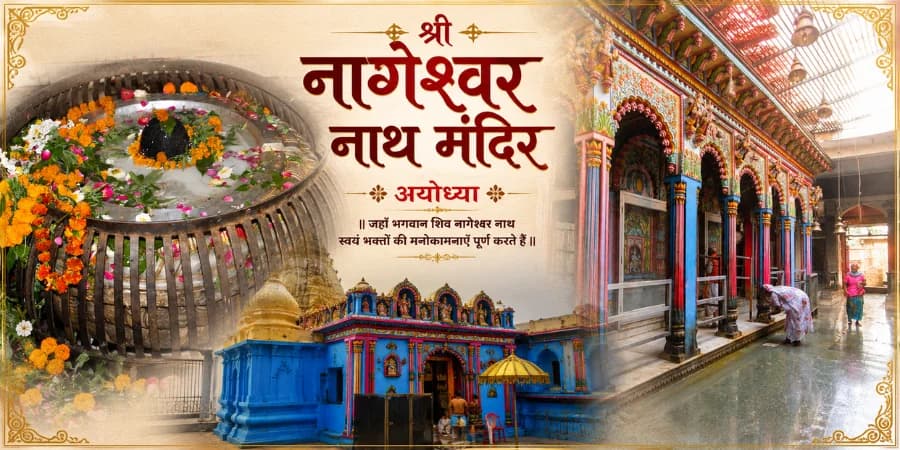
Nageshwarnath Temple (Nageshwarnath Mahadev) is one of the most ancient Shiva temples in Ayodhya, located near Ram Ki Paidi on the banks of the Saryu. By tradition it was built by Kush, the son of Lord Ram, in honour of a Nag-Kanya who returned his lost armlet, and it is revered as the Kshetrapal (guardian deity) of Ayodhya. Darshan is free, open roughly 5 AM–12 PM and 4 PM–10 PM, and the temple is about 2 km from Ram Mandir. It is busiest on Mondays, during Sawan and on Mahashivratri, when a grand Shiv Barat is taken out.
Deity
Lord Shiva
Built by
Kush (son of Ram)
Entry
Free
From Ram Mandir
2 km
Nageshwarnath Temple is among the oldest and most revered shrines in Ayodhya, dedicated to Lord Shiva and standing close to Ram Ki Paidi on the banks of the sacred Saryu river. It is venerated as the Kshetrapal— the divine guardian who protects the holy city of Lord Ram. For generations, pilgrims have considered a visit to Nageshwarnath an essential part of a complete Ayodhya yatra, seeking Mahadev's blessing alongside darshan at Ram Mandir, Hanuman Garhi and Kanak Bhawan. The temple enshrines a Shivling worshipped daily with abhishekam, bel patra and Saryu jal, and its quiet, ancient atmosphere offers a contemplative contrast to the grandeur of the new Ram Mandir. Its location near the Saryu ghats makes it easy to combine darshan here with the evening Saryu Aarti.
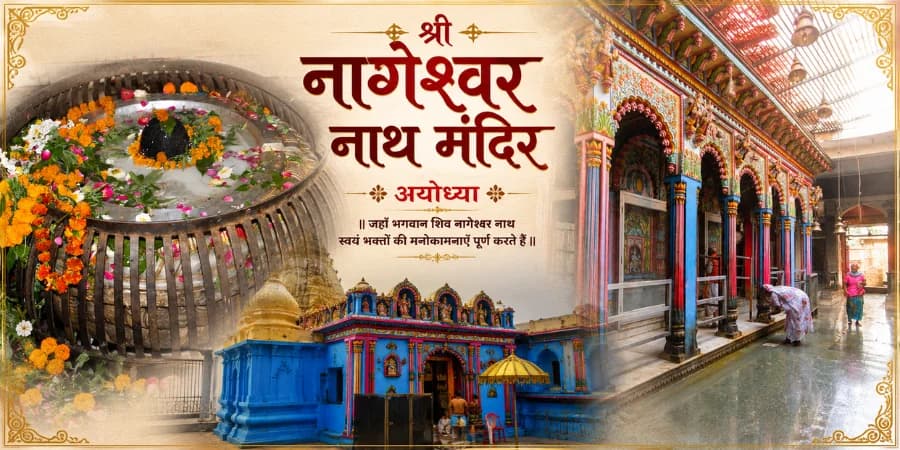
Nageshwarnath Mahadev
Ancient Shiva Temple · Ayodhya
The origin of Nageshwarnath Temple is woven into the very legend of Ayodhya. Tradition holds that it was built by Kush, the son of Lord Ram: while bathing in the Saryu, Kush lost his armlet (bajuband), which was found by a Nag-Kanya — a serpent maiden and ardent devotee of Lord Shiva. Enchanted by her devotion, Kush built this temple of Nageshwarnath (“Lord of the Nagas”) in her honour. The temple is also famously credited with helping Raja Vikramaditya rediscover the lost site of ancient Ayodhya centuries later — it is said to have survived as a living landmark when much of the old city had faded. The present structure has been renovated over the ages, with a notable renovation attributed to the 18th century, yet the continuous worship of Shiva here makes Nageshwarnath a sacred thread linking modern Ayodhya to its Treta Yuga roots.
Son of Lord Ram, in honour of a devoted Nag-Kanya who returned his lost armlet.
Said to have helped Raja Vikramaditya locate the lost ancient city of Ayodhya.
Continuous Shiva worship through the ages — the Kshetrapal of the holy city.
The Nageshwarnath Temple timings follow the traditional two-session pattern of Ayodhya's temples. Darshan is generally open from around 5:00 AM to 12:00 PM in the morning and 4:00 PM to 10:00 PM in the evening, with the morning opening shifting to about 5:30 AM and the evening closing near 9:00 PM in winter. The day begins with the Mangala Aarti and the evening Sandhya Aarti at dusk is the most attended. Mondays are especially busy as they are dedicated to Lord Shiva, and during the holy month of Sawan and on Mahashivratri the temple stays open far longer with extended, often round-the-clock darshan. Because timings can change on festival days, arrive early and verify locally or with Ayodhya Varanasi Guides. The tables below show the seasonal darshan windows and the daily aarti schedule at Nageshwarnath Mahadev.
Mangala Aarti
~5:00 AM
First aarti as the temple opens
Shringar / Bhog
~12:00 PM
Midday offering before the afternoon break
Sandhya Aarti
~7:00 PM
Evening aarti — the most attended
Shayan Aarti
~9:30 PM
Final aarti before closing
✦ Timings are seasonal and extend during Sawan & Mahashivratri. Verify locally before visiting.
The Nageshwarnath Mahadev temple reflects the layered history of Ayodhya — an ancient shrine renovated across centuries into the structure devotees see today. At its heart is the Shivling, worshipped continuously with water, milk, bel patra and dhatura, set within a sanctum that radiates a calm, age-old devotion. The temple sits near Ram Ki Paidi and the Theri Bazaar area, so a visit naturally flows into the riverside Saryu ghats. Within the complex and its surroundings you will find smaller shrines, a Nandi facing the sanctum, and the gentle rhythm of bells and aartis that mark the day. Unlike the soaring grandeur of the new Ram Mandir, Nageshwarnath offers an intimate, meditative experience that connects visitors to Ayodhya's most ancient spiritual layer. Photography is generally permitted in the outer premises; follow the priests' guidance inside the sanctum, especially on busy Sawan Mondays and during Mahashivratri.
Festivals transform Nageshwarnath Temple into one of the most vibrant spiritual centres of Ayodhya. Mahashivratri is the grandest occasion — the temple is decorated, special abhishekam and night-long aartis are performed, and a famous Shiv Barat (the divine wedding procession of Lord Shiva) is traditionally taken out through the city from the Nageshwarnath area. The holy month of Sawan (Shravan) brings continuous streams of devotees and Kanwariyas, especially on Sawan Somwar (Mondays), to offer Saryu and Ganga jal on the Shivling. The temple is also active during Kartik Purnima, Shravan Shivratri and other Shiva festivals, with extended darshan hours. If you wish to witness these celebrations, plan well ahead, expect very large crowds, and book your Ayodhya accommodation and guide early — our team can arrange a smooth, well-timed darshan even on the busiest festival days.
Nageshwarnath Temple is centrally located in old Ayodhya, near Ram Ki Paidi and Theri Bazaar, which makes it easy to reach and to combine with other darshan. It is just about 0.5 km from Ram Ki Paidi (the Saryu Aarti ghat), roughly 2 km from Shri Ram Janmabhoomi (Ram Mandir) and about 2 km from the Ayodhya Dham railway station. The Maharishi Valmiki International Airport is around 12 km away, with flights from Delhi, Mumbai and other cities. E-rickshaws and autos run throughout Ayodhya to the temple. For pilgrims travelling from outside, Ayodhya is well connected by road and rail — about 135 km from Lucknow, and within a few hours of Varanasi and Prayagraj on the Uttar Pradesh spiritual circuit. The tables below give the distance, travel time and best transport mode, first for places within Ayodhya from Nageshwarnath, and then for reaching Ayodhya from major cities.
Ayodhya Dham Junction — 2 km, with nationwide connectivity.
Maharishi Valmiki International Airport — 12 km, flights from Delhi, Mumbai & more.
E-rickshaws and autos run to the temple from across the city.
One of the joys of visiting Nageshwarnath Temple is how close it sits to Ayodhya's most important sacred sites, letting you build a rich, walkable darshan circuit. Just half a kilometre away is Ram Ki Paidi, where the spectacular evening Saryu Aarti is held; about two kilometres away stands the grand Ram Mandir at Lord Ram's birthplace; and nearby you will find Hanuman Garhi, Kanak Bhawan and Dashrath Mahal. A typical day pairs morning darshan at Ram Mandir and Hanuman Garhi with a visit to Nageshwarnath and the surrounding temples, ending with the Saryu Aarti at dusk. The sites below are all within easy reach of Nageshwarnath by foot or a short e-rickshaw ride — our local guides can sequence them for the smoothest, most meaningful Ayodhya experience.
The grand Saryu ghats with the spectacular evening aarti, just a short walk away.
Lord Ram's birthplace and the grand new temple — the heart of any Ayodhya yatra.
The hilltop Hanuman temple, traditionally visited before Ram Mandir darshan.
The golden palace temple gifted to Sita, with gold-crowned Sita-Ram idols.
The royal palace complex of King Dashrath, Lord Ram's father.
The Saryu ghat where Lord Ram is believed to have taken Jal Samadhi.
A few practical pointers make a visit to Nageshwarnath Mahadev far smoother and more meaningful. As an ancient, living Shiva temple in the busy old quarter of Ayodhya near Theri Bazaar and Ram Ki Paidi, it draws steady streams of devotees — and huge crowds on Mondays, through the month of Sawan and on Mahashivratri, when a grand Shiv Barat passes through. Knowing the best time to arrive, what to carry for the abhishekam, the rules on footwear and photography, and how to combine your darshan with the nearby Saryu Aarti and Ram Mandir will save you time and let you focus on the worship. Below are honest, on-the-ground tips from our local Ayodhya guides to help you plan a calm, well-timed and spiritually rewarding visit to the Kshetrapal of Ayodhya.
The temple is calmest and coolest soon after it opens around 5 AM. Weekday mornings let you offer jal and have unhurried darshan of the Shivling before the day's crowd arrives.
Mondays are dedicated to Lord Shiva, and the whole month of Sawan plus Mahashivratri draw enormous crowds. They are spiritually powerful but expect long queues — plan and arrive very early.
Devotees offer Saryu or Ganga jal, bel patra (bilva leaves) and dhatura on the Shivling. Buy these from the authorised stalls near the temple, and a simple heartfelt abhishekam is enough.
Remove footwear before entering and use the shoe stand. The temple is near the narrow lanes of Theri Bazaar, so carry minimal luggage and keep an eye on traffic and crowds outside.
Photos are generally fine in the outer complex, but follow the priests' guidance inside the sanctum. On festival days, phones and bags may face security checks — keep them handy.
On Mahashivratri a grand Shiv Barat (Lord Shiva's wedding procession) is taken out from the Nageshwarnath area. Roads get diverted and crowds peak — reach early and follow the local guidance.
Ram Ki Paidi is just 0.5 km away. Time your visit so you can have Nageshwarnath darshan and then walk over for the spectacular evening Saryu Aarti — a perfect close to the day.
The story of Kush, the Nag-Kanya and Raja Vikramaditya brings the temple alive. A certified local guide adds the history and context most visitors miss — and helps you sequence nearby darshans.
Our local guide's honest tip: most visitors rush to Ram Mandir and skip Nageshwarnath — but this quiet, ancient temple is where you truly feel Ayodhya's oldest spiritual layer. Visit at dawn during Sawan, before the Monday rush, to offer jal in peace. Take ten extra minutes to hear the legend of Kush and the Nag-Kanya — it transforms the darshan. Ayodhya Varanasi Guides can pair it with the Saryu Aarti and Ram Mandir for the perfect Ayodhya day.
Let Ayodhya Varanasi Guides arrange your complete Ayodhya day — darshan at Nageshwarnath Mahadev, Ram Mandir Sugam Darshan, Hanuman Garhi, Kanak Bhawan and the evening Saryu Aarti — with a certified local guide, AC transport and flexible timing. Often combined into a full Ayodhya–Prayagraj–Varanasi yatra.
Here are the most common questions devotees and travellers ask about Nageshwarnath Temple, Ayodhya — drawn from what people actually search on Google. From who built the temple and its legend with Kush and the Nag-Kanya, to the darshan and aarti timings, Mahashivratri and Sawan, the distance from Ram Mandir, what to offer and whether it is a Jyotirlinga, these answers cover everything you need for a meaningful visit. If your question is not covered, the team at Ayodhya Varanasi Guides is happy to help you plan your Nageshwarnath darshan and complete Ayodhya yatra.
According to tradition, the Nageshwarnath Temple was established by Kush, the son of Lord Ram. The legend says Kush lost his armlet while bathing in the Saryu, and a Nag-Kanya (serpent maiden), a devotee of Lord Shiva, found and returned it. To honour her devotion, Kush built this Shiva temple. The present structure has been renovated over the centuries — a major renovation is attributed to the 18th century — but the shrine is regarded as one of the most ancient in Ayodhya.
Nageshwarnath is among Ayodhya's oldest temples and is considered the Kshetrapal (presiding guardian deity) of the city. Tradition links its origin to Kush and the Nag-Kanya legend. It is also believed that this temple helped Raja Vikramaditya rediscover the lost site of ancient Ayodhya. Through the rise and fall of the city over the ages, the worship of Lord Shiva at Nageshwarnath is said to have continued, making it a living thread connecting modern Ayodhya to its legendary past.
The temple is generally open from around 5:00 AM to 12:00 PM in the morning and 4:00 PM to 10:00 PM in the evening (in winter it opens at about 5:30 AM and closes around 9:00 PM). Darshan begins with the Mangala Aarti and the evening Sandhya Aarti is the most attended. On Mahashivratri and during the month of Sawan, the temple stays open much longer with extended darshan.
Kshetrapal means the guardian or protector deity of a sacred region. Nageshwarnath Mahadev is revered as the Kshetrapal of Ayodhya — the divine guardian who watches over the holy city of Lord Ram. Many devotees consider it auspicious to seek Lord Shiva's blessing at Nageshwarnath as part of a complete Ayodhya pilgrimage, alongside Ram Mandir, Hanuman Garhi and the Saryu Aarti.
Nageshwarnath Temple is about 2 km from Shri Ram Janmabhoomi (Ram Mandir) — roughly an 8–10 minute e-rickshaw ride or a 20–25 minute walk through Ayodhya's old town. It is also just 0.5 km from Ram Ki Paidi, where the evening Saryu Aarti is held, making it easy to combine all three in a single Ayodhya itinerary.
Mahashivratri is the grandest festival at Nageshwarnath. The temple is decorated, special abhishekam and night-long aartis are performed, and thousands of devotees queue for darshan. A famous Shiv Barat (the wedding procession of Lord Shiva) is traditionally taken out from the Nageshwarnath area through Ayodhya. If you visit on Mahashivratri, expect very heavy crowds and plan to arrive early.
Yes. The month of Sawan (Shravan, July–August) is the most sacred time for Shiva worship, and Nageshwarnath sees huge numbers of devotees, especially on Mondays (Sawan Somwar). Kanwariyas and pilgrims offer Ganga / Saryu jal on the Shivling. Darshan timings are usually extended through Sawan, and the temple atmosphere is especially vibrant.
Devotees offer water (often Saryu or Ganga jal), milk, bel patra (bilva leaves), dhatura, flowers and fruits to the Shivling. These items are available at stalls near the temple. A simple, heartfelt abhishekam of the lingam is the traditional offering. During Sawan and Mahashivratri, the offering of jal and bel patra is especially auspicious.
No. Darshan at Nageshwarnath Temple is completely free for all devotees. There is no ticket or entry charge. A small voluntary donation (dakshina) to the temple or priests is optional. Like most Ayodhya temples, phones and large bags may be subject to security checks during major festivals.
Early mornings on weekdays, soon after the temple opens, are the calmest and coolest. Mondays, Mahashivratri and the whole of Sawan are spiritually powerful but very crowded. October to March offers the most pleasant weather for exploring Ayodhya on foot. Visiting in the evening lets you combine darshan with the nearby Saryu Aarti at Ram Ki Paidi.
The temple is near Ram Ki Paidi and Theri Bazaar, about 2 km from Ayodhya Dham railway station and 12 km from Maharishi Valmiki International Airport. E-rickshaws and autos run throughout Ayodhya to the temple. From Lucknow it is about 135 km (2.5–3 hours by road or train), and it is well connected from Varanasi and Prayagraj for the wider UP pilgrimage circuit.
Absolutely — it is part of the ideal Ayodhya day. Pilgrims typically do Hanuman Garhi and Ram Mandir Sugam Darshan in the morning, visit Nageshwarnath and other temples through the day, and end with the evening Saryu Aarti at Ram Ki Paidi nearby. Ayodhya Varanasi Guides arranges this complete itinerary with a certified local guide and transport.
No. The twelve Jyotirlingas are a specific, separate list of Shiva shrines (which includes Kashi Vishwanath in Varanasi but not Nageshwarnath Ayodhya). Nageshwarnath is an extremely ancient and revered Shiva temple and the Kshetrapal of Ayodhya, but it is not counted among the twelve Jyotirlingas. It remains one of the most important Shiva temples to visit in Ayodhya.
There is no strictly enforced dress code, but modest, traditional clothing is respected at this sacred Shiva temple. Footwear is removed before entering. If you plan a Saryu snan beforehand, carry a change of clothes. During Sawan and Mahashivratri, many devotees wear saffron or traditional attire while offering jal to the Shivling.
Yes. Ayodhya Varanasi Guides arranges complete Ayodhya temple tours covering Nageshwarnath Mahadev, Ram Mandir Sugam Darshan, Hanuman Garhi, Kanak Bhawan and the Saryu Aarti — with a certified local guide, AC transport and flexible timing, often as part of a larger Ayodhya–Prayagraj–Varanasi yatra. Call +91 9058430503 to plan your visit.
From Ram Mandir darshan in Ayodhya to Ganga Aarti at Dashashwamedh Ghat — we plan every detail so you can focus on what truly matters.
38K+
Happy Pilgrims
4.9★
Google Rating
200+
Tour Packages
Fill in your details — we'll reach out within minutes.
4.9 rated by 38,000+ pilgrims
Explore More of Ayodhya
Nageshwarnath Temple, Ayodhya — also known as Nageshwarnath Mahadev — is one of the most ancient and sacred Shiva temples in the holy city of Lord Ram. Built, by tradition, by Kush, the son of Lord Ram, and revered as the Kshetrapal (guardian deity) of Ayodhya, it stands near Ram Ki Paidi on the banks of the Saryu river, offering a deeply meditative darshan that connects pilgrims to Ayodhya's oldest spiritual roots.
The history of Nageshwarnath is tied to the legend of Kush and a devoted Nag-Kanya who returned his lost armlet, and to Raja Vikramaditya, who is said to have rediscovered ancient Ayodhya with the help of this surviving shrine. Renovated over many centuries, the temple has preserved continuous Shiva worship, making it a living link to the Treta Yuga heritage of the city.
Darshan is generally available from about 5:00 AM to 12:00 PM and 4:00 PM to 10:00 PM, beginning with the Mangala Aarti and featuring the evening Sandhya Aarti. Timings extend during Sawan and on Mahashivratri, when the temple draws enormous crowds and a grand Shiv Barat is taken out.
Located about 2 km from Ram Mandir and 0.5 km from Ram Ki Paidi, Nageshwarnath is easy to combine with Ram Mandir Sugam Darshan, Hanuman Garhi and the Saryu Aarti in a single day. Many pilgrims extend the trip to Prayagraj and Varanasi. Ayodhya Varanasi Guides arranges complete Ayodhya temple tours with certified local guides and AC transport.