
Sankat Mochan Hanuman Temple — Timings, Phone Rules & Visitor Guide
Sankat Mochan Hanuman Temple is one of the most beloved temples in Varanasi, founded by Goswami Tulsidas in the 16th century on the spot where he is believed to have had a vision of Lord Hanuman. The name means “the reliever of troubles”, and devotees come with exactly that in mind. It stands on the bank of the Assi, near BHU. Darshan is free and the temple is open from about 5 AM to 10 PM — but note the rule that catches everyone out: mobile phones and bags are not allowed inside. Tuesdays and Saturdays are the busiest days.
- Timings
- ~5:00 AM – 10:00 PM daily
- Important
- No mobile phones or bags inside
- Founded By
- Goswami Tulsidas, 16th century
- Entry
- Free · no ticket
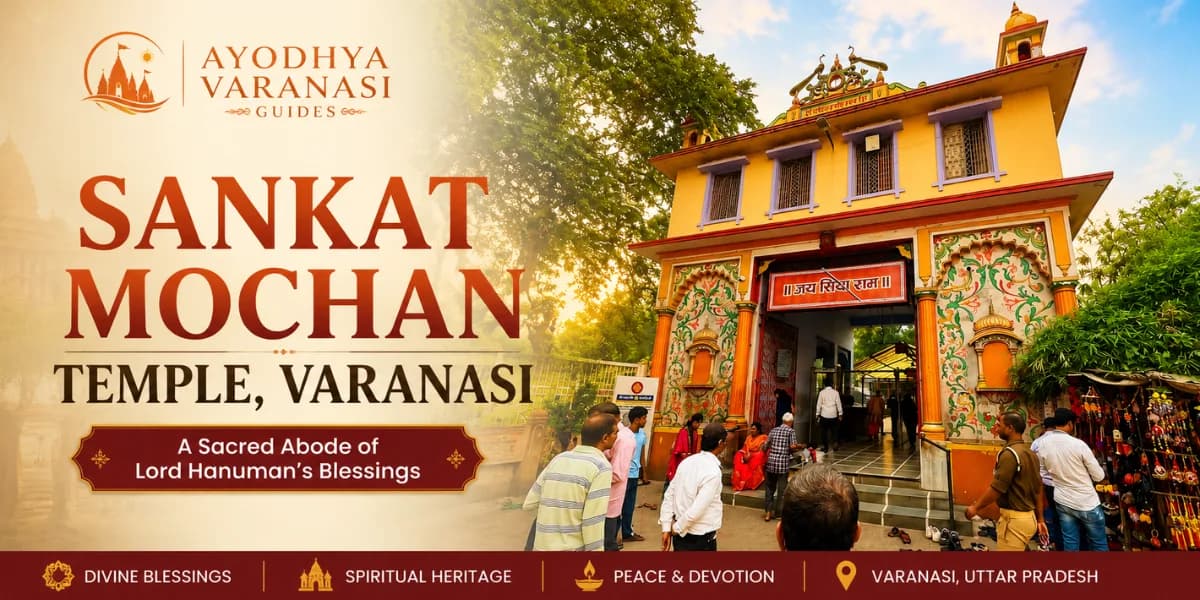
Sankat Mochan
Varanasi · The Reliever of Troubles
4.9 / 5 · Kashi Darshan Help
Temples · Ghats · Aarti
- Timings
- ~5:00 AM – 10:00 PM, daily
- Deity
- Lord Hanuman as Sankat Mochan
- Restrictions
- Mobile phones & bags not permitted inside
- Founded By
- Goswami Tulsidas, author of the Ramcharitmanas
- Entry
- Free · no ticket required
- Location
- Sankat Mochan Road, near BHU, Varanasi
What Are the Sankat Mochan Temple Timings?
Sankat Mochan keeps long hours — roughly 5:00 AM to 10:00 PM — without the long midday closure common at other Kashi temples. Darshan is free. Aartis are held in the very early morning and late evening. The single most important thing to know before you arrive is not a timing at all: mobile phones and bags must be left outside, and this is strictly enforced.
Early Morning (Best)
Calmest darshan; morning aarti
Daytime
Open throughout; no midday break
Evening
Busy and atmospheric; late aarti
Tuesday & Saturday
Hanuman's days; heaviest crowds
Mobile Phones
Leave in your vehicle or at the counter
Bags & Large Items
Travel light; security screening applies
Footwear
Racks at the entrance
Offerings
Sold at the stalls outside
Tip: the no-phone rule is the thing visitors trip over. There is nowhere convenient to leave a phone if you have arrived by boat or on foot, so plan to come by vehicle and leave your phone in it. WhatsApp us and we will handle the logistics along with your Kashi darshan.
When Is the Best Month to Visit Sankat Mochan? (2026)
Two calendars shape this temple — the weekly one, since Tuesday and Saturday are Hanuman’s days, and Hanuman Jayanti in April, when the famous music festival is held. October to March is the comfortable season.
Hanuman Jayanti in April is the temple's greatest occasion, and the Sankat Mochan Sangeet Samaroh runs alongside it. Every Tuesday and Saturday brings large crowds throughout the year.
Why Did Tulsidas Found Sankat Mochan Temple?
What Is Sankat Mochan Temple?
Sankat Mochan Hanuman Temple stands on the bank of the Assi river near Banaras Hindu University, and is among the most loved temples in Varanasi. The deity is Lord Hanuman as Sankat Mochan — the reliever of troubles — and the name is not decorative. People come here with something specific weighing on them.
Who Founded It?
The temple was established by Goswami Tulsidas, the 16th-century poet-saint who composed the Ramcharitmanas. Tradition holds that it was built on the very spot where Tulsidas had a vision of Lord Hanuman — which places the temple at the intersection of the two things Kashi remembers Tulsidas for: his devotion, and his poetry.
What Is Tulsidas’s Connection with Varanasi?
A deep one. Tulsidas composed much of the Ramcharitmanas in Varanasi, having begun it in Ayodhya, and he founded this temple. The nearby Tulsi Manas Mandir stands at the site associated with that composition. Between the two temples, a visitor can trace the whole of his life in this city in an afternoon.
Why Is Hanuman Approached for Trouble?
Because of what he does in the Ramayana — he goes where no one else can, carries what no one else can lift, and returns. In Kashi, Hanuman is the deity of obstacles removed and difficulties lifted, and the queue at Sankat Mochan on a Tuesday is made largely of people carrying illness, court cases, unemployment and family trouble. It is a working temple in the fullest sense.
What Is the Sankat Mochan Sangeet Samaroh?
One of the great cultural events of India, and it belongs to this temple. The Sankat Mochan Sangeet Samaroh is an annual festival of Indian classical music and dance held over several nights to coincide with Hanuman Jayanti. It has run for over a century. Two things make it remarkable: entry is free, and the performers — including some of the biggest names in Indian classical music — take no fee. They come as an offering to Hanuman.
Why Are There So Many Monkeys?
They are part of the place, and given the deity, nobody is inclined to remove them. The temple grounds are full of macaques and they are bold. Do not carry food openly, keep spectacles and phones secure — though the phone question is settled anyway, since you cannot bring one in.
Did you know? At the Sankat Mochan Sangeet Samaroh, some of the most celebrated classical musicians in India perform through the night without payment and to a free audience — the whole festival is offered to Hanuman rather than sold to a public.
How Does a Visit to Sankat Mochan Work?
Straightforward once you know the phone rule. Here is the sequence, including the part people get wrong.
- 1
Leave Your Phone in the Vehicle
Mobile phones are not permitted inside and there is limited provision for leaving them. Arriving by car or auto and leaving it there is much the simplest approach.
- 2
Travel Light
Bags and large items are also restricted, and security screening applies at the entrance. Carry as little as possible.
- 3
Buy Laddoo and Sindoor
Besan ke laddoo and sindoor are the traditional offerings to Hanuman, and stalls outside sell both along with garlands.
- 4
Leave Footwear at the Stands
Racks are provided outside. On Tuesdays and Saturdays the area is crowded, so note where you leave them.
- 5
Join the Darshan Queue
Short on ordinary weekdays, long on Tuesdays, Saturdays and during Hanuman Jayanti.
- 6
Have Darshan of Sankat Mochan
Stand before Hanuman at the temple Tulsidas founded, on the spot where he is believed to have seen him.
- 7
Watch for the Monkeys
The grounds are full of them and they are confident. Keep spectacles secure and do not carry food in the open.
- 8
Continue to Durga Kund and Tulsi Manas
Both are within a kilometre or two, and the three together make the best temple hour in Varanasi.
When Should You Visit Sankat Mochan Temple?
The day of the week matters more here than at almost any other temple in Kashi.
Best Time of Day — Early Morning
Between 5 and 8 AM the queue is shortest, the air is cool and the temple is at its calmest. It also frees the rest of your morning for the ghats.
Most Devotional — Tuesday & Saturday
Hanuman's days. The atmosphere is powerful and the crowds are heavy — go very early on those mornings if you want darshan without a long wait.
Most Special — Hanuman Jayanti & the Sangeet Samaroh
April brings Hanuman Jayanti and the free classical music festival that runs alongside it. If you have any interest in Indian classical music, plan your Varanasi trip around these dates.
What Can You See at Sankat Mochan Temple?
A working temple with a great deal of life in it, and a genuine cultural institution attached.
The Sankat Mochan Sanctum
Top PickThe Main Darshan
Lord Hanuman as the reliever of troubles, at the temple Goswami Tulsidas founded on the spot where he is said to have seen him.
The Sangeet Samaroh Stage
Top PickA Century of Music
The grounds where India's greatest classical musicians perform each April, free of charge and free to attend, as an offering to Hanuman.
The Tulsidas Connection
Kashi's Poet-Saint
The living link to the author of the Ramcharitmanas, whose composition site is marked at nearby Tulsi Manas Mandir.
The Laddoo Offerings
The Tradition
Besan ke laddoo and sindoor offered to Hanuman, sold at the stalls outside and central to the ritual here.
The Monkeys
Part of the Place
Macaques throughout the grounds — appropriate at a Hanuman temple, and bold enough to require a little care.
Why Is Sankat Mochan So Loved in Varanasi?
Of all the temples in Kashi, this is the one the city itself is most attached to. Here is why.
The Temple People Bring Trouble To
Illness, court cases, unemployment, family difficulty. The queue on a Tuesday is made of real problems, which gives the place its particular weight.
Founded by Tulsidas Himself
Not merely old — founded by the poet who gave north India its Ramayana, on the spot where he saw Hanuman.
A Free Music Festival Over a Century Old
Legendary musicians performing through the night without fee, to an audience admitted free. There is nothing else quite like it in India.
The Heart of the Best Temple Cluster in Kashi
Durga Kund, Tulsi Manas, Tridev, ISKCON and the BHU temple are all within a short ride.
Is There an Entry Fee at Sankat Mochan Temple? (2026)
Darshan is completely free — there is no ticket and no paid queue. Even the famous music festival is free to attend. Only offerings cost anything.
Everything essential here is free. What we add is the practicalities and the cluster — handling the phone and bag restriction, timing your visit around the Tuesday and Saturday crowds, and combining Sankat Mochan with Durga Kund, Tulsi Manas, Tridev and the BHU temple in one well-planned outing. Pricing confirmed in writing.
Auto fares are indicative and vary with traffic and time of day. Agree the fare before setting off.
What Do Devotees Say About Sankat Mochan Temple?
1,384 verified reviews
Every Tuesday for thirty years. When my son was ill I came here every day for a month. This is where Banaras brings its troubles — you can feel it in the queue. Tulsidas founded it and it has never lost that.
Arun Kumar Dwivedi
Varanasi
Our guide warned us about the no-phone rule and told us to come by car and leave everything in it. Just as well — we saw several visitors turned back at the gate. Peaceful darshan once inside.
Priya Venkatesh
Bengaluru
We planned our whole Varanasi trip around the Sangeet Samaroh. Legendary musicians playing through the night, free entry, no fees taken. I have never experienced anything like it anywhere in India.
Debashish Roy
Kolkata
Went at 6 AM on a weekday and walked straight in. Beautiful, calm, full of devotion. The monkeys are bold so keep your glasses on tight — one nearly took mine.
Manisha Rathore
Udaipur
Very important temple and worth the visit. Do avoid Tuesday and Saturday unless you want the full experience with a long wait. Free entry and no touts, which was refreshing.
Ganesh Pillai
Thrissur
How Do You Fit Sankat Mochan Into a Kashi Day?
It anchors the southern temple cluster, which is best done as one block rather than scattered stops.
Sunrise boat ride on the Ganga. Begin on the water for first light along the ghats.
Kashi Vishwanath darshan. Darshan of the Jyotirlinga at Shri Kashi Vishwanath Dham. We assist with VIP darshan to save you the queue.
Vishalakshi & Mrityunjay Mahadev. The Shakti Peetha at Mir Ghat and the healing well at Daranagar, both close to the Dham.
Sankat Mochan Hanuman Temple. Darshan at the temple Tulsidas founded. Leave phones and bags in the vehicle.
Durga Kund Temple. The red 18th-century Durga temple beside its sacred tank, a short ride away.
Tulsi Manas Mandir. The whole Ramcharitmanas inscribed in marble, at the site where Tulsidas composed it.
Ganga Aarti at Dashashwamedh Ghat. Close the day with the great evening aarti on the riverfront.
Which Tour Package Covers Sankat Mochan?
Sankat Mochan is best seen as part of a planned Kashi darshan rather than a single stop — the old-city temples keep different hours and the ghats reward proper sequencing. These are the itineraries our guests book most, each with Kashi Vishwanath VIP darshan assistance, a certified local guide and transport, priced in writing before you travel.
- 1 Day1 Day Varanasi Tour PackageKashi Vishwanath darshan, a sunrise boat ride and the evening Ganga Aarti.
- 2 Days2 Days Varanasi Tour PackageKashi Vishwanath, the ghats, Sarnath and the old-city temple circuit.
- 3 Days3 Days Varanasi Tour PackageKashi at a proper pace — the Dham, the Bhairavs, the Durgakund cluster and the aarti.
- 4 Days4 Days Varanasi Tour PackageEverything in Kashi plus Sarnath, with time for the temples most itineraries skip.
- 2 Days2 Days Ayodhya Varanasi Tour PackageRam Mandir and Kashi Vishwanath across two cities, with the Ganga Aarti.
- 3 Days3 Days Ayodhya Varanasi Tour PackageThe classic pairing — Ram Mandir, Kashi Vishwanath and the ghats.
- 3 Days3 Days Varanasi Prayagraj Tour PackageKashi and the confluence, with time for the ghats and the Sangam boat ride.
- 4 Days4 Days Ayodhya Varanasi Prayagraj Tour PackageAll three cities — Ram Mandir, Kashi Vishwanath and the Triveni Sangam.
- 5 Days5 Days Ayodhya Varanasi Prayagraj Tour PackageThe complete sacred circuit at a comfortable, senior-friendly pace.
Want Sankat Mochan built into a custom itinerary? We plan around your dates, your pace and what you actually want to see.
See all Varanasi & Ayodhya tour packagesHow Do You Reach Sankat Mochan Temple?
The temple is on Sankat Mochan Road near Banaras Hindu University, on the bank of the Assi in south Varanasi. Vehicles reach it directly, which matters given the phone rule.
By Road / Taxi
The recommended approach. Come by car or auto and leave your phone and bags in the vehicle — far simpler than trying to find somewhere to store them at the temple.
By Train
Banaras station is about 3 km away and Varanasi Junction (Cantt) roughly 7 km. Both connect to Delhi, Lucknow, Prayagraj and Ayodhya.
By Air
Lal Bahadur Shastri International Airport, Babatpur is around 30 km away, with taxis at the terminal. Allow over an hour in traffic.
The Last Mile
E-rickshaws run constantly along Sankat Mochan Road and Lanka. Everyone knows the temple by name.
Where Is Sankat Mochan Temple Located in Varanasi?
Sankat Mochan Hanuman Temple stands on Sankat Mochan Road near BHU, on the bank of the Assi in south Varanasi. Use the map below to navigate to the gate.
Varanasi
- Area: Sankat Mochan Road, near BHU, Varanasi
- PIN: Varanasi 221005
- From Kashi Vishwanath: ~5 km
- From Assi Ghat: ~2 km
- Note: Mobile phones and bags not allowed inside
Where Should You Stay Near Sankat Mochan Temple?
The southern quarter around Lanka and Assi is the natural base for this cluster of temples.
Lanka & Naria
Guesthouses and mid-range hotels beside BHU, walking distance from Sankat Mochan and close to Durga Kund and Tulsi Manas.
Assi Ghat & Ravidas Gate
The calmer southern end of the ghats, about 10 minutes away, with cafés and its own sunrise boat boarding point.
Godowlia & Dashashwamedh
The heart of Kashi, walking distance from Kashi Vishwanath and the evening Ganga Aarti, about 30 minutes from Sankat Mochan.
What Else Can You Visit Near Sankat Mochan?
This is the most walkable temple cluster in Varanasi — five significant temples within a few kilometres.
Durga Kund Temple
The red 18th-century Durga temple beside its sacred tank, with a swayambhu idol. ~1.5 km.
Tulsi Manas Mandir
The whole Ramcharitmanas inscribed in marble, at the site where Tulsidas composed it. ~1.5 km.
New Vishwanath Temple (BHU)
The marble replica on the BHU campus with the tallest temple shikhar in the world. Open in the afternoon.
Tridev Temple
The temple to Brahma, Vishnu and Mahesh near Tulsi Manas, with shrines of Maa Sati and Khatu Shyam.
ISKCON Temple, Varanasi
Sri Sri Radha Gopal Bihari on Durgakund Road — calm, welcoming, with daily kirtan and free prasadam.
Kashi Vishwanath Temple
The Jyotirlinga of Kashi, ~5 km away. We assist with VIP darshan to skip the main queue.
Hanuman Jayanti & the Sangeet Samaroh at Sankat Mochan
Hanuman Jayanti, in April, is the greatest day of the year at Sankat Mochan. The temple fills from before dawn until late at night, with a grand procession, chola offerings and continuous recitation of the Hanuman Chalisa.
Running alongside it is the Sankat Mochan Sangeet Samaroh — a festival of Indian classical music and dance that has been held for over a century. Some of the greatest names in Indian classical music perform through the night, taking no fee, before an audience admitted free of charge. If you have any interest in classical music, this is worth building an entire Varanasi trip around.
What Should You Know Before Visiting Sankat Mochan?
One rule matters more than everything else here, and visitors are turned away over it every day.
Mobile phones are not allowed inside
This is the rule people get caught by. There is limited provision for storing them at the temple, so come by vehicle and leave your phone in it.
Bags and large items are restricted too
Security screening applies at the entrance. Travel as light as you possibly can.
Avoid Tuesday and Saturday if you want a quick darshan
These are Hanuman's days and the queue is long. Wonderful atmosphere, but go very early or choose another day.
Early morning is the sweet spot
Between 5 and 8 AM you can often walk straight in, even in season.
Watch the monkeys
The grounds are full of confident macaques. Keep spectacles secure and do not carry food openly.
Buy laddoo and sindoor outside
Besan ke laddoo and sindoor are the traditional offerings to Hanuman, and the stalls at the entrance sell everything you need.
Plan around the Sangeet Samaroh
If you visit in April, the free classical music festival runs alongside Hanuman Jayanti. It is one of the great cultural events in India.
Do the whole cluster in one outing
Durga Kund, Tulsi Manas, Tridev, ISKCON and the BHU temple are all within a few kilometres. Four separate trips wastes a day in traffic.
It is a working temple, not a sight
Many people in the queue are carrying real difficulty. Keep photography — where permitted at all — discreet and respectful.
Dress modestly
Standard temple etiquette applies, with footwear removed at the entrance.
Sankat Mochan Temple Varanasi — Frequently Asked Questions
The questions visitors ask us most about Sankat Mochan — the phone rule, timings, Tulsidas, the music festival and the monkeys.
Sankat Mochan Hanuman Temple is one of the most revered temples in Varanasi, dedicated to Lord Hanuman as 'the reliever of troubles'. It stands on the bank of the Assi near BHU and was founded by Goswami Tulsidas in the 16th century.
Still have a question?
Our local team replies within 30 minutes.
Written & verified by the local Varanasi guide team at Ayodhya Varanasi Guides
Our government-certified Kashi guides take visitors to Sankat Mochan every week, including through Hanuman Jayanti and the Sangeet Samaroh, and know exactly how to handle the phone and bag restrictions. Last updated: July 2026. Aarti timings and entry rules can change on festival days — message us for the position on your travel date.
Lay Your Troubles Before Hanuman at Sankat Mochan
Let Ayodhya Varanasi Guides plan your Kashi darshan — Sankat Mochan with the phone and bag logistics handled, Durga Kund and Tulsi Manas in the same outing, Kashi Vishwanath with VIP darshan assistance and the evening Ganga Aarti. Confirmed in writing.