
Tridev Temple, Varanasi — Timings, Khatu Shyam Darshan & Guide
Tridev Mandir stands on Sankat Mochan Road near Tulsi Manas Mandir, in the Naria area of Varanasi. It is dedicated to the Tridev — Brahma, Vishnu and Mahesh — which makes it unusual anywhere in India, since temples honouring Lord Brahma are extremely rare. The principal murtis worshipped here are Maa Sati and Khatu Shyam, alongside shrines to Ganesh, Ram-Sita-Lakshman, Radha-Krishna, Ma Anjani and Shiva-Parvati. Entry is free, the temple is clean, calm and well maintained, and it sits within minutes of Sankat Mochan, Durga Kund and the ISKCON temple.
- Timings
- ~6 AM–12 PM & 4:30 PM–9 PM
- Dedicated To
- Tridev — Brahma, Vishnu & Mahesh
- Main Murtis
- Maa Sati & Khatu Shyam
- Entry
- Free · no ticket
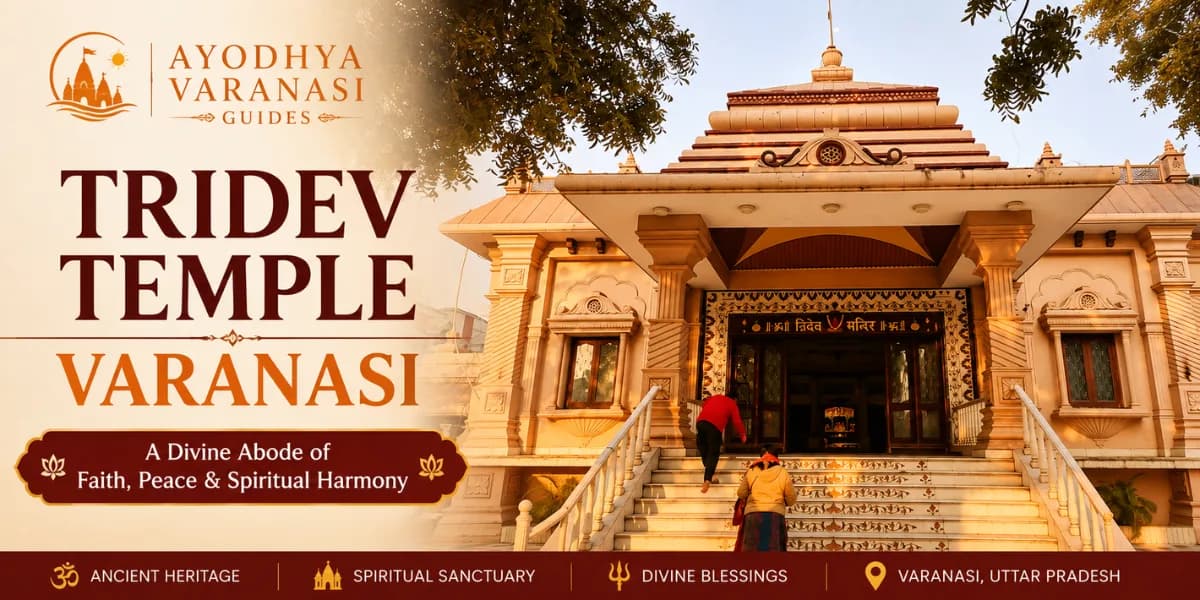
Tridev Mandir
Varanasi · Brahma, Vishnu & Mahesh
4.9 / 5 · Kashi Darshan Help
Temples · Ghats · Aarti
- Timings
- ~6:00 AM–12:00 PM & 4:30 PM–9:00 PM
- Dedicated To
- The Tridev — Brahma, Vishnu, Mahesh
- Main Murtis
- Maa Sati & Khatu Shyam
- Other Shrines
- Ganesh, Ram Darbar, Radha-Krishna, Anjani
- Entry
- Free · no ticket required
- Location
- Sankat Mochan Road, Naria, Varanasi 221010
What Are the Tridev Mandir Timings?
Tridev Mandir opens in two sessions, roughly 6:00 AM to 12:00 PM and 4:30 PM to 9:00 PM, closing through the afternoon. In practice this means the temple should be visited before 1:00 PM or after 4:30 PM — the single most useful thing to know before you set out. Darshan is free and there is rarely any queue.
Morning Session
The quietest and coolest darshan
Afternoon Break
Temple closed
Evening Session
Aarti and evening bhajan
Morning Aarti
Shringar of the deities
Evening Aarti
The most atmospheric hour
Khatu Shyam Ekadashi
Special for Shyam devotees
Navratri & Shivratri
Extended hours and larger crowds
Tip: the afternoon closure catches most visitors out. Since Tridev Mandir sits in the same quarter as Sankat Mochan, Durga Kund, Tulsi Manas and ISKCON, we plan the whole cluster into one morning or one evening. WhatsApp us and we will sequence it for your date.
When Is the Best Month to Visit Tridev Mandir? (2026)
The temple is compact, clean and comfortable through the year, so the festival calendar shapes the visit more than the weather. October to March is the pleasant window across Varanasi.
Navratri and Janmashtami bring the largest gatherings. For most of the year Tridev Mandir is a quiet neighbourhood temple with no queue at all.
What Makes Tridev Mandir Different From Other Varanasi Temples?
What Is Tridev Mandir?
Tridev Mandir is a temple on Sankat Mochan Road, near Tulsi Manas Mandir in the Naria area of Varanasi. It takes its name from the Tridev — the three great deities Brahma, Vishnu and Mahesh — who are honoured here together rather than singly, as is almost always the case elsewhere.
Who Are the Tridev?
The Trimurti or Tridev are the three functions of the divine in Hindu cosmology — Brahma the creator, Vishnu the preserver and Mahesh (Shiva) the destroyer. Between them they hold the whole cycle of creation, sustenance and dissolution. Almost every temple in India is dedicated to one of them, or to the Goddess. Very few honour all three in the same place.
Why Is a Brahma Temple So Unusual?
This is what makes Tridev Mandir genuinely notable. Temples to Lord Brahma are exceptionally rare in India — the famous one at Pushkar is celebrated precisely because it is almost alone. Tradition offers various explanations for why Brahma is so seldom worshipped in temples. Whatever the reason, a shrine where Brahma is honoured alongside Vishnu and Shiva is a rarity worth knowing about, especially in Shiva’s own city.
Who Are Maa Sati and Khatu Shyam?
The principal murtis worshipped here are Maa Sati and Khatu Shyam. Khatu Shyam Ji — Barbarik, the grandson of Bhima, who gave his head in sacrifice before the Mahabharata war and was blessed by Krishna to be worshipped in his own name — is one of the most beloved deities of Rajasthan, drawing millions to Khatu in Sikar. Finding his darshan in Varanasi matters a great deal to Rajasthani and Marwari devotees living in or visiting the city.
What Other Deities Are Worshipped Here?
The temple holds a generous spread of shrines — Lord Ganesh, the Ram Darbar with Ram, Sita and Lakshman, Radha and Krishna, Ma Anjani (the mother of Hanuman) and Shiva with Parvati. For families who want to offer prayers across several traditions in one visit, few temples in Varanasi make it so easy.
Where Does It Sit Among Varanasi’s Temples?
Tridev Mandir is a modern, well-maintained neighbourhood temple rather than an ancient shrine, and it does not pretend otherwise. Its value is in being clean, calm, uncrowded and easy — and in sitting inside the most walkable temple cluster in Varanasi, minutes from Sankat Mochan, Durga Kund, Tulsi Manas Mandir and ISKCON.
Did you know? Temples dedicated to Lord Brahma are among the rarest in India — the great temple at Pushkar in Rajasthan is famous largely for that reason. A shrine honouring Brahma alongside Vishnu and Shiva, in the heart of Shiva’s own city, is an unusual thing to come across.
What Is a Visit to Tridev Mandir Like?
An easy, unhurried temple visit with no queue and nothing complicated about it. Here is how it goes.
- 1
Reach Sankat Mochan Road
The temple is on Sankat Mochan Road near Tulsi Manas Mandir, in the Naria area. Autos and e-rickshaws drop you at the gate.
- 2
Check You Are Within the Session
The temple closes through the afternoon. Come before noon or after 4:30 PM — this catches out more visitors than anything else.
- 3
Leave Footwear at the Entrance
Shoe racks are provided. The complex is kept notably clean, which regular visitors always mention.
- 4
Have Darshan of the Tridev
Offer prayers to Brahma, Vishnu and Mahesh together — a combination you will rarely find in one temple anywhere.
- 5
Visit the Khatu Shyam Shrine
Darshan of Khatu Shyam Ji, especially meaningful for Rajasthani and Marwari devotees far from Khatu.
- 6
Offer Prayers to Maa Sati
The other principal murti of the temple, and the focus of particular devotion during Navratri.
- 7
Complete the Smaller Shrines
Ganesh, the Ram Darbar, Radha-Krishna, Ma Anjani and Shiva-Parvati are all within the same compound.
- 8
Walk On to Sankat Mochan
The Hanuman temple founded by Tulsidas is minutes away, along with Durga Kund, Tulsi Manas Mandir and ISKCON.
When Should You Visit Tridev Mandir?
The temple is comfortable in any season. What matters is avoiding the afternoon closure and catching an aarti if you can.
Best Time of Day — Morning or Early Evening
Come between 6 AM and noon, or after 4:30 PM. The morning session is the calmest; the evening session around 7 PM gives you the aarti and the bhajan.
Best Season — October to March
Varanasi's cool months make the whole Durgakund and Sankat Mochan temple cluster comfortable to walk in a single outing. May and June are best kept to the early morning.
Most Special — Navratri & Janmashtami
Both Navratris bring devotion to the Maa Sati shrine, and Janmashtami is celebrated at the Radha-Krishna shrine. Khatu Shyam devotees mark the monthly Ekadashi here.
What Can You See at Tridev Mandir?
A compact temple with an unusually generous range of shrines. Here is what to look for.
The Tridev Shrine
Top PickBrahma, Vishnu & Mahesh
The three great deities honoured together — a combination that is genuinely rare, particularly the presence of Lord Brahma.
The Khatu Shyam Murti
Top PickRajasthan's Beloved Deity
Darshan of Khatu Shyam Ji, a great comfort to Rajasthani and Marwari devotees living in or visiting Varanasi.
The Maa Sati Shrine
The Other Principal Murti
One of the two main deities of the temple, and the focus of particular devotion through Navratri.
The Ram Darbar
Ram, Sita & Lakshman
The full Ram Darbar alongside shrines to Ganesh, Radha-Krishna, Ma Anjani and Shiva with Parvati.
The Clean, Calm Complex
Easy and Unhurried
A well-kept, spacious temple with no queue — a genuine relief if the old city lanes have worn you out.
Why Add Tridev Mandir to a Varanasi Itinerary?
It is not an ancient shrine, and it does not need to be. Here is what it actually offers.
Brahma, Vishnu and Mahesh in One Place
A rare thing anywhere in India, and rarer still in Shiva's own city. Worth seeing simply because you seldom can.
Khatu Shyam Darshan in Kashi
For Rajasthani and Marwari families, finding Khatu Shyam Ji hundreds of miles from Sikar means a great deal.
Many Shrines, One Short Visit
Ganesh, Ram Darbar, Radha-Krishna, Anjani, Shiva-Parvati and the Tridev — families can offer prayers across traditions in half an hour.
The Best Temple Cluster in Varanasi
Sankat Mochan, Durga Kund, Tulsi Manas and ISKCON are all within minutes. This is the most efficient temple hour in the city.
Is There an Entry Fee at Tridev Mandir? (2026)
Entry and darshan are completely free — there is no ticket and no paid queue. Offerings are entirely optional.
The temple costs nothing. What we add is the cluster walk — Tridev Mandir, Sankat Mochan, Durga Kund, Tulsi Manas Mandir and ISKCON all sit within a few minutes of each other, and doing them in one planned outing rather than four separate trips is the single biggest time saving available in Varanasi. Pricing confirmed in writing.
Auto fares are indicative and vary with traffic and time of day. Agree the fare before setting off.
What Do Visitors Say About Tridev Mandir?
1,026 verified reviews
As a Marwari family we visit Khatu Shyam Ji every year. Finding his darshan here in Kashi was an unexpected joy. Beautifully kept temple and very peaceful — we went twice in three days.
Mahesh Chandra Agarwal
Jaipur
Lovely clean temple with so many deities in one place. My mother wanted Ram Darbar, my daughter wanted Radha-Krishna, and everyone was happy in half an hour. Right next to Sankat Mochan too.
Sarita Mishra
Allahabad
I had no idea Brahma was worshipped anywhere except Pushkar. Our guide pointed out that all three of the Trimurti are honoured here, which I found genuinely interesting.
Vivek Raghavan
Chennai
Went during Navratri for the Maa Sati darshan. Busier than usual but very well managed and the atmosphere was lovely. Combined it with Durga Kund the same evening.
Pooja Bansal
Gurugram
Good local temple, spotlessly maintained. Just remember it shuts in the afternoon — we arrived at 2 PM the first time and had to return in the evening. Free entry and no hassle at all.
Anil Kumar Shukla
Varanasi
How Do You Fit Tridev Mandir Into a Kashi Day?
Tridev sits in the Sankat Mochan and Durgakund cluster, so it belongs with those stops rather than on its own. Here is the day we plan.
Sunrise boat ride on the Ganga. Begin on the water for the classic Varanasi sunrise along the ghats.
Kashi Vishwanath darshan. Darshan of the Jyotirlinga at Shri Kashi Vishwanath Dham. We assist with VIP darshan to save you the queue.
Kal Bhairav & Batuk Bhairav. Bhairav darshan, which tradition says completes a Kashi yatra.
Tridev Mandir. Darshan of the Tridev, Khatu Shyam and Maa Sati — comfortably within the morning session.
Sankat Mochan & Durga Kund. The Hanuman temple founded by Tulsidas, and the great Durga temple, both minutes away.
Tulsi Manas Mandir & ISKCON. Complete the cluster before the afternoon closures begin.
Ganga Aarti at Dashashwamedh Ghat. Close the day with the great evening aarti on the riverfront.
Which Tour Package Covers Tridev Mandir?
Tridev Mandir is best seen as part of a planned Kashi darshan rather than a single stop — the old-city temples keep different hours and the ghats reward proper sequencing. These are the itineraries our guests book most, each with Kashi Vishwanath VIP darshan assistance, a certified local guide and transport, priced in writing before you travel.
- 1 Day1 Day Varanasi Tour PackageKashi Vishwanath darshan, a sunrise boat ride and the evening Ganga Aarti.
- 2 Days2 Days Varanasi Tour PackageKashi Vishwanath, the ghats, Sarnath and the old-city temple circuit.
- 3 Days3 Days Varanasi Tour PackageKashi at a proper pace — the Dham, the Bhairavs, the Durgakund cluster and the aarti.
- 4 Days4 Days Varanasi Tour PackageEverything in Kashi plus Sarnath, with time for the temples most itineraries skip.
- 2 Days2 Days Ayodhya Varanasi Tour PackageRam Mandir and Kashi Vishwanath across two cities, with the Ganga Aarti.
- 3 Days3 Days Ayodhya Varanasi Tour PackageThe classic pairing — Ram Mandir, Kashi Vishwanath and the ghats.
- 3 Days3 Days Varanasi Prayagraj Tour PackageKashi and the confluence, with time for the ghats and the Sangam boat ride.
- 4 Days4 Days Ayodhya Varanasi Prayagraj Tour PackageAll three cities — Ram Mandir, Kashi Vishwanath and the Triveni Sangam.
- 5 Days5 Days Ayodhya Varanasi Prayagraj Tour PackageThe complete sacred circuit at a comfortable, senior-friendly pace.
Want Tridev Mandir built into a custom itinerary? We plan around your dates, your pace and what you actually want to see.
See all Varanasi & Ayodhya tour packagesHow Do You Reach Tridev Mandir in Varanasi?
Tridev Mandir is on Sankat Mochan Road near Tulsi Manas Mandir, in the Naria area of south Varanasi. It is on a main road, so vehicles reach it directly — a real advantage over the old-city temples.
By Road / Taxi
The simplest option. Taxis and autos reach the temple gate directly via Lanka and Sankat Mochan Road, unlike the temples buried in the old city lanes.
By Train
Banaras station is about 2 km away and Varanasi Junction (Cantt) roughly 7 km. Both connect to Delhi, Lucknow, Prayagraj and Ayodhya.
By Air
Lal Bahadur Shastri International Airport, Babatpur is around 30 km away, with taxis at the terminal. Allow an hour in traffic.
The Last Mile
E-rickshaws run constantly along Lanka and Sankat Mochan Road. Ask for Tulsi Manas Mandir and the temple is right there.
Where Is Tridev Mandir Located in Varanasi?
Tridev Mandir stands on Sankat Mochan Road, near Tulsi Manas Mandir, in the Naria area of Varanasi. Use the map below to navigate to the gate.
Varanasi
- Area: Sankat Mochan Road, Naria, Varanasi
- PIN: Varanasi 221010
- From Tulsi Manas Mandir: ~300 m
- From Kashi Vishwanath: ~4.5 km
- Dedicated to: Brahma, Vishnu and Mahesh
Where Should You Stay Near Tridev Mandir?
The temple is in the Lanka and Naria quarter, one of the more comfortable and modern parts of Varanasi to base yourself in.
Lanka & Naria
Near Banaras Hindu University, with guesthouses and mid-range hotels, walking distance from Tridev Mandir, Sankat Mochan and Durga Kund.
Assi Ghat & Ravidas Gate
The calmer southern end of the ghats, about 15 minutes away, with cafés and easy access to sunrise boat rides.
Cantt & Sigra
Branded and business hotels near the railway station with parking and dining — the easiest base if you are arriving or leaving by train.
What Else Is Worth Visiting Near Tridev Mandir?
This quarter holds the most walkable set of temples in Varanasi — you can cover four or five in a single outing.
ISKCON Temple, Varanasi
Sri Sri Radha Gopal Bihari on Durgakund Road — calm, welcoming, with daily kirtan and free prasadam.
Kashi Vishwanath Temple
The Jyotirlinga of Kashi, ~4.5 km away. We assist with VIP darshan to skip the main queue.
Kashi Vishwanath VIP Darshan
Skip-the-queue Sugam darshan assistance at Shri Kashi Vishwanath Dham, arranged in advance.
Tulsi Manas Mandir
The whole Ramcharitmanas inscribed in marble, ~300 m away — the closest temple to this one.
Durga Kund Temple
The red 18th-century Durga temple beside its sacred tank, a short walk away.
Sankat Mochan Temple
The Hanuman temple founded by Tulsidas, ~1 km away. Note the no-phone rule.
Ganga Aarti, Dashashwamedh Ghat
The world-famous evening aarti on the riverfront — the unmissable Varanasi experience.
How to Commute in Varanasi
Autos, e-rickshaws, boats and taxis — how to get around the city without stress.
Navratri, Janmashtami & Khatu Shyam Ekadashi at Tridev Mandir
Both Navratris bring particular devotion to the Maa Sati shrine, with the temple busier and more festive than at any other time of year. Janmashtami is celebrated at the Radha-Krishna shrine, and Ram Navami at the Ram Darbar.
For Khatu Shyam devotees, the monthly Shukla Ekadashi carries special meaning — the day associated with Shyam Baba across Rajasthan. Varanasi’s Rajasthani and Marwari community gathers here, a long way from Khatu but not without darshan.
What Should You Know Before Visiting Tridev Mandir?
An easy temple to visit — just a few practical points worth knowing first.
Mind the afternoon closure
The temple shuts roughly between 12 and 4:30 PM. Come before noon or after 4:30 — this is the most common mistake visitors make here.
Do the whole cluster in one outing
Sankat Mochan, Durga Kund, Tulsi Manas and ISKCON are all within minutes. Four separate trips across Varanasi traffic is a waste of a day.
Vehicles reach the gate
Unlike the old-city temples, this one is on a main road, so taxis and autos drop you right outside — useful with elderly family members.
Ask about the Brahma connection
Most visitors do not realise how rare it is to find Lord Brahma worshipped in a temple. It is the most interesting thing about the place.
Good for multi-generational families
With shrines to Ganesh, Ram, Krishna, Shiva, Sati and Khatu Shyam in one compound, everyone finds their deity in a single short visit.
It is a modern temple, not an ancient one
Do not come expecting the antiquity of Kashi Vishwanath. The value here is cleanliness, calm and the unusual combination of deities.
Footwear off at the entrance
Racks are provided, and the complex is kept notably clean — regular visitors always remark on it.
Expect crowds during Navratri
The Maa Sati shrine draws large numbers through both Navratris. Go early in the session on those days.
Photography rules vary
Follow the temple staff's guidance, particularly around the main murtis.
It is a short visit
Thirty to forty-five minutes covers the temple comfortably. Treat it as one stop in the cluster rather than a destination on its own.
Tridev Temple Varanasi — Frequently Asked Questions
The questions visitors ask us most about Tridev Mandir — the deities, timings, the Khatu Shyam shrine, location and how to combine it with the nearby temples.
Tridev Mandir is a temple on Sankat Mochan Road near Tulsi Manas Mandir, in the Naria area of Varanasi. It is dedicated to the Tridev — Brahma, Vishnu and Mahesh — and its principal murtis are Maa Sati and Khatu Shyam.
Still have a question?
Our local team replies within 30 minutes.
Written & verified by the local Varanasi guide team at Ayodhya Varanasi Guides
Our government-certified Kashi guides walk the Sankat Mochan and Durgakund temple cluster with guests every week, and regularly bring Rajasthani and Marwari families to Tridev Mandir for Khatu Shyam darshan. Last updated: July 2026. Session timings shift on festival days — message us for the schedule on your travel date.
Have Darshan of Brahma, Vishnu and Mahesh at Tridev Mandir
Let Ayodhya Varanasi Guides plan your Kashi darshan — Tridev Mandir with Khatu Shyam and Maa Sati, the Sankat Mochan and Durgakund temple cluster, Kashi Vishwanath with VIP darshan assistance and the evening Ganga Aarti — in one well-sequenced day with a certified local guide. Confirmed in writing.