
Treta Ke Thakur, Ayodhya — The Temple That Opens Once a Year
Treta Ke Thakur stands at Naya Ghat on the bank of the Saryu, on ground believed to be the site of Lord Ram’s Ashwamedha Yagna. It is unlike any other temple in Ayodhya for one reason: it is open to the public only one day each year — Kartik Shukla Ekadashi, usually in November or December. Inside are idols of Ram, Sita, Lakshman, Hanuman, Bharat and Sugriv, all carved from a single block of black sandstone. The temple was built about 300 years ago by the King of Kullu and renovated in the 1700s by Ahilyabai Holkar.
- Opens
- One day a year · Kartik Shukla Ekadashi
- The Idols
- Carved from a single black sandstone
- The Site
- Ram's Ashwamedha Yagna ground
- Entry
- Free · on that day only
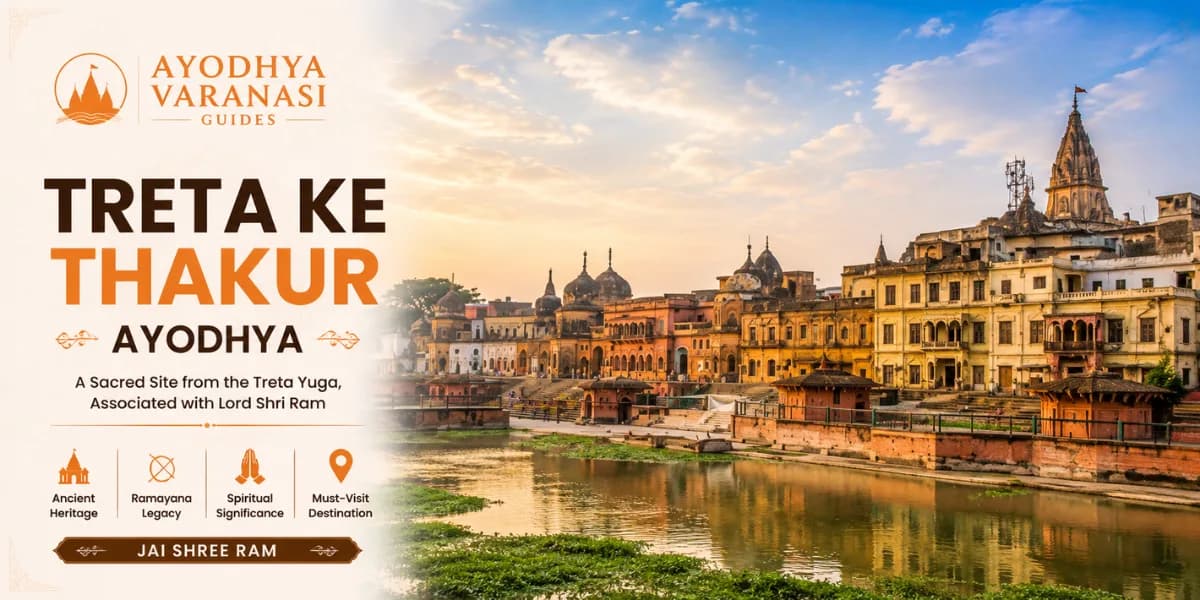
Treta Ke Thakur
Naya Ghat, Ayodhya · Open One Day a Year
4.9 / 5 · Ayodhya Darshan Help
Rare darshan planning
- Public Opening
- Kartik Shukla Ekadashi only (Nov/Dec)
- Deities
- Ram, Sita, Lakshman, Hanuman, Bharat, Sugriv
- The Idols
- All carved from one black sandstone block
- History
- Built by the King of Kullu; renovated by Ahilyabai Holkar
- Entry
- Free on the opening day
- Location
- Naya Ghat, on the Saryu, Ayodhya
When Does Treta Ke Thakur Open to the Public?
This is the only question that matters here. Treta Ke Thakur is not a temple you can visit on a normal day. It opens to the public once a year, on Kartik Shukla Ekadashi — the eleventh day of the bright fortnight of Kartik, which falls in November or December depending on the year. On that single day darshan is free and the crowds are enormous. On every other day of the year you can see the temple from outside, and no more.
Kartik Shukla Ekadashi
Usually November or December
Every Other Day
Exterior viewing only
On the Opening Day
Extended hours; enormous queues
Entry
No ticket on the opening day
Confirm the Date
It moves each year with the lunar calendar
Arrive Before Dawn
The queue builds very early
Book Accommodation
Ayodhya fills for the Ekadashi
Allow Several Hours
This is not a quick darshan
Tip: the Ekadashi date moves every year with the lunar calendar, and it is the single thing you must get right. WhatsApp us well in advance and we will confirm the exact 2026 date, book your stay before Ayodhya fills, and get you into the queue early.
When Should You Plan a Treta Ke Thakur Visit? (2026)
For this temple the calendar is unusually simple. One day in November or December is when you can go inside. Every other month, the answer is that you can see the building and the Saryu behind it, but the doors are shut.
Kartik Shukla Ekadashi shifts each year with the lunar calendar and can fall in either November or December. Confirm the exact date before booking travel — this is the whole trip.
Why Does Treta Ke Thakur Open Only Once a Year?
What Is Treta Ke Thakur?
Treta Ke Thakur — also called Tretanath Mandir — stands at Naya Ghat on the bank of the Saryu in Ayodhya. The name means the Lord of the Treta Yuga, the age in which Lord Ram lived. It is one of the most significant temples in the city and, for all but one day of the year, one of the least seen.
What Happened on This Ground?
Tradition holds that this is the site where Lord Ram performed the Ashwamedha Yagna — the great horse sacrifice undertaken by an emperor to assert sovereignty, and one of the defining royal acts of his reign after the return from Lanka. The temple stands on that ground, which is what gives it its standing among Ayodhya’s shrines.
What Is Inside?
The sanctum holds idols of Lord Ram, Sita, Lakshman, Hanuman, Bharat and Sugriv — and the remarkable thing is that they are all carved from a single block of black sandstone. It is an unusual and technically demanding piece of work, and for most visitors the fact that so few people ever see it only sharpens the impression.
Who Built It?
The temple as it stands was built about 300 years ago by the King of Kullu, who came from the Himalayan hills to raise a shrine on this ground. It was later renovated in the 1700s by Ahilyabai Holkar, the Maratha queen of Indore whose temple building across northern India — at Kashi Vishwanath, Somnath, Gaya and elsewhere — reshaped the pilgrimage landscape of the subcontinent.
Why Only One Day?
The temple follows the practice of opening to the public solely on Kartik Shukla Ekadashi, the eleventh day of the bright fortnight of Kartik — a date of great significance in the Vaishnava calendar, associated with the awakening of Lord Vishnu from his cosmic sleep. For the rest of the year the doors stay shut, which is precisely why the one day draws the crowds it does.
What Is It Like on the Day?
Extraordinary, and demanding. Ayodhya fills, the queue at Naya Ghat begins forming long before dawn, and the darshan is brief when it finally comes. Visitors who plan for it properly — confirmed date, accommodation booked months ahead, an early start — describe it as one of the most memorable darshans available anywhere in the city.
Did you know? Ahilyabai Holkar, who renovated this temple in the 1700s, also rebuilt the Kashi Vishwanath temple in Varanasi in 1780. Her hand is on sacred sites right across the Ayodhya–Varanasi circuit.
What Is Darshan at Treta Ke Thakur Like?
On the one day it opens, this is a serious undertaking rather than a casual stop. Here is how it goes.
- 1
Confirm the Ekadashi Date
Kartik Shukla Ekadashi moves each year with the lunar calendar, falling in November or December. Everything depends on getting this right.
- 2
Book Accommodation Months Ahead
Ayodhya fills for the Ekadashi. Leaving your stay until the last weeks means paying heavily or staying far out in Faizabad.
- 3
Reach Naya Ghat Before Dawn
The queue at the Saryu bank begins forming in the dark. Arriving at first light already means a long wait.
- 4
Join the Queue
Expect crowds on a scale you will not see at this temple on any other day of the year, because there is no other day.
- 5
Enter the Sanctum
The doors open, and the temple that has been shut for a year receives the public.
- 6
See the Single-Stone Idols
Ram, Sita, Lakshman, Hanuman, Bharat and Sugriv, all carved from one block of black sandstone. Look properly — you will not get another chance for twelve months.
- 7
Step Out to the Saryu
The temple stands at Naya Ghat on the riverbank, and the Saryu is a few steps away once you are through.
- 8
Continue Your Ayodhya Darshan
Ram Ki Paidi, Mani Parvat and the Ramkot temples are all close, and the rest of the city is at its most alive on this day.
When Should You Visit Treta Ke Thakur?
There is really only one answer, and then a second-best one for the rest of the year.
The Only Time — Kartik Shukla Ekadashi
November or December, depending on the year. This is the one day the temple opens to the public, and planning a trip around it is the only way to see inside.
On the Day — Before Dawn
The queue at Naya Ghat forms in the dark. Arriving at sunrise already means a substantial wait. Go as early as you can manage.
The Rest of the Year — Exterior Only
You can see the temple and the Saryu behind it at any time, and it sits close to Ram Ki Paidi and Mani Parvat. But the doors will be shut.
What Can You See at Treta Ke Thakur?
On the opening day, this is what you have come for.
The Single-Stone Idols
Top PickThe Reason to Come
Ram, Sita, Lakshman, Hanuman, Bharat and Sugriv, all carved from one block of black sandstone — visible to the public for one day a year.
The Ashwamedha Yagna Ground
Top PickThe Site Itself
The ground on which Lord Ram is believed to have performed the great horse sacrifice after his return from Lanka.
The Ahilyabai Holkar Renovation
18th-Century Work
The Maratha queen's hand on the temple, part of her building across the pilgrimage sites of northern India.
Naya Ghat & the Saryu
The Setting
The temple stands on the riverbank, with the Saryu a few steps away and Ram Ki Paidi close by.
The Ekadashi Crowds
The Atmosphere
A whole city converging on one temple for one day — an atmosphere you will not find at any other Ayodhya shrine.
Why Is Treta Ke Thakur Worth Planning a Trip Around?
Very few temples in India reward this kind of planning. Here is why this one does.
A Darshan Available One Day in 365
Scarcity is the whole character of this temple. Whatever you see inside, you see knowing almost nobody else will this year.
Six Deities From One Stone
Ram, Sita, Lakshman, Hanuman, Bharat and Sugriv carved from a single block of black sandstone — a remarkable piece of work.
The Ashwamedha Ground
The site of Lord Ram's great horse sacrifice — a moment of the Ramayana that has almost no other physical marker.
A Himalayan King and a Maratha Queen
Built by the King of Kullu, renovated by Ahilyabai Holkar. Two very distant patrons on one small piece of Saryu bank.
Is There an Entry Fee at Treta Ke Thakur? (2026)
On the one day it opens, darshan is free — there is no ticket. The real cost of this visit is not money but planning: the right date, accommodation booked far ahead, and an early enough start.
The darshan is free but the logistics are everything. What we do is confirm the exact Ekadashi date for your year, book accommodation before Ayodhya fills, and get your group into the queue early enough to matter. Miss any one of those and the trip does not work. Pricing confirmed in writing.
Accommodation rates in Ayodhya rise sharply around Kartik Shukla Ekadashi and Deepotsav. Book as far ahead as you can.
What Do Visitors Say About Treta Ke Thakur?
1,097 verified reviews
We planned a year in advance for the Ekadashi. Reached Naya Ghat at four in the morning and the queue was already long. Worth every minute — six deities from one stone, and the knowledge that the doors close again for a year.
Hari Om Shukla
Kanpur
Our guide told us the date months ahead and booked our stay in September, which turned out to be essential. By November there was nothing available in Ayodhya at any price.
Sarala Devi Agarwal
Delhi
I had visited Ayodhya twice before and never known this temple existed, because it is shut on every ordinary day. Standing inside on the one day it opens was a completely different experience from any other darshan.
Venkat Raman
Hyderabad
The atmosphere on Ekadashi is unlike anything else in Ayodhya. Enormous crowds but very well managed. Learning that Ahilyabai Holkar renovated it, as she did Kashi Vishwanath, tied a lot together for us.
Poonam Mishra
Lucknow
Do not turn up hoping — it really is shut the rest of the year. We saw the exterior in March and came back for the Ekadashi in November. Free darshan, but go before dawn.
Suresh Chandra Pal
Gorakhpur
How Do You Plan an Ekadashi Day in Ayodhya?
On the one day Treta Ke Thakur opens, it comes first and everything else follows. Here is the day we build.
Reach Naya Ghat and join the queue. The queue forms in the dark on Kartik Shukla Ekadashi. This is the whole reason for the trip — do not be late.
Treta Ke Thakur darshan. The doors open and the temple receives the public for the only time this year.
Hanuman Garhi darshan. The guardian of Ayodhya, a short ride away once you are through the queue.
Ram Janmabhoomi (Ram Lalla). Darshan at the Ram Mandir. We assist with Sugam (VIP) Darshan, which matters on a day this busy.
Valmiki Bhawan. The midday stop, open when the Ramkot temples close.
Mani Parvat & Sugriv Qila. The ancient mounds, with the best panorama over a city at its fullest.
Saryu Aarti at Ram Ki Paidi. Close an extraordinary day on the riverfront with the evening aarti.
Which Tour Package Covers Treta Ke Thakur?
Most visitors reach Treta Ke Thakur as part of a wider Ayodhya darshan rather than as a trip of its own. These are the itineraries our guests book most — each one includes Ram Mandir darshan with Sugam (VIP) assistance, a certified local guide, comfortable transport and pricing confirmed in writing before you travel.
- 1 Day1 Day Ayodhya Tour PackageRam Mandir darshan, Hanuman Garhi and the Saryu Aarti in a single day.
- 2 Days2 Days Ayodhya Tour PackageThe full Ramkot temple circuit at an unhurried pace, with an evening on the Saryu.
- 3 Days3 Days Ayodhya Tour PackageAyodhya in depth — the temples, the mounds, Guptar Ghat and the lesser-known shrines.
- 2 Days2 Days Ayodhya Varanasi Tour PackageRam Mandir and Kashi Vishwanath across two cities, with the Ganga Aarti.
- 3 Days3 Days Ayodhya Varanasi Tour PackageThe classic pairing — Ram Mandir, Kashi Vishwanath and the ghats.
- 3 Days3 Days Ayodhya Prayagraj Tour PackageRam Mandir darshan with the Triveni Sangam snan.
- 4 Days4 Days Ayodhya Varanasi Prayagraj Tour PackageAll three cities — Ram Mandir, Kashi Vishwanath and the Triveni Sangam.
- 5 Days5 Days Ayodhya Varanasi Prayagraj Tour PackageThe complete sacred circuit at a comfortable, senior-friendly pace.
Want Treta Ke Thakur built into a custom itinerary? We plan around your dates, your pace and what you actually want to see.
See all Ayodhya & Varanasi tour packagesHow Do You Reach Treta Ke Thakur in Ayodhya?
The temple is at Naya Ghat on the Saryu, in central Ayodhya close to Ram Ki Paidi. It is easy to reach — the difficulty is the date, not the directions.
On Foot From Ram Ki Paidi
Naya Ghat is very close to Ram Ki Paidi, and many visitors simply walk. On the Ekadashi, expect traffic restrictions and walk in any case.
By Road / Taxi
Autos and e-rickshaws reach Naya Ghat easily on ordinary days. On the opening day, expect diversions and a walk at the end.
By Train
Ayodhya Dham Junction is about 2 km away, well connected to Lucknow, Varanasi, Prayagraj and Delhi. Book far ahead for the Ekadashi.
By Air
Maharishi Valmiki International Airport, Ayodhya Dham is roughly 10 km away, with taxis at the terminal.
Where Is Treta Ke Thakur Located in Ayodhya?
Treta Ke Thakur stands at Naya Ghat on the bank of the Saryu in central Ayodhya, a short walk from Ram Ki Paidi. Use the map below to find it.
Ayodhya
- Area: Naya Ghat, on the Saryu, Ayodhya
- PIN: Ayodhya 224123
- From Ram Ki Paidi: ~500 m
- Public opening: Kartik Shukla Ekadashi only
- The site: Ram's Ashwamedha Yagna ground
Where Should You Stay for the Ekadashi Darshan?
Ayodhya fills completely for Kartik Shukla Ekadashi. Where you stay matters far more than usual, and so does when you book.
Naya Ghat & Ram Ki Paidi
Walking distance from Treta Ke Thakur, which matters enormously on a day with traffic restrictions and a pre-dawn queue. Books out first.
Ramkot & Ram Path
Near the Ram Janmabhoomi and Hanuman Garhi, about 2 km from Naya Ghat — walkable early in the morning.
Ayodhya Dham / Faizabad
More availability and better value, 10–20 minutes out by taxi. Where you will end up if you book late.
What Else Can You Visit Near Treta Ke Thakur?
Naya Ghat sits in the middle of Ayodhya's riverside cluster, so everything is close.
Ram Ki Paidi & Saryu Aarti
The riverfront steps and the evening aarti, a few hundred metres along the Saryu.
Mani Parvat
The 65-foot sacred mound with the best panorama over Ayodhya, about a kilometre away.
Choti Devkali Temple
The shrine of Sita's kuldevi, brought from Mithila after her marriage — also near Naya Ghat.
Ram Mandir (Ram Janmabhoomi)
The grand temple of Ram Lalla, ~2 km away. We assist with Sugam (VIP) Darshan to skip the queue.
Valmiki Ashram (Valmiki Bhawan)
The marble temple where all 24,000 verses of the Valmiki Ramayana are inscribed on the walls.
Nageshwarnath Temple
The ancient Shiva temple of Ayodhya, said to be built by Kush, son of Lord Ram.
Kartik Shukla Ekadashi at Treta Ke Thakur
Kartik Shukla Ekadashi — the eleventh day of the bright fortnight of Kartik, in November or December — is the one day of the year that Treta Ke Thakur opens its doors to the public. It is a date of great significance in the Vaishnava calendar, associated with the awakening of Lord Vishnu, and all of Ayodhya turns towards this one temple at Naya Ghat.
The queue forms long before dawn and the city fills completely. The date shifts every year with the lunar calendar, so confirm it before booking anything — and book accommodation months ahead, because rooms in central Ayodhya are gone well in advance.
What Should You Know Before Visiting Treta Ke Thakur?
One fact governs everything else about this temple.
It is shut on every other day of the year
This is not a temple you can add to an ordinary Ayodhya itinerary. Turning up in March or July means seeing the outside of a locked building.
The date moves every year
Kartik Shukla Ekadashi follows the lunar calendar and can fall in November or December. Confirm the exact date before booking travel.
Book accommodation months ahead
Ayodhya fills for the Ekadashi. Leave it late and you will be staying in Faizabad and paying heavily for it.
Arrive before dawn
The queue at Naya Ghat forms in the dark. Arriving at sunrise already means a substantial wait.
Expect traffic restrictions
On the opening day, vehicles will not reach Naya Ghat. Plan to walk the last stretch whichever way you arrive.
The darshan itself is brief
After a long queue, the time inside is short. Look properly at the single-stone idols — you will not get another chance for a year.
It is free
There is no ticket on the opening day. Do not pay anyone claiming to sell entry.
Combine it with the rest of Ayodhya
Once you are through the queue, Ram Ki Paidi, Mani Parvat and the Ramkot temples are all close and the city is at its most alive.
You can see the exterior any time
If you are in Ayodhya outside the Ekadashi, the building and its riverside setting are still worth ten minutes on a Naya Ghat walk.
Dress modestly
Standard temple etiquette applies, with footwear removed at the entrance.
Treta Ke Thakur Ayodhya — Frequently Asked Questions
The questions visitors ask us most about Treta Ke Thakur — when it opens, what is inside, who built it and how to plan the one day it is possible to visit.
Treta Ke Thakur, also called Tretanath Mandir, is a temple at Naya Ghat on the bank of the Saryu in Ayodhya, standing on ground believed to be the site of Lord Ram's Ashwamedha Yagna. It opens to the public only one day each year.
Still have a question?
Our local team replies within 30 minutes.
Written & verified by the local Ayodhya guide team at Ayodhya Varanasi Guides
Our government-certified guides plan Kartik Shukla Ekadashi darshans at Treta Ke Thakur every year, and know how early the Naya Ghat queue forms and how far ahead Ayodhya books out. Last updated: July 2026. The Ekadashi date shifts annually — message us and we will confirm the exact date for your travel year before you book anything.
Plan the One Day You Can Enter Treta Ke Thakur
Let Ayodhya Varanasi Guides plan your Kartik Shukla Ekadashi darshan — the exact date confirmed for your year, accommodation booked before Ayodhya fills, and an early start on the Naya Ghat queue — alongside the Ram Mandir with Sugam Darshan assistance and the evening Saryu Aarti.