
Choti Devkali Temple, Ayodhya — The Kuldevi Sita Brought From Mithila
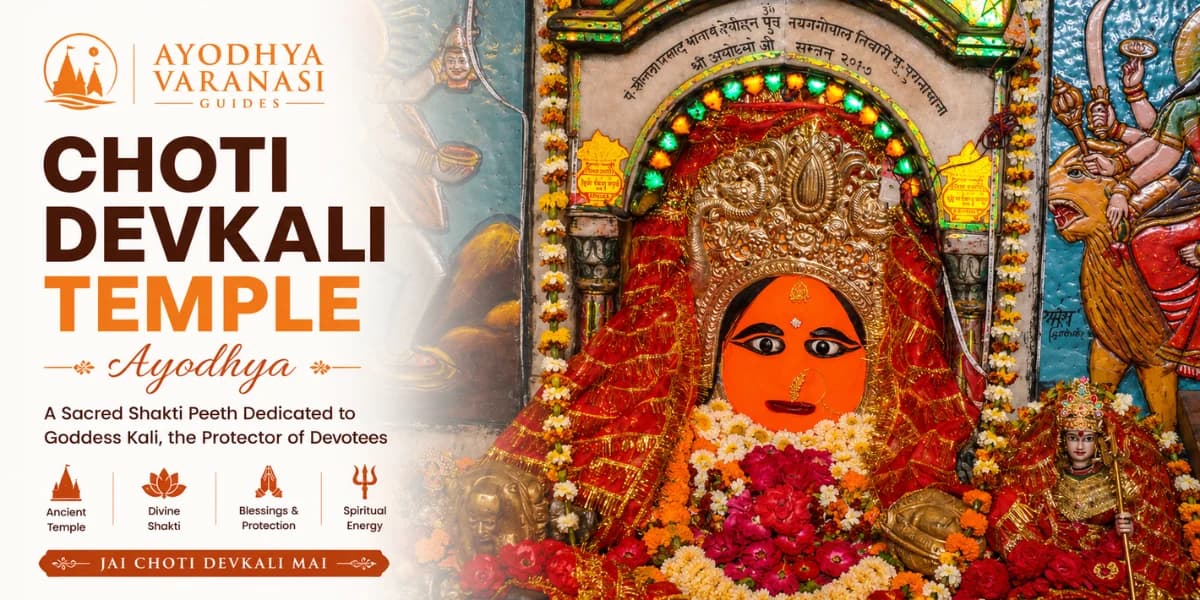
Chhoti Devkali Mandir near Naya Ghat holds one of the most human stories in Ayodhya. When Sita came from Janakpur after her marriage to Lord Ram, she brought with her the idol of Goddess Girija Devi — her family deity from Mithila — and King Dashrath had this temple built at her request so that she could continue to worship her own kuldevi in her new home. The Devi, a form of Parvati worshipped as Sarvamangala, became the kuldevi of Lord Ram’s family too. Darshan is free, and Navratri is the great season here.
- Timings
- ~5 AM–12 PM & 4 PM–9 PM
- The Story
- Sita's kuldevi, brought from Mithila
- Built By
- King Dashrath, at Sita's request
- Entry
- Free · no ticket
Chhoti Devkali
Ayodhya · The Goddess of Sita's Family
4.9 / 5 · Ayodhya Darshan Help
Devi temples · Ram Mandir
- Timings
- ~5:00 AM–12:00 PM & 4:00 PM–9:00 PM
- Deity
- Mata Devkali — Girija Devi, a form of Parvati
- Significance
- Kuldevi of Sita, and of Lord Ram's family
- Origin
- Built by King Dashrath at Sita's request
- Entry
- Free · no ticket required
- Location
- Near Naya Ghat, on the Saryu, Ayodhya
What Are the Choti Devkali Temple Timings?
Chhoti Devkali follows the usual Ayodhya pattern of morning and evening sessions — roughly 5:00 AM to 12:00 PM and 4:00 PM to 9:00 PM — with a break through the middle of the day. Darshan is free and unhurried on ordinary days. Hours extend considerably during both Navratris, when the temple is decorated and cultural programmes are held.
Early Morning (Best)
The calmest darshan of the day
Late Morning
Busier with local devotees
Midday Break
Temple usually closed
Evening
Aarti; pairs with the Saryu Aarti
Morning Aarti
Shringar of the Devi
Evening Aarti
The most atmospheric hour
Both Navratris
Decorations, rituals, cultural programmes
Vivah Panchami
The marriage of Ram and Sita
Tip: this temple sits close to Naya Ghat, Treta Ke Thakur and Ram Ki Paidi — a cluster you can walk in under an hour. Doing them together makes far more sense than separate trips. WhatsApp us and we will route your Ayodhya morning.
When Is the Best Month to Visit Choti Devkali? (2026)
This is a Devi temple, so the Navratri calendar shapes it most. October to March is the comfortable window across Ayodhya, and the temple stays pleasantly quiet for much of the year.
Both Navratris bring decorations, rituals and cultural programmes to the temple. Vivah Panchami, marking the marriage of Ram and Sita, carries particular meaning at a shrine tied to that marriage.
Why Did Sita Bring a Goddess With Her to Ayodhya?
What Is Chhoti Devkali Mandir?
Chhoti Devkali Mandir stands near Naya Ghat on the Saryu, at what tradition places as the north-east corner of the old Saptasagar. It is dedicated to Mata Devkali — Girija Devi, a form of Goddess Parvati, worshipped here as Sarvamangala, the auspicious one.
What Is the Story Behind It?
It is the sort of detail the Ramayana is full of and that almost no visitor is told. When Sita came to Ayodhya from Janakpur after her marriage to Lord Ram, she brought with her the idol of her family deity — Girija Devi, the kuldevi she had worshipped all her life in Mithila. A bride carrying her own goddess into her husband’s house.
Why Did Dashrath Build the Temple?
Because Sita asked. King Dashrath had this shrine built at her request, so that his daughter-in-law could continue to worship her own kuldevi in her new home. It is a small act of family kindness preserved in stone — and it is the reason the temple exists at all.
Who Is Worshipped Here?
The Devi is Girija — Parvati — honoured as Sarvamangala. Having come as Sita’s kuldevi from Mithila, she became the kuldevi of Lord Ram’s family too, and devotees come to her for the protection a family deity gives. For many visiting families, that is precisely why they come.
What Happened to the Temple Over the Centuries?
It has not had an easy history. The Devkali temple was destroyed twice — in the Hun invasions and again in the Mughal period — and rebuilt each time. In its most recent chapter, the temple was rededicated on 19 September 2002. That it stands at all, after that, is part of what the shrine means locally.
What Is the Difference Between Chhoti and Badi Devkali?
Ayodhya has both a Chhoti (small) Devkali and a Badi (big) Devkali. They are separate shrines to the same goddess, and visitors sometimes confuse them. Chhoti Devkali, near Naya Ghat, is the one associated directly with the story of Sita bringing her kuldevi from Mithila.
Did you know? The kuldevi of Lord Ram’s family came from Mithila, not Ayodhya — carried into the city by a bride who did not want to leave her goddess behind. It is one of the most quietly human details in the whole Ramayana.
How Do You Have Darshan at Choti Devkali Temple?
A short, unhurried darshan at a shrine most Ayodhya visitors walk past without knowing the story.
- 1
Reach the Naya Ghat Area
The temple is near Naya Ghat on the Saryu side of central Ayodhya. Autos and e-rickshaws reach the area; the last stretch is a short walk.
- 2
Buy Flowers and a Chunri
Stalls nearby sell flowers, chunris and prasad — the traditional offerings at a Devi shrine.
- 3
Leave Footwear and Enter
Footwear comes off outside. The temple is small and, outside Navratri, rarely crowded.
- 4
Have Darshan of Mata Devkali
Stand before Girija Devi — Parvati as Sarvamangala — the goddess Sita brought with her from Janakpur.
- 5
Hear the Story on the Spot
Ask your guide for the account of Sita carrying her kuldevi to Ayodhya and Dashrath building this shrine for her. It changes the visit entirely.
- 6
Offer Prayers as a Family
This is a kuldevi shrine, and families visiting together often come specifically for that — the protection a family deity is held to give.
- 7
Walk to Naya Ghat
The Saryu is a few minutes away, with Treta Ke Thakur on the same stretch of riverbank.
- 8
Continue to Ram Ki Paidi
The great riverfront steps and the evening Saryu Aarti are close by, and make the natural end to the walk.
When Should You Visit Choti Devkali Temple?
The temple is open all year and free. The session timing and Navratri are what shape the visit.
Best Time of Day — Early Morning
Come between 5 and 8 AM for the calmest darshan, before the local devotees arrive and well ahead of the midday closure.
Best Season — October to March
Ayodhya's cool months make the Naya Ghat temple cluster comfortable to walk. November and February are the pick of the year.
Most Special — Navratri & Vivah Panchami
Both Navratris bring decorations, rituals and cultural programmes. Vivah Panchami, marking the marriage of Ram and Sita, carries obvious meaning at a temple born from that marriage.
What Can You See at Choti Devkali Temple?
A small shrine whose value lies almost entirely in what it commemorates.
The Girija Devi Idol
Top PickSita's Kuldevi
The image of Goddess Girija — Parvati as Sarvamangala — the family deity Sita is believed to have carried with her from Janakpur to Ayodhya.
The Dashrath Connection
Top PickBuilt for a Daughter-in-Law
The shrine King Dashrath had built at Sita's request, so she could go on worshipping her own goddess in her new home.
The Kuldevi Tradition
For Families
A family deity shrine, which is why visiting families often come here specifically rather than as part of a general circuit.
The Navratri Decorations
Twice a Year
The temple at its most alive, with rituals and cultural programmes through both Navratris.
The Naya Ghat Quarter
The Setting
Close to the Saryu, Treta Ke Thakur and Ram Ki Paidi — the most walkable cluster in Ayodhya.
Why Is This Small Temple Worth Finding?
It takes twenty minutes and it carries one of the best stories in Ayodhya.
A Bride Who Brought Her Goddess
Sita carrying her kuldevi from Mithila to Ayodhya is a detail of extraordinary tenderness, and this temple exists because of it.
Built by Dashrath for Sita
Not a royal monument or a victory temple — a father-in-law building a shrine so his son's wife would not have to leave her goddess behind.
A Kuldevi for Families
The family deity of Lord Ram's own house. Families visiting Ayodhya together often make a point of coming here.
In the Best Walking Cluster
Minutes from Naya Ghat, Treta Ke Thakur and Ram Ki Paidi — it costs almost nothing to add.
Is There an Entry Fee at Choti Devkali Temple? (2026)
Darshan is completely free — there is no ticket and no paid queue, even during Navratri. Only offerings and any special puja carry a cost.
The darshan costs nothing. What we add is the story and the routing — a guide who can tell you why Sita brought this goddess to Ayodhya, and a walk that takes in Choti Devkali, Treta Ke Thakur, Naya Ghat and Ram Ki Paidi in a single unhurried hour. Pricing confirmed in writing.
Auto and e-rickshaw fares are indicative and vary with season and distance.
What Do Devotees Say About Choti Devkali Temple?
1,058 verified reviews
We are from Mithila, and finding the goddess Sita brought from our own region enshrined in Ayodhya moved my mother to tears. She said it was like following a daughter to her new home.
Madhuri Jha
Darbhanga
Small temple that we would have walked straight past. Our guide told us Dashrath built it so Sita could keep worshipping her own kuldevi. Twenty minutes, and it stayed with me longer than some far bigger temples.
Anil Kumar Pandey
Lucknow
Visited during Chaitra Navratri. Beautifully decorated with cultural programmes going on. Very busy but joyful. We came as a family specifically because she is a kuldevi.
Radhika Sharma
Jaipur
Peaceful and easy to reach, close to Naya Ghat. Learning that the temple was destroyed twice and rebuilt, and rededicated only in 2002, gave it a different weight.
Suresh Chandra Mishra
Prayagraj
Lovely small shrine with a beautiful story. Do mind the afternoon closure — we arrived at 2 PM and had to return in the evening. Free entry, no touts at all.
Kavita Singh
Kanpur
How Do You Fit Choti Devkali Into an Ayodhya Day?
It belongs in the Naya Ghat walking cluster, which is the most efficient hour in Ayodhya.
Hanuman Garhi darshan. Begin with the guardian of Ayodhya, as tradition asks, before Ram Lalla.
Ram Janmabhoomi (Ram Lalla). Darshan at the Ram Mandir. We assist with Sugam (VIP) Darshan so you are not queuing for hours.
Kanak Bhawan & Sita Ki Rasoi. The Ramkot cluster — the golden palace and the sacred kitchen of Goddess Sita.
Choti Devkali Temple. The kuldevi Sita brought from Mithila — a natural follow-on from Sita Ki Rasoi.
Valmiki Bhawan. The midday stop, open when the Ramkot temples close.
Mani Parvat & Sugriv Qila. The ancient mounds, with the best panorama over Ayodhya.
Saryu Aarti at Ram Ki Paidi. Close the day on the riverfront with the evening aarti.
Which Tour Package Covers Chhoti Devkali?
Most visitors reach Chhoti Devkali as part of a wider Ayodhya darshan rather than as a trip of its own. These are the itineraries our guests book most — each one includes Ram Mandir darshan with Sugam (VIP) assistance, a certified local guide, comfortable transport and pricing confirmed in writing before you travel.
- 1 Day1 Day Ayodhya Tour PackageRam Mandir darshan, Hanuman Garhi and the Saryu Aarti in a single day.
- 2 Days2 Days Ayodhya Tour PackageThe full Ramkot temple circuit at an unhurried pace, with an evening on the Saryu.
- 3 Days3 Days Ayodhya Tour PackageAyodhya in depth — the temples, the mounds, Guptar Ghat and the lesser-known shrines.
- 2 Days2 Days Ayodhya Varanasi Tour PackageRam Mandir and Kashi Vishwanath across two cities, with the Ganga Aarti.
- 3 Days3 Days Ayodhya Varanasi Tour PackageThe classic pairing — Ram Mandir, Kashi Vishwanath and the ghats.
- 3 Days3 Days Ayodhya Prayagraj Tour PackageRam Mandir darshan with the Triveni Sangam snan.
- 4 Days4 Days Ayodhya Varanasi Prayagraj Tour PackageAll three cities — Ram Mandir, Kashi Vishwanath and the Triveni Sangam.
- 5 Days5 Days Ayodhya Varanasi Prayagraj Tour PackageThe complete sacred circuit at a comfortable, senior-friendly pace.
Want Chhoti Devkali built into a custom itinerary? We plan around your dates, your pace and what you actually want to see.
See all Ayodhya & Varanasi tour packagesHow Do You Reach Choti Devkali Temple in Ayodhya?
The temple is near Naya Ghat on the Saryu side of central Ayodhya, a short distance from Ram Ki Paidi and easy to reach from anywhere in the temple town.
On Foot From Ram Ki Paidi
The temple is close enough to walk from the Saryu ghats — about ten minutes through the Naya Ghat area.
By Road / Auto
Autos and e-rickshaws reach the Naya Ghat area easily. Expect a short walk at the end through the lanes.
By Train
Ayodhya Dham Junction is about 2 km away, well connected to Lucknow, Varanasi, Prayagraj and Delhi.
By Air
Maharishi Valmiki International Airport, Ayodhya Dham is roughly 10 km away, with taxis at the terminal.
Where Is Choti Devkali Temple Located in Ayodhya?
Chhoti Devkali Mandir stands near Naya Ghat on the Saryu side of central Ayodhya, close to Treta Ke Thakur and Ram Ki Paidi. Use the map below to navigate.
Ayodhya
- Area: Near Naya Ghat, central Ayodhya
- PIN: Ayodhya 224123
- From Ram Ki Paidi: ~800 m
- From Treta Ke Thakur: ~400 m
- Deity: Girija Devi — Sita's kuldevi
Where Should You Stay Near Choti Devkali Temple?
The temple is central, so most Ayodhya stays put it within a short walk or ride.
Naya Ghat & Ram Ki Paidi
Riverside guesthouses and hotels within walking distance of Choti Devkali, Treta Ke Thakur and the evening Saryu Aarti.
Ramkot & Ram Path
Stays near the Ram Janmabhoomi, Hanuman Garhi and Kanak Bhawan — ideal if early Ram Lalla darshan is your priority.
Ayodhya Dham / Faizabad
Branded and mid-range hotels with more space, parking and dining, 10–20 minutes away by taxi.
What Else Can You Visit Near Choti Devkali Temple?
The temple sits in Ayodhya's most walkable quarter, close to the Saryu.
Treta Ke Thakur
The temple at Naya Ghat that opens to the public only one day a year, on Kartik Shukla Ekadashi. ~400 m.
Ram Ki Paidi & Saryu Aarti
The riverfront steps on the Saryu and the evening aarti, about 800 m away.
Sita Ki Rasoi
The sacred kitchen of Goddess Sita in Ramkot — a natural pairing with her kuldevi's shrine.
Kanak Bhawan
The 'Golden Palace' of Sita-Ram with gold-adorned idols, in Ramkot.
Mani Parvat
The 65-foot sacred mound with the best panorama over Ayodhya, a short ride away.
Ram Mandir (Ram Janmabhoomi)
The grand temple of Ram Lalla, ~2 km away. We assist with Sugam (VIP) Darshan to skip the queue.
Navratri & Vivah Panchami at Choti Devkali
Both Navratris are the great seasons here. Through Chaitra Navratri (March or April) and Ashwin Navratri (September or October), the temple is decorated, special rituals are performed and cultural programmes are held, drawing devotees from across the region.
Vivah Panchami, which marks the marriage of Lord Ram and Sita, carries a particular meaning at a shrine that exists because of that marriage — the goddess a bride carried from Mithila to Ayodhya. Deepotsav and Ram Navami fill the wider city.
What Should You Know Before Visiting Choti Devkali?
A short and easy visit, and a few things will get much more out of it.
Ask for the story
The temple looks modest until someone tells you Sita brought this goddess from Mithila and Dashrath built the shrine for her. Without that, it is twenty minutes wasted.
Mind the midday closure
The temple shuts for roughly four hours in the middle of the day. Come in the morning session or after 4 PM.
Do not confuse it with Badi Devkali
Ayodhya has both a Chhoti and a Badi Devkali. This one, near Naya Ghat, is the shrine tied to the story of Sita's kuldevi.
Pair it with Sita Ki Rasoi
Both belong to Sita's side of the Ayodhya story. Visiting them in the same morning makes far more sense than treating them as separate stops.
Walk the Naya Ghat cluster
Choti Devkali, Treta Ke Thakur and Ram Ki Paidi are all within a kilometre. One unhurried hour covers the lot.
Navratri means crowds
Both Navratris bring decorations and large numbers. Wonderful atmosphere, but go early in the session on those days.
It is a small shrine
Do not arrive expecting scale. The value here is the story and the kuldevi tradition, not architecture.
Good for families
This is a family-deity shrine, and families visiting Ayodhya together often make a point of coming for exactly that reason.
Expect a short walk
Autos reach the Naya Ghat area but the last stretch is through lanes. Nothing difficult, but not door-to-door.
Dress modestly
Standard temple etiquette applies, with footwear removed at the entrance.
Choti Devkali Temple Ayodhya — Frequently Asked Questions
The questions visitors ask us most about Chhoti Devkali — the Sita connection, the deity, timings and how it fits an Ayodhya day.
Chhoti Devkali Mandir near Naya Ghat in Ayodhya is dedicated to Mata Devkali — Girija Devi, a form of Goddess Parvati worshipped as Sarvamangala. It was built by King Dashrath for Sita, so she could continue worshipping her family deity after her marriage.
Still have a question?
Our local team replies within 30 minutes.
Written & verified by the local Ayodhya guide team at Ayodhya Varanasi Guides
Our government-certified guides bring visitors to Chhoti Devkali through the year, and tell the story of Sita carrying her kuldevi from Mithila standing in front of the shrine that story produced. Last updated: July 2026. Darshan hours extend during Navratri — message us for the timing on your travel date.
Meet the Goddess Sita Brought to Ayodhya at Choti Devkali
Let Ayodhya Varanasi Guides plan your Ayodhya darshan — Choti Devkali, Treta Ke Thakur and Ram Ki Paidi in one walkable hour, alongside the Ram Mandir with Sugam Darshan assistance, the Ramkot temples and the evening Saryu Aarti — with a guide who knows the stories. Confirmed in writing.