
Kaal Bhairav Temple, Varanasi — The Kotwal of Kashi
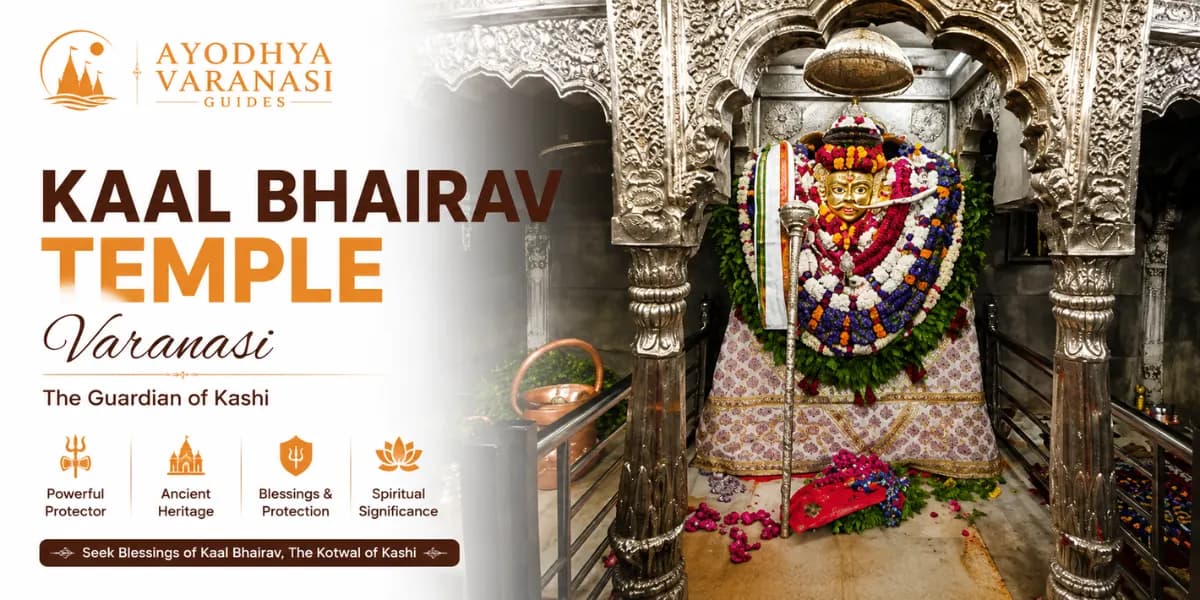
Kaal Bhairav is the Kotwal of Kashi — the guardian and police chief of the city. Tradition holds that Lord Vishwanath appointed him, and that no one may reside in Kashi, or attain liberation here, without Bhairav’s permission. Many pilgrims therefore visit him before Kashi Vishwanath, to seek that permission first. The temple’s signature is the sacred black thread (kala dhaga) tied on the wrist by the priests for protection — and, unusually, sealed liquor is offered as prasad, a ritual found almost nowhere else in India. Darshan is free, and the temple is open 5 AM to 12 PM and 1:30 PM to 9:30 PM.
- Timings
- 5 AM–12 PM & 1:30 PM–9:30 PM
- Take Home
- The sacred black thread
- Unusual
- Sealed liquor offered as prasad
- Entry
- Free · no ticket
Kaal Bhairav
Varanasi · Guardian of the City
4.9 / 5 · Kashi Darshan Help
Bhairav · Vishwanath · Ghats
- Timings
- 5:00 AM–12:00 PM & 1:30 PM–9:30 PM
- Deity
- Kaal Bhairav, the Kotwal of Kashi
- The Prasad
- A black thread tied by the priest
- Rare Ritual
- Sealed liquor offered to the deity
- Entry
- Free · no ticket required
- Location
- Near Daranagar & Vishweshwarganj, Varanasi
What Are the Kaal Bhairav Temple Timings?
Kaal Bhairav is open 5:00 AM to 12:00 PM and 1:30 PM to 9:30 PM — only a short afternoon break, which makes it easier to fit in than most old-city temples. The Mangala Aarti begins around 5:30 AM. Darshan is free. Sunday and Tuesday are the traditional days for Bhairav, and Ashtami and Chaturdashi in each lunar fortnight carry particular significance.
Early Morning (Best)
Mangala Aarti ~5:30 AM; quietest darshan
Late Morning
Busy with Vishwanath pilgrims
Short Break
Briefer than most Kashi temples
Afternoon & Evening
Open late; evening aarti
The Black Thread
Ask the priest to tie it on your wrist
Liquor Offering
Sealed bottles offered as prasad
Sunday & Tuesday
The traditional days of Bhairav
Ashtami & Chaturdashi
Especially significant for Bhairav worship
Tip: the black thread is the whole point for most devotees — ask the priest to tie it before you leave, because visitors often realise afterwards that everyone else came away with one and they did not. WhatsApp us and we will sequence Bhairav properly within your Kashi darshan.
When Is the Best Month to Visit Kaal Bhairav? (2026)
The weekly and fortnightly calendar matters more here than the season. October to March is comfortable across Varanasi, and Bhairav Ashtami in November or December is the temple’s greatest day.
Bhairav Ashtami, in the month of Margashirsha, is the greatest day of the year here. Sundays, Tuesdays, Ashtami and Chaturdashi bring the weekly and fortnightly crowds.
Why Is Kaal Bhairav Called the Kotwal of Kashi?
What Is Kaal Bhairav Temple?
Kaal Bhairav is among the most important temples in Varanasi and, for the city itself, arguably the most consequential. He is the fierce, protective form of Lord Shiva, and in Kashi he holds an office: Kotwal — the guardian, the police chief, the officer of the city.
What Does It Mean to Need His Permission?
This is the belief that governs everything here. Tradition holds that Lord Vishwanath appointed Bhairav as Kotwal, declaring that no one may reside in Kashi — or attain moksha here — without his permission. Kashi is Shiva’s city, but Bhairav keeps the gate. That is why so many pilgrims make a point of coming to him before going to Kashi Vishwanath.
Should You Visit Before or After Vishwanath?
Both practices exist and both are respectable. Many hold that you should seek Bhairav’s permission first, before entering the Dham — arriving in his city and reporting to the officer in charge. Others say a Kashi yatra is incomplete until Bhairav darshan is done, and visit afterwards. What matters, in either telling, is that you do not leave Kashi without seeing him.
What Is the Black Thread?
The signature of this temple. The priests tie a sacred black thread — the kala dhaga — around the wrist or arm, and devotees wear it for protection against the evil eye and misfortune. You will see it on wrists all across Varanasi and far beyond it. For most people, the thread is what they came for, and it is the prasad they carry home.
Why Is Liquor Offered Here?
It is one of the rarest rituals in Indian temple worship. At Kaal Bhairav, sealed liquor is offered to the deity as prasad — a practice found almost nowhere else in India. It belongs to the fierce, Tantric character of Bhairav worship, and devotees hold that the offering pleases him and secures his protection from negativity.
How Does He Relate to Batuk Bhairav?
Kashi is guarded by Bhairav in several forms, and the two best known are complementary. Kaal Bhairav is the Kotwal — the officer, the fierce guardian whose permission you seek. Batuk Bhairav at Kamachha is the same deity as a child, approached for healing and the lifting of affliction. Many pilgrims visit both on the same day.
Did you know? Kaal Bhairav is one of the very few temples in India where liquor is offered to the deity as prasad — sealed bottles presented at the shrine, a ritual belonging to the fierce Tantric character of Bhairav worship.
How Does a Kaal Bhairav Darshan Work?
A short darshan with one thing you must not forget to ask for.
- 1
Reach the Daranagar Area
The temple is in the old city near Daranagar and Vishweshwarganj, about 2 km from Kashi Vishwanath. Autos reach the area; the last stretch is on foot.
- 2
Consider Coming Before Vishwanath
Many pilgrims visit Bhairav first, to seek the Kotwal's permission before entering the Dham. If you can plan the order, this is the traditional one.
- 3
Buy Offerings Outside
Stalls sell flowers, garlands and — distinctively here — sealed liquor, offered as prasad to the deity.
- 4
Leave Footwear and Enter
Footwear comes off outside. The temple is compact and the queue moves quickly outside festival days.
- 5
Have Darshan of Kaal Bhairav
Stand before the Kotwal of Kashi — the guardian whose permission tradition says every resident and pilgrim of this city requires.
- 6
Ask for the Black Thread
This is the part not to miss. Ask the priest to tie the kala dhaga on your wrist. It is the prasad of this temple and what most devotees come for.
- 7
Observe the Photography Rules
Photography inside is generally restricted. Follow the priests' guidance rather than assuming.
- 8
Continue to Mrityunjay Mahadev
The temple of victory over death, with its Dhanvantari healing well, is about 400 metres away on the same walk.
When Should You Visit Kaal Bhairav Temple?
The day of the week matters here, and so does where Bhairav falls in your Kashi sequence.
Best Time of Day — Early Morning
Between 5 and 8 AM the queue is shortest and the Mangala Aarti at about 5:30 is the finest darshan of the day. It also lets you go on to Kashi Vishwanath afterwards.
Most Devotional — Sunday & Tuesday
The traditional days of Bhairav, along with Ashtami and Chaturdashi in each lunar fortnight. Powerful atmosphere, heavier crowds.
Greatest Day — Bhairav Ashtami
Bhairav Ashtami, in the month of Margashirsha (November or December), is the temple's own festival and the biggest gathering of its year.
What Can You See at Kaal Bhairav Temple?
A compact old-city shrine with a very particular character.
The Kaal Bhairav Sanctum
Top PickThe Kotwal Himself
The fierce guardian of Kashi, whose permission tradition holds is required to reside in the city or attain liberation here.
The Black Thread
Top PickWhat You Take Home
The kala dhaga tied on the wrist by the priests for protection — the prasad of this temple, worn across Varanasi and far beyond.
The Liquor Offering
A Rare Ritual
Sealed liquor presented to the deity as prasad, a practice belonging to the Tantric character of Bhairav worship and found almost nowhere else.
The Mangala Aarti
~5:30 AM
The first aarti of the day, and the calmest and most powerful time to stand before the Kotwal.
The Old-City Lanes
Daranagar
A working quarter between Vishwanath and the northern city, with none of the tourist apparatus of the ghats.
Why Should No Kashi Yatra Skip Kaal Bhairav?
Of all the temples in Varanasi, this is the one tradition treats as non-negotiable.
Permission to Be in Kashi
Tradition holds no one resides here or attains moksha without Bhairav's leave. Whatever else you see, this is the darshan the city itself treats as required.
The Black Thread
Tied by the priest, worn for protection, carried home across India. For most devotees this single object is the reason for the visit.
Liquor as Prasad
A ritual you will encounter at almost no other temple in India, and one that tells you a great deal about the character of Bhairav worship.
On the Vishwanath Walk
Close enough to the Dham that adding it costs you very little — and it sits on the same route as Mrityunjay Mahadev.
Is There an Entry Fee at Kaal Bhairav Temple? (2026)
Darshan is completely free, and so is the black thread — it is prasad, not a purchase. Only offerings carry a cost.
The darshan and the thread are free. What we add is the sequencing — visiting Bhairav before the Vishwanath Dham as tradition asks, making sure you actually come away with the thread, and combining him with Batuk Bhairav and Mrityunjay Mahadev on one walk. Pricing confirmed in writing.
Auto fares are indicative and vary with traffic and time of day. Agree the fare before setting off.
What Do Devotees Say About Kaal Bhairav Temple?
1,418 verified reviews
No Banarasi would leave the city without Baba's darshan. He is the Kotwal — you take his permission to be here. Outsiders rush to Vishwanath and skip him entirely, which we find hard to understand.
Shyam Narayan Mishra
Varanasi
Our guide brought us here before the Vishwanath Dham, explaining that you take Bhairav's permission first. We came away with the black thread, which I still wear. Nobody had told us any of this.
Kavitha Reddy
Hyderabad
The liquor offering genuinely surprised me — sealed bottles presented at the shrine. Our guide explained the Tantric background. Unlike any temple I have visited anywhere.
Jaspreet Singh
Chandigarh
Went for the Mangala Aarti at 5:30 in the morning. Almost empty, extraordinarily powerful. Do ask for the thread before you leave — my husband forgot and we had to go back the next day.
Malini Iyer
Chennai
Very important temple in narrow old-city lanes. Photography is restricted inside so do not argue with the priests. Free darshan and the thread is free too — do not let anyone charge you for it.
Ramesh Chandra Gupta
Agra
Should You Visit Kaal Bhairav Before Kashi Vishwanath?
Tradition says seek the Kotwal's permission first. Here is the Kashi morning we plan around that.
Kaal Bhairav — Mangala Aarti. Begin with the Kotwal of Kashi, seeking permission before entering the Dham. The 5:30 aarti is the finest darshan of the day.
Mrityunjay Mahadev at Daranagar. The temple of victory over death and the Dhanvantari healing well, 400 metres away on the same walk.
Kashi Vishwanath darshan. Darshan of the Jyotirlinga with Bhairav's permission sought. We assist with VIP darshan to save you the queue.
Vishalakshi Temple at Mir Ghat. The Shakti Peetha that tradition holds completes the Vishwanath darshan — Shiva and Shakti together.
Batuk Bhairav at Kamachha. Bhairav in his child form, and the eternal lamp whose oil is given as prasad.
New Vishwanath Temple, BHU. The afternoon stop, open when the old city closes.
Ganga Aarti at Dashashwamedh Ghat. Close the day with the great evening aarti on the riverfront.
Which Tour Package Covers Kaal Bhairav?
Kaal Bhairav is best seen as part of a planned Kashi darshan rather than a single stop — the old-city temples keep different hours and the ghats reward proper sequencing. These are the itineraries our guests book most, each with Kashi Vishwanath VIP darshan assistance, a certified local guide and transport, priced in writing before you travel.
- 1 Day1 Day Varanasi Tour PackageKashi Vishwanath darshan, a sunrise boat ride and the evening Ganga Aarti.
- 2 Days2 Days Varanasi Tour PackageKashi Vishwanath, the ghats, Sarnath and the old-city temple circuit.
- 3 Days3 Days Varanasi Tour PackageKashi at a proper pace — the Dham, the Bhairavs, the Durgakund cluster and the aarti.
- 4 Days4 Days Varanasi Tour PackageEverything in Kashi plus Sarnath, with time for the temples most itineraries skip.
- 2 Days2 Days Ayodhya Varanasi Tour PackageRam Mandir and Kashi Vishwanath across two cities, with the Ganga Aarti.
- 3 Days3 Days Ayodhya Varanasi Tour PackageThe classic pairing — Ram Mandir, Kashi Vishwanath and the ghats.
- 3 Days3 Days Varanasi Prayagraj Tour PackageKashi and the confluence, with time for the ghats and the Sangam boat ride.
- 4 Days4 Days Ayodhya Varanasi Prayagraj Tour PackageAll three cities — Ram Mandir, Kashi Vishwanath and the Triveni Sangam.
- 5 Days5 Days Ayodhya Varanasi Prayagraj Tour PackageThe complete sacred circuit at a comfortable, senior-friendly pace.
Want Kaal Bhairav built into a custom itinerary? We plan around your dates, your pace and what you actually want to see.
See all Varanasi & Ayodhya tour packagesHow Do You Reach Kaal Bhairav Temple in Varanasi?
The temple is in the old city near Daranagar and Vishweshwarganj, about 2 km from Kashi Vishwanath. You arrive on foot through the lanes.
On Foot From Kashi Vishwanath
About 2 km through the old-city lanes — roughly 20 minutes on foot, passing Mrityunjay Mahadev on the way.
By Road / Auto
Autos reach the edge of the Daranagar and Vishweshwarganj area. From there it is a short walk; no vehicle reaches the temple door.
By Train
Varanasi Junction (Cantt) is about 4 km away and Banaras station roughly 6 km. Take an auto towards Vishweshwarganj, then walk.
By Air
Lal Bahadur Shastri International Airport, Babatpur is around 24 km away, with taxis at the terminal. Allow an hour in traffic.
Where Is Kaal Bhairav Temple Located in Varanasi?
Kaal Bhairav Temple stands in the old city near Daranagar and Vishweshwarganj, about 2 km from Kashi Vishwanath. Use the map below to navigate.
Varanasi
- Area: Near Daranagar & Vishweshwarganj, old city
- PIN: Varanasi 221001
- From Kashi Vishwanath: ~2 km on foot
- From Mrityunjay Mahadev: ~400 m
- The prasad: A sacred black thread
Where Should You Stay Near Kaal Bhairav Temple?
The temple is in the old city, so staying near the central ghats puts it within a walk.
Godowlia & Dashashwamedh
The heart of Kashi, within walking distance of Kaal Bhairav, Mrityunjay Mahadev, Kashi Vishwanath and the evening Ganga Aarti.
Assi Ghat & Ravidas Gate
The quieter southern end of the ghats, popular with longer-staying visitors, about 5 km from Daranagar.
Cantt & Sigra
Branded and business hotels near the railway station with parking and dining, 20 to 30 minutes from the old city.
What Else Can You Visit Near Kaal Bhairav?
The temple sits on the old-city walking route between the Dham and the northern quarters.
Mrityunjay Mahadev Temple
The temple of victory over death with the Dhanvantari healing well, ~400 m away on the same walk.
Kashi Vishwanath Temple
The Jyotirlinga of Kashi, ~2 km away — visited after seeking Bhairav's permission. VIP darshan assistance available.
Batuk Bhairav Temple
Bhairav in his child form at Kamachha, famed for its eternal lamp and healing oil prasad.
Vishalakshi Temple
The Shakti Peetha at Mir Ghat that tradition holds completes the Kashi Vishwanath darshan.
Annapurna Temple
The goddess of nourishment, beside the Vishwanath Dham — her golden idol is shown once a year.
Ganga Aarti, Dashashwamedh Ghat
The world-famous evening aarti on the riverfront.
Bhairav Ashtami at Kaal Bhairav
Bhairav Ashtami — the appearance day of Lord Bhairav, falling in the month of Margashirsha in November or December — is the greatest day of the year at this temple. The lanes around Daranagar fill completely, darshan runs long into the night and the queue for the black thread stretches far outside the compound.
Sundays and Tuesdays are the traditional weekly days of Bhairav, and Ashtami and Chaturdashi in each lunar fortnight carry particular significance. Navratri and Mahashivratri also bring heavy crowds to the Kotwal of Kashi.
What Should You Know Before Visiting Kaal Bhairav?
A short darshan, and one thing visitors forget that they later regret.
Ask for the black thread
This is the prasad of the temple and what most devotees come for. Ask the priest to tie it before you leave — people frequently realise afterwards that they missed it.
The thread is free
It is prasad, not a purchase. Do not let anyone charge you for it.
Consider coming before Kashi Vishwanath
Tradition holds you seek the Kotwal's permission before entering the Dham. If you can plan the order, this is the traditional sequence.
Do not be surprised by the liquor
Sealed liquor is offered to the deity here as prasad — a rare ritual belonging to the Tantric character of Bhairav worship, and entirely normal at this temple.
Photography is restricted inside
Follow the priests' instructions rather than assuming. This is enforced.
Sunday and Tuesday are the busy days
Along with Ashtami and Chaturdashi in each fortnight. Wonderful atmosphere, longer queues.
No vehicle reaches the door
The temple is deep in the old-city lanes near Daranagar. Autos get you close; the rest is on foot.
Combine it with Mrityunjay Mahadev
The temple of victory over death is 400 metres away on the same walk, and the two belong together.
Bhairav Ashtami means hours
In November or December the lanes fill completely and darshan runs through the night. Arrive very early on that day.
Dress modestly
Standard temple etiquette applies, with footwear removed at the entrance.
Kaal Bhairav Temple Varanasi — Frequently Asked Questions
The questions pilgrims ask us most about Kaal Bhairav — the Kotwal tradition, the black thread, the liquor offering, timings and whether to visit before Vishwanath.
Kaal Bhairav is one of the most important temples in Varanasi, dedicated to the fierce protective form of Lord Shiva who serves as the Kotwal — the guardian and police chief — of Kashi. It stands in the old city near Daranagar and Vishweshwarganj.
Still have a question?
Our local team replies within 30 minutes.
Written & verified by the local Varanasi guide team at Ayodhya Varanasi Guides
Our government-certified Kashi guides take pilgrims to Kaal Bhairav every week, and sequence the darshan before the Vishwanath Dham as the city’s own tradition asks. Last updated: July 2026. Darshan hours extend on Bhairav Ashtami and other festival days — message us for the timing on your travel date.
Seek the Permission of the Kotwal at Kaal Bhairav
Let Ayodhya Varanasi Guides plan your Kashi darshan in the traditional order — Kaal Bhairav first for the Kotwal’s permission and the black thread, then Kashi Vishwanath with VIP darshan assistance, Vishalakshi, Batuk Bhairav and the evening Ganga Aarti. Confirmed in writing.