
Vishalakshi Temple, Varanasi — The Shakti Peetha at Mir Ghat
Vishalakshi Temple at Mir Ghat, a short walk from Kashi Vishwanath, is one of the 51 Shakti Peethas — the sacred sites where parts of Goddess Sati’s body fell. Tradition here holds that her karna kundala (earring) fell at this spot, though another account says it was one of her eyes. The name means “the wide-eyed goddess”. She is also Vishalakshi Gauri, one of the nine Gauris of Kashi. The temple is built in a distinctly South Indian style, darshan is free, and Kajali Teej in Bhadrapada is its great festival.
- Timings
- ~4 AM–12 PM & 3 PM–10 PM
- Significance
- One of the 51 Shakti Peethas
- Deity
- Devi Vishalakshi — the wide-eyed goddess
- Entry
- Free · no ticket
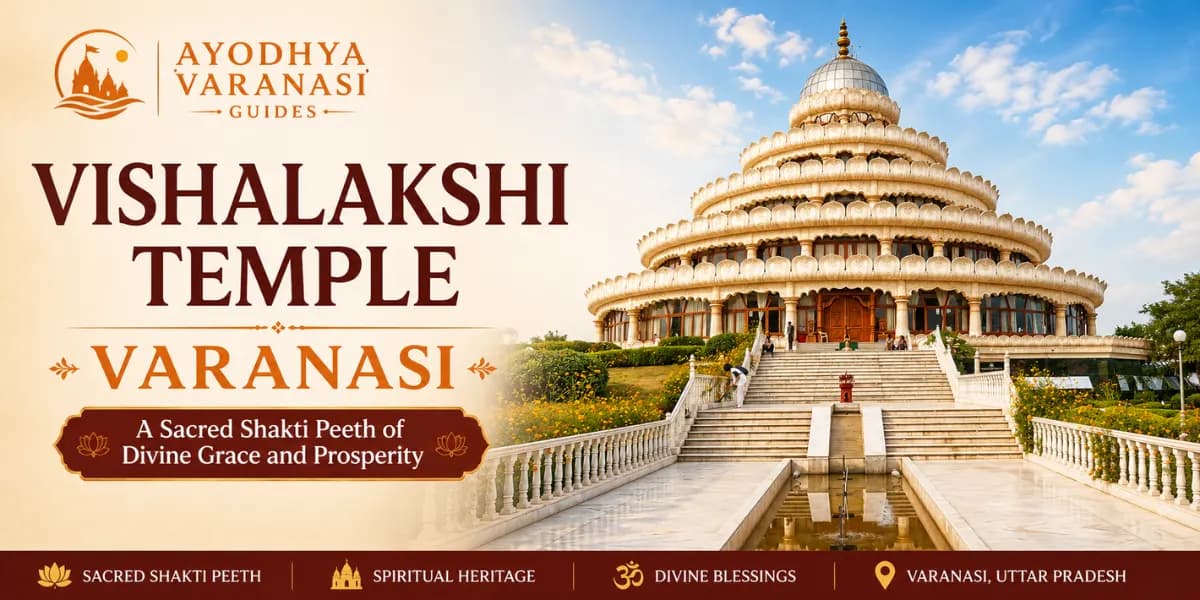
Vishalakshi Temple
Mir Ghat, Varanasi · Shakti Peetha of Kashi
4.9 / 5 · Kashi Darshan Help
Shakti Peethas · Vishwanath
- Timings
- ~4:00 AM–12:00 PM & 3:00 PM–10:00 PM
- Deity
- Devi Vishalakshi (Vishalakshi Gauri)
- Significance
- Shakti Peetha — Sati's earring fell here
- Also
- One of the nine Gauris of Kashi
- Entry
- Free · no ticket required
- Location
- Mir Ghat, near Kashi Vishwanath
What Are the Vishalakshi Temple Timings?
Vishalakshi opens in two sessions like most old-city temples — roughly 4:00 AM to 12:00 PM and 3:00 PM to 10:00 PM — with an afternoon break. Darshan is free and, outside festival days, unhurried. Hours extend considerably during Navratri and on Kajali Teej, when queues run well outside the temple.
Early Morning (Best)
Quiet lanes; the calmest darshan
Late Morning
Busier with Vishwanath visitors
Afternoon Break
Temple usually closed
Evening
Open late; good after the Ganga Aarti
Morning Aarti
Shringar of the Devi
Evening Aarti
The most atmospheric hour
Navratri
Both Navratris; extended hours
Kajali Teej
The temple's great festival
Tip: Vishalakshi is barely 500 metres from Kashi Vishwanath through the galis, so there is no reason to make a separate trip — do it in the same walk. Tradition also pairs the Devi with Vishwanath, so the two darshans belong together. WhatsApp us and we will route it.
When Is the Best Month to Visit Vishalakshi Temple? (2026)
This is a Devi temple, so the Navratri and Teej calendar shapes it. October to March is the comfortable window for walking the old-city lanes that lead to it.
Kajali Teej in Bhadrapada and both Navratris are the great occasions here, with queues running far outside the temple. Ordinary weekday mornings are quiet.
Why Is Vishalakshi One of the 51 Shakti Peethas?
What Is Vishalakshi Temple?
Vishalakshi Temple stands at Mir Ghat on the Varanasi riverfront, a few hundred metres from Kashi Vishwanath. It is dedicated to Devi Vishalakshi — vishal akshi, the goddess with vast or wide eyes — and it is one of the most important Devi shrines in the city.
What Are the Shakti Peethas?
When Sati immolated herself at Daksha’s yagna, Lord Shiva carried her body across the world in grief until Vishnu’s chakra severed it, and the pieces fell to earth. Each place where a part came to rest became a Shakti Peetha — a seat of the Goddess. There are traditionally 51 of them across the subcontinent, and pilgrims spend lifetimes visiting them.
What Fell at Kashi?
Tradition here holds that Sati’s karna kundala — her earring — fell at this spot. A second and widely held account says that one of her eyes fell here, which fits the name of the goddess rather neatly. Both traditions are told at the temple, and neither displaces the other.
Why Is She Called Vishalakshi?
Because of the eyes. Vishalakshi means the one with wide, vast eyes — a form of the Goddess whose gaze takes in everything. In a city where Shiva is the presiding lord, Vishalakshi is the Shakti who watches over Kashi, and the pairing of the two is fundamental to how the city understands itself.
What Are the Nine Gauris of Kashi?
Vishalakshi is also known as Vishalakshi Gauri, one of the nine Gauris of Kashi — nine forms of the Goddess honoured across the city in a traditional circuit called the Gauri Yatra, performed particularly during Navratri. It is a pilgrimage almost no visitor is told about, and Vishalakshi is one of its most important stations.
Why Does the Temple Look South Indian?
Because it largely is. The temple was rebuilt with support from South Indian devotees, and its architecture and ritual style carry an unmistakably Dravidian character — striking in the middle of the north Indian old city. Vishalakshi is held in very high regard in the South, and South Indian pilgrims come to Kashi specifically for her darshan.
Did you know? Tradition holds that a visit to Kashi Vishwanath is completed by darshan of Vishalakshi — Shiva and Shakti together. The two temples are barely five hundred metres apart, and the overwhelming majority of visitors do only one of them.
How Do You Have Darshan at Vishalakshi Temple?
A short walk from the Vishwanath Dham through the old-city lanes, and a darshan that most visitors never think to make.
- 1
Walk From Kashi Vishwanath
Vishalakshi is about 500 metres away through the galis, towards Mir Ghat. It is a five to ten minute walk, and easy to fold into your Vishwanath visit.
- 2
Find Mir Ghat
The temple sits just back from Mir Ghat on the riverfront, near the Dharma Kupa. Ask locally — everyone in the lanes knows it.
- 3
Leave Footwear at the Entrance
Footwear comes off outside. The temple is compact, and the interior is dim and intimate.
- 4
Notice the South Indian Style
The architecture and the ritual style are distinctly Dravidian — unmistakable once you look, and unusual in the middle of the north Indian old city.
- 5
Have Darshan of Devi Vishalakshi
Stand before the wide-eyed goddess — one of the 51 Shakti Peethas, where Sati's earring is believed to have fallen.
- 6
Complete the Shiva–Shakti Pairing
If you have already had Vishwanath darshan, this is the moment tradition points to. Shiva and Shakti, in the same walk.
- 7
Ask About the Nine Gauris
Vishalakshi is one of the nine Gauris of Kashi. If the Gauri Yatra interests you, ask the priests or your guide which others are nearby.
- 8
Step Down to Mir Ghat
The riverfront is a few steps away, quieter than Dashashwamedh and a good place to sit for a few minutes.
When Should You Visit Vishalakshi Temple?
The temple is open long hours and free. What shapes your visit is the session timing and the Devi calendar.
Best Time of Day — Early Morning
Come between 4 and 8 AM, ideally straight after or before Kashi Vishwanath darshan. The lanes are quiet and the temple unhurried.
Best Season — October to March
Comfortable weather for walking the old-city galis, which is the only way to reach it. May and June are best limited to the early morning.
Most Special — Kajali Teej & Navratri
Kajali Teej, on the third day of the waning fortnight of Bhadrapada in August, is the temple's own festival. Both Navratris bring the Gauri Yatra and enormous devotion.
What Can You See at Vishalakshi Temple?
A small shrine carrying enormous significance. Here is what to notice.
The Vishalakshi Sanctum
Top PickThe Shakti Peetha
The image of the wide-eyed goddess at one of the 51 Shakti Peethas, where Sati's earring — or, by another tradition, her eye — is believed to have fallen.
The South Indian Architecture
Top PickDravidian in Kashi
A distinctly South Indian temple style in the middle of the north Indian old city, reflecting the deep reverence for Vishalakshi in the South.
The Shiva–Shakti Pairing
Completing Vishwanath
Tradition holds that darshan at Kashi Vishwanath is completed by darshan of Vishalakshi. The two temples are barely 500 metres apart.
Vishalakshi Gauri
One of Nine
Her place among the nine Gauris of Kashi, honoured on the traditional Gauri Yatra performed during Navratri.
Mir Ghat
The Riverfront
The ghat just below the temple, quieter than Dashashwamedh and a pleasant place to sit for a few minutes after darshan.
Why Do So Few Visitors Reach Vishalakshi?
It sits five hundred metres from the busiest temple in Varanasi and is missed by almost everyone. Here is what they walk past.
One of the 51 Shakti Peethas
Pilgrims spend lifetimes visiting the Shakti Peethas. One of them is a five-minute walk from Kashi Vishwanath and hardly anyone is told.
It Completes the Vishwanath Darshan
Shiva and Shakti belong together in Kashi. Tradition holds that the Vishwanath darshan is finished here, not at the Dham.
The Gauri Yatra
Vishalakshi is one of the nine Gauris of Kashi, on a devotional circuit that almost no visitor encounters.
A South Indian Temple in the Galis
Dravidian architecture and ritual in the heart of the north Indian old city — a genuine surprise when you step inside.
Is There an Entry Fee at Vishalakshi Temple? (2026)
Darshan is completely free — there is no ticket and no paid queue. Only offerings and any special puja carry a cost.
The darshan is free and it is a five-minute walk from the Dham. What we add is the knowledge that it is there at all, plus a guide who can walk you through the galis, explain the Shakti Peetha tradition and extend it into the Gauri Yatra if you want to go further. Pricing confirmed in writing.
Offering prices are indicative. Special pujas are arranged directly with the temple priests.
What Do Devotees Say About Vishalakshi Temple?
1,198 verified reviews
For South Indians Vishalakshi is a major Shakti Peetha and we came to Kashi specifically for her darshan. The temple feels like home — the architecture, the rituals, everything. Deeply moving.
Padmanabhan Iyer
Madurai
Our guide told us the Vishwanath darshan is completed at Vishalakshi. Nobody had ever mentioned it. Five hundred metres away and we would have gone home without it. That is why you take a guide.
Sunita Mahajan
Nagpur
Visited during Navratri and did part of the Gauri Yatra with our guide. Extraordinary — a whole circuit of Devi temples across Kashi that we had no idea existed.
Bhavana Iyengar
Bengaluru
Came on Kajali Teej. Packed, joyful, completely different atmosphere from an ordinary day. Go early on that date, the queue in the lanes is long.
Rajat Sinha
Ranchi
Small temple, easy to miss in the galis, but very significant. Mind the afternoon closure. Free darshan and the priests were happy to explain the Shakti Peetha story.
Kalyani Desai
Mumbai
How Do You Fit Vishalakshi Into a Kashi Darshan?
It belongs in the same walk as Kashi Vishwanath, not as a separate trip. Here is the morning we plan.
Sunrise boat ride on the Ganga. Begin on the water for first light along the ghats.
Kashi Vishwanath darshan. Darshan of the Jyotirlinga at Shri Kashi Vishwanath Dham. We assist with VIP darshan to save you the queue.
Vishalakshi Temple at Mir Ghat. A five-minute walk through the galis to complete the Vishwanath darshan with the Devi — Shiva and Shakti together.
Mrityunjay Mahadev at Daranagar. The temple of victory over death and the Dhanvantari healing well, on the way to Kal Bhairav.
Kal Bhairav & Batuk Bhairav. Bhairav darshan, which tradition says completes a Kashi yatra.
New Vishwanath Temple, BHU. The afternoon stop, open when the old city closes.
Ganga Aarti at Dashashwamedh Ghat. Close the day with the great evening aarti on the riverfront.
Which Tour Package Covers Vishalakshi Temple?
Vishalakshi Temple is best seen as part of a planned Kashi darshan rather than a single stop — the old-city temples keep different hours and the ghats reward proper sequencing. These are the itineraries our guests book most, each with Kashi Vishwanath VIP darshan assistance, a certified local guide and transport, priced in writing before you travel.
- 1 Day1 Day Varanasi Tour PackageKashi Vishwanath darshan, a sunrise boat ride and the evening Ganga Aarti.
- 2 Days2 Days Varanasi Tour PackageKashi Vishwanath, the ghats, Sarnath and the old-city temple circuit.
- 3 Days3 Days Varanasi Tour PackageKashi at a proper pace — the Dham, the Bhairavs, the Durgakund cluster and the aarti.
- 4 Days4 Days Varanasi Tour PackageEverything in Kashi plus Sarnath, with time for the temples most itineraries skip.
- 2 Days2 Days Ayodhya Varanasi Tour PackageRam Mandir and Kashi Vishwanath across two cities, with the Ganga Aarti.
- 3 Days3 Days Ayodhya Varanasi Tour PackageThe classic pairing — Ram Mandir, Kashi Vishwanath and the ghats.
- 3 Days3 Days Varanasi Prayagraj Tour PackageKashi and the confluence, with time for the ghats and the Sangam boat ride.
- 4 Days4 Days Ayodhya Varanasi Prayagraj Tour PackageAll three cities — Ram Mandir, Kashi Vishwanath and the Triveni Sangam.
- 5 Days5 Days Ayodhya Varanasi Prayagraj Tour PackageThe complete sacred circuit at a comfortable, senior-friendly pace.
Want Vishalakshi Temple built into a custom itinerary? We plan around your dates, your pace and what you actually want to see.
See all Varanasi & Ayodhya tour packagesHow Do You Reach Vishalakshi Temple in Varanasi?
The temple is at Mir Ghat in the old city, about 500 metres from Kashi Vishwanath. No vehicle reaches it — you arrive on foot through the galis, or by boat to the ghat.
On Foot From Kashi Vishwanath
The usual route and by far the easiest. About 500 metres through the old-city lanes towards Mir Ghat — five to ten minutes.
By Boat
Board at Dashashwamedh and step off at Mir Ghat. A pleasant approach, and the temple is a short climb up from the water.
By Road / Taxi
Vehicles reach only as far as Godowlia. From there it is a walk of about fifteen minutes through the lanes.
By Train
Varanasi Junction (Cantt) is about 5 km away and Banaras station roughly 6 km. Take an auto to Godowlia, then walk.
Where Is Vishalakshi Temple Located in Varanasi?
Vishalakshi Temple stands just back from Mir Ghat in the old city, about 500 metres from Kashi Vishwanath through the galis. Use the map below to find the ghat.
Varanasi
- Area: Mir Ghat, old city, Varanasi
- PIN: Varanasi 221001
- From Kashi Vishwanath: ~500 m through the galis
- Significance: One of the 51 Shakti Peethas
- Access: On foot or by boat only
Where Should You Stay Near Vishalakshi Temple?
The temple is deep in the old city, so staying near the central ghats puts it within a short walk.
Godowlia & Dashashwamedh
The heart of Kashi, walking distance from Vishalakshi, Kashi Vishwanath and the evening Ganga Aarti. The best base for an old-city trip.
Assi Ghat & Ravidas Gate
The quieter southern end of the ghats, popular with longer-staying visitors, about 4 km along the riverfront.
Cantt & Sigra
Branded and business hotels near the railway station with parking and dining, about 20 to 35 minutes from the old city.
What Else Is Near Vishalakshi Temple?
Mir Ghat sits in the densest concentration of sacred sites anywhere in Varanasi.
Kashi Vishwanath Temple
The Jyotirlinga of Kashi, ~500 m through the galis — the darshan that Vishalakshi traditionally completes.
Kashi Vishwanath VIP Darshan
Skip-the-queue Sugam darshan assistance at Shri Kashi Vishwanath Dham, arranged in advance.
Mrityunjay Mahadev Temple
The temple of victory over death at Daranagar, with the Dhanvantari well whose water is believed to heal.
Nepali Temple, Lalita Ghat
The Nepalese wooden pagoda replica of Kathmandu's Pashupatinath, a short walk along the riverfront.
Ratneshwar Mahadev Temple
The leaning temple of Varanasi beside Manikarnika Ghat, best seen from a boat.
Ganga Aarti, Dashashwamedh Ghat
The world-famous evening aarti, a short walk south along the ghats.
Kajali Teej & Navratri at Vishalakshi Temple
Kajali Teej — on the third day of the waning fortnight of Bhadrapada, usually in August — is the temple’s own great festival. Women come in enormous numbers for the Devi’s darshan, the lanes around Mir Ghat fill completely, and the queue runs far outside the temple. It is the single most vivid day of the year here.
Both Navratris — Chaitra in March or April and Ashwin in September or October, culminating in Vijayadashami — bring intense devotion, and the traditional Gauri Yatra across the nine Gauris of Kashi is performed during this season. Arrive early on any of these dates.
What Should You Know Before Visiting Vishalakshi Temple?
A short darshan, and the main thing is simply knowing it is there.
Do it in the same walk as Kashi Vishwanath
It is 500 metres away through the galis. Tradition holds the Vishwanath darshan is completed here, so the two belong together.
Mind the afternoon closure
The temple shuts for roughly three hours in the middle of the day, as most old-city shrines do. Come in the morning or after 3 PM.
No vehicle reaches it
Mir Ghat is deep in the old city. You arrive on foot through the lanes or by boat to the ghat below.
Ask about the nine Gauris
Vishalakshi is one of nine Gauri temples across Kashi. If the Gauri Yatra interests you, a guide can build several into one walk.
Expect crowds on Kajali Teej
The temple's own festival in August fills the lanes completely. Arrive very early or accept a long wait.
It is a small shrine
Do not arrive expecting the scale of the Vishwanath Dham. The significance here is doctrinal, not architectural.
Look at the architecture
The South Indian style is unmistakable once you notice it, and unusual in the middle of the north Indian old city.
The galis are easy to get lost in
The lanes around Mir Ghat are a maze. If you are on your own, ask often — locals will point you right.
Dress modestly
Standard temple etiquette applies, with footwear removed at the entrance.
Combine it with Mir Ghat
The riverfront is a few steps below and far quieter than Dashashwamedh — worth a few minutes after darshan.
Vishalakshi Temple Varanasi — Frequently Asked Questions
The questions pilgrims ask us most about Vishalakshi — the Shakti Peetha tradition, timings, the Gauri Yatra and how to reach Mir Ghat.
Vishalakshi Temple at Mir Ghat is one of the 51 Shakti Peethas, dedicated to Devi Vishalakshi, the wide-eyed goddess. It stands about 500 metres from Kashi Vishwanath through the old-city lanes and is one of the most important Devi shrines in Kashi.
Still have a question?
Our local team replies within 30 minutes.
Written & verified by the local Varanasi guide team at Ayodhya Varanasi Guides
Our government-certified Kashi guides walk visitors from the Vishwanath Dham to Vishalakshi every day, and regularly assist South Indian pilgrim groups who come to Kashi specifically for this Shakti Peetha. Last updated: July 2026. Darshan hours extend during Navratri and Kajali Teej — message us for the timing on your travel date.
Complete Your Kashi Vishwanath Darshan at Vishalakshi
Let Ayodhya Varanasi Guides plan your Kashi darshan — Kashi Vishwanath with VIP darshan assistance and Vishalakshi in the same walk, the Bhairav temples, Mrityunjay Mahadev and the evening Ganga Aarti — with a certified local guide who knows the galis and the traditions. Confirmed in writing.