
Nepali Temple, Varanasi — The Kathwala Temple at Lalita Ghat
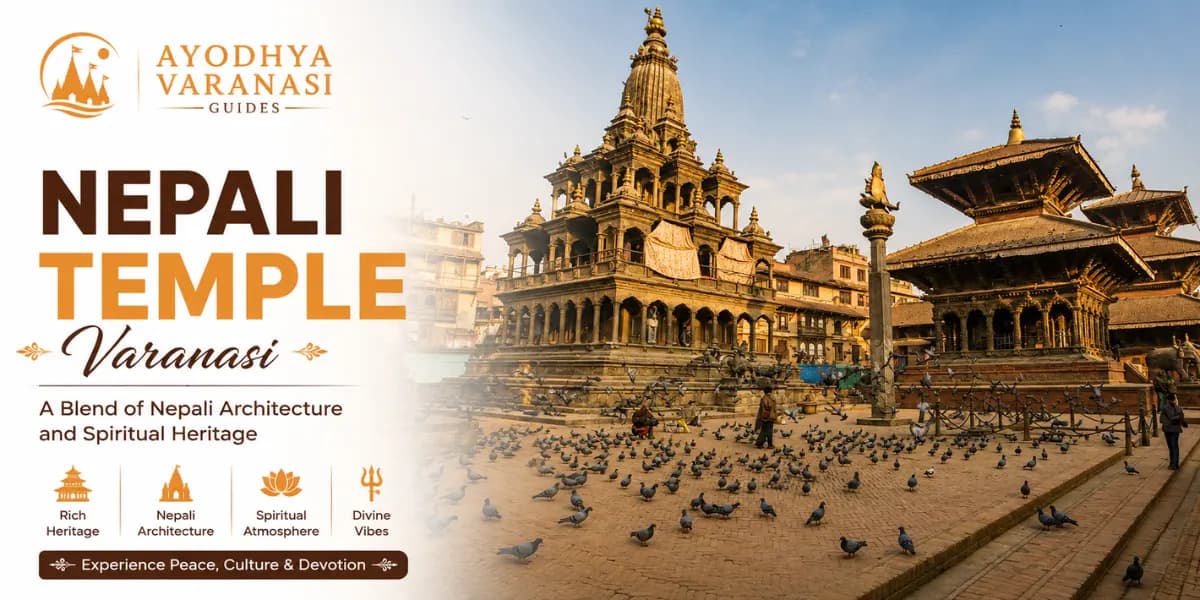
The Nepali Temple at Lalita Ghat — known locally as the Kathwala Temple, the “wooden one” — is a pagoda-style replica of Kathmandu’s Pashupatinath, built in terracotta, stone and Terai wood brought from Nepal. It was begun by King Rana Bahadur Shah of Nepal during his exile in Varanasi (1800–1804) and completed by his son years after the king was assassinated. Its intricately carved wooden struts have earned it the nickname “mini Khajuraho”. Entry is free, photography inside is prohibited, and it now sits directly beside the Kashi Vishwanath Dham corridor.
- Timings
- ~5 AM–12 PM & 3 PM–9 PM
- Built Of
- Terai wood, terracotta & stone
- Deity
- Pashupatinath (Lord Shiva)
- Entry
- Free · no photography inside
Nepali Temple
Lalita Ghat, Varanasi · The Kathwala Temple
4.9 / 5 · Kashi Darshan Help
Ghats · Vishwanath Dham
- Timings
- ~5:00 AM–12:00 PM & 3:00 PM–9:00 PM
- Deity
- Lord Shiva as Pashupatinath
- Also Known As
- Kathwala Temple · Nepali Mandir
- Built By
- King Rana Bahadur Shah of Nepal
- Entry
- Free · photography prohibited inside
- Location
- Lalita Ghat, beside Kashi Vishwanath Dham
What Are the Nepali Temple Timings?
The Nepali Temple generally follows the pattern of the ghat temples — open early morning through midday, closing for a few hours, then reopening in the afternoon until evening, roughly 5:00 AM to 12:00 PM and 3:00 PM to 9:00 PM. Darshan is free. The one rule everyone should know before arriving: photography inside the temple is not permitted, and it is enforced.
Early Morning (Best)
Quiet, cool, beautiful ghat light
Late Morning
Open; busier with Dham visitors
Afternoon Break
Usually closed
Evening
Combine with the Ganga Aarti
Photography
Strictly enforced inside the temple
Footwear
Racks at the entrance
Time Needed
Small temple; the carvings reward slowness
Sawan & Shivratri
Busier, as at every Shiva temple in Kashi
Tip: the temple sits at Lalita Ghat, right where the Kashi Vishwanath Dham corridor meets the river. Walk out of the Dham towards the Ganga and you are almost there — most visitors pass within fifty metres of it without knowing. WhatsApp us and we will fold it into your Vishwanath darshan.
When Is the Best Month to Visit the Nepali Temple? (2026)
The temple is small and sheltered, so Varanasi’s weather matters more than any temple calendar here. October to March is the comfortable window for walking the ghats, which is how most people reach it.
During a strong monsoon the Ganga can rise over the lower ghat steps, affecting the riverside approach. In those weeks reach the temple through the Vishwanath Dham corridor instead.
Why Is There a Nepali Temple in Varanasi?
What Is the Nepali Temple?
The Nepali Temple at Lalita Ghat is a pagoda-style Shiva temple built in the Nepalese manner — a deliberate replica of the great Pashupatinath Temple of Kathmandu. Varanasi has a thousand temples, and not one of them looks like this. Tiered roofs, dark carved timber and heavy wooden struts: for a moment on the ghats you are somewhere else entirely.
Who Built It, and Why?
It was begun by King Rana Bahadur Shah of Nepal, who lived in exile in Varanasi from 1800 to 1804. Far from Kathmandu and unable to visit his own Pashupatinath, he resolved to build one here. He returned to Nepal before it was finished, and on 25 April 1806 he was assassinated by his stepbrother. His son, Girvan Yuddha Bikram Shah Deva, completed the temple two decades later — a building begun in exile and finished in his father’s memory.
Why Is It Called the Kathwala Temple?
Because of what it is made of. Kath means wood, and Varanasi simply calls it the Kathwala Temple — the wooden one. The timber came from the Terai region of Nepal, carried down with Nepalese craftsmen who worked it in their own tradition. The wood is famously resistant to termites and insects, which is how carved timber has survived two centuries of Varanasi humidity beside a river.
Why Is It Called “Mini Khajuraho”?
The wooden struts and panels carry intricate erotic carvings in the Nepalese temple tradition, which has earned the building its local nickname of “mini Khajuraho”. Such carvings are entirely conventional on Nepalese pagoda temples, where they are understood as auspicious and protective. It is one of the reasons photography inside is not allowed.
How Does It Connect Kashi and Kathmandu?
Deeply, and for a long time. Kashi has drawn Nepalese pilgrims, scholars, kings and exiles for centuries, and Nepal has its own quarter in this city. The temple is also known as Shri Samrajyeshwar Pashupatinath, and for Nepalese devotees in Varanasi it is home ground in a foreign city — the place where Kathmandu’s greatest shrine has a presence on the Ganga.
What Has Changed With the Vishwanath Dham Corridor?
A great deal. Lalita Ghat is one of the points where the Kashi Vishwanath Dham corridor reaches the river, so the Nepali Temple now stands directly beside the route that millions of pilgrims take between the Jyotirlinga and the Ganga. A temple that was once tucked away in the ghat lanes is suddenly on the main path — though most people still walk straight past it.
Did you know? The Terai timber used here is naturally resistant to termites — which is why two-hundred-year-old wooden carvings have survived on a riverbank in one of the most humid cities in northern India.
What Do You See at the Nepali Temple?
A short visit, but one that rewards looking carefully rather than walking through. Here is how it goes.
- 1
Reach Lalita Ghat
Walk down through the Kashi Vishwanath Dham corridor towards the river, or approach along the ghats from Dashashwamedh — about fifteen minutes on foot.
- 2
Find the Wooden Pagoda
The temple is unmistakable once you see it — tiered roofs and dark carved timber, quite unlike anything else on the Varanasi riverfront.
- 3
Put Your Camera Away
Photography inside the temple is prohibited and enforced. Take your exterior shots from the ghat before you enter.
- 4
Leave Footwear at the Entrance
Racks are provided. The temple is small and the interior is dim and cool.
- 5
Have Darshan of Pashupatinath
The presiding deity is Lord Shiva as Pashupatinath, in the manner of the great Kathmandu shrine this temple replicates.
- 6
Look Up at the Wooden Struts
This is the part people miss. The carved timber struts and panels are the reason the building matters — Nepalese woodwork of a kind found nowhere else in Varanasi.
- 7
Step Out to the Ghat
Lalita Ghat gives you the Ganga on one side and the new Vishwanath Dham rising behind — one of the best vantage points in the city.
- 8
Continue Along the Ghats
Manikarnika and the leaning Ratneshwar Mahadev are a few minutes north; Dashashwamedh and the evening aarti lie south.
When Should You Visit the Nepali Temple?
It is a small, sheltered temple, so plan around the light on the ghats and the afternoon closure rather than any festival.
Best Time of Day — Early Morning
Come between 5 and 8 AM. The ghats are at their most beautiful, the temple is quiet, and you can pair it with a sunrise boat ride and Kashi Vishwanath darshan straight afterwards.
Best Season — October to March
Varanasi's cool months make walking the ghats a pleasure. November brings Dev Deepawali, when the entire riverfront including Lalita Ghat is lit with thousands of lamps.
Avoid — Peak Monsoon Afternoons
In a strong monsoon the Ganga can rise over the lower ghat steps and make the riverside approach awkward. Reach the temple through the Vishwanath Dham corridor instead, and mind the midday closure.
What Makes the Nepali Temple Worth Seeing?
A compact building carrying a great deal of craftsmanship and history. Here is what to look at.
The Wooden Pagoda Architecture
Top PickKathmandu on the Ganga
Tiered roofs and Nepalese pagoda construction — the only building of its kind on the Varanasi riverfront, and instantly recognisable.
The Carved Terai Timber
Top PickTwo Centuries Old
Struts and panels worked by Nepalese craftsmen in termite-resistant Terai wood, still intact after two hundred years beside the river.
The Pashupatinath Sanctum
The Darshan
Lord Shiva worshipped as Pashupatinath, in the manner of the great Kathmandu temple this building replicates.
The 'Mini Khajuraho' Panels
Nepalese Tradition
The intricate erotic carvings conventional to Nepalese pagoda temples, which gave the building its local nickname.
Lalita Ghat
The Setting
One of the points where the Kashi Vishwanath Dham corridor reaches the Ganga — an excellent vantage point over the river.
Why Do So Many Visitors Walk Past This Temple?
It sits beside one of the busiest pilgrim routes in India and is still missed by almost everyone. Here is what they are missing.
A Building Like No Other in Kashi
A thousand temples in Varanasi, and exactly one Nepalese wooden pagoda. Ten minutes here is a complete change of scene.
A Temple Built in Exile
Begun by a king far from home who never saw it finished, and completed by his son after his assassination. The story is as remarkable as the building.
The Kashi–Kathmandu Link
Centuries of Nepalese devotion, scholarship and exile in Varanasi, standing in carved wood on the riverbank.
Right Beside the Dham
Lalita Ghat is where the Vishwanath corridor meets the Ganga. You are already there — it costs you twenty minutes.
Is There an Entry Fee at the Nepali Temple? (2026)
Entry and darshan are completely free — there is no ticket and no queue. The only thing that is restricted rather than charged is photography inside, which is not permitted at any price.
The temple costs nothing. What we add is a ghat heritage walk that actually explains what you are looking at — the Nepalese woodwork, the exile story behind the building, and the run of ghats from Lalita to Manikarnika including the leaning Ratneshwar Mahadev. Pricing confirmed in writing.
Boat fares are indicative and vary with season, river level and demand. Agree the fare before boarding.
What Do Visitors Say About the Nepali Temple?
1,173 verified reviews
As a Nepali visiting Kashi, standing in front of our own Pashupatinath in wood on the Ganga was very moving. My grandfather had told me about it. Beautifully kept and the priests were welcoming.
Prabin Shrestha
Kathmandu
We came out of the Vishwanath Dham towards the river and our guide pointed this out. Completely different architecture from anything else in Varanasi. Do respect the no-photography rule inside — it is taken seriously.
Sheela Raman
Bengaluru
The wooden carvings are extraordinary, especially when you learn the timber came from Nepal two hundred years ago and has survived the humidity. Twenty minutes well spent right next to the Dham.
Jitendra Malhotra
Amritsar
Visited at sunrise from the ghat side. Very peaceful, hardly anyone there, and the contrast with the stone temples all around is striking. Our guide told us the story of the exiled king, which made it.
Claire Dubois
Lyon
Small temple but genuinely unusual. Note the afternoon closure — we arrived at 1:30 PM and had to come back. Free entry and right beside the corridor, so no reason to skip it.
Harshad Patel
Ahmedabad
How Do You Fit the Nepali Temple Into a Kashi Day?
It sits at Lalita Ghat between the Dham and the river, so it slots naturally into the classic Varanasi morning.
Sunrise boat ride on the Ganga. Begin on the water for first light along the ghats, passing Lalita Ghat from the river.
Ratneshwar Mahadev at Manikarnika. The leaning temple in the best light of the day, a few minutes north by boat.
Kashi Vishwanath darshan. Darshan of the Jyotirlinga at Shri Kashi Vishwanath Dham. We assist with VIP darshan to save you the queue.
Nepali Temple at Lalita Ghat. Walk out of the Dham towards the river to the wooden pagoda — twenty minutes among the Nepalese carvings.
Kal Bhairav & Batuk Bhairav. Bhairav darshan, which tradition says completes a Kashi yatra.
Sarnath (optional). Where the Buddha gave his first sermon, ~10 km away.
Ganga Aarti at Dashashwamedh Ghat. Close the day with the great evening aarti on the riverfront.
Which Tour Package Covers Nepali Temple?
Nepali Temple is best seen as part of a planned Kashi darshan rather than a single stop — the old-city temples keep different hours and the ghats reward proper sequencing. These are the itineraries our guests book most, each with Kashi Vishwanath VIP darshan assistance, a certified local guide and transport, priced in writing before you travel.
- 1 Day1 Day Varanasi Tour PackageKashi Vishwanath darshan, a sunrise boat ride and the evening Ganga Aarti.
- 2 Days2 Days Varanasi Tour PackageKashi Vishwanath, the ghats, Sarnath and the old-city temple circuit.
- 3 Days3 Days Varanasi Tour PackageKashi at a proper pace — the Dham, the Bhairavs, the Durgakund cluster and the aarti.
- 4 Days4 Days Varanasi Tour PackageEverything in Kashi plus Sarnath, with time for the temples most itineraries skip.
- 2 Days2 Days Ayodhya Varanasi Tour PackageRam Mandir and Kashi Vishwanath across two cities, with the Ganga Aarti.
- 3 Days3 Days Ayodhya Varanasi Tour PackageThe classic pairing — Ram Mandir, Kashi Vishwanath and the ghats.
- 3 Days3 Days Varanasi Prayagraj Tour PackageKashi and the confluence, with time for the ghats and the Sangam boat ride.
- 4 Days4 Days Ayodhya Varanasi Prayagraj Tour PackageAll three cities — Ram Mandir, Kashi Vishwanath and the Triveni Sangam.
- 5 Days5 Days Ayodhya Varanasi Prayagraj Tour PackageThe complete sacred circuit at a comfortable, senior-friendly pace.
Want Nepali Temple built into a custom itinerary? We plan around your dates, your pace and what you actually want to see.
See all Varanasi & Ayodhya tour packagesHow Do You Reach the Nepali Temple in Varanasi?
The temple is at Lalita Ghat, on the riverfront immediately beside the Kashi Vishwanath Dham corridor. No vehicle reaches it — you arrive on foot or by boat.
Through the Vishwanath Dham
The easiest route. Walk out of the Kashi Vishwanath Dham corridor towards the Ganga — Lalita Ghat is one of the points where the corridor meets the river.
By Boat
Board at Dashashwamedh or Assi Ghat and step off at Lalita Ghat. This is also the best way to see the temple's pagoda roofs from the water.
By Train
Varanasi Junction (Cantt) is about 5 km away and Banaras station roughly 6 km. Take an auto to Godowlia and walk down to the ghats.
By Air
Lal Bahadur Shastri International Airport, Babatpur is around 25 km away, with taxis at the terminal. Allow an hour in traffic.
Where Is the Nepali Temple Located in Varanasi?
The Nepali Temple stands at Lalita Ghat on the Varanasi riverfront, immediately beside the Kashi Vishwanath Dham corridor and a short walk south of Manikarnika Ghat.
Varanasi
- Area: Lalita Ghat, beside Kashi Vishwanath Dham
- PIN: Varanasi 221001
- From Kashi Vishwanath: ~200 m through the corridor
- From Manikarnika Ghat: ~400 m along the ghats
- Access: On foot or by boat only
Where Should You Stay Near the Nepali Temple?
The temple is in the heart of the old-city riverfront, so staying near the ghats puts it within a few minutes' walk.
Godowlia & Dashashwamedh
The heart of Kashi, walking distance from Lalita Ghat, the Vishwanath Dham and the evening Ganga Aarti. Best base for a ghat-focused trip.
Assi Ghat & Ravidas Gate
The quieter southern end of the ghats, popular with longer-staying visitors, with its own boat boarding point about 4 km south.
Cantt & Sigra
Branded and business hotels near the railway station with parking and dining, about 20 to 35 minutes from the ghats.
What Else Can You See Near the Nepali Temple?
Lalita Ghat sits in the middle of the richest stretch of the Varanasi riverfront.
Kashi Vishwanath Temple
The Jyotirlinga of Kashi, ~200 m through the corridor. We assist with VIP darshan to skip the main queue.
Kashi Vishwanath VIP Darshan
Skip-the-queue Sugam darshan assistance at Shri Kashi Vishwanath Dham, arranged in advance.
Ratneshwar Mahadev Temple
The leaning temple of Varanasi at Manikarnika Ghat, a few minutes north along the riverfront.
Ganga Aarti, Dashashwamedh Ghat
The world-famous evening aarti, a kilometre south along the ghats — best viewed from a boat.
Adi Keshava Temple
The fifth and final tirtha of the Kashi Panchtirthi Yatra, at the Ganga–Varuna confluence north of here.
How to Commute in Varanasi
Autos, e-rickshaws, boats and taxis — how to get around the old city and the ghats without stress.
Mahashivratri & Dev Deepawali at Lalita Ghat
Mahashivratri brings devotion to every Shiva temple in Kashi, and the Nepali Temple — a Pashupatinath shrine — is no exception. Sawan is similarly busy, with the Vishwanath Dham corridor beside it carrying enormous numbers of pilgrims down to the river.
The most spectacular night of the year here is Dev Deepawali on Kartik Purnima in November, when every ghat on the Varanasi riverfront is lit with thousands of earthen lamps — Lalita Ghat included. Seeing the wooden pagoda against a riverfront of lamps is unforgettable, and boats book out weeks in advance.
What Should You Know Before Visiting the Nepali Temple?
A short and easy visit, but a few rules and details are worth knowing first.
Photography inside is prohibited
This is enforced, and it is the rule visitors most often fall foul of. Take your exterior photographs from the ghat before you go in.
Reach it through the Vishwanath Dham
Lalita Ghat is where the corridor meets the river. Walking out of the Dham towards the Ganga is by far the easiest approach.
Mind the afternoon closure
The temple generally shuts for a few hours around midday. Come in the morning or after 3 PM.
Look up at the struts
The carved wooden struts and panels are the whole point of the building, and most visitors never raise their eyes to them.
No vehicle reaches it
Lalita Ghat is accessible on foot or by boat only. Expect a walk through the galis or down the ghat steps.
Watch the river level in the monsoon
In July and August the Ganga can rise over the lower steps, making the riverside approach awkward. Use the corridor route instead.
It is a small temple
Twenty to thirty minutes is enough. Treat it as a stop on a ghat walk rather than a destination in itself.
Be respectful of the carvings
The erotic panels are conventional in Nepalese temple architecture and are treated as auspicious. Photographing or joking about them inside is not appreciated.
Dress modestly
Standard temple etiquette applies, with footwear removed at the entrance.
Combine it with Manikarnika
The leaning Ratneshwar Mahadev and Manikarnika Ghat are only a few minutes north along the riverfront.
Nepali Temple Varanasi — Frequently Asked Questions
The questions visitors ask us most about the Nepali Temple — who built it, the photography rule, timings, location and how to reach Lalita Ghat.
It is a pagoda-style Shiva temple at Lalita Ghat built in the Nepalese manner, as a replica of the Pashupatinath Temple in Kathmandu. Made of terracotta, stone and carved Terai wood from Nepal, it is known locally as the Kathwala Temple, meaning 'the wooden one'.
Still have a question?
Our local team replies within 30 minutes.
Written & verified by the local Varanasi guide team at Ayodhya Varanasi Guides
Our government-certified Kashi guides walk the ghats past Lalita Ghat every day and bring visitors into the Nepali Temple as part of the Vishwanath Dham route. Last updated: July 2026. Timings can shift on festival days and the riverside approach changes with the monsoon — message us for the position on your travel date.
See Kathmandu's Pashupatinath on the Ganga at the Nepali Temple
Let Ayodhya Varanasi Guides plan your Kashi darshan — the Nepali Temple at Lalita Ghat, Kashi Vishwanath with VIP darshan assistance, the leaning Ratneshwar Mahadev at Manikarnika and the evening Ganga Aarti — with a certified local guide who can explain the woodwork and the history. Confirmed in writing.