
Durga Kund Temple, Varanasi — The Red Temple & Its Sacred Tank
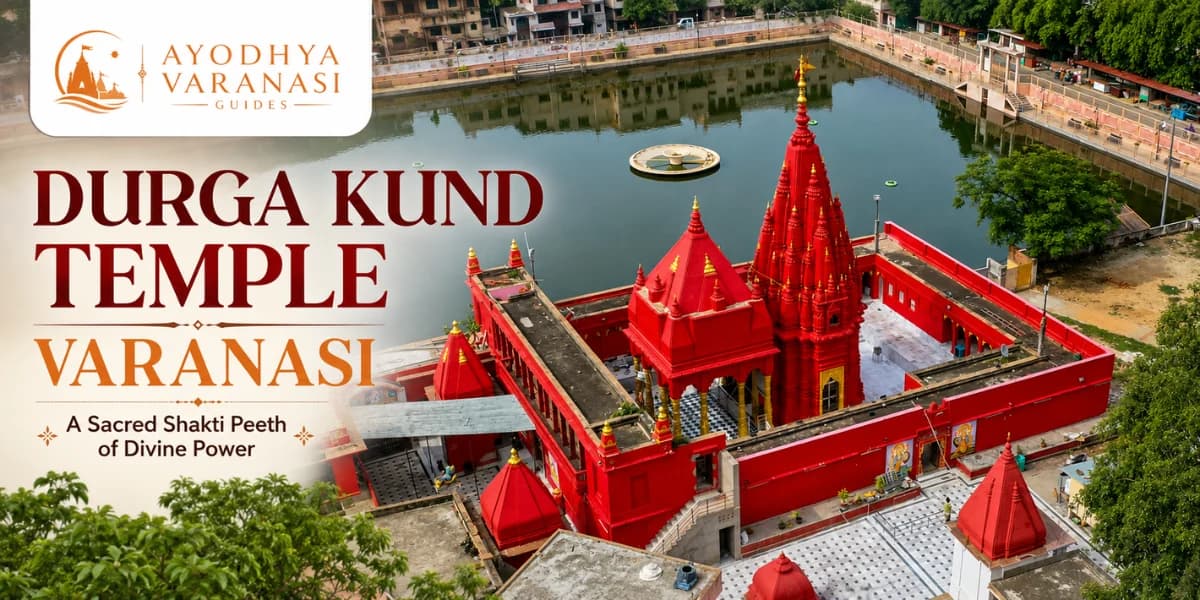
Durga Kund Temple — the Durga Mandir — is one of the most striking temples in Varanasi, instantly recognisable by its deep red ochre colour, said to reflect the fiery nature of the goddess. It was built in the 18th century by the Bengali queen Rani Bhabani of Natore, in North Indian Nagara style with a multi-tiered shikhara. The idol of the goddess is held to be swayambhu — not made by human hands but appeared of itself. Beside it lies the Durga Kund, a rectangular tank once connected to the Ganga. Darshan is free, and Navratri is the great season.
- Timings
- ~4 AM–1 PM & 3 PM–8 PM
- Famous For
- The red temple & swayambhu idol
- Built
- 18th c. by Rani Bhabani of Natore
- Entry
- Free · no ticket
Durga Kund Temple
Varanasi · The Red Temple of the Goddess
4.9 / 5 · Kashi Darshan Help
Devi temples · Vishwanath
- Timings
- ~4:00 AM–1:00 PM & 3:00 PM–8:00 PM
- Deity
- Goddess Durga; swayambhu idol
- Architecture
- Nagara style; red ochre and sandstone
- Built By
- Rani Bhabani of Natore, 18th century
- Entry
- Free · no ticket required
- Location
- Durgakund, near Sankat Mochan, Varanasi
What Are the Durga Kund Temple Timings?
Durga Mandir opens very early — from around 4:00 AM to 1:00 PM, and again from 3:00 PM to 8:00 PM. Darshan is free. The temple is busiest on Tuesdays and Fridays, the traditional days of the Devi, and hours extend considerably through both Navratris, when the queue runs well outside the compound.
Early Morning (Best)
Quietest darshan; opens very early
Late Morning
Busier; local devotees arrive
Afternoon Break
Temple usually closed
Evening
Aarti; the kund looks best at dusk
Morning Aarti
Shringar of the Devi
Evening Aarti
The most atmospheric hour
Tuesday & Friday
The traditional days of the Devi
Navratri
Extended hours; very long queues
Tip: Durga Kund sits within a kilometre or two of Sankat Mochan, Tulsi Manas, Tridev and ISKCON. Doing all of them in one outing is by far the best use of a Varanasi morning — four separate trips across the city traffic wastes a day. WhatsApp us and we will route the cluster.
When Is the Best Month to Visit Durga Kund Temple? (2026)
This is a Devi temple, so the Navratri calendar dominates. October to March is the comfortable season across Varanasi, and both Navratris bring the temple fully alive.
Both Navratris are extraordinary here, with queues running far outside the compound. Tuesdays and Fridays bring large crowds throughout the year.
Why Is the Durga Temple in Varanasi Red?
What Is Durga Kund Temple?
Durga Kund Temple, usually called simply the Durga Mandir, is one of the most important Devi temples in Varanasi and one of the most photographed buildings in the city. It stands beside the Durga Kund, a rectangular sacred tank, in the southern quarter of Varanasi that takes its name from the temple.
Why Is It Red?
The temple’s deep red ochre colour is its defining feature, and it is deliberate. The hue is said to reflect the fiery nature of the goddess — Durga in her aspect of power and protection. The colour comes from red sandstone and ochre rather than paint, which is why it has held for centuries rather than fading.
Who Built It?
The temple was constructed in the 18th century by Rani Bhabani of Natore, a Bengali queen and one of the great temple patrons of her age. Her patronage is part of a long thread of Bengali devotion in Kashi, which shaped a great deal of the city’s religious architecture, and it explains the temple’s particular importance to Bengali pilgrims.
What Is the Swayambhu Idol?
This is the heart of the temple’s sanctity. The image of the goddess here is held to be swayambhu — self-manifested. Tradition holds that it was not carved or installed by any human hand but appeared of itself in the temple. A swayambhu murti is regarded very differently from a consecrated one, and it is why this shrine carries the standing it does.
What Is the Kund Itself?
The Durga Kund is the rectangular tank beside the temple, edged with steps on all sides. It was once connected to the Ganga, which gave its water the sanctity of the river itself. It remains the visual centre of the whole quarter, and the temple reflected in it at dusk is the image most visitors carry away.
Why Is It Called the Monkey Temple?
Because of the macaques. Large troops of monkeys live in and around the temple and the trees along the kund, and foreign visitors have long called it the “Monkey Temple” for that reason. They are bold and quick — keep food out of sight, hold on to spectacles and phones, and do not attempt to feed them.
Did you know? The red of the Durga Mandir comes from red sandstone and ochre rather than paint — which is why a temple built in the 18th century still carries the colour that makes it the most recognisable building in south Varanasi.
What Is a Visit to Durga Kund Temple Like?
Busy, colourful and full of life — and there is a little more to it than the sanctum.
- 1
Reach Durgakund
The temple is in the Durgakund quarter of south Varanasi, near Sankat Mochan. Autos and e-rickshaws reach it directly.
- 2
Walk Around the Kund First
Take the tank before the temple. The red shikhara reflected in the water is the view the temple is known for, and it is best seen from the far side.
- 3
Leave Footwear and Belongings
Racks are provided. Keep bags closed and phones secured — the monkeys here are practised at both.
- 4
Join the Darshan Queue
Short on ordinary weekday mornings, long on Tuesdays, Fridays and throughout both Navratris.
- 5
Have Darshan of the Devi
Stand before the swayambhu image of Goddess Durga — the idol tradition holds was never made by human hands.
- 6
Note the Nagara Architecture
The multi-tiered shikhara and the carving are a fine example of North Indian temple architecture in its 18th-century form.
- 7
Check Sanctum Access If You Are a Visitor
Non-Hindu visitors are generally welcome in the courtyard, though access to the inner sanctum may be restricted. Follow the temple's guidance rather than assuming.
- 8
Walk On to Sankat Mochan and Tulsi Manas
Both are within about 1.5 km, and the three together make the best temple hour in Varanasi.
When Should You Visit Durga Kund Temple?
It opens earlier than almost anything else in the city, which gives you a genuinely good option most visitors never use.
Best Time of Day — Early Morning
The temple opens around 4 AM. Arriving between 4 and 7 gives you the shortest queue, the coolest air and the red stone at its best in first light.
Best Season — October to March
Varanasi's cool months are right for the whole southern temple cluster. November and February are especially pleasant if you want the temple without Navratri crowds.
Most Special — Chaitra & Ashwin Navratri
Both Navratris transform the temple, with queues far outside the compound and the whole quarter in celebration. Extraordinary to witness, but arrive at first light.
What Can You See at Durga Kund Temple?
The temple, the tank and the quarter around them are all part of the visit.
The Red Nagara Shikhara
Top PickThe Iconic View
The multi-tiered red spire that makes this the most recognisable temple building in south Varanasi, in red sandstone and ochre rather than paint.
The Swayambhu Durga Idol
Top PickThe Main Darshan
The image of the goddess held to have appeared of itself rather than being carved or installed by human hands.
The Durga Kund
The Sacred Tank
The rectangular stepped tank beside the temple, once connected to the Ganga, and the setting for the temple's most photographed view.
The 18th-Century Architecture
Rani Bhabani's Temple
A fine example of North Indian Nagara style, built by the Bengali queen Rani Bhabani of Natore.
The Monkeys
The 'Monkey Temple'
Large troops of macaques around the temple and the kund — entertaining, bold, and worth keeping your belongings secure around.
Why Is Durga Kund One of the Essential Kashi Temples?
It appears on almost every Varanasi list, and for once the reputation is earned. Here is why.
The Most Striking Building in South Varanasi
Deep red, multi-tiered and reflected in its own tank. Nothing else in the city looks like it.
A Swayambhu Devi
An image held never to have been made by human hands. That places the shrine in a different category from a consecrated temple.
Built by a Queen
Rani Bhabani of Natore, one of the great temple patrons of the 18th century, and part of the long Bengali devotional thread in Kashi.
The Anchor of the Best Temple Cluster
Sankat Mochan, Tulsi Manas, Tridev, ISKCON and the BHU temple are all within a few kilometres.
Is There an Entry Fee at Durga Kund Temple? (2026)
Darshan is completely free — there is no ticket and no paid queue, even during Navratri. Only offerings and any special puja carry a cost.
The darshan is free. What we add is the cluster and the timing — Durga Kund, Sankat Mochan, Tulsi Manas, Tridev and ISKCON all sit within a few kilometres, and doing them in one planned outing rather than five separate trips is the single biggest time saving available in Varanasi. Pricing confirmed in writing.
Auto fares are indicative and vary with traffic and time of day. Agree the fare before setting off.
What Do Devotees Say About Durga Kund Temple?
1,327 verified reviews
As a Bengali family we felt a particular connection here — built by Rani Bhabani of Natore, and still so loved by Bengalis in Kashi. The red temple against the kund at sunset is unforgettable.
Sujata Chatterjee
Kolkata
Our guide had us there at 5 AM and we walked straight in. By nine the queue was around the block. Walk around the kund first — the reflection of the red shikhara is the shot everyone comes for.
Vikram Malhotra
Delhi
Visited during Ashwin Navratri. The queue was enormous but very well managed and the atmosphere was electric. The whole quarter is celebrating, not just the temple.
Anitha Krishnan
Chennai
Beautiful building and a fascinating history. As a foreign visitor I was welcomed in the courtyard; sanctum access was restricted, which the staff explained politely. The monkeys took a real interest in my camera bag.
James Whitfield
Manchester
Important Devi temple and very old. Mind the afternoon closure between 1 and 3. Do it with Sankat Mochan and Tulsi Manas, they are all close together — sensible planning by the team.
Ram Avtar Gupta
Kanpur
How Do You Fit Durga Kund Into a Kashi Day?
It belongs in the southern cluster, which is best done as one continuous block. Here is the day we plan.
Sunrise boat ride on the Ganga. Begin on the water for first light along the ghats.
Kashi Vishwanath darshan. Darshan of the Jyotirlinga at Shri Kashi Vishwanath Dham. We assist with VIP darshan to save you the queue.
Vishalakshi & Mrityunjay Mahadev. The Shakti Peetha at Mir Ghat and the healing well at Daranagar.
Sankat Mochan Hanuman Temple. Darshan at the temple Tulsidas founded. Leave phones and bags in the vehicle.
Durga Kund Temple. The red temple and its sacred tank — walk the kund before the sanctum.
Tulsi Manas Mandir. The whole Ramcharitmanas inscribed in marble, minutes away.
Ganga Aarti at Dashashwamedh Ghat. Close the day with the great evening aarti on the riverfront.
Which Tour Package Covers Durga Kund Temple?
Durga Kund Temple is best seen as part of a planned Kashi darshan rather than a single stop — the old-city temples keep different hours and the ghats reward proper sequencing. These are the itineraries our guests book most, each with Kashi Vishwanath VIP darshan assistance, a certified local guide and transport, priced in writing before you travel.
- 1 Day1 Day Varanasi Tour PackageKashi Vishwanath darshan, a sunrise boat ride and the evening Ganga Aarti.
- 2 Days2 Days Varanasi Tour PackageKashi Vishwanath, the ghats, Sarnath and the old-city temple circuit.
- 3 Days3 Days Varanasi Tour PackageKashi at a proper pace — the Dham, the Bhairavs, the Durgakund cluster and the aarti.
- 4 Days4 Days Varanasi Tour PackageEverything in Kashi plus Sarnath, with time for the temples most itineraries skip.
- 2 Days2 Days Ayodhya Varanasi Tour PackageRam Mandir and Kashi Vishwanath across two cities, with the Ganga Aarti.
- 3 Days3 Days Ayodhya Varanasi Tour PackageThe classic pairing — Ram Mandir, Kashi Vishwanath and the ghats.
- 3 Days3 Days Varanasi Prayagraj Tour PackageKashi and the confluence, with time for the ghats and the Sangam boat ride.
- 4 Days4 Days Ayodhya Varanasi Prayagraj Tour PackageAll three cities — Ram Mandir, Kashi Vishwanath and the Triveni Sangam.
- 5 Days5 Days Ayodhya Varanasi Prayagraj Tour PackageThe complete sacred circuit at a comfortable, senior-friendly pace.
Want Durga Kund Temple built into a custom itinerary? We plan around your dates, your pace and what you actually want to see.
See all Varanasi & Ayodhya tour packagesHow Do You Reach Durga Kund Temple in Varanasi?
The temple is in the Durgakund quarter of south Varanasi, near Sankat Mochan and the BHU campus. It is on a main road, so vehicles reach it directly.
By Road / Taxi
The simplest option. Durgakund Road is a main route and taxis and autos drop you at the temple without any walking through lanes.
By Train
Banaras station is about 3 km away and Varanasi Junction (Cantt) roughly 7 km. Both connect to Delhi, Lucknow, Prayagraj and Ayodhya.
By Air
Lal Bahadur Shastri International Airport, Babatpur is around 30 km away, with taxis at the terminal. Allow over an hour in traffic.
The Last Mile
E-rickshaws run constantly along Durgakund Road. Ask for Durga Mandir or Durgakund — both are universally known.
Where Is Durga Kund Temple Located in Varanasi?
Durga Kund Temple stands on Durgakund Road in south Varanasi, beside its sacred tank and within a short walk of the ISKCON temple and Tulsi Manas Mandir.
Varanasi
- Area: Durgakund, south Varanasi
- PIN: Varanasi 221005
- From Kashi Vishwanath: ~5 km
- From Sankat Mochan: ~1.5 km
- Also known as: Durga Mandir · the Monkey Temple
Where Should You Stay Near Durga Kund Temple?
The Durgakund and Lanka quarter is the natural base for the southern temple cluster.
Durgakund & Bhelupur
Quiet residential streets with guesthouses and mid-range hotels, walking distance from Durga Kund, ISKCON and Tulsi Manas.
Assi Ghat & Ravidas Gate
The calmer southern end of the ghats, about 10 minutes away, with cafés and its own sunrise boat boarding point.
Cantt & Sigra
Branded and business hotels near the railway station with parking and dining, 30 to 40 minutes from the temple.
What Else Can You Visit Near Durga Kund Temple?
This quarter holds the most walkable set of temples in Varanasi — several within five minutes of each other.
Tulsi Manas Mandir
The whole Ramcharitmanas inscribed in marble, at the site where Tulsidas composed it. ~500 m.
ISKCON Temple, Varanasi
Sri Sri Radha Gopal Bihari on Durgakund Road — calm, welcoming, with daily kirtan and free prasadam. ~500 m.
Sankat Mochan Temple
The Hanuman temple founded by Tulsidas, ~1.5 km away. Note the no-phone rule.
Tridev Temple
The temple to Brahma, Vishnu and Mahesh near Tulsi Manas, with shrines of Maa Sati and Khatu Shyam.
New Vishwanath Temple (BHU)
The marble replica on the BHU campus with the tallest temple shikhar in the world.
Kashi Vishwanath Temple
The Jyotirlinga of Kashi, ~5 km away. We assist with VIP darshan to skip the main queue.
Chaitra & Ashwin Navratri at Durga Kund
Both Navratris transform Durga Kund. Through Chaitra Navratri (March or April) and Ashwin Navratri (September or October), the queue runs far outside the compound, the whole quarter is decorated and the temple is open extended hours from before dawn until late at night.
Ashwin Navratri culminates in Vijayadashami, and the Bengali community of Kashi observes Durga Puja with particular devotion at a temple built by a Bengali queen. If you are visiting during either Navratri, arrive at first light — by mid-morning the wait is long.
What Should You Know Before Visiting Durga Kund Temple?
An easy temple to visit, with a few things worth knowing first.
Watch the monkeys carefully
Large troops live around the temple and the kund, and they are practised thieves. Keep food out of sight, hold on to spectacles, phones and camera bags, and do not feed them.
It opens at 4 AM
Earlier than almost anything else in Varanasi. A pre-dawn darshan here means no queue at all, even in season.
Mind the 1 to 3 PM closure
The temple shuts through the early afternoon. Come in the morning or after 3 PM.
Walk around the kund first
The reflection of the red shikhara in the tank is the view the temple is famous for, and it is best from the far side — most visitors miss it entirely.
Sanctum access may be restricted for non-Hindus
Visitors are generally welcome in the courtyard, but inner sanctum access can be limited. Follow the temple's guidance rather than assuming either way.
Tuesday and Friday are Devi days
Larger crowds and a stronger atmosphere. Go very early on those mornings if you want a quick darshan.
Navratri means long queues
Both Navratris bring the largest crowds of the year, with the queue running outside the compound. Arrive at first light.
Do the whole cluster in one outing
ISKCON and Tulsi Manas are five minutes away on foot, Sankat Mochan and Tridev a short ride. Five separate trips wastes a day in traffic.
Photography of the exterior is the shot
The red temple against the kund is what you have come to photograph. Follow staff guidance about the sanctum.
Dress modestly
Standard temple etiquette applies, with footwear removed at the entrance.
Durga Kund Temple Varanasi — Frequently Asked Questions
The questions visitors ask us most about the Durga Mandir — the red colour, the swayambhu idol, timings, the monkeys and sanctum access.
Durga Kund Temple, or Durga Mandir, is one of the most important Devi temples in Varanasi, built in the 18th century beside a sacred rectangular tank called the Durga Kund. It is instantly recognisable by its deep red colour.
Still have a question?
Our local team replies within 30 minutes.
Written & verified by the local Varanasi guide team at Ayodhya Varanasi Guides
Our government-certified Kashi guides walk the Durgakund temple cluster with visitors every week, including through both Navratris when the queues run outside the compound. Last updated: July 2026. Darshan hours and sanctum access rules can change on festival days — message us for the position on your travel date.
See the Red Temple of the Goddess at Durga Kund
Let Ayodhya Varanasi Guides plan your Kashi darshan — Durga Kund, Sankat Mochan and Tulsi Manas in a single morning, with Kashi Vishwanath VIP darshan assistance and the evening Ganga Aarti — with a certified local guide who knows the timings and the shortcuts. Confirmed in writing.