
Tulsi Manas Mandir, Varanasi — The Ramcharitmanas Written in Marble
Tulsi Manas Mandir is a white marble temple at Durgakund, built by the Birla family in 1964 at the site where Goswami Tulsidas is believed to have composed the Ramcharitmanas in the 16th century. Its remarkable feature is that the entire Ramcharitmanas is inscribed on its marble walls — all seven kandas, from the Bal Kanda to the Uttar Kanda, carved and illustrated with murals. Entry is free, and it is open 5:30 AM to 12:00 PM and 3:30 PM to 9:00 PM. It stands minutes from Durga Kund and the ISKCON temple.
- Timings
- 5:30 AM–12 PM & 3:30 PM–9 PM
- On the Walls
- The whole Ramcharitmanas, 7 kandas
- Built
- 1964 by the Birla family
- Entry
- Free · no ticket
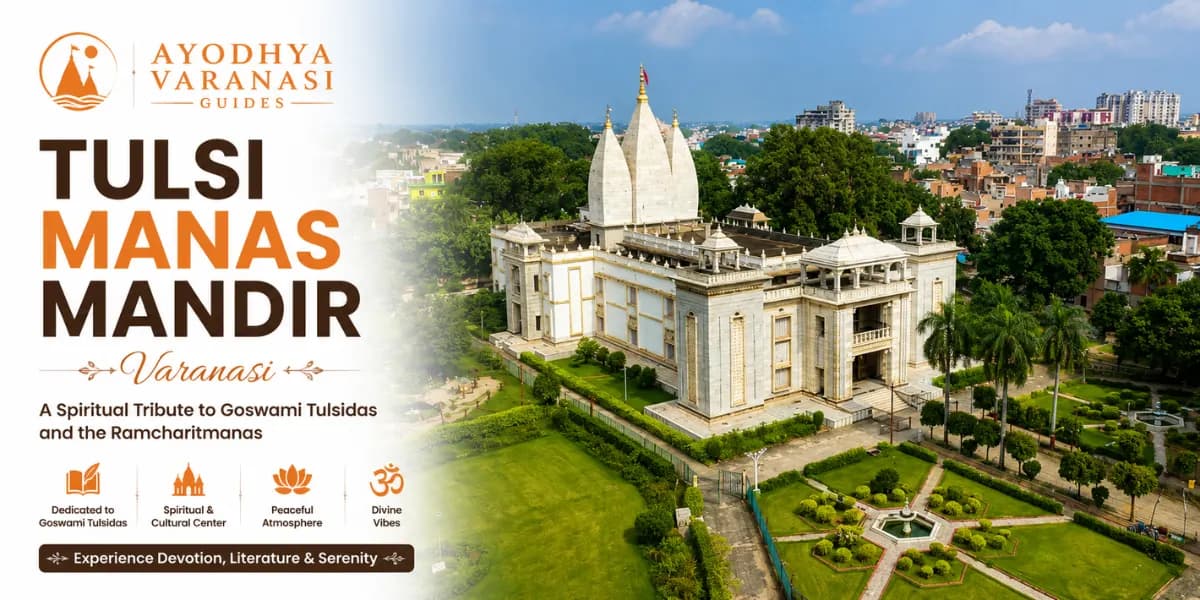
Tulsi Manas Mandir
Varanasi · Where Tulsidas Wrote the Manas
4.9 / 5 · Kashi Darshan Help
Temples · Ghats · Aarti
- Timings
- 5:30 AM–12:00 PM & 3:30 PM–9:00 PM
- Famous For
- The entire Ramcharitmanas inscribed in marble
- Deities
- Lord Ram, Sita and Lakshman
- Built
- 1964, by the Birla family, in white marble
- Entry
- Free · no ticket required
- Location
- Durgakund, near Durga Mandir, Varanasi
What Are the Tulsi Manas Mandir Timings?
Tulsi Manas Mandir is open 5:30 AM to 12:00 PM and 3:30 PM to 9:00 PM, with a break through the early afternoon. Entry is free and there is no queue. Allow 30 to 45 minutes — the darshan takes minutes, but the walls are the reason to come, and visitors who start reading them tend to stay far longer than they planned.
Morning (Best)
Cool marble; quiet and unhurried
Afternoon Break
Temple closed
Evening
Pleasant; pairs with the Durgakund cluster
Darshan
Ram, Sita and Lakshman in the sanctum
The Inscribed Walls
All seven kandas, with murals
The Ramayana Displays
Animated scenes; check availability
Total Visit
Combine with Durga Kund and ISKCON
Tip: if you have also visited Valmiki Bhawan in Ayodhya, where the whole Valmiki Ramayana is inscribed in marble, this is its counterpart — the Sanskrit epic in one city, the Awadhi retelling in the other. Ask your guide to tie the two together. WhatsApp us to plan both.
When Is the Best Month to Visit Tulsi Manas Mandir? (2026)
The temple is indoors, cool and rarely crowded, so it is comfortable year-round. October to March is the pleasant window across Varanasi, and Ram Navami is the most fitting day to visit.
Ram Navami and the Dussehra Ramlila season carry particular meaning at a temple built around the Ramcharitmanas. Otherwise it stays comfortably uncrowded all year.
Why Is the Whole Ramcharitmanas Written on These Walls?
What Is Tulsi Manas Mandir?
Tulsi Manas Mandir is a white marble temple at Durgakund in south Varanasi, dedicated to Lord Ram and built around a single idea: that the Ramcharitmanas itself should be the substance of the building. Its walls carry the complete text of the epic, inscribed in marble and illustrated with murals.
Why Was It Built Here?
Because of what happened on this ground. It is believed to stand at the site where Goswami Tulsidas composed the Ramcharitmanas in the 16th century. Tulsidas began the work in Ayodhya on Ram Navami and completed it in Varanasi — and this is the spot the city associates with that composition.
Who Built the Temple?
The temple was constructed in 1964 by the Birla family, in the white marble that marks all their temples. It is one of three Birla temples a visitor to this region can see: this one, the New Vishwanath Temple at BHU a few kilometres away, and the Ram Janaki Birla Temple in Ayodhya. All three are free, spacious and open to everybody.
What Exactly Is on the Walls?
The entire Ramcharitmanas — all seven kandas, from the Bal Kanda through to the Uttar Kanda — inscribed into the marble and accompanied by vivid murals depicting the scenes. You do not read about the epic here; you walk through the text of it, chapter by chapter, in the order Tulsidas wrote it.
Who Was Tulsidas?
Goswami Tulsidas composed the Ramcharitmanas in Awadhi, the spoken language of the region, rather than in Sanskrit — and in doing so put the story of Lord Ram into the mouths and homes of ordinary north India. He also founded the Sankat Mochan temple, a short ride from here. Between the two, this quarter of Varanasi is his.
What Are the Animated Ramayana Displays?
The temple is also known for animated model displays depicting scenes from the Ramayana, usually on an upper floor — moving figures that tell episodes of the story. They are a favourite with children, and a small charge or restricted hours may apply, so ask at the temple on the day.
Did you know? There is a matching temple in Ayodhya — Valmiki Bhawan, where all 24,000 verses of the Sanskrit Valmiki Ramayana are inscribed in marble. Between the two cities you can walk through both great tellings of the Ramayana, each carved into stone.
What Do You Actually See at Tulsi Manas Mandir?
A calm, unhurried visit with no queue — and one that rewards reading rather than glancing.
- 1
Reach Durgakund
The temple is on Durgakund Road, a few hundred metres from the Durga Mandir and the ISKCON temple. Vehicles reach the gate directly.
- 2
Leave Footwear at the Entrance
Racks are provided. The marble floors are cool underfoot for most of the year.
- 3
Have Darshan of Ram, Sita and Lakshman
The sanctum holds the deities at the heart of the epic whose text surrounds you.
- 4
Start at the Bal Kanda
The Ramcharitmanas runs in sequence around the walls. Begin at the first kanda rather than wandering, and the whole thing reads as a journey.
- 5
Walk the Seven Kandas
From the Bal Kanda through to the Uttar Kanda, inscribed in marble and illustrated with murals as you go.
- 6
Find a Verse You Know
Most Indian visitors stop here. Almost everyone can recite something from the Manas, and finding it cut into the wall is the moment people remember.
- 7
Ask About the Animated Displays
Moving Ramayana scenes are usually shown on an upper floor. Hours and any charge vary, so check at the temple.
- 8
Walk On to Durga Kund and ISKCON
Both are five minutes away, and Sankat Mochan — founded by Tulsidas himself — is a short ride.
When Should You Visit Tulsi Manas Mandir?
Indoors and cool, so this is really about the afternoon closure and where it sits in your cluster.
Best Time of Day — Morning
Between 5:30 and 11 AM the marble is cool, the temple is quiet and you have time to read the walls properly before the midday closure.
Best Season — October to March
Comfortable for the whole Durgakund cluster. That said, the marble interior is a genuine refuge in May and June when the rest of Varanasi is punishing.
Most Fitting — Ram Navami
Ram Navami, in March or April, is the most appropriate day to stand inside the Ramcharitmanas. The Dussehra and Ramlila season in October also fills the city.
What Can You See at Tulsi Manas Mandir?
One extraordinary feature, and a building designed entirely around it.
The Ramcharitmanas in Marble
Top PickAll Seven Kandas
The complete text of Tulsidas's epic inscribed into the temple walls, from the Bal Kanda to the Uttar Kanda, accompanied by murals of the scenes.
The Ram, Sita & Lakshman Sanctum
Top PickThe Darshan
The deities at the centre of the epic, in the temple built at the site where its author composed it.
The Murals
The Epic Illustrated
Vivid painted scenes accompanying the inscribed verses, following the story through its seven chapters.
The Animated Ramayana Displays
Popular With Children
Moving model scenes from the Ramayana, usually on an upper floor. Hours and any charge vary — ask on the day.
The White Marble Interior
Cool and Calm
Spacious, clean and quiet, with none of the crush of the old city — and a genuine escape from the heat in summer.
Why Is Tulsi Manas Mandir Worth Half an Hour?
Most visitors put their head in and leave in five minutes. Here is what they miss.
You Walk Through the Epic
Not a display about the Ramcharitmanas — the actual text, complete, surrounding you in marble. Nothing else in Varanasi does this.
The Ground Where It Was Written
Tulsidas composed the Manas at this site. Standing inside his own words, on his own ground, is a rare kind of visit.
Children Actually Enjoy It
The animated Ramayana displays and the murals hold young attention far better than another sanctum queue.
Five Minutes From Durga Kund
It sits in the most walkable temple cluster in Varanasi, so it costs you almost nothing to add.
Is There an Entry Fee at Tulsi Manas Mandir? (2026)
Entry and darshan are completely free — no ticket and no queue. The only thing that may carry a small charge is the animated Ramayana display, so ask at the temple on the day.
The temple costs nothing. What we add is the context and the cluster — a guide who can point you to the verses that matter and explain the Tulsidas thread running through Varanasi and Ayodhya, plus a route that covers Durga Kund, ISKCON, Tridev and Sankat Mochan in the same outing. Pricing confirmed in writing.
Charges for the animated displays and their operating hours are set by the temple and can change. Ask at the entrance.
What Do Visitors Say About Tulsi Manas Mandir?
1,263 verified reviews
I have recited the Manas every morning for forty years. To find the whole of it cut into marble, in the place Tulsidas wrote it, was overwhelming. I stood at the Sundar Kanda for a long time.
Krishna Kumar Mishra
Gorakhpur
We had seen Valmiki Bhawan in Ayodhya with the Sanskrit Ramayana in marble, and our guide pointed out this is the Awadhi counterpart. Two epics, two cities, both in stone. Lovely connection.
Aparna Deshmukh
Nashik
Local here. Everyone visits Durga Kund and walks past this one. The murals and the seven kandas are worth an hour. Our children loved the moving Ramayana models upstairs.
Rakesh Jaiswal
Varanasi
Beautifully cool marble in the middle of a hot Varanasi day, completely calm and free. Do go in the morning — the afternoon closure caught us out on the first attempt.
Sunita Agarwal
Bhopal
Fascinating even if you cannot read the script — the murals tell the story clearly and our guide translated key verses. A welcome change of pace from the ghats.
Michael Brennan
Dublin
How Do You Fit Tulsi Manas Mandir Into a Kashi Day?
It belongs in the Durgakund cluster, which is best done as one continuous block. Here is the day we plan.
Sunrise boat ride on the Ganga. Begin on the water for first light along the ghats.
Kashi Vishwanath darshan. Darshan of the Jyotirlinga at Shri Kashi Vishwanath Dham. We assist with VIP darshan to save you the queue.
Vishalakshi & Mrityunjay Mahadev. The Shakti Peetha at Mir Ghat and the healing well at Daranagar.
Sankat Mochan Hanuman Temple. The temple Tulsidas founded. Leave phones and bags in the vehicle.
Durga Kund Temple. The red temple and its sacred tank, a short ride away.
Tulsi Manas Mandir & ISKCON. The Ramcharitmanas in marble, and the Radha Gopal Bihari temple five minutes away. Beat the noon closure.
Ganga Aarti at Dashashwamedh Ghat. Close the day with the great evening aarti on the riverfront.
Which Tour Package Covers Tulsi Manas Mandir?
Tulsi Manas Mandir is best seen as part of a planned Kashi darshan rather than a single stop — the old-city temples keep different hours and the ghats reward proper sequencing. These are the itineraries our guests book most, each with Kashi Vishwanath VIP darshan assistance, a certified local guide and transport, priced in writing before you travel.
- 1 Day1 Day Varanasi Tour PackageKashi Vishwanath darshan, a sunrise boat ride and the evening Ganga Aarti.
- 2 Days2 Days Varanasi Tour PackageKashi Vishwanath, the ghats, Sarnath and the old-city temple circuit.
- 3 Days3 Days Varanasi Tour PackageKashi at a proper pace — the Dham, the Bhairavs, the Durgakund cluster and the aarti.
- 4 Days4 Days Varanasi Tour PackageEverything in Kashi plus Sarnath, with time for the temples most itineraries skip.
- 2 Days2 Days Ayodhya Varanasi Tour PackageRam Mandir and Kashi Vishwanath across two cities, with the Ganga Aarti.
- 3 Days3 Days Ayodhya Varanasi Tour PackageThe classic pairing — Ram Mandir, Kashi Vishwanath and the ghats.
- 3 Days3 Days Varanasi Prayagraj Tour PackageKashi and the confluence, with time for the ghats and the Sangam boat ride.
- 4 Days4 Days Ayodhya Varanasi Prayagraj Tour PackageAll three cities — Ram Mandir, Kashi Vishwanath and the Triveni Sangam.
- 5 Days5 Days Ayodhya Varanasi Prayagraj Tour PackageThe complete sacred circuit at a comfortable, senior-friendly pace.
Want Tulsi Manas Mandir built into a custom itinerary? We plan around your dates, your pace and what you actually want to see.
See all Varanasi & Ayodhya tour packagesHow Do You Reach Tulsi Manas Mandir?
The temple is on Durgakund Road in south Varanasi, a few hundred metres from the Durga Mandir. It is on a main road, so vehicles reach the gate directly.
By Road / Taxi
The simplest option. Durgakund Road is a main route and taxis and autos drop you at the temple gate with no lanes to negotiate.
By Train
Banaras station is about 3 km away and Varanasi Junction (Cantt) roughly 7 km. Both connect to Delhi, Lucknow, Prayagraj and Ayodhya.
By Air
Lal Bahadur Shastri International Airport, Babatpur is around 30 km away, with taxis at the terminal. Allow over an hour in traffic.
The Last Mile
E-rickshaws run constantly along Durgakund Road. Ask for Tulsi Manas Mandir or Durga Mandir — the two are a few hundred metres apart.
Where Is Tulsi Manas Mandir Located in Varanasi?
Tulsi Manas Mandir stands on Durgakund Road in south Varanasi, a few hundred metres from the Durga Mandir and the ISKCON temple. Use the map below to navigate.
Varanasi
- Area: Durgakund Road, south Varanasi
- PIN: Varanasi 221005
- From Durga Kund Temple: ~500 m
- From Kashi Vishwanath: ~5 km
- Built: 1964, by the Birla family
Where Should You Stay Near Tulsi Manas Mandir?
The Durgakund and Lanka quarter is the natural base for this cluster of temples.
Durgakund & Bhelupur
Quiet residential streets with guesthouses and mid-range hotels, walking distance from Tulsi Manas, Durga Kund and ISKCON.
Assi Ghat & Ravidas Gate
The calmer southern end of the ghats, about 10 minutes away, with cafés and its own sunrise boat boarding point.
Godowlia & Dashashwamedh
The heart of Kashi, walking distance from Kashi Vishwanath and the evening Ganga Aarti, about 30 minutes from Durgakund.
What Else Can You Visit Near Tulsi Manas Mandir?
Several significant temples sit within a five-minute walk — the most efficient temple hour in Varanasi.
Durga Kund Temple
The red 18th-century Durga temple beside its sacred tank, with a swayambhu idol. ~500 m.
ISKCON Temple, Varanasi
Sri Sri Radha Gopal Bihari on Durgakund Road — daily kirtan and free prasadam. ~500 m.
Tridev Temple
The temple to Brahma, Vishnu and Mahesh, with shrines of Maa Sati and Khatu Shyam. ~300 m.
Sankat Mochan Temple
The Hanuman temple founded by Tulsidas himself, ~1.5 km away. Note the no-phone rule.
New Vishwanath Temple (BHU)
The other Birla temple in Varanasi, with the tallest temple shikhar in the world.
Valmiki Ashram, Ayodhya
The matching temple in Ayodhya, where the whole Sanskrit Valmiki Ramayana is inscribed in marble.
Ram Navami & the Ramlila Season at Tulsi Manas Mandir
Ram Navami, in March or April, is the most fitting day of the year to visit a temple built around the Ramcharitmanas. The temple is decorated, recitation of the Manas fills the halls, and devotees come to read the very verses they have recited all their lives cut into the marble around them.
The Dussehra and Ramlila season in September and October brings the whole of Varanasi’s Ram tradition alive, and the city’s famous Ramnagar Ramlila runs at that time. Dev Deepawali in November lights the riverfront. Book accommodation early for any of these.
What Should You Know Before Visiting Tulsi Manas Mandir?
An easy visit, and a few things will get you much more out of it.
Mind the noon to 3:30 PM closure
The temple shuts through the early afternoon. Come before noon or after 3:30 — this catches out more visitors than anything else.
Allow half an hour, not five minutes
The darshan is quick; the seven kandas on the walls are the reason to come. Most people who start reading stay far longer than planned.
Start at the Bal Kanda
The text runs in sequence around the walls. Beginning at the first chapter rather than wandering makes the whole circuit read as a journey.
Ask about the animated displays
The moving Ramayana model scenes are usually upstairs, with their own hours and possibly a small charge. Ask at the entrance rather than assuming.
Good for children
The murals and the animated displays hold young attention far better than another sanctum. One of the more child-friendly stops in Varanasi.
It is a cool refuge in summer
The marble interior is genuinely comfortable in May and June, when the ghats and lanes are punishing.
Combine it with the whole cluster
Durga Kund, ISKCON and Tridev are all within five minutes on foot, and Sankat Mochan is a short ride. One outing covers the lot.
Pair it with Valmiki Bhawan in Ayodhya
If your trip covers both cities, the Sanskrit Ramayana is in marble there and the Awadhi Manas is in marble here. Ask your guide to connect them.
Vehicles reach the gate
It is on a main road with no lanes to walk — useful with elderly family members.
Dress modestly
Standard temple etiquette applies, with footwear removed at the entrance.
Tulsi Manas Mandir Varanasi — Frequently Asked Questions
The questions visitors ask us most about Tulsi Manas Mandir — the inscribed walls, timings, entry, the animated displays and the Tulsidas connection.
Tulsi Manas Mandir is a white marble temple at Durgakund in Varanasi, built by the Birla family in 1964 at the site where Goswami Tulsidas is believed to have composed the Ramcharitmanas. The entire epic is inscribed on its walls.
Still have a question?
Our local team replies within 30 minutes.
Written & verified by the local Varanasi guide team at Ayodhya Varanasi Guides
Our government-certified Kashi guides walk the Durgakund temple cluster with visitors every week and connect the Tulsidas thread running from Ayodhya to Varanasi. Last updated: July 2026. The animated display hours and any charges are set by the temple and can change — message us and we will check ahead for your travel date.
Walk Through the Whole Ramcharitmanas at Tulsi Manas Mandir
Let Ayodhya Varanasi Guides plan your Kashi darshan — Tulsi Manas, Durga Kund, ISKCON and Sankat Mochan in a single morning, with Kashi Vishwanath VIP darshan assistance and the evening Ganga Aarti — and a guide who can connect Tulsidas across both Ayodhya and Varanasi. Confirmed in writing.