
Valmiki Ashram, Ayodhya — Valmiki Bhawan, Timings & Visitor Guide
The site known in Ayodhya as the Valmiki Ashram is Valmiki Bhawan (Valmiki Ramayan Bhawan) at Karsewakpuram, a temple dedicated to Maharishi Valmiki, the Adi Kavi and author of the Ramayana. Its extraordinary feature is that all 24,000 verses of the Valmiki Ramayana are inscribed on marble across its walls — the entire epic, in stone, in one building. The sanctum holds an image of Valmiki. Entry is free, it is open roughly 9 AM to 6 PM, and it is about 3 km from Ayodhya railway station. Note that Valmiki’s original ashram, where Sita took refuge, is traditionally placed at Bithoor near Kanpur, not in Ayodhya.
- Timings
- ~9:00 AM – 6:00 PM daily
- Famous For
- 24,000 Ramayana verses in marble
- Entry
- Free · no ticket
- Location
- Karsewakpuram, Ayodhya
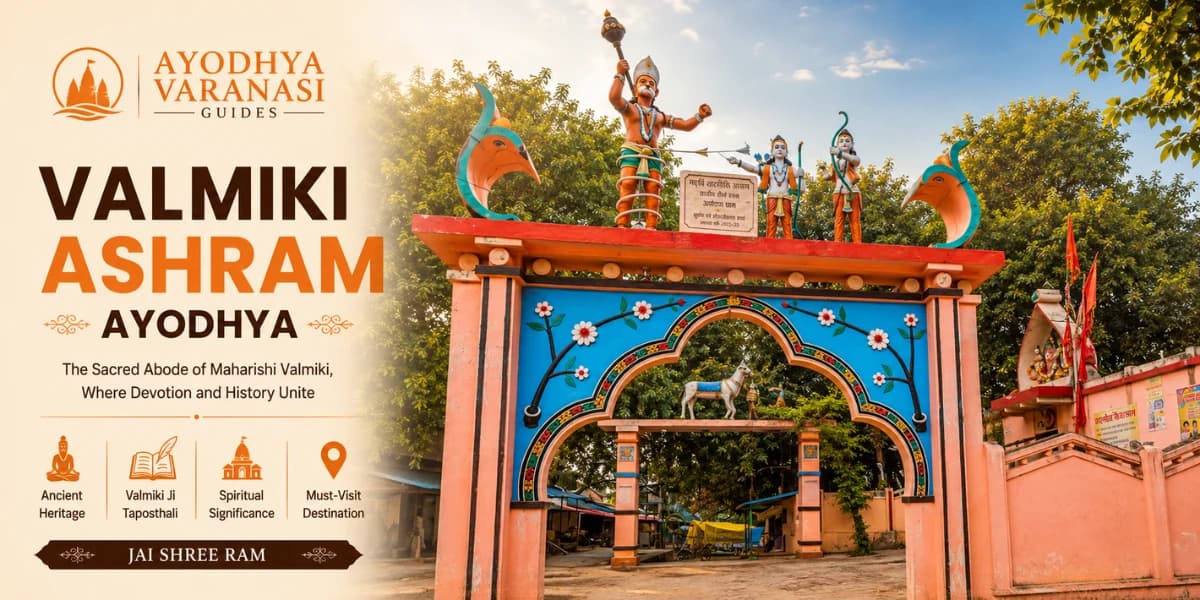
Valmiki Bhawan
Ayodhya · The Ramayana Written in Stone
4.9 / 5 · Ayodhya Darshan Help
Heritage · Ram Mandir
- Timings
- ~9:00 AM – 6:00 PM, daily
- Famous For
- All 24,000 Ramayana shlokas in marble
- Dedicated To
- Maharishi Valmiki, the Adi Kavi
- Also Known As
- Valmiki Bhawan · Valmiki Ramayan Bhawan
- Entry
- Free · no ticket required
- Location
- Karsewakpuram, ~3 km from Ayodhya Dham Junction
What Are the Valmiki Bhawan Timings?
Valmiki Bhawan keeps daytime hours, roughly 9:00 AM to 6:00 PM, and unlike most Ayodhya temples it does not close for a long midday break — which makes it a useful stop in the middle of the day when the rest of the city’s shrines are shut. Entry is free. Allow 30 to 45 minutes: less if you only want darshan, more if you actually want to read the walls.
Morning
Quiet and cool; the best light inside
Midday (Useful)
Open when most Ayodhya temples are closed
Evening
Pleasant; arrive by 5:15 to have time
Darshan of Valmiki
The sanctum image of the Adi Kavi
Reading the Walls
The inscribed verses of the epic
Total Visit
Easy to combine with Ram Ki Paidi
Tip: Valmiki Bhawan is one of the few places in Ayodhya that stays open through the midday hours, when the Ram Mandir and Ramkot temples are closed. We use it to fill exactly that gap in the day. WhatsApp us and we will slot it into your Ayodhya itinerary.
When Is the Best Month to Visit Valmiki Bhawan? (2026)
The building is indoors and comfortable in any weather, so this is one Ayodhya stop the season barely affects. October to March is pleasant across the city, and Valmiki Jayanti in October is the special day here.
Valmiki Jayanti (Ashwin Purnima, usually October) is the main day of the year here. Deepotsav fills all of Ayodhya at around the same season.
Who Was Maharishi Valmiki — and What Is Valmiki Bhawan?
What Is Valmiki Bhawan?
Valmiki Bhawan, also called the Valmiki Ramayan Bhawan, is a temple at Karsewakpuram in Ayodhya dedicated to Maharishi Valmiki. Its sanctum holds an image of the sage, but the building itself is the real marvel: the entire Valmiki Ramayana — all 24,000 verses — is inscribed on marble across its walls. You walk through the epic rather than reading it from a book.
Who Was Maharishi Valmiki?
Valmiki is the Adi Kavi — the first poet. He composed the Ramayana, the earliest of the two great Sanskrit epics, and in doing so gave the story of Lord Ram the form in which the world has known it for millennia. Every retelling since, from Tulsidas to television, descends from what this one sage wrote.
What Is the Story of Ratnakar?
Tradition tells that Valmiki began life as Ratnakar, a highwayman. Confronted by sages who asked whether his family would share the burden of his sins as they shared his plunder — and finding they would not — he was shattered, and turned to meditation so complete that an anthill grew over him. He emerged as Valmiki, from valmika, an anthill. It is one of the great transformation stories in Indian tradition.
How Did the First Shloka Come About?
Walking by a river, Valmiki saw a hunter shoot one of a pair of krauncha birds in the moment of their courtship. The surviving bird’s grief tore through him, and what came out of his mouth was a curse — but it emerged in perfect metre. That utterance, ma nishada, is held to be the first shloka of Sanskrit poetry. Poetry itself, in this telling, was born out of compassion for grief — and from that verse came the whole Ramayana.
Where Was Valmiki’s Actual Ashram?
This is the question visitors most often arrive with, so it is worth answering plainly. The ashram of the Ramayana — where Sita took refuge after leaving Ayodhya, where Luv and Kush were born and raised, and where the boys learned the epic from Valmiki himself — is traditionally placed at Bithoor, near Kanpur, not in Ayodhya. Valmiki Bhawan is a temple honouring the sage in Ayodhya, not the site of his hermitage. Both are worth visiting; they are simply different places.
What Is the Ayodhya Connection?
It is a deep one even so. Valmiki gave Ayodhya its story, and it was in Ayodhya that Luv and Kush recited the Ramayana before Lord Ram himself — the sons singing their father’s life back to him without either side knowing who the other was, one of the most extraordinary scenes in world literature. The city’s airport, Maharishi Valmiki International Airport, Ayodhya Dham, is named for him.
Did you know? The Sanskrit word shloka is traditionally linked to shoka, meaning grief — because the first verse ever composed came out of Valmiki’s sorrow at the killing of a bird. Poetry, in this understanding, begins with compassion.
What Do You Actually See at Valmiki Bhawan?
A calm, unhurried visit with no queue and nothing you are required to do. Here is how it unfolds.
- 1
Reach Karsewakpuram
Valmiki Bhawan is about 3 km from Ayodhya Dham Junction, on the Mani Ramdas Ji Ki Chhawni road. Autos and e-rickshaws reach it easily.
- 2
Leave Footwear at the Entrance
Shoes come off outside, as at any temple. The marble floors inside are kept clean and cool.
- 3
Have Darshan of Maharishi Valmiki
The sanctum holds an image of the Adi Kavi — a rare thing in itself, as few temples anywhere are dedicated to a poet.
- 4
Walk the Inscribed Walls
This is the reason to come. All 24,000 verses of the Ramayana are cut into marble around you — take the time to actually walk the whole circuit.
- 5
Find a Verse You Know
If you read Sanskrit or Hindi, look for a passage you recognise. Visitors often spend longer here than they expected once they start reading.
- 6
Sit for a While
It is quiet, cool and almost never crowded. One of the few places in Ayodhya where you can simply sit without being moved along.
- 7
Continue to Ram Ki Paidi
The Saryu ghats are close by, and the evening aarti is the natural next stop if you have visited in the late afternoon.
When Should You Visit Valmiki Bhawan?
It is indoors and comfortable year-round, which makes it one of the most flexible stops in Ayodhya — and unusually useful at the wrong time of day for everywhere else.
Best Time of Day — Midday
This is genuinely the smart slot. Most Ayodhya temples close between 12 and 4 PM, but Valmiki Bhawan stays open — so it fills the dead hour in your itinerary perfectly, and the marble interior is cool.
Best Season — October to March
Comfortable weather across the city for the wider Ayodhya circuit. That said, the building itself is pleasant even in May and June, which is more than can be said for the rest of the town.
Most Special — Valmiki Jayanti
Valmiki Jayanti, on Ashwin Purnima in October, honours the Adi Kavi and is the main observance here. Deepotsav lights up all of Ayodhya around the same season.
What Can You See at Valmiki Bhawan?
A compact site with one truly remarkable feature. Here is what to look for.
The 24,000 Inscribed Verses
Top PickThe Whole Ramayana in Marble
Every verse of the Valmiki Ramayana cut into marble across the walls of the building — an act of devotion on a scale that is hard to grasp until you stand inside it.
The Sanctum Image of Valmiki
Top PickThe Adi Kavi
The image of Maharishi Valmiki in the sanctum — a temple dedicated to a poet, which is rare almost anywhere in the world.
The Marble Interior
Cool and Calm
Clean, quiet, air-cooled by the stone and almost never crowded. One of the most restful interiors in Ayodhya.
The Ramayana Kanda by Kanda
Follow the Story
The verses run in sequence, so you can trace the epic from the Bala Kanda through to the end as you walk the circuit.
Karsewakpuram
The Setting
A quiet quarter of Ayodhya away from the main temple crush, within easy reach of Ram Ki Paidi and the Ram Janmabhoomi.
Why Is Valmiki Bhawan Worth Half an Hour?
It rarely appears on Ayodhya itineraries. Here is what visitors say made it worthwhile.
You Walk Through the Epic
Not a museum display about the Ramayana — the actual text, all of it, surrounding you in stone. Nothing else in Ayodhya does this.
A Temple to a Poet
Shrines to gods are everywhere. A temple honouring the man who wrote the story is something else entirely.
Open When Everything Else Is Shut
The midday hours in Ayodhya are dead time. This is the one stop that solves them.
Quiet in a Crowded City
Cool marble, few visitors and somewhere to sit. A genuine relief in the middle of a heavy darshan day.
Is There an Entry Fee at Valmiki Bhawan? (2026)
Entry to Valmiki Bhawan is completely free — there is no ticket and no queue. The only cost involved is getting there.
The visit costs nothing. What we add is context and sequencing — a guide who can tell you the Ratnakar story and the origin of the first shloka while you stand among the verses, and an itinerary that uses Valmiki Bhawan to fill the midday hours when the rest of Ayodhya is closed. Pricing confirmed in writing.
Auto and e-rickshaw fares are indicative and vary with season and distance.
What Do Visitors Say About Valmiki Bhawan?
1,038 verified reviews
I have read the Ramayana all my life and never imagined seeing the whole of it written on walls. I stood there reading for forty minutes. My family had to come and find me.
Shyam Sundar Mishra
Prayagraj
Our guide brought us here at 1 PM when the Ram Mandir and Kanak Bhawan were closed. Clever planning — cool marble, quiet, and genuinely interesting. It saved a dead hour in the day.
Anjana Kulkarni
Nashik
The story of how Valmiki became Valmiki, told standing in his temple, was the best twenty minutes of our Ayodhya trip. My teenagers actually listened, which never happens.
Devendra Pal
Ludhiana
We came looking for Valmiki's ashram and learned it is actually at Bithoor near Kanpur. Our guide explained it honestly instead of pretending. The Bhawan itself was still very much worth visiting.
Kalpana Reddy
Hyderabad
Peaceful and unusual — a temple to a poet. It is a short visit, maybe half an hour, so treat it as an addition rather than a main stop. Free entry and easy to reach.
Sanjeev Bhatia
Gurugram
How Do You Fit Valmiki Bhawan Into an Ayodhya Day?
Because it stays open through the midday closure, Valmiki Bhawan slots into the exact hour when the rest of Ayodhya shuts. This is the day we plan around it.
Hanuman Garhi darshan. Begin with the guardian of Ayodhya, as tradition asks, before Ram Lalla.
Ram Janmabhoomi (Ram Lalla). Darshan at the Ram Mandir. We assist with Sugam (VIP) Darshan so you are not queuing for hours.
Kanak Bhawan & Sita Ki Rasoi. The Ramkot cluster — the golden palace and the sacred kitchen of Goddess Sita.
Valmiki Bhawan. The perfect midday stop, open when the Ramkot temples close. Cool marble and the whole Ramayana on the walls.
Lunch & rest. A break through the hottest part of the afternoon.
Mani Parvat & Sugriv Qila. The ancient mounds, with the best panorama over Ayodhya from the top.
Saryu Aarti at Ram Ki Paidi. Close the day on the riverfront with the evening aarti.
Which Tour Package Covers Valmiki Bhawan?
Most visitors reach Valmiki Bhawan as part of a wider Ayodhya darshan rather than as a trip of its own. These are the itineraries our guests book most — each one includes Ram Mandir darshan with Sugam (VIP) assistance, a certified local guide, comfortable transport and pricing confirmed in writing before you travel.
- 1 Day1 Day Ayodhya Tour PackageRam Mandir darshan, Hanuman Garhi and the Saryu Aarti in a single day.
- 2 Days2 Days Ayodhya Tour PackageThe full Ramkot temple circuit at an unhurried pace, with an evening on the Saryu.
- 3 Days3 Days Ayodhya Tour PackageAyodhya in depth — the temples, the mounds, Guptar Ghat and the lesser-known shrines.
- 2 Days2 Days Ayodhya Varanasi Tour PackageRam Mandir and Kashi Vishwanath across two cities, with the Ganga Aarti.
- 3 Days3 Days Ayodhya Varanasi Tour PackageThe classic pairing — Ram Mandir, Kashi Vishwanath and the ghats.
- 3 Days3 Days Ayodhya Prayagraj Tour PackageRam Mandir darshan with the Triveni Sangam snan.
- 4 Days4 Days Ayodhya Varanasi Prayagraj Tour PackageAll three cities — Ram Mandir, Kashi Vishwanath and the Triveni Sangam.
- 5 Days5 Days Ayodhya Varanasi Prayagraj Tour PackageThe complete sacred circuit at a comfortable, senior-friendly pace.
Want Valmiki Bhawan built into a custom itinerary? We plan around your dates, your pace and what you actually want to see.
See all Ayodhya & Varanasi tour packagesHow Do You Reach Valmiki Bhawan in Ayodhya?
Valmiki Bhawan is at Karsewakpuram, about 3 km from Ayodhya Dham Junction, on the Mani Ramdas Ji Ki Chhawni road. It is easy to reach from anywhere in the city.
By Air
Maharishi Valmiki International Airport, Ayodhya Dham — named after the sage himself — is roughly 11 km away, with taxis at the terminal.
By Train
Ayodhya Dham Junction is about 3 km away. Ram Ghat Halt is the nearest station of all, within walking distance of the Bhawan.
By Road / Taxi
Ayodhya sits on NH-27 and the new Ram Path — about 135 km from Lucknow, 200 km from Varanasi and 165 km from Prayagraj.
The Last Mile
Autos and e-rickshaws reach Karsewakpuram directly and can drop you at the gate. Ask for Valmiki Bhawan or Valmiki Ramayan Bhawan.
Where Is Valmiki Bhawan Located in Ayodhya?
Valmiki Bhawan stands at Karsewakpuram in Ayodhya, on the Mani Ramdas Ji Ki Chhawni road, close to Ram Ghat Halt and about 1.5 km from Ram Ki Paidi. Use the map below to navigate.
Ayodhya
- Area: Karsewakpuram, Ayodhya
- PIN: Ayodhya 224123
- From Ayodhya Dham Junction: ~3 km
- Nearest halt: Ram Ghat Halt (walking distance)
- Known for: 24,000 Ramayana verses in marble
Where Should You Stay Near Valmiki Bhawan?
Karsewakpuram is central, so most Ayodhya stays put the Bhawan within a short ride. These are the areas we recommend.
Naya Ghat & Ram Ki Paidi
Riverside guesthouses and hotels about 1.5 km away, within easy reach of both Valmiki Bhawan and the evening Saryu Aarti.
Ramkot & Ram Path
Stays near the Ram Janmabhoomi, Hanuman Garhi and Kanak Bhawan — ideal if early-morning Ram Lalla darshan is your priority.
Ayodhya Dham / Faizabad
Branded and mid-range hotels with more space, parking and dining, 10–20 minutes away by taxi.
What Else Can You See Near Valmiki Bhawan?
Karsewakpuram sits close to Ayodhya's riverfront and mound cluster. Here is what to combine with your visit.
Ram Ki Paidi & Saryu Aarti
The great riverfront steps on the Saryu, ~1.5 km away, and the setting for the evening aarti.
Mani Parvat
The 65-foot sacred mound linked to Hanuman's Sanjeevani mountain, with the best views over the city.
Ram Mandir (Ram Janmabhoomi)
The grand temple of Ram Lalla, ~2 km away. We assist with Sugam (VIP) Darshan to skip the queue.
Nageshwarnath Temple
The ancient Shiva temple of Ayodhya, said to be built by Kush, son of Lord Ram — near Ram Ki Paidi.
Tulsi Smarak Bhawan
The Tulsidas memorial ~1.5 km away, with a free Ramlila performed every evening from 6 to 9 PM.
Guptar Ghat
The tranquil ghat where Lord Ram is believed to have taken Jal Samadhi, about 9 km away on the Saryu.
Valmiki Jayanti at Valmiki Bhawan
Valmiki Jayanti — also called Pragat Diwas — falls on Ashwin Purnima, usually in October, and honours the birth of the Adi Kavi. It is the main observance of the year at Valmiki Bhawan, with recitation, processions and special puja, and it carries particular meaning in the city whose story Valmiki gave to the world.
Deepotsav around Diwali falls in the same season and lights up all of Ayodhya, while Ram Navami brings the city’s biggest crowds in March or April. Book transport and accommodation early for any of these dates.
What Should You Know Before Visiting Valmiki Bhawan?
A simple visit, but a few things are worth knowing before you arrive.
This is not Valmiki's original ashram
The ashram where Sita took refuge and Luv and Kush were born is traditionally at Bithoor near Kanpur. Valmiki Bhawan is a temple honouring the sage in Ayodhya — worth visiting, but a different place.
Use it for the midday gap
It stays open when the Ram Mandir and Ramkot temples close between roughly 12 and 4 PM. This is the single best reason to know about it.
Allow more time than you think
Most people plan fifteen minutes and stay forty once they start reading the walls. Half an hour to forty-five minutes is realistic.
Ask for the Ratnakar story
How a highwayman became the first poet, and how the first shloka came out of grief for a bird — both told standing among the verses. It transforms the visit.
Closes by around 6 PM
Arrive by 5:15 at the latest if you want time inside. It does not have late evening hours like the ghat temples.
Footwear off at the entrance
Standard temple etiquette applies, and the marble floors are kept clean.
It is very quiet
Rarely crowded outside Valmiki Jayanti. If the Ram Mandir queues have worn you down, this is a genuine break.
Good for children and elderly visitors
Level access, cool interiors, somewhere to sit and no queues — one of the easiest stops in Ayodhya for family groups.
Photography rules vary
Follow the staff's guidance, particularly around the sanctum image.
Combine it with Ram Ki Paidi
The Saryu ghats are 1.5 km away, which makes a late-afternoon visit followed by the evening aarti a natural pairing.
Valmiki Ashram / Valmiki Bhawan Ayodhya — Frequently Asked Questions
The questions visitors ask us most about Valmiki Bhawan — the inscribed verses, timings, where Valmiki's actual ashram is, and how to include it in an Ayodhya trip.
Valmiki Bhawan, also called the Valmiki Ramayan Bhawan, is a temple at Karsewakpuram in Ayodhya dedicated to Maharishi Valmiki, the author of the Ramayana. Its remarkable feature is that all 24,000 verses of the Valmiki Ramayana are inscribed on marble across its walls.
Still have a question?
Our local team replies within 30 minutes.
Written & verified by the local Ayodhya guide team at Ayodhya Varanasi Guides
Our government-certified guides bring visitors to Valmiki Bhawan through the year, and regularly explain the difference between this temple and Valmiki’s traditional ashram at Bithoor. This guide is written from that first-hand experience. Last updated: July 2026. Opening hours can change on festival days — message us for the position on your travel date.
Walk Through the Whole Ramayana at Valmiki Bhawan
Let Ayodhya Varanasi Guides plan a complete Ayodhya darshan — Valmiki Bhawan with all 24,000 verses in marble, the Ram Mandir with Sugam Darshan assistance, the Ramkot temples, the ancient mounds and the evening Saryu Aarti — with a knowledgeable local guide and comfortable transport, confirmed in writing.