
Tulsi Smarak Bhawan, Ayodhya — Daily Ramlila, Museum & Visitor Guide
Tulsi Smarak Bhawan is the memorial to Goswami Tulsidas, the poet-saint who composed the Ramcharitmanas — and it is the best free evening in Ayodhya. A Ramlila is performed here every single day from 6:00 to 9:00 PM, not only during the festival season. The building was raised in 1969 by Sri Vishwanath Das, then Governor of Uttar Pradesh, and it houses a museum, a library and the Ayodhya Research Sansthan. Entry is free. One thing to know: it is closed on Mondays and on the second Sunday of each month.
- Ramlila
- Daily · 6:00 PM – 9:00 PM
- Museum
- 10:00 AM – 9:00 PM
- Closed
- Mondays & 2nd Sunday
- Entry
- Free · no ticket
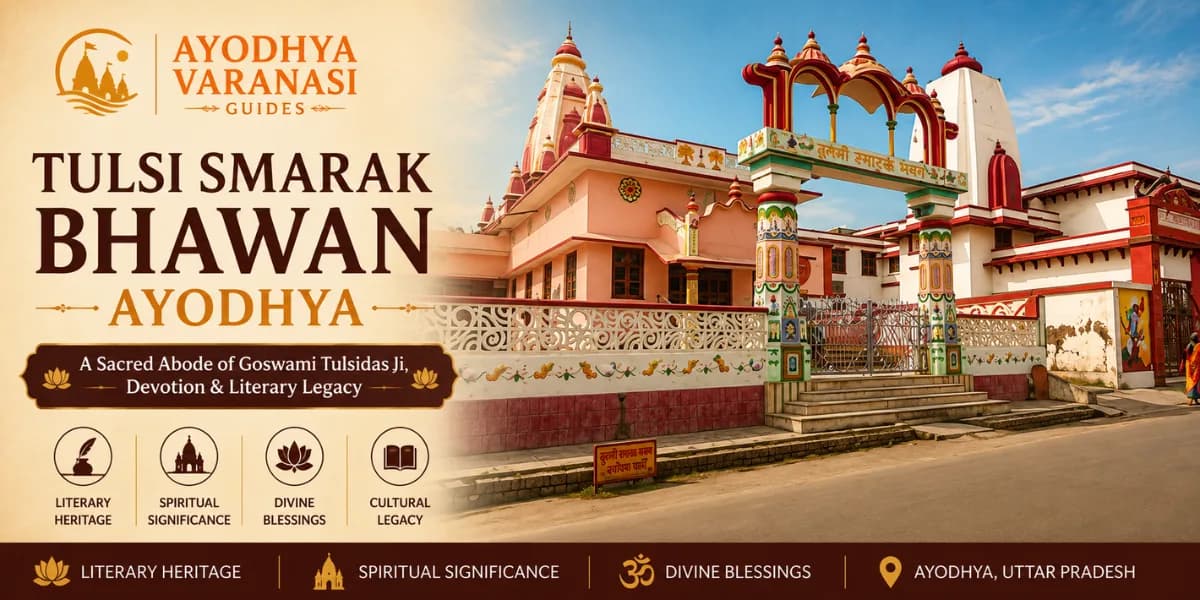
Tulsi Smarak Bhawan
Ayodhya · Ramlila Every Evening
4.9 / 5 · Ayodhya Tours
Temples · Culture · Aarti
- Daily Ramlila
- 6:00 PM – 9:00 PM, every evening
- Museum Timings
- 10:00 AM – 9:00 PM
- Library
- 10:30 AM – 4:30 PM
- Closed On
- Mondays & the 2nd Sunday monthly
- Entry
- Free · no ticket required
- Location
- Rajgang crossing area, Ayodhya
What Are the Tulsi Smarak Bhawan Timings?
This is a cultural institution rather than a temple, so it keeps museum hours, not darshan hours — and that catches visitors out. The museum is open 10:00 AM to 9:00 PM, the library 10:30 AM to 4:30 PM, and the Ramlila runs from 6:00 to 9:00 PM every evening. Crucially, the whole facility is closed on Mondays and on the second Sunday of every month.
Museum
Longer hours than most Ayodhya sites
Library & Research Centre
Shorter hours; come in the day
Daily Ramlila
Every evening, free to attend
Closed
The whole facility shuts
Museum & Exhibits
Manuscripts, artefacts and displays
The Ramlila
Stay as long or as little as you like
Library Visit
For readers and researchers
Tip: the Ramlila starts at 6:00 PM — the same hour as the Saryu Aarti at Ram Ki Paidi. You cannot do both properly on the same evening, so pick one per night. We usually put the aarti on the first evening and the Ramlila on the second. WhatsApp us and we will sequence it.
When Is the Best Month to Visit Tulsi Smarak Bhawan? (2026)
The Ramlila runs every evening of the year, so unlike most Ayodhya attractions there is no season you need to plan around. What changes is the weather for sitting through an outdoor evening performance.
October is the peak, with the Ramlila season and Deepotsav filling all of Ayodhya. Remember the facility closes on Mondays and the second Sunday of every month, whatever the season.
Why Does Ayodhya Have a Memorial to Tulsidas?
What Is Tulsi Smarak Bhawan?
Tulsi Smarak Bhawan is a memorial and cultural centre dedicated to Goswami Tulsidas. It was built in 1969 by Sri Vishwanath Das, then Governor of Uttar Pradesh, and it holds a museum, a library, the Ayodhya Research Sansthan, and a hall where a Ramlila is staged every single evening of the year.
Who Was Goswami Tulsidas?
Tulsidas (16th century) composed the Ramcharitmanas — the retelling of the Ramayana in Awadhi that put the story of Lord Ram into the mouths and homes of ordinary north India. Valmiki gave the Ramayana its Sanskrit form; Tulsidas gave it to the people. When a family in a village recites the Ramayana today, it is almost certainly his verses they are speaking.
What Is the Ayodhya Connection?
A direct one. Tradition holds that Tulsidas began writing the Ramcharitmanas in Ayodhya, on Ram Navami in Samvat 1631 (1574 CE), and completed it later in Varanasi. The greatest devotional work in the language was started in this city, which is why the memorial belongs here rather than anywhere else.
What Is the Daily Ramlila?
The reason to come. A Ramlila is performed here every evening from 6:00 to 9:00 PM, all year round — not only during the Navratri season when Ramlilas are staged across north India. It is free to attend, you may stay for ten minutes or three hours, and it is the one place in Ayodhya where you can watch the story of Ram enacted rather than simply told.
What Is the Ayodhya Research Sansthan?
A research centre housed within the Bhawan, devoted to studying and preserving the literary, cultural and spiritual heritage of Ayodhya. Together with the library and reading rooms, it makes this the scholarly institution of the city — a side of Ayodhya that visitors, focused on darshan, almost never encounter.
Why Should a Pilgrim Bother?
Because Ayodhya empties out after dark. The temples close, the aarti ends, and most visitors go back to their hotels with the evening gone. Tulsi Smarak Bhawan is the answer to the question of what to do in Ayodhya at night — and it happens to be a free, three-hour, live retelling of exactly the story you came here for.
Did you know? Tulsidas also founded the Sankat Mochan temple in Varanasi, one of the most beloved Hanuman temples in India. His life links the two great cities of an Ayodhya–Varanasi pilgrimage.
What Do You Actually Do at Tulsi Smarak Bhawan?
There is no darshan queue and no ritual — it is a cultural visit. Here is how an evening here works.
- 1
Check the Day First
The facility is closed on Mondays and on the second Sunday of every month. This is the single most common reason people arrive to a locked gate.
- 2
Come for the Museum in the Afternoon
The museum opens at 10 AM. Exhibits cover Tulsidas, the Ramcharitmanas and the cultural heritage of Ayodhya.
- 3
Visit the Library or Research Centre
The library runs 10:30 AM to 4:30 PM, alongside the Ayodhya Research Sansthan. Worth half an hour if you read Hindi or have an interest in the texts.
- 4
Take Your Seat Before 6 PM
The Ramlila begins at 6:00 PM. Arrive a few minutes early for a decent seat, particularly during the October season.
- 5
Watch the Ramlila
Three hours of the Ram katha performed live, in costume, with music. Free, and open to anyone who walks in.
- 6
Stay as Long as You Like
There is no obligation to sit through the whole thing. Many visitors watch for thirty or forty minutes and leave quietly.
- 7
Ask Which Episode Is Playing
The Ramlila runs as a cycle, so ask at the gate which part of the story tonight covers — it makes far more sense if you know.
When Should You Visit Tulsi Smarak Bhawan?
The Ramlila runs every night of the year, so this is about which day you come and which evening you spend here.
Best Time — Evening, from 6 PM
The Ramlila is the whole point. Arrive just before six, and treat the museum as something to add earlier in the afternoon if you have time.
Avoid — Mondays & the Second Sunday
The facility closes completely on Mondays and on the second Sunday of every month. Check the date before you plan your evening around it.
Most Special — Ramlila Season & Deepotsav
October brings the traditional Ramlila season and Deepotsav, when the performances draw their largest audiences and the whole city is lit. Book accommodation well ahead.
What Can You See at Tulsi Smarak Bhawan?
Four distinct things under one roof, which is unusual for Ayodhya.
The Daily Ramlila
Top Pick6 to 9 PM, Every Evening
A live performance of the Ram katha, free to attend, every single night of the year — not just during the festival season.
The Museum
Top Pick10 AM to 9 PM
Exhibits on Goswami Tulsidas, the Ramcharitmanas and the literary and cultural heritage of Ayodhya.
The Library & Reading Rooms
10:30 AM to 4:30 PM
A working library of texts on Ram bhakti, the Ramayana tradition and the history of Ayodhya.
The Ayodhya Research Sansthan
Scholarship
The research centre devoted to studying and preserving Ayodhya's literary, cultural and spiritual heritage.
The Tulsidas Memorial Itself
Built in 1969
The Bhawan raised in memory of the poet who began the Ramcharitmanas in this city on Ram Navami, 1574.
What Is There to Do in Ayodhya in the Evening?
This is the question the Bhawan answers, and very few visitors know about it.
A Free Ramlila, Every Single Night
Three hours of the Ram katha performed live, all year round. Nowhere else in Ayodhya offers this, and it costs nothing.
It Solves the Empty Evening
Ayodhya's temples close and the aarti ends by seven. Without this, most visitors have nothing to do after dark.
The Tulsidas Connection
The Ramcharitmanas was begun in Ayodhya. This is the city's memorial to the man who put Ram's story into everyday north Indian speech.
Children Watch It Happily
Costume, music and a story they already half know. Far easier for young children than another temple queue.
Is There an Entry Fee at Tulsi Smarak Bhawan? (2026)
Entry is free — the museum, the library and the nightly Ramlila all cost nothing. This is, by some distance, the best-value evening in Ayodhya.
Everything here is free. What we add is planning — the Ramlila clashes exactly with the Saryu Aarti at 6 PM, and the Bhawan is shut on Mondays and second Sundays. Getting both into a two-night stay takes a little sequencing, and that is what we do. Confirmed in writing.
Auto and e-rickshaw fares are indicative and vary with season and distance.
What Do Visitors Say About Tulsi Smarak Bhawan?
1,067 verified reviews
We had no idea there was a Ramlila here every single night. We watched for two hours and it was the best part of our Ayodhya trip. Free, and hardly any tourists among the audience.
Ramesh Chandra Awasthi
Lucknow
Our guide warned us it is closed on Mondays, which saved us a wasted evening — we had planned to go on exactly that day. Went Tuesday instead. My children were completely absorbed.
Preeti Saraswat
Gwalior
The museum and library were a pleasant surprise. Learning that Tulsidas began writing the Ramcharitmanas here in Ayodhya, on Ram Navami, gave the whole trip a different meaning.
Bhaskar Joshi
Vadodara
Visited during the Ramlila season in October. Packed, wonderful atmosphere, and beautifully performed. Go early for a seat at that time of year.
Anjum Rehman
Delhi
Good evening out and completely free. Just note it starts at 6 PM, the same time as the Saryu Aarti, so you have to choose. We did the aarti one night and this the next.
Sunil Kumar Verma
Patna
How Do You Fit the Ramlila Into an Ayodhya Trip?
The Ramlila clashes with the Saryu Aarti, so this works best across two evenings. Here is the two-night plan we build for guests.
Hanuman Garhi darshan. Begin with the guardian of Ayodhya, as tradition asks, before Ram Lalla.
Ram Janmabhoomi (Ram Lalla). Darshan at the Ram Mandir. We assist with Sugam (VIP) Darshan so you are not queuing for hours.
Kanak Bhawan & Sita Ki Rasoi. The Ramkot cluster — the golden palace and the sacred kitchen of Goddess Sita.
Saryu Aarti at Ram Ki Paidi. The first evening goes to the riverfront aarti — lamps, bells and the Saryu at dusk.
Mani Parvat & Sugriv Qila. The ancient mounds, with the best panorama over Ayodhya from the top.
Valmiki Bhawan & Tulsi Smarak museum. The midday hours, when the temples close — the Ramayana in marble, then the Tulsidas museum.
Ramlila at Tulsi Smarak Bhawan. The second evening goes to the Ramlila — three hours of the Ram katha, performed live and free.
Which Tour Package Covers Tulsi Smarak Bhawan?
Most visitors reach Tulsi Smarak Bhawan as part of a wider Ayodhya darshan rather than as a trip of its own. These are the itineraries our guests book most — each one includes Ram Mandir darshan with Sugam (VIP) assistance, a certified local guide, comfortable transport and pricing confirmed in writing before you travel.
- 1 Day1 Day Ayodhya Tour PackageRam Mandir darshan, Hanuman Garhi and the Saryu Aarti in a single day.
- 2 Days2 Days Ayodhya Tour PackageThe full Ramkot temple circuit at an unhurried pace, with an evening on the Saryu.
- 3 Days3 Days Ayodhya Tour PackageAyodhya in depth — the temples, the mounds, Guptar Ghat and the lesser-known shrines.
- 2 Days2 Days Ayodhya Varanasi Tour PackageRam Mandir and Kashi Vishwanath across two cities, with the Ganga Aarti.
- 3 Days3 Days Ayodhya Varanasi Tour PackageThe classic pairing — Ram Mandir, Kashi Vishwanath and the ghats.
- 3 Days3 Days Ayodhya Prayagraj Tour PackageRam Mandir darshan with the Triveni Sangam snan.
- 4 Days4 Days Ayodhya Varanasi Prayagraj Tour PackageAll three cities — Ram Mandir, Kashi Vishwanath and the Triveni Sangam.
- 5 Days5 Days Ayodhya Varanasi Prayagraj Tour PackageThe complete sacred circuit at a comfortable, senior-friendly pace.
Want Tulsi Smarak Bhawan built into a custom itinerary? We plan around your dates, your pace and what you actually want to see.
See all Ayodhya & Varanasi tour packagesHow Do You Reach Tulsi Smarak Bhawan in Ayodhya?
Tulsi Smarak Bhawan stands near the Rajgang crossing in Ayodhya, close to the main road and within easy reach of the temple town and Ram Ki Paidi.
By Road / Taxi
The simplest option. The Bhawan is on a main road, so taxis and autos reach it directly without any walking through lanes.
By Train
Ayodhya Dham Junction is about 2 km away and Ayodhya Cantt roughly 7 km. Both are well connected to Lucknow, Varanasi, Prayagraj and Delhi.
By Air
Maharishi Valmiki International Airport, Ayodhya Dham is roughly 10 km away, with taxis at the terminal. Lucknow airport (~140 km) is the larger alternative.
The Last Mile
E-rickshaws run constantly through this part of Ayodhya. Ask for Tulsi Smarak Bhawan — it is a known landmark.
Where Is Tulsi Smarak Bhawan Located in Ayodhya?
Tulsi Smarak Bhawan stands near the Rajgang crossing in Ayodhya, about 1.5 km from Ram Ki Paidi and 2 km from Ayodhya Dham Junction. Use the map below to navigate.
Ayodhya
- Area: Rajgang crossing area, Ayodhya
- PIN: Ayodhya 224123
- From Ram Ki Paidi: ~1.5 km
- From Ayodhya Dham Junction: ~2 km
- Closed on: Mondays & the second Sunday monthly
Where Should You Stay to Attend the Ramlila?
The Ramlila ends at 9 PM, so staying somewhere you can get back from easily after dark makes a real difference.
Naya Ghat & Ram Ki Paidi
Riverside guesthouses and hotels about 1.5 km away, walkable or a short e-rickshaw hop after the performance ends.
Ramkot & Ram Path
Stays near the Ram Janmabhoomi, Hanuman Garhi and Kanak Bhawan — ideal if early-morning Ram Lalla darshan is your priority.
Ayodhya Dham / Faizabad
Branded and mid-range hotels with more space, parking and dining, 10–20 minutes away by taxi.
What Else Can You Visit Near Tulsi Smarak Bhawan?
The Bhawan sits centrally, close to the riverfront and the ancient mounds.
Valmiki Ashram (Valmiki Bhawan)
The marble temple ~1.5 km away where all 24,000 verses of the Valmiki Ramayana are inscribed on the walls.
Ram Ki Paidi & Saryu Aarti
The riverfront steps on the Saryu and the evening aarti — which clashes with the Ramlila, so plan across two evenings.
Ram Mandir (Ram Janmabhoomi)
The grand temple of Ram Lalla, ~2 km away. We assist with Sugam (VIP) Darshan to skip the queue.
Mani Parvat
The 65-foot sacred mound with the best panorama over Ayodhya, about a kilometre away.
Nageshwarnath Temple
The ancient Shiva temple of Ayodhya, said to be built by Kush, son of Lord Ram — near Ram Ki Paidi.
Surya Kund
The sacred Sun temple and kund of the Suryavanshi dynasty at Darshan Nagar.
Ramlila Season & Deepotsav at Tulsi Smarak Bhawan
Although the Ramlila here runs every evening of the year, October is when it comes into its own. The traditional Ramlila season around Navratri and Dussehra draws the largest audiences, and the performances take on the scale and energy of the festival across north India.
Deepotsav around Diwali lights all of Ayodhya with lakhs of lamps and fills the city completely, while Ram Navami in March or April is the other great occasion — and the anniversary of the day Tulsidas is said to have begun the Ramcharitmanas here in 1574. Book accommodation well ahead for any of these.
What Should You Know Before Visiting Tulsi Smarak Bhawan?
Straightforward, but two scheduling details decide whether your evening works or not.
Closed Mondays and the second Sunday
The whole facility shuts on those days. This is the single most common reason visitors arrive at a locked gate — check the date before planning your evening.
The Ramlila clashes with the Saryu Aarti
Both start at 6 PM. You cannot do both properly on the same night, so spread them across two evenings if you can.
It is free — do not pay anyone
Museum, library and Ramlila all cost nothing. Politely decline if anyone asks for an entry charge.
Arrive a few minutes before six
Seating is first come, first served, and during the October Ramlila season it fills up well before the performance starts.
You need not stay all three hours
Many visitors watch for thirty or forty minutes and slip out quietly. Nobody minds.
Ask which episode is playing
The Ramlila runs as a cycle through the Ram katha. Knowing tonight's episode makes the performance far easier to follow.
The library keeps shorter hours
10:30 AM to 4:30 PM, unlike the museum which stays open until 9 PM. Come in the day if the library is your reason for visiting.
It is a cultural centre, not a temple
There is no darshan, no queue and no ritual here. Come expecting a museum and a performance.
Good for children and evenings
Costume, music and a familiar story hold children's attention far better than another temple queue, and it fills the hours when Ayodhya has little else.
Dress for the weather
The evening performance runs 6 to 9 PM. Carry a shawl in December and January, when Ayodhya evenings get genuinely cold.
Tulsi Smarak Bhawan Ayodhya — Frequently Asked Questions
The questions visitors ask us most about Tulsi Smarak Bhawan — the daily Ramlila, timings, closures, entry and how to fit it around the Saryu Aarti.
It is a memorial and cultural centre in Ayodhya dedicated to Goswami Tulsidas, the poet who composed the Ramcharitmanas. Built in 1969, it houses a museum, a library, the Ayodhya Research Sansthan and a hall where a Ramlila is performed every evening.
Still have a question?
Our local team replies within 30 minutes.
Written & verified by the local Ayodhya guide team at Ayodhya Varanasi Guides
Our government-certified guides take visitors to the nightly Ramlila at Tulsi Smarak Bhawan through the year, and plan around its Monday and second-Sunday closures. Last updated: July 2026. Performance timings can shift on festival days and during the October Ramlila season — message us for the position on your travel date.
Watch the Ram Katha Performed Live at Tulsi Smarak Bhawan
Let Ayodhya Varanasi Guides plan your Ayodhya trip so you catch both — the Saryu Aarti on one evening and the free nightly Ramlila on the other — alongside the Ram Mandir with Sugam Darshan assistance, the Ramkot temples and the ancient mounds. Confirmed in writing.