
Mani Parvat, Ayodhya — Timings, History, Steps & Visitor Guide
Mani Parvat (Mani Parbat) is a roughly 65-foot-high sacred mound in the heart of Ayodhya, a short walk from Ram Ki Paidi. Devotees believe it is a fragment of the Sanjeevani mountain that fell here as Hanuman carried it to Lanka to revive Lakshman. A flight of stone steps leads up to small shrines and one of the best open views over Ayodhya. Entry is free, it is usually accessible from around 6 AM to 7 PM, and the climb takes about 10 minutes. Ayodhya’s famous Sawan Jhula Mela (Jhulanotsav) traditionally begins here.
- Timings
- ~6:00 AM – 7:00 PM daily
- Height
- ~65 feet · about 100 steps
- Entry
- Free · no ticket
- Famous For
- Sawan Jhula Mela starts here
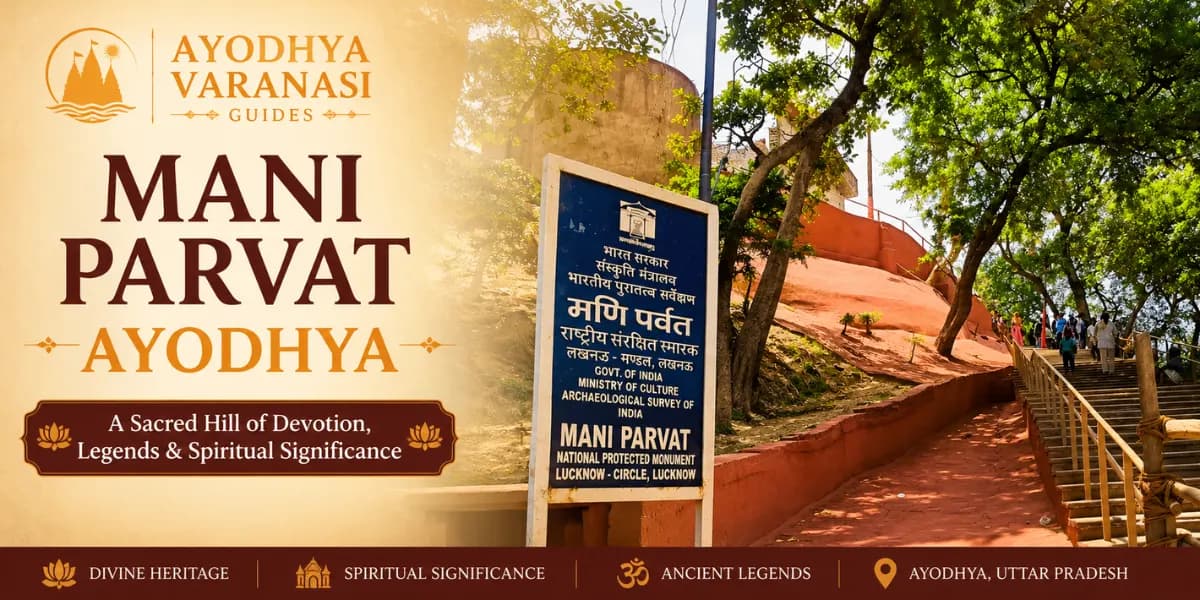
Mani Parvat
Ayodhya · A Piece of the Sanjeevani Mountain
4.9 / 5 · Guided Ayodhya Tours
Heritage mounds · Ram Mandir
- Timings
- ~6:00 AM – 7:00 PM (daylight hours)
- Height
- ~65 ft · around 100 stone steps
- Legend
- A fragment of Hanuman's Sanjeevani hill
- Also Known As
- Mani Parbat · Manik Parvat
- Entry
- Free · no ticket required
- Location
- Central Ayodhya, near Ram Ki Paidi & Naya Ghat
What Are the Mani Parvat Timings — and How Long Does the Climb Take?
Mani Parvat is an open, ASI-listed heritage mound rather than a walled temple, so it does not follow strict aarti hours. In practice it is visited in daylight, roughly 6:00 AM to 7:00 PM. The climb up the stone steps takes about 8–12 minutes at an easy pace, and most visitors spend 30–45 minutes here in total.
Morning (Best)
Cool air, soft light, quiet steps
Midday
Open, but hot and exposed in summer
Evening (Best)
Sunset views over Ayodhya
The Climb Up
About 100 stone steps, with landings
At the Top
Shrines, views and photographs
Total Visit
Easy to combine with Ram Ki Paidi
Tip: during Sawan (July–August) the Jhula Mela brings large crowds and the mound stays busy well into the evening. Message us on WhatsApp for the current Jhulanotsav dates and the best hour to climb on your travel date.
When Is the Best Month to Visit Mani Parvat? (2026)
Mani Parvat is an open-air climb, so the weather matters more here than at an indoor temple. October to March is the most comfortable stretch, while Sawan (July–August) is the most atmospheric thanks to the Jhula Mela.
Crowds peak during Sawan Jhula Mela, Ram Navami and Deepotsav. Weekday mornings are the quietest time of all.
Why Is It Called Mani Parvat? The History, Legend & Significance
What Exactly Is Mani Parvat?
Mani Parvat is an ancient earthen mound about 65 feet high rising out of central Ayodhya, crowned with small shrines and reached by a flight of stone steps. It is not a hill in the geological sense — it is a tila, a raised heritage mound of the kind archaeologists have long studied in this city. It sits alongside two sister mounds, Sugriv Parvat (Sugriv Qila) and Kuber Tila, and is protected as a site of archaeological importance.
Why Is It Named “Mani” Parvat?
The most loved explanation is in the name itself. Mani means jewel or gem. As Hanuman flew from the Himalayas to Lanka carrying the entire Sanjeevani mountain to save Lakshman, a piece of that luminous, herb-bearing peak is believed to have broken away and fallen at Ayodhya — leaving behind this jewel of a hill. That is why local families still speak of Mani Parvat as a living fragment of the Ramayana rather than a monument.
Is There Another Story Behind the Mound?
Yes — Ayodhya rarely has just one story. A second tradition holds that this is the mound where Goddess Sita and her companions came to play and rest, and some versions connect it with jewels and ornaments from her wedding procession. A third links the mound to sages who meditated on this raised, quiet ground long before the city grew around it.
Was Mani Parvat Really a Buddhist Stupa?
This is the question historians ask most. It is widely believed that the Buddha spent time in Ayodhya (ancient Saketa) and preached here, and that a stupa and monastery attributed to Emperor Ashoka once stood on this mound. The scale and shape of the tila support that reading. For visitors, this is what makes Mani Parvat unusual: one small hill carrying a Ramayana legend, a Buddhist past and a living Vaishnava festival at the same time.
What Is the Sawan Jhula Mela Connection?
Every year in the month of Sawan (Shravan), Ayodhya celebrates Jhulanotsav — the swing festival, when deities from the city’s temples are placed on beautifully decorated jhulas. Traditionally, the Sawan Jhula Mela begins from Mani Parvat on Hariyali Teej, and processions set out from here through the city. For a few weeks the quiet mound becomes the busiest, most joyful spot in Ayodhya.
Why Should You Bother Climbing It?
Because it gives you something no other stop in Ayodhya does — perspective. From the top you look out over temple shikhars, the Ram Ki Paidi steps and the line of the Saryu, and the geography of the whole pilgrimage suddenly makes sense. Ten minutes of climbing buys you the clearest picture of Ayodhya you will get all trip.
Did you know? Mani Parvat is one of three ancient mounds clustered in this part of Ayodhya — Mani Parvat, Sugriv Parvat and Kuber Tila. Locals still call them the “parvats” of Ayodhya, and you can walk between them in under fifteen minutes.
How Do You Visit Mani Parvat? A Step-by-Step Walkthrough
Visiting Mani Parvat is refreshingly simple — no queues, no tickets, no passes. Here is exactly how a visit unfolds.
- 1
Reach the Base of the Mound
Mani Parvat sits in central Ayodhya near Naya Ghat and Ram Ki Paidi. Autos and e-rickshaws drop you at the base; the mound is visible from the road.
- 2
Start Up the Stone Steps
A broad flight of roughly 100 stone steps with landings leads to the top. Take it slowly — there is no hurry and the landings make good rest points.
- 3
Pause at the Shrines on the Way
Small shrines and idols are set along the climb. Devotees stop, bow and offer a moment of prayer as they go up.
- 4
Reach the Summit Shrines
At the top are modest temples, including a shrine associated with Goddess Sita, along with a flag and a quiet open platform.
- 5
Take in the View Over Ayodhya
Turn a full circle. You can pick out temple spires, rooftops, the greenery around Ram Ki Paidi and, on a clear day, the line of the Saryu.
- 6
Walk Across to Sugriv Qila
The sister mound, Sugriv Qila, is a short walk away — most visitors do both together in one easy loop.
- 7
Continue to Ram Ki Paidi for the Aarti
Finish your evening at the Saryu Aarti on the ghats, roughly a kilometre away.
When Is the Best Time to Climb Mani Parvat?
The mound is open all year, but the hour of the day matters more than the season. These are the windows our guides recommend.
Best Season — October to March
Ayodhya's cool, dry months make the climb effortless and the visibility from the top is at its best. November and February are the sweet spot. Avoid the exposed midday heat of May and June entirely.
Best Time of Day — Early Morning or Sunset
Come at 6–8 AM for cool air and near-empty steps, or after 4:30 PM for golden light over the temple skyline. Sunset from the top of Mani Parvat is one of Ayodhya's quiet pleasures.
Most Special — Sawan Jhula Mela
During Sawan (July–August), Jhulanotsav traditionally begins here and the mound comes alive with swings, processions and crowds. It is the most vivid time to visit — but plan for slippery steps and heavy footfall.
What Can You Actually See at Mani Parvat?
Mani Parvat is a compact site, and knowing what to look for turns a ten-minute climb into a memorable stop. Here are the highlights.
The Stone Stairway
Top PickThe Climb
Around a hundred broad stone steps rise from the road to the summit, with landings where devotees pause. The climb itself is part of the experience.
The Summit Shrines
The Devotional Heart
Small temples and idols crown the mound, including a shrine associated with Goddess Sita. Simple, unhurried and rarely crowded outside festival season.
The Panoramic View of Ayodhya
Top PickThe Best Reason to Climb
One of the few elevated viewpoints in the city — temple shikhars, rooftops, the greenery of Ram Ki Paidi and the distant course of the Saryu.
The Ancient Mound Itself
Layered History
The tila is an archaeologically protected site long associated with a stupa and monastery attributed to Emperor Ashoka — history you are literally standing on.
Sugriv Parvat & Kuber Tila Nearby
The Sister Mounds
Two more ancient mounds sit within a short walk, completing Ayodhya's little cluster of sacred hills.
What Should You Not Miss at Mani Parvat?
Four things our guests consistently say made the climb worth it.
The Sanjeevani Story on Site
Hear the Hanuman and Sanjeevani legend told at the very mound it belongs to — it lands quite differently standing there.
Sunset From the Summit
Time your climb for late afternoon and watch the light go gold over Ayodhya's temple skyline.
The Sawan Jhula Mela
If you visit in Sawan, catch the decorated swings and the procession that traditionally sets out from here.
The Buddhist Layer
Ask about the Ashokan stupa association — few visitors realise Ayodhya's Ramayana mound also carries a Buddhist past.
Is There an Entry Fee at Mani Parvat? (2026 Costs)
There is no entry fee and no ticket at Mani Parvat — it is open to everyone, free of charge. The only money you might spend is on the auto ride, a small offering, or an optional guide. Here is a realistic picture.
Everything at Mani Parvat is free. What we offer is a guided Ayodhya darshan that ties the mounds into the bigger picture — Mani Parvat, Sugriv Qila, the Ram Mandir (with Sugam Darshan help), the Ramkot temples and the Saryu Aarti — with fixed, written pricing.
Auto and e-rickshaw fares are indicative and vary with season, distance and bargaining.
What Do Visitors Say About Mani Parvat?
1,146 verified reviews
We almost skipped Mani Parvat because it looked like just a hill from the road. Our guide insisted, and it turned out to be the best half hour of the day. The view over Ayodhya from the top explains the whole city.
Rakesh Tiwari
Kanpur
Climbed at 7 in the morning — barely anyone there, lovely light, and the guide told the Sanjeevani story right at the top. My children still talk about it. The steps are easy even for my mother at 68.
Meenal Deshpande
Pune
Visited during Sawan and the Jhula Mela atmosphere was incredible. Very crowded, but our guide timed it well and we saw the procession without any chaos. Transport and pricing were exactly as promised.
Arvind Kumar
Delhi
What I appreciated most was learning about the Buddhist stupa history — nobody else had mentioned it. Mani Parvat and Sugriv Qila together took barely an hour and added real depth to our Ayodhya trip.
Shalini Rao
Hyderabad
Simple, free and genuinely worth the climb. The steps get warm in the afternoon so go early or late. Team arranged everything smoothly and did not rush us at any stop.
Nitin Agarwal
Lucknow
How Do You Fit Mani Parvat Into an Ayodhya Day?
Mani Parvat needs less than an hour, which makes it easy to slot into a full Ayodhya darshan day. This is the plan our guests enjoy most.
Hanuman Garhi darshan. Begin, as tradition dictates, at Hanuman Garhi — the guardian of Ayodhya is honoured first.
Ram Janmabhoomi (Ram Lalla). Proceed to the Ram Mandir for Ram Lalla darshan. We assist with Sugam (VIP) Darshan to save you hours in the queue.
Kanak Bhawan & Sita Ki Rasoi. Walk the Ramkot cluster — the golden palace of Sita-Ram and the sacred kitchen of Goddess Sita.
Mani Parvat climb. Climb the mound in the cool of the late afternoon, hear the Sanjeevani legend and take in the view over Ayodhya.
Sugriv Qila. Walk across to the neighbouring mound of Sugriv Qila with its Jain temple and Ramayana associations.
Saryu Aarti at Ram Ki Paidi. Close the day on the riverfront with the evening Saryu Aarti — lamps, bells and the river at dusk.
Which Tour Package Covers Mani Parvat?
Most visitors reach Mani Parvat as part of a wider Ayodhya darshan rather than as a trip of its own. These are the itineraries our guests book most — each one includes Ram Mandir darshan with Sugam (VIP) assistance, a certified local guide, comfortable transport and pricing confirmed in writing before you travel.
- 1 Day1 Day Ayodhya Tour PackageRam Mandir darshan, Hanuman Garhi and the Saryu Aarti in a single day.
- 2 Days2 Days Ayodhya Tour PackageThe full Ramkot temple circuit at an unhurried pace, with an evening on the Saryu.
- 3 Days3 Days Ayodhya Tour PackageAyodhya in depth — the temples, the mounds, Guptar Ghat and the lesser-known shrines.
- 2 Days2 Days Ayodhya Varanasi Tour PackageRam Mandir and Kashi Vishwanath across two cities, with the Ganga Aarti.
- 3 Days3 Days Ayodhya Varanasi Tour PackageThe classic pairing — Ram Mandir, Kashi Vishwanath and the ghats.
- 3 Days3 Days Ayodhya Prayagraj Tour PackageRam Mandir darshan with the Triveni Sangam snan.
- 4 Days4 Days Ayodhya Varanasi Prayagraj Tour PackageAll three cities — Ram Mandir, Kashi Vishwanath and the Triveni Sangam.
- 5 Days5 Days Ayodhya Varanasi Prayagraj Tour PackageThe complete sacred circuit at a comfortable, senior-friendly pace.
Want Mani Parvat built into a custom itinerary? We plan around your dates, your pace and what you actually want to see.
See all Ayodhya & Varanasi tour packagesHow Do You Reach Mani Parvat in Ayodhya?
Mani Parvat is in central Ayodhya near Naya Ghat and Ram Ki Paidi, so it is easy to reach from anywhere in the temple town. Here are your options.
By Air
Maharishi Valmiki International Airport, Ayodhya Dham is about 10 km away, with taxis at the terminal. Lucknow airport (~140 km) is the bigger alternative for international connections.
By Train
Ayodhya Dham Junction is roughly 2 km away — a 10-minute auto ride. The station is well connected with Lucknow, Varanasi, Prayagraj and Delhi.
By Road / Taxi
Ayodhya is on NH-27 and the new Ram Path. It is about 135 km from Lucknow, 200 km from Varanasi and 165 km from Prayagraj — all comfortable half-day drives.
The Last Mile
E-rickshaws run constantly around Naya Ghat and Ram Ki Paidi. From Ram Ki Paidi it is a pleasant 15-minute walk, or a ₹30–₹80 e-rickshaw hop.
Where Is Mani Parvat Located in Ayodhya?
Mani Parvat rises in central Ayodhya, close to Naya Ghat and Ram Ki Paidi, with Sugriv Qila just a few minutes away on foot. Use the map below to navigate straight to the base of the steps.
Ayodhya
- Area: Central Ayodhya, near Naya Ghat
- PIN: Ayodhya 224123
- From Ram Ki Paidi: ~1 km
- From Ayodhya Dham Junction: ~2 km
- Height: ~65 feet, about 100 steps
Where Should You Stay Near Mani Parvat?
Mani Parvat is central, so almost any Ayodhya stay puts it within a short ride. These are the three areas we recommend most often, depending on what you want from your trip.
Naya Ghat & Ram Ki Paidi
Riverside guesthouses and hotels within walking distance of both the mound and the evening Saryu Aarti — the most convenient base for this side of Ayodhya.
Ramkot & Ram Path
Stays clustered near the Ram Janmabhoomi, Hanuman Garhi and Kanak Bhawan. Ideal if early-morning Ram Lalla darshan is your priority.
Ayodhya Dham / Faizabad
Branded and mid-range hotels with more space, parking and dining. About 10–20 minutes by taxi from the mound — a good pick for families and longer stays.
What Else Is Worth Seeing Near Mani Parvat?
Mani Parvat sits within easy reach of Ayodhya's most important sites — here is what to pair it with.
Sugriv Qila
The neighbouring ancient mound linked to Sugriv the Vanar king, with an important Jain temple on top. A 5-minute walk.
Ram Ki Paidi & Saryu Aarti
The great riverfront steps on the Saryu, about a kilometre away, and the setting for the evening aarti.
Ram Mandir (Ram Janmabhoomi)
The grand temple of Ram Lalla, ~2 km away. We assist with Sugam (VIP) Darshan to skip the main queue.
Hanuman Garhi
The hilltop shrine of Lord Hanuman, traditionally visited before Ram Lalla darshan.
Nageshwarnath Temple
The ancient Shiva temple of Ayodhya, said to be built by Kush, son of Lord Ram — near Ram Ki Paidi.
Guptar Ghat
The serene ghat where Lord Ram is believed to have taken Jal Samadhi, about 9 km away on the Saryu.
Bharat Kund, Nandigram
Where Hanuman fell struck by Bharat's arrow while carrying the Sanjeevani — the other half of this mound's story, ~20 km away.
Sawan Jhula Mela — Ayodhya's Swing Festival Begins at Mani Parvat
Through the monsoon month of Sawan (Shravan), Ayodhya celebrates Jhulanotsav — the festival of swings, when deities from temples across the city are seated on decorated jhulas and gently rocked to devotional song. By long tradition, the Sawan Jhula Mela begins at Mani Parvat on Hariyali Teej, and the processions set out from this mound into the city.
For those weeks the quiet climb becomes Ayodhya’s liveliest gathering — flowers, swings, kirtan and crowds pouring up the steps. If you are visiting in July or August, it is worth planning your trip around these dates. Book transport and stay early, because the town fills up fast.
What Should You Know Before Climbing Mani Parvat?
None of this is complicated, but a few local pointers will make the visit smoother and more meaningful.
It is a climb, not a walk
Around a hundred stone steps lead to the top. There is no lift or ramp, so factor this in for elderly travellers or anyone with knee trouble.
Go early morning or after 4:30 PM
The mound is completely exposed to the sun. Midday climbs in April to June are genuinely uncomfortable.
Wear grippy footwear
The steps can be dusty in summer and slippery during the monsoon. Sandals with a decent sole beat smooth-soled shoes.
Carry water, buy nothing at the top
There are no shops or taps on the mound. A small bottle of water is all you need.
Entry is free — do not pay anyone
There is no ticket for Mani Parvat. If someone asks for an entry charge, politely decline.
Combine it with Sugriv Qila
The two mounds are a five-minute walk apart. Doing them together takes barely an hour and makes far more sense than separate trips.
Expect crowds during Sawan
The Jhula Mela transforms the site in July and August. Wonderful atmosphere, but arrive early and keep an eye on children on the steps.
Respect the shrines at the top
Remove footwear before stepping onto the temple platforms and keep voices low — people come here to pray, not just to see a view.
It is an ASI-protected mound
Please do not carve, climb the slopes off the steps or leave litter. This is a genuine archaeological site.
Sunset is the photographer's hour
The light on Ayodhya's skyline from the summit around 5:30–6:00 PM in winter is the best photo you will take here.
Mani Parvat Ayodhya — Frequently Asked Questions
The questions visitors ask us most about Mani Parvat — timings, steps, legend, entry fee and how to fit it into an Ayodhya trip.
Mani Parvat is an ancient sacred mound about 65 feet high in central Ayodhya, topped with small shrines and reached by roughly a hundred stone steps. Devotees believe it is a fragment of the Sanjeevani mountain that fell here as Hanuman carried it to Lanka to revive Lakshman.
Still have a question?
Our local team replies within 30 minutes.
Written & verified by the local Ayodhya guide team at Ayodhya Varanasi Guides
Our government-certified guides walk visitors up Mani Parvat and around Ayodhya every week, and this guide reflects what we see on the ground rather than what is copied online. Last updated: July 2026. Access hours and festival dates can shift, especially during Sawan — message us for the position on your travel date.
See Ayodhya From the Top of Mani Parvat
Let Ayodhya Varanasi Guides plan a complete Ayodhya darshan — Mani Parvat and Sugriv Qila, the Ram Mandir with Sugam Darshan assistance, the Ramkot temples and the evening Saryu Aarti — with a knowledgeable local guide and comfortable transport. Everything confirmed in writing before you travel.