
Sugriv Qila, Ayodhya — History, Timings & Visitor Guide
Sugriv Qila (also called Sugriv Parvat or Sugriv Kila) is an ancient raised mound in central Ayodhya, roughly 300 metres from Mani Parvat. Tradition holds that this is where Sugriv, the Vanar king and ally of Lord Ram, stayed when he came to Ayodhya after the victory over Lanka. Today the mound is best known for the important Digambar Jain temple on it — Ayodhya being the birthplace of five Jain Tirthankaras. Entry is free, the climb takes only a few minutes, and it is almost always paired with a visit to neighbouring Mani Parvat.
- Timings
- ~6:00 AM – 7:00 PM daily
- Height
- ~35 feet · a short stepped climb
- Entry
- Free · no ticket
- Known For
- Sugriv legend & Jain temple
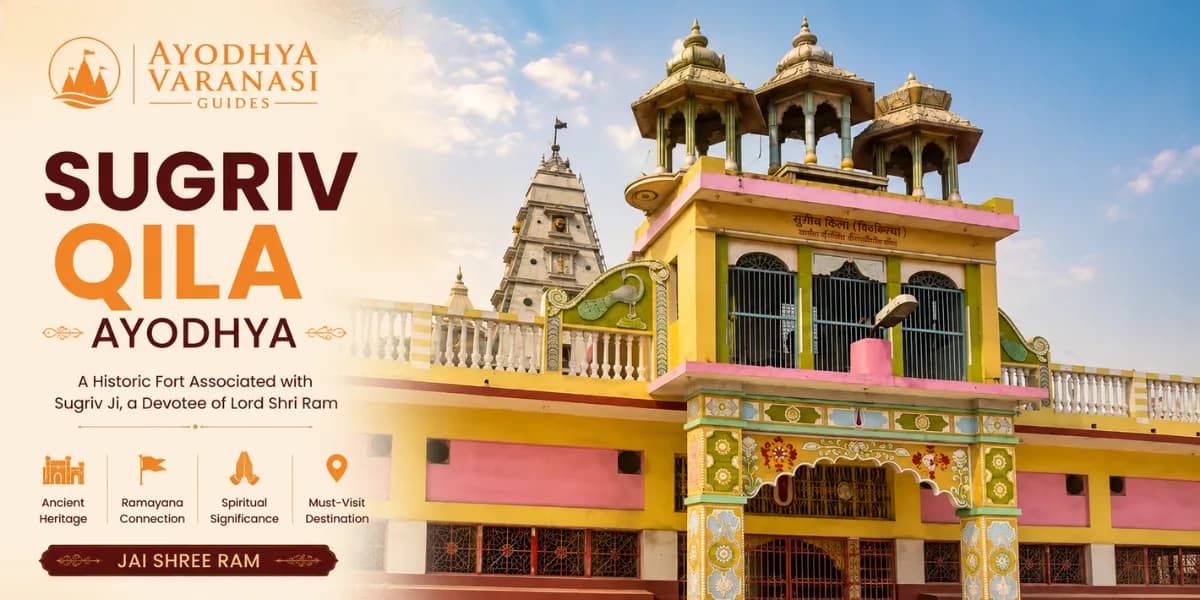
Sugriv Qila
Ayodhya · The Mound of the Vanar King
4.9 / 5 · Guided Ayodhya Tours
Heritage mounds · Ram Mandir
- Timings
- ~6:00 AM – 7:00 PM (daylight hours)
- Height
- ~35 ft mound, short stepped climb
- Legend
- Where Sugriv the Vanar king stayed
- Also Known As
- Sugriv Kila · Sugriv Parvat · Sugriv Tila
- Entry
- Free · no ticket required
- Location
- Central Ayodhya, beside Mani Parvat
What Are the Sugriv Qila Timings — and How Long Do You Need?
Sugriv Qila is an open heritage mound rather than a gated temple, so it is visited in daylight, roughly 6:00 AM to 7:00 PM. The Jain temple on top follows its own darshan hours in the morning and evening, with a midday break. The climb is short — most visitors are done in 20 to 30 minutes, which is why it pairs so neatly with Mani Parvat next door.
Morning (Best)
Cool, quiet, temple open for darshan
Midday
Mound open; Jain temple usually closed
Evening (Best)
Pleasant light, temple reopens
The Climb
A short flight of steps to the top
Jain Temple Darshan
Calm, well-kept and rarely crowded
Total Visit
Add Mani Parvat for a 1-hour loop
Tip: the Jain temple keeps standard morning and evening darshan hours, so a midday visit may find it closed even though the mound is open. Message us on WhatsApp and we will confirm the current darshan timing for your travel date.
When Is the Best Month to Visit Sugriv Qila? (2026)
Like Ayodhya’s other mounds, Sugriv Qila is an open-air site — the weather shapes the visit more than anything else. October to March is the comfortable window, and the mound stays pleasantly quiet for most of the year.
Sugriv Qila is one of Ayodhya's quieter sites. Crowds only really build during Ram Navami, Sawan and Deepotsav, or on major Jain festival days.
Why Is It Called Sugriv Qila? The History, Legend & Jain Connection
What Is Sugriv Qila?
Sugriv Qila — also written Sugriv Kila and known locally as Sugriv Parvat — is an ancient raised mound in central Ayodhya, standing around 35 feet high with a stepped path to the top. It is one of three sacred tilas clustered in this part of the city, alongside Mani Parvat and Kuber Tila, and is recorded as a site of archaeological importance.
Who Was Sugriv, and Why Is the Mound Named for Him?
Sugriv was the Vanar king of Kishkindha and one of Lord Ram’s most important allies in the war against Ravana — it was his army that searched for Sita and crossed to Lanka. Ayodhya’s tradition holds that when Sugriv came to the city after the victory, this raised ground was given to him as his place of stay. The name has stuck for centuries: the qila, or fort, of Sugriv.
Was There Really a Fort Here?
Local accounts say a structure was raised on this mound to mark Lord Ram’s triumphant return from Lanka, and that it was later restored during the great rebuilding of Ayodhya attributed to Maharaja Vikramaditya. What survives today is the mound itself rather than fortifications — but the elevated ground, the commanding position and the persistence of the name all point to a site that mattered a great deal in the ancient city.
Why Is There a Jain Temple on Sugriv Qila?
Because Ayodhya is one of the holiest places in Jainism. It is revered as the birthplace of five Tirthankaras — including Rishabhdev (Adinath), the very first Tirthankara. A Digambar Jain temple stands on Sugriv Qila today, cared for and visited by Jain pilgrims from across India. It is one of the clearest reminders that Ayodhya’s sacred story is shared by more than one tradition.
What Else Is Believed About This Mound?
Older traditions describe sages meditating on this quiet, raised ground, and some accounts connect the mound with ornaments associated with Goddess Sita. Archaeologists, meanwhile, read Ayodhya’s cluster of tilas as evidence of the city’s deep, layered antiquity. As so often in Ayodhya, faith and archaeology stand side by side rather than in conflict.
Why Should You Visit?
Sugriv Qila takes twenty minutes and gives you two things at once — a Ramayana site named for one of its great allies, and a living Jain shrine in the heart of a Ram-centred city. Very few Ayodhya visitors make the short walk over from Mani Parvat, which is exactly why it is worth doing.
Did you know? Ayodhya is revered in Jainism as the birthplace of five Tirthankaras — Rishabhdev (Adinath), Ajitnath, Abhinandannath, Sumatinath and Anantnath. The Digambar Jain temple on Sugriv Qila is part of that ancient, less-known layer of the city.
How Do You Visit Sugriv Qila? A Step-by-Step Walkthrough
There is no ticket, no queue and no ceremony to time your arrival around. This is simply how a visit unfolds.
- 1
Walk Over From Mani Parvat
Sugriv Qila is about 300 metres from Mani Parvat — a five-minute walk. Almost everyone does the two mounds together.
- 2
Climb the Steps
A short flight of steps leads to the top of the mound. It is a gentler climb than Mani Parvat and takes only a few minutes.
- 3
Have Darshan at the Jain Temple
The Digambar Jain temple on the mound is calm, clean and welcoming. Remove your footwear and observe the quiet.
- 4
Learn the Sugriv Connection
Take a moment at the top to place the story — this is the ground Ayodhya's tradition associates with the Vanar king after the return from Lanka.
- 5
Look Out Over the City
The mound gives an open, elevated view of the surrounding rooftops and temple spires, quieter than the panorama from Mani Parvat.
- 6
Continue to Ram Ki Paidi
The Saryu ghats are about a kilometre away — the natural next stop, especially in the late afternoon.
When Is the Best Time to Visit Sugriv Qila?
The mound is open every day of the year. What changes is the heat, the light and whether the Jain temple is open — plan around those three things.
Best Season — October to March
Ayodhya's cool months make the climb effortless and the mound genuinely pleasant to linger on. November and February are ideal. Skip the midday sun of May and June.
Best Time of Day — Morning or Late Afternoon
Come between 7 and 10 AM or after 4:30 PM. Both windows are cool, and both fall within the Jain temple's darshan hours — a midday visit may find the shrine closed.
Most Special — Mahavir Jayanti & Ram Navami
Mahavir Jayanti brings Jain pilgrims to the temple, while Ram Navami and Sawan fill the neighbouring mounds with festival crowds. Both make for a livelier, more colourful visit.
What Can You See at Sugriv Qila?
It is a small site, but each part of it carries a distinct piece of Ayodhya's history. Here is what to look for.
The Digambar Jain Temple
Top PickThe Main Attraction
A well-kept Jain temple crowning the mound, honouring Ayodhya's standing as the birthplace of five Tirthankaras. Peaceful, spotless and rarely crowded.
The Ancient Mound Itself
Top PickLayered History
A roughly 35-foot tila protected as an archaeological site, one of three ancient mounds in this corner of Ayodhya.
The Stepped Climb
The Approach
A short, manageable flight of steps to the top — considerably gentler than the climb at neighbouring Mani Parvat.
Views Over Old Ayodhya
Quiet Panorama
An open outlook across rooftops, temple spires and the green of the Ram Ki Paidi area, without the crowds of the bigger viewpoints.
Mani Parvat & Kuber Tila Nearby
The Sister Mounds
The other two ancient mounds of Ayodhya, both within a short walk — together they make an easy, rewarding heritage loop.
What Makes Sugriv Qila Worth the Detour?
Four reasons our guests are glad they made the five-minute walk from Mani Parvat.
A Ramayana Site Most People Miss
Named for Sugriv, the Vanar king whose army made the rescue of Sita possible — a corner of the epic that rarely gets its own stop.
Ayodhya's Jain Heritage
The Digambar Jain temple opens up a side of Ayodhya as the birthplace of five Tirthankaras that most itineraries never mention.
Genuine Quiet
Even in peak season this mound stays calm. If the crowds at the Ram Mandir have worn you out, this is the antidote.
An Easy Climb
Far gentler than Mani Parvat, which makes it workable for older travellers who might not manage the hundred steps next door.
Is There an Entry Fee at Sugriv Qila? (2026 Costs)
There is no entry fee at Sugriv Qila — neither for the mound nor for the Jain temple on top. The only spending here is optional. This is what a visit realistically costs.
Sugriv Qila itself costs nothing. What we add is context and convenience — a guide who can tell you the Sugriv story and explain Ayodhya’s Jain heritage, plus transport that links the mounds with the Ram Mandir, the Ramkot temples and the Saryu Aarti. Pricing confirmed in writing.
Auto and e-rickshaw fares are indicative and vary with season and distance.
What Do Visitors Say About Sugriv Qila?
1,063 verified reviews
As a Jain family visiting Ayodhya, this was the stop that mattered most to us. The temple on Sugriv Qila is beautifully kept and our guide knew the Tirthankara connection properly — most guides do not.
Vikas Jain
Indore
We did Mani Parvat and Sugriv Qila together in about an hour. Sugriv Qila is much easier to climb, which helped my parents. Very quiet compared to the rest of Ayodhya.
Sunita Pandey
Varanasi
I had no idea there was a mound named after Sugriv in Ayodhya. Our guide told the whole story of the Vanar army standing right there. Small site, but it stayed with me.
Harish Chandra
Bhopal
Peaceful and free to visit. Do check the temple timings — we came at 2 PM and the shrine was shut for the midday break, so we had to come back in the evening.
Anjali Sethi
Chandigarh
Well organised trip. The team combined Sugriv Qila, Mani Parvat and the Saryu Aarti in one smooth evening. No hidden charges, and the driver was patient throughout.
Mahendra Kumar
Patna
How Do You Fit Sugriv Qila Into an Ayodhya Day?
Sugriv Qila needs less than half an hour, so it slips easily into a full darshan day. Here is the plan we recommend most often.
Hanuman Garhi darshan. Begin with the guardian of Ayodhya, as tradition asks, before proceeding to Ram Lalla.
Ram Janmabhoomi (Ram Lalla). Darshan at the Ram Mandir. We assist with Sugam (VIP) Darshan so you are not queuing for hours.
Kanak Bhawan & Sita Ki Rasoi. The Ramkot cluster — the golden palace of Sita-Ram and the sacred kitchen of Goddess Sita.
Sugriv Qila. A gentle climb, darshan at the Digambar Jain temple and the story of the Vanar king in Ayodhya.
Mani Parvat. Walk five minutes to the taller mound for the Sanjeevani legend and the best view over the city.
Saryu Aarti at Ram Ki Paidi. Close the day on the riverfront with lamps, bells and the Saryu at dusk.
Which Tour Package Covers Sugriv Qila?
Most visitors reach Sugriv Qila as part of a wider Ayodhya darshan rather than as a trip of its own. These are the itineraries our guests book most — each one includes Ram Mandir darshan with Sugam (VIP) assistance, a certified local guide, comfortable transport and pricing confirmed in writing before you travel.
- 1 Day1 Day Ayodhya Tour PackageRam Mandir darshan, Hanuman Garhi and the Saryu Aarti in a single day.
- 2 Days2 Days Ayodhya Tour PackageThe full Ramkot temple circuit at an unhurried pace, with an evening on the Saryu.
- 3 Days3 Days Ayodhya Tour PackageAyodhya in depth — the temples, the mounds, Guptar Ghat and the lesser-known shrines.
- 2 Days2 Days Ayodhya Varanasi Tour PackageRam Mandir and Kashi Vishwanath across two cities, with the Ganga Aarti.
- 3 Days3 Days Ayodhya Varanasi Tour PackageThe classic pairing — Ram Mandir, Kashi Vishwanath and the ghats.
- 3 Days3 Days Ayodhya Prayagraj Tour PackageRam Mandir darshan with the Triveni Sangam snan.
- 4 Days4 Days Ayodhya Varanasi Prayagraj Tour PackageAll three cities — Ram Mandir, Kashi Vishwanath and the Triveni Sangam.
- 5 Days5 Days Ayodhya Varanasi Prayagraj Tour PackageThe complete sacred circuit at a comfortable, senior-friendly pace.
Want Sugriv Qila built into a custom itinerary? We plan around your dates, your pace and what you actually want to see.
See all Ayodhya & Varanasi tour packagesHow Do You Reach Sugriv Qila in Ayodhya?
Sugriv Qila sits in central Ayodhya right beside Mani Parvat, near Naya Ghat and Ram Ki Paidi — easy to reach from anywhere in the temple town.
By Air
Maharishi Valmiki International Airport, Ayodhya Dham is about 10 km away with taxis at the terminal. Lucknow airport (~140 km) is the larger alternative.
By Train
Ayodhya Dham Junction is roughly 2 km away — a 10-minute auto ride. Ayodhya Cantt is about 7 km. Both are well connected to Lucknow, Varanasi and Delhi.
By Road / Taxi
Ayodhya sits on NH-27 and the new Ram Path — about 135 km from Lucknow, 200 km from Varanasi and 165 km from Prayagraj.
The Last Mile
E-rickshaws are constantly available around Naya Ghat. From Ram Ki Paidi it is a 15-minute walk, and from Mani Parvat just five minutes on foot.
Where Is Sugriv Qila Located in Ayodhya?
Sugriv Qila stands in central Ayodhya beside Mani Parvat, close to Naya Ghat and about a kilometre from Ram Ki Paidi. Use the map below to navigate to the base of the mound.
Ayodhya
- Area: Central Ayodhya, near Naya Ghat
- PIN: Ayodhya 224123
- From Mani Parvat: ~300 m (5-minute walk)
- From Ram Ki Paidi: ~1 km
- On the mound: Digambar Jain temple
Where Should You Stay Near Sugriv Qila?
Sugriv Qila is central, so most Ayodhya stays put it within a short ride. These are the areas we suggest depending on what you want from your trip.
Naya Ghat & Ram Ki Paidi
Riverside hotels and guesthouses within walking distance of both Sugriv Qila and Mani Parvat, plus the evening Saryu Aarti.
Ramkot & Ram Path
Stays near the Ram Janmabhoomi, Hanuman Garhi and Kanak Bhawan — ideal if early-morning Ram Lalla darshan is your priority.
Ayodhya Dham / Faizabad
Branded and mid-range hotels with more space, parking and dining options, 10–20 minutes from the mounds by taxi.
What Else Can You See Near Sugriv Qila?
Sugriv Qila sits in the middle of Ayodhya's most walkable cluster of sites — here is what to combine it with.
Mani Parvat
The taller neighbouring mound linked to Hanuman's Sanjeevani mountain, with the best panorama of Ayodhya. Five minutes on foot.
Ram Ki Paidi & Saryu Aarti
The great riverfront steps on the Saryu, about a kilometre away, and the setting for the evening aarti.
Ram Mandir (Ram Janmabhoomi)
The grand temple of Ram Lalla, ~2 km away. We assist with Sugam (VIP) Darshan to skip the main queue.
Hanuman Garhi
The hilltop shrine of Lord Hanuman, traditionally visited before Ram Lalla darshan.
Nageshwarnath Temple
The ancient Shiva temple of Ayodhya, said to be built by Kush, son of Lord Ram — near Ram Ki Paidi.
Jain Temple (Badi Murti)
Ayodhya's principal Jain shrine at Raiganj, with a 31-foot marble statue of Lord Rishabhdev — a natural pairing with the Jain temple on this mound.
Guptar Ghat
The tranquil ghat where Lord Ram is believed to have taken Jal Samadhi, about 9 km away on the Saryu.
What Should You Know Before Visiting Sugriv Qila?
A short visit, but a few local pointers will save you a wasted trip and make the stop more meaningful.
Check the Jain temple's darshan hours
The mound is open all day, but the temple on top closes for a midday break. Come before noon or after 4 PM if you want darshan.
Do it together with Mani Parvat
The two mounds are 300 metres apart. Visiting them separately wastes time — as a pair they make a comfortable one-hour loop.
The climb is gentle
Sugriv Qila is a much easier climb than Mani Parvat, which makes it a good option for elderly travellers and young children.
Remove footwear at the temple
As at any shrine, leave your shoes outside the temple platform and keep your voice low inside.
Respect Jain customs
Digambar Jain temples have their own conventions. Do not touch the idols, avoid leather items inside, and follow the attendants' guidance.
Entry is free — do not pay anyone
There is no ticket for the mound or the temple. Politely decline if anyone asks for an entry charge.
Morning and evening are best
The mound is exposed to the sun. Between April and June, restrict your visit to the early morning or after 5 PM.
It is an archaeologically protected mound
Please stay on the steps and paths, and do not litter or carve on the structures. This is a genuine heritage site.
Carry water
There are no shops or taps on the mound itself, though you will find vendors on the road below.
Ask your guide for the Sugriv story
The mound looks unremarkable until someone tells you what it is. A guide turns twenty minutes here into the most memorable stop of the afternoon.
Sugriv Qila Ayodhya — Frequently Asked Questions
The questions visitors ask us most about Sugriv Qila — its history, the Jain temple, timings, entry fee and how to combine it with Mani Parvat.
Sugriv Qila, also called Sugriv Kila or Sugriv Parvat, is an ancient raised mound about 35 feet high in central Ayodhya. Tradition holds that it is where Sugriv, the Vanar king and ally of Lord Ram, stayed when he came to Ayodhya after the victory over Lanka. A Digambar Jain temple stands on top today.
Still have a question?
Our local team replies within 30 minutes.
Written & verified by the local Ayodhya guide team at Ayodhya Varanasi Guides
Our government-certified guides walk visitors between Ayodhya’s ancient mounds every week, and regularly assist Jain pilgrim families at the temple on Sugriv Qila. This guide reflects what we see on the ground. Last updated: July 2026. Temple darshan hours can change on festival days — message us for the position on your travel date.
Discover Ayodhya's Hidden Heritage at Sugriv Qila
Let Ayodhya Varanasi Guides plan a complete Ayodhya darshan — Sugriv Qila and Mani Parvat, the Ram Mandir with Sugam Darshan assistance, the Ramkot temples and the evening Saryu Aarti — with a knowledgeable local guide and comfortable transport, confirmed in writing before you travel.