
Ram Mandir, Ayodhya — Darshan Timings, Sugam Darshan Booking & Complete Guide
Shri Ram Janmabhoomi Mandir — the Ram Mandir — stands at the birthplace of Lord Ram in Ayodhya, consecrated on 22 January 2024 and structurally completed in November 2025. General darshan of Ram Lalla runs roughly 7:00 AM – 11:30 AM and 2:00 PM – 7:00 PM, and darshan is completely free. A free Sugam Darshan e-pass booked on the official srjbtkshetra.org portal cuts the queue from roughly 60–90 minutes to 30–45. Mobile phones, cameras and bags are not permitted inside — use the free lockers at the entry zone.
- Darshan
- ~7:00–11:30 AM & 2:00–7:00 PM
- Entry
- Free · Sugam e-pass also free
- Phones
- Not allowed · free lockers
- Style
- Nagara · 161 ft shikhar
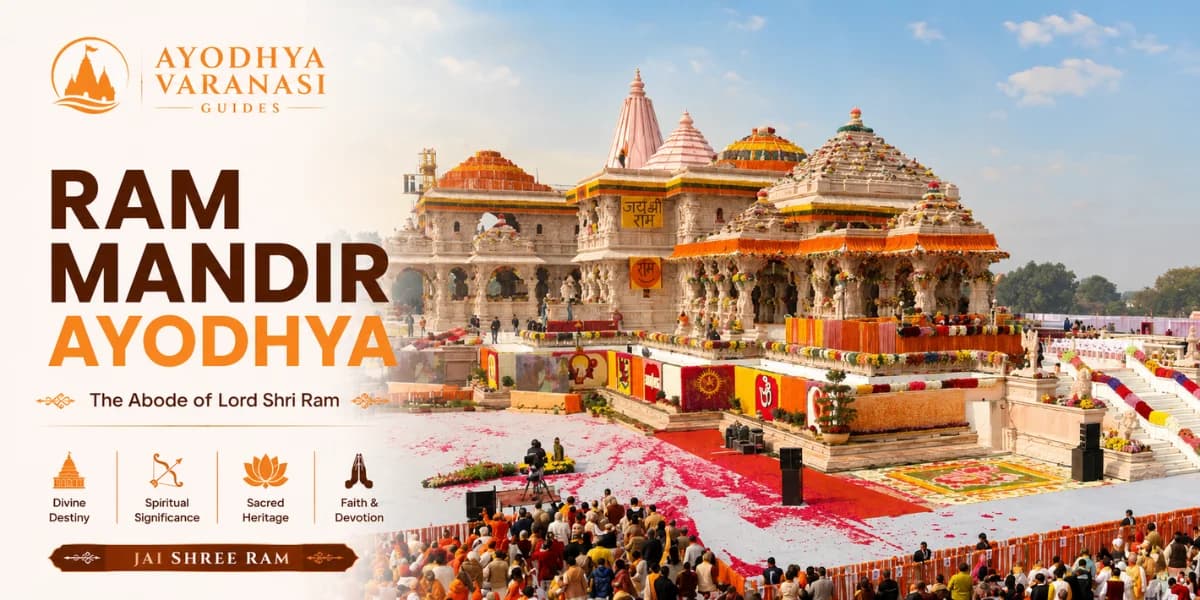
Shri Ram Janmabhoomi Mandir
Ayodhya · The birthplace of Lord Ram
4.9 / 5 · Darshan Help
Ram Mandir · Sugam Darshan
- Darshan Timings
- ~7:00–11:30 AM & 2:00–7:00 PM
- Deity
- Ram Lalla (Lord Ram as a child)
- Entry Fee
- Free · no ticket for general darshan
- Consecrated
- 22 January 2024 (Pran Pratishtha)
- Location
- Ram Janmabhoomi, Ramkot, Ayodhya 224123
- Time Needed
- 1.5–2 hours (2–3 hrs on peak days)
What Are the Ram Mandir Darshan and Aarti Timings? (2026)
The temple opens before dawn for the Mangala Aarti, and general darshan of Ram Lalla runs in two sessions — roughly 7:00 AM to 11:30 AM and 2:00 PM to 7:00 PM — with a midday break that catches out more visitors than anything else. The 7:00–11:00 AM window is the sweet spot: the temple is fresh from the morning aartis and queues have not yet peaked. Aarti attendance needs a separate free pass.
Morning Session
Best window · arrive by 6:30 AM
Midday Break
Temple closed for bhog & rest
Afternoon Session
Quieter after 4 PM on weekdays
Mangala Aarti
The first aarti · limited passes
Shringar Aarti
The deity is adorned
Sandhya Aarti
Evening aarti after darshan closes
Tip: published aarti times differ slightly between sources and shift with the season and the temple calendar — the Mangala Aarti is variously listed at 4:00 and 4:30 AM. Aarti passes are free but separate from darshan passes and are strictly limited. WhatsApp us and we will confirm the exact timings and pass availability for your travel date.
When Is the Best Month to Visit the Ram Mandir? (2026)
Ram Lalla darshan is open year-round, but weather and crowd levels swing enormously. October to March is the comfortable season; Ram Navami, Diwali Deepotsav and the Pran Pratishtha anniversary in January bring the largest crowds of the year.
September and February give the shortest queues. On Ram Navami and Deepotsav expect several lakh visitors in a single day — book Sugam Darshan and your stay weeks ahead.
The History, Architecture and Significance of the Ram Mandir
Why Is Ayodhya's Ram Mandir So Important?
The temple stands on Ram Janmabhoomi — revered by Hindus as the exact birthplace of Lord Ram, the seventh avatar of Vishnu and the central figure of the Ramayana. Ayodhya is one of the seven Sapta Puri, the holiest cities in Hinduism. The Pran Pratishtha of Ram Lalla on 22 January 2024 marked the culmination of a centuries-long movement and made this the most visited pilgrimage site in northern India.
What Does the Ram Lalla Idol Look Like?
The consecrated idol in the sanctum is Ram Lalla — Lord Ram as a five-year-old child. Sculpted by Arun Yogiraj from a single block of dark krishna shila stone from Karnataka, the 51-inch murti shows the child Ram standing, holding a golden bow and arrow, framed by an arch carrying the ten avatars of Vishnu. The dark stone is deliberate — it is resistant to the water and milk of daily abhishek.
How Big Is the Ram Mandir and What Style Is It Built In?
Designed by the Sompura family of temple architects, the mandir follows the North Indian Nagara style. It measures 380 ft long, 250 ft wide and 161 ft tall across three storeys, resting on 392 pillars with 44 doors and five mandapas — Nritya, Rang, Sabha, Prarthana and Kirtan. It is built from Rajasthan's Bansi Paharpur pink sandstone with a Makrana marble sanctum, and famously uses no iron or steel anywhere in the superstructure — the stone is interlocked, in the manner of temples built to last a millennium.
What Is the Surya Tilak on Ram Navami?
On Ram Navami, an engineered arrangement of mirrors and lenses channels a beam of sunlight onto the forehead of Ram Lalla at noon for a few minutes — the Surya Tilak. Designed with CBRI Roorkee and IIA Bengaluru, it echoes the Ramayana's description of Ram as a descendant of the Sun dynasty, the Suryavansh.
Is the Ram Mandir Complex Finished?
Yes. The Shri Ram Janmabhoomi Teerth Kshetra announced completion of all construction in 2025. The Ram Darbar — Ram, Sita, Lakshman, Bharat, Shatrughna and Hanuman — was consecrated on the first floor in June 2025, and on 25 November 2025 the sacred dhwaj was hoisted atop the 161-ft gold-plated shikhar, formally marking the temple complete. Access to the first floor has been restricted for general visitors — confirm the current position before you travel.
What Else Is Inside the Complex?
A 732-metre double-storey parkota (rampart wall) encircles the temple, with corner shrines to Surya, Bhagwati, Ganesh and Shiva, and shrines to Annapurna and Hanuman. The Saptmandir honours seven figures of the Ramayana — Maharshi Vashishtha, Vishwamitra, Agastya and Valmiki, Devi Ahilya, Nishadraj Guha and Mata Shabari — a deliberate acknowledgement of the tribal and marginalised devotees central to Ram's story.
Did you know? By long tradition, pilgrims take the blessings of Hanuman at Hanuman Garhi first — he is the Kotwal, the guardian who holds the keys to Ram's city — and only then proceed to Ram Lalla darshan. Almost no first-time visitor is told this.
How Do You Get Darshan at the Ram Mandir? Step by Step
The Ram Mandir has a strict, well-organised entry process, and knowing it in advance is the difference between a two-hour visit and a five-hour ordeal. Here is exactly how darshan works.
- 1
Book a free Sugam Darshan e-pass
Register on the official portal online.srjbtkshetra.org with a government photo ID and choose a date and time slot. Slots open at midnight, 15 days ahead, and peak dates fill within minutes. The pass is free — nobody should ever charge you for it.
- 2
Take Hanuman Garhi darshan first
Follow the local tradition of seeking Hanuman's blessings at Hanuman Garhi, roughly 1.5 km away, before entering Ram Janmabhoomi.
- 3
Leave phones and bags in a locker
Phones, cameras, smartwatches, power banks and bags are not permitted inside. Free lockers operate at the entry zone and around Ram Path — deposit everything before you join the queue.
- 4
Clear the security check
Carry your e-pass and the same government photo ID you registered with. Security is layered and thorough; allow extra time on festival days.
- 5
Walk the queue corridor
The covered corridor runs about 500 metres to the temple. With a Sugam pass expect roughly 30–45 minutes; without one, 60–90 minutes or considerably longer on peak days.
- 6
Climb the 32 steps to the sanctum
Thirty-two steps lead up to the Garbhagriha. Ramps and wheelchair assistance are available — ask staff at the entry point if you are travelling with elderly parents.
- 7
Darshan of Ram Lalla
You will have a short darshan of Ram Lalla in the sanctum — typically well under a minute at busy times. Keep moving with the queue and take it in rather than trying to linger.
- 8
Collect prasad and exit
Prasad is distributed at the exit. From here continue to Kanak Bhawan, Dashrath Mahal and the evening Saryu Aarti at Ram Ki Paidi.
What Is the Best Time to Visit the Ram Mandir?
The season, the hour and the festival calendar together decide whether you have a calm darshan or spend half a day in a queue. Here is how to choose.
Best Season — October to March
Ayodhya's winter is cool and dry, ideal for the walk through the queue corridor and for combining Ram Mandir with Hanuman Garhi, Kanak Bhawan and the Saryu Aarti. Avoid May–June, when it crosses 40°C and stone floors get hot underfoot.
Best Time of Day — 7 to 9 AM
Arrive at the entry gate by 6:30 AM for the opening of the morning session. This is the shortest queue of the day and the most peaceful darshan. The 4 PM onwards slot on a weekday is the quiet second-best.
Most Spectacular — Ram Navami & Deepotsav
Ram Navami brings the Surya Tilak at noon, and the Deepotsav around Diwali lights Ayodhya with millions of diyas. Both are unforgettable and both draw several lakh people in a day — book darshan, transport and stay weeks in advance.
What Can You See Inside the Ram Mandir Complex?
Most visitors see only the sanctum and leave. The complex is far larger than the main temple, and knowing what surrounds it turns a 40-minute queue into a proper pilgrimage.
The Garbhagriha — Ram Lalla
Top PickThe Main Darshan
The Makrana marble sanctum on the ground floor holds the 51-inch Ram Lalla idol carved by Arun Yogiraj, reached by 32 steps and framed by a gold-plated doorway.
Ram Darbar (First Floor)
Consecrated June 2025
The full court of Ram — with Sita, Lakshman, Bharat, Shatrughna and Hanuman — enshrined on the first floor. General access has been restricted; check the current position on arrival.
The Parkota & Corner Shrines
732-metre Rampart
The double-storey wall encircling the temple, with shrines at its four corners to Surya, Bhagwati, Ganesh and Shiva, plus the Annapurna and Hanuman temples.
Saptmandir
Seven Rishi Shrines
Temples to Maharshi Vashishtha, Vishwamitra, Agastya and Valmiki, Devi Ahilya, Nishadraj Guha and Mata Shabari — the sages and devotees of the Ramayana.
The Five Mandapas
Nagara Architecture
Nritya, Rang, Sabha, Prarthana and Kirtan mandapas run along the temple's axis, their 392 pillars carved with deities and dancing figures.
Kuber Tila & the Ancient Shiva Temple
Within the Grounds
A restored mound in the southwest of the complex with an ancient Shiva temple and a statue of Jatayu — quiet, and skipped by almost everyone.
What Is Not Allowed Inside the Ram Mandir?
The single most common reason visits go wrong. Security is strict and there is no arguing at the gate — read this before you leave your hotel.
Phones, Cameras & Smartwatches
Mobile phones, cameras, smartwatches, power banks and all personal electronics are prohibited inside the complex. Photography of the sanctum is not permitted. Deposit everything in a locker before you queue.
Bags, Belts & Sharp Objects
Large bags, backpacks, sharp objects, lighters, tobacco and outside food are not allowed through security. Carry only your ID and a small wallet.
Free Locker Facility
Free lockers operate near the entry zone, with additional official centres run by Nagar Nigam Ayodhya around Ram Path, Beniganj and the dharamshalas. Arrive 20–30 minutes early to use them without rushing.
Dress Code
Modest, traditional clothing — kurta-pyjama, saree, salwar-kameez, or full-length trousers with a sleeved top. Carry a dupatta for shoulder cover. Slip-on footwear saves time; it is removed before entry.
Is There Any Entry Fee for Ram Mandir Darshan?
No. Both general darshan and the Sugam Darshan e-pass are completely free — the Trust operates no paid or VIP darshan whatsoever. Anyone charging you for a Ram Mandir pass is running a scam. The only real costs of a visit are transport, prasad and any guide or aarti arrangement you choose.
Darshan is free. What we charge for is the planning — a certified local guide, AC transport, Sugam Darshan and aarti pass assistance, and an itinerary timed around the queue. Every quote is confirmed in writing, with no advance payment.
Book passes only on the official srjbtkshetra.org domain. The Trust has repeatedly warned against fake booking sites and paid 'VIP darshan' agents.
Ram Mandir Darshan — Reviews from Our Guests
2,864 verified reviews
We had no idea phones were banned inside. Our guide told us the night before, arranged the locker and had our Sugam passes ready with the IDs matched. Darshan took 35 minutes on a Saturday. Without them we would have wasted half the day.
Rajesh Agarwal
Indore
Travelled with my 78-year-old father. The team arranged wheelchair assistance at the 32 steps and timed our slot for the quiet afternoon session. He got a proper darshan without exhaustion. Genuinely thoughtful people.
Meenakshi Nair
Kochi
Booked the 5-day Ayodhya Prayagraj Varanasi circuit. The guide explained the Nagara architecture, the 392 pillars and the Saptmandir — things we would never have noticed. Took us to Hanuman Garhi first as tradition requires.
Sanjay Deshmukh
Pune
Visited on the Pran Pratishtha anniversary. Enormous crowd but the planning was flawless — early start, right gate, no confusion. Honest pricing, nothing hidden, and they never once asked for advance payment.
Poonam Sharma
Jaipur
The Mangala Aarti pass is very hard to get and they were upfront that it might not come through, then managed it. Standing there at 4 AM was the moment of the trip. Straightforward, no false promises.
Arvind Kumar
Hyderabad
How Do You Plan a Perfect Ayodhya Darshan Day?
One well-sequenced day covers the Ram Mandir and everything around it. This is the plan our guests follow — built around the queue, not against it.
Hanuman Garhi darshan. Begin as tradition asks — the blessings of Hanuman, Kotwal of Ayodhya, before entering Ram's city. The 76 steps are peaceful at this hour.
Reach the Ram Mandir entry gate. Deposit phones and bags in the locker, clear security and be in the corridor as the morning session opens.
Ram Lalla darshan. The shortest queue of the day. With a Sugam pass, expect to be through in 30–45 minutes.
Kanak Bhawan & Dashrath Mahal. The ornate 'golden palace' gifted to Sita, and the palace of King Dashrath — both a short walk from the mandir.
Nageshwarnath & old Ayodhya. The ancient Shiva temple founded by Ram's son Kush, and the lanes and ghats of the old town.
Sita Ki Rasoi & Mani Parvat. Sita's sacred kitchen and the hillock said to be a fragment of Hanuman's Sanjeevani mountain.
Saryu Aarti at Ram Ki Paidi. Close the day with the evening Saryu Aarti on the riverfront — lamps, bells and the river at dusk.
Which Tour Package Covers Shri Ram Janmabhoomi Mandir?
Most visitors reach Shri Ram Janmabhoomi Mandir as part of a wider Ayodhya darshan rather than as a trip of its own. These are the itineraries our guests book most — each one includes Ram Mandir darshan with Sugam (VIP) assistance, a certified local guide, comfortable transport and pricing confirmed in writing before you travel.
- 1 Day1 Day Ayodhya Tour PackageRam Mandir darshan, Hanuman Garhi and the Saryu Aarti in a single day.
- 2 Days2 Days Ayodhya Tour PackageThe full Ramkot temple circuit at an unhurried pace, with an evening on the Saryu.
- 3 Days3 Days Ayodhya Tour PackageAyodhya in depth — the temples, the mounds, Guptar Ghat and the lesser-known shrines.
- 2 Days2 Days Ayodhya Varanasi Tour PackageRam Mandir and Kashi Vishwanath across two cities, with the Ganga Aarti.
- 3 Days3 Days Ayodhya Varanasi Tour PackageThe classic pairing — Ram Mandir, Kashi Vishwanath and the ghats.
- 3 Days3 Days Ayodhya Prayagraj Tour PackageRam Mandir darshan with the Triveni Sangam snan.
- 4 Days4 Days Ayodhya Varanasi Prayagraj Tour PackageAll three cities — Ram Mandir, Kashi Vishwanath and the Triveni Sangam.
- 5 Days5 Days Ayodhya Varanasi Prayagraj Tour PackageThe complete sacred circuit at a comfortable, senior-friendly pace.
Want Shri Ram Janmabhoomi Mandir built into a custom itinerary? We plan around your dates, your pace and what you actually want to see.
See all Ayodhya & Varanasi tour packagesHow Do You Reach the Ram Mandir in Ayodhya?
The Ram Mandir sits in Ramkot, central Ayodhya, reached along the newly built Ram Path. Ayodhya now has its own international airport and a redeveloped railway station, so getting here is far easier than it was even three years ago. Vehicles stop at designated points — the final stretch to the entry gate is on foot.
By Air
Maharishi Valmiki International Airport, Ayodhya Dham is ~10 km from the mandir with flights from Delhi, Mumbai, Bengaluru and Ahmedabad. Lucknow's Chaudhary Charan Singh airport (~135 km) has far wider connectivity.
By Train
Ayodhya Dham Junction, redeveloped in 2023, is ~2 km away and connected to Delhi, Lucknow, Varanasi, Prayagraj and Mumbai. Ayodhya Cantt (Faizabad) is the second station, ~8 km out.
By Road / Taxi
Ayodhya lies on NH-27, with the Ram Path, Bhakti Path and Dharma Path built specifically to move pilgrims to the mandir. ~135 km from Lucknow, ~165 km from Prayagraj, ~200 km from Varanasi.
The Final Approach
Private vehicles stop at designated parking on Ram Path and Birla Dharamshala. From there take an e-rickshaw or walk to the entry gate — deposit phones in a locker on the way.
Ram Mandir Location — Ramkot, Ayodhya
The Shri Ram Janmabhoomi Mandir stands in Ramkot, the historic heart of Ayodhya, with Hanuman Garhi and Kanak Bhawan within walking distance. Use the map below to navigate to the entry gate.
Ayodhya
- Area: Ramkot, Ayodhya — on Ram Path
- PIN: Ayodhya 224123
- From Ayodhya Dham Junction: ~2 km
- From Hanuman Garhi: ~1.5 km
- Access: Walk / e-rickshaw · 32 steps to sanctum
Where Should You Stay Near the Ram Mandir?
Staying close to Ram Path is worth a great deal here — the 6:30 AM start is far easier when the mandir is a ten-minute walk away. These are the areas we book for our guests.
Ram Path & Ramkot
New hotels, dharamshalas and guesthouses along Ram Path, minutes from the entry gate and Hanuman Garhi. The right choice if you want the early-morning session without a commute.
Near Ram Ki Paidi / Saryu
Riverside stays close to Ram Ki Paidi — ideal if the evening Saryu Aarti matters to you, and quieter than the temple precinct at night.
Ayodhya Dham & Faizabad
Branded and mid-range hotels with better rooms, dining and parking, roughly 15–30 minutes from the mandir by taxi. Better value on peak dates when Ram Path rates surge.
Which Temples Should You Visit Near the Ram Mandir?
The Ram Mandir takes a morning. Ayodhya deserves a full day — here is what to pair it with, most of it within a couple of kilometres.
Hanuman Garhi
The fort-like hilltop shrine of Bal Hanuman, ~1.5 km away — visited before Ram Lalla darshan by long tradition.
Kanak Bhawan
The ornate 'golden palace' said to have been gifted to Sita by Queen Kaikeyi — one of Ayodhya's most beautiful temples.
Sita Ki Rasoi
The sacred kitchen of Goddess Sita, honoured as a form of Annapurna, a short walk from the Janmabhoomi.
Nageshwarnath Temple
One of Ayodhya's oldest Shiva temples, traditionally founded by Kush, the son of Lord Ram.
Ram Ki Paidi & Saryu Aarti
The riverfront steps on the Saryu where the evening aarti is performed — the best way to end an Ayodhya day.
Mani Parvat
The hillock believed to be a fragment of the Sanjeevani mountain dropped by Hanuman, with fine views over the city.
Guptar Ghat
The peaceful ghat where Lord Ram is believed to have taken Jal Samadhi and returned to his divine abode.
All Ayodhya, Varanasi & Prayagraj Temples
The complete list of temples and sacred sites across the three cities, each with darshan timings and a full guide.
Ram Navami & Deepotsav at the Ram Mandir
Ram Navami — the birth of Lord Ram — is the greatest day of the year here. At noon, mirrors and lenses engineered with CBRI Roorkee channel sunlight onto the forehead of Ram Lalla for the Surya Tilak, a few minutes that draw devotees from across the world.
Around Diwali, Ayodhya's Deepotsav lights the Saryu ghats with millions of diyas in a record-setting display, and 22 January marks the Pran Pratishtha anniversary. Each of these days brings several lakh visitors — extraordinary to witness, and impossible to manage without planning transport, darshan slots and stay well in advance.
Things to Know Before Visiting the Ram Mandir
Locally verified, practical and specific. These are the things our guides tell every guest the night before darshan.
Book the Sugam pass 15 days ahead
Slots release at midnight, exactly 15 days before the date, on online.srjbtkshetra.org — and peak dates are gone within minutes. Set an alarm.
Your ID must match the booking
Carry the same government photo ID you registered with. A mismatch at security means you do not get in, pass or no pass.
Leave your phone in the hotel or a locker
Phones, cameras, smartwatches and power banks are all prohibited. Free lockers exist, but using one adds 20–30 minutes on a busy morning.
Visit Hanuman Garhi first
Local tradition asks that you take Hanuman's blessings before Ram Lalla's darshan. It also happens to be beautiful at sunrise.
Mind the midday break
The temple closes roughly 11:30 AM to 2:00 PM. Arriving at noon is the single most common wasted trip we see.
There are 32 steps to the sanctum
Ramps and wheelchair assistance are available — ask at the entry point rather than at the steps if you are travelling with elderly parents.
Wear slip-on footwear
Footwear is removed before entry, and slip-ons save real time in a queue of thousands. Carry socks in winter — the marble is bitterly cold before dawn.
Nobody can sell you a VIP pass
The Trust runs no paid darshan of any kind. Both the darshan pass and the aarti pass are free. Anyone charging for one is a fraud.
Aarti passes are separate and scarce
Attending the Mangala or Shringar Aarti needs its own free pass, issued in very limited numbers. Request it well ahead and have a backup plan.
Allow 1.5–2 hours, more on peak days
Between the locker, security, the 500-metre corridor and the queue, budget two hours. On Ram Navami or Deepotsav, budget half a day.
Ram Mandir Ayodhya — Frequently Asked Questions
The questions pilgrims ask us most about Ram Lalla darshan — timings, Sugam Darshan booking, entry rules, dress code, architecture and how to plan the day.
General darshan of Ram Lalla runs in two sessions — roughly 7:00 AM to 11:30 AM and 2:00 PM to 7:00 PM — with the temple closed in between. The 7:00–11:00 AM window has the shortest queue. Timings shift slightly with the season and the temple calendar, so confirm before you travel.
Still have a question?
Our local team replies within 30 minutes.
Written & verified by the local Ayodhya guide team at Ayodhya Varanasi Guides
Our government-certified Ayodhya guides take pilgrims through Ram Mandir darshan every day and deal with the Sugam Darshan portal, the locker queues and the aarti passes first-hand. This guide is reviewed regularly against on-ground conditions. Last updated: August 2026. Darshan and aarti timings can change on festivals and by order of the Trust — message us for the position on your travel date.
Have a calm, unhurried darshan of Ram Lalla
Let Ayodhya Varanasi Guides handle the parts that go wrong — the Sugam Darshan slot booked the moment it opens, ID checks matched, lockers sorted, and a day timed around the queue rather than into it. Hanuman Garhi first, then Ram Lalla, Kanak Bhawan and the evening Saryu Aarti, with a certified local guide and comfortable transport. Confirmed in writing, no advance payment.