
Surya Kund, Ayodhya — The Sun Temple of the Suryavanshis
Surya Kund at Darshan Nagar, Ayodhya is an ancient sacred tank with a temple of Surya Dev, the Sun God — and it carries a significance most visitors miss. Lord Ram belonged to the Ikshvaku or Suryavanshi dynasty, the solar line, and Surya was their kul devta. This is where those kings worshipped their dynastic lord. Also called Ghoshark Teerth, after King Gosha of the Ikshvakus, tradition holds that Surya himself stayed here for a month after attending Lord Ram’s coronation. The rectangular kund has been restored under a ₹40.95 crore project. Entry is free, and Makar Sankranti is the great day.
- Timings
- ~6 AM–8 PM daily
- Significance
- Kul devta of Ram's solar dynasty
- Also Known As
- Suraj Kund · Ghoshark Teerth
- Entry
- Free · no ticket
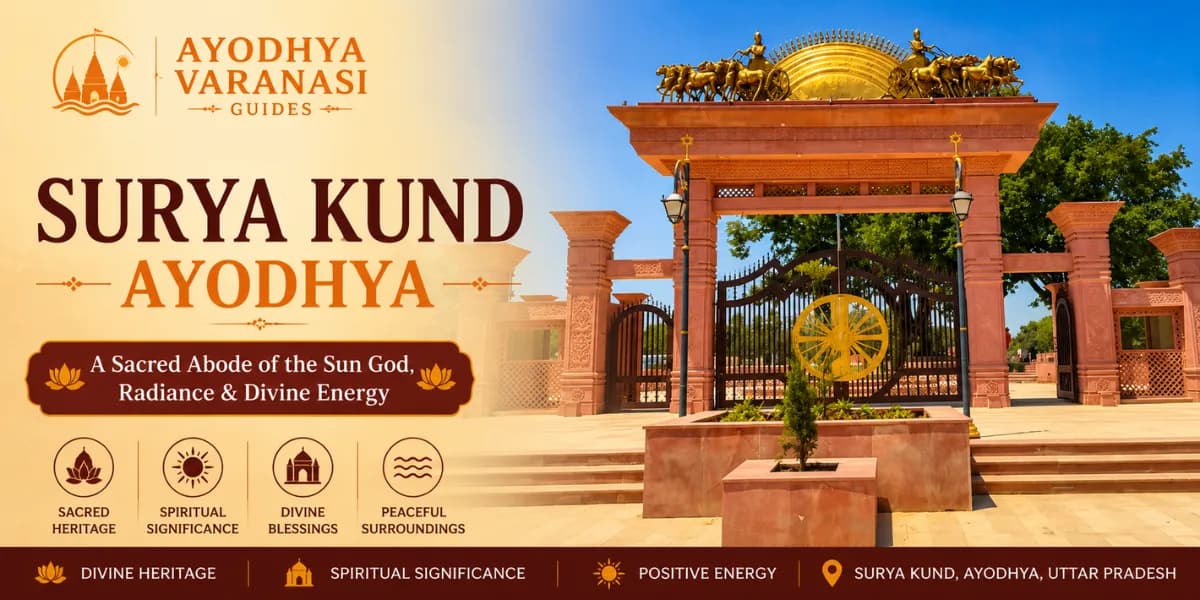
Surya Kund
Darshan Nagar, Ayodhya · The Solar Dynasty's Tirth
4.9 / 5 · Ayodhya Darshan Help
Heritage · Ram Mandir
- Timings
- ~6:00 AM – 8:00 PM, daily
- Deity
- Surya Dev, the Sun God
- Significance
- Dynastic shrine of the Ikshvaku Suryavanshis
- Also Known As
- Suraj Kund · Ghoshark Teerth · Pracheen Kund
- Entry
- Free · no ticket required
- Location
- Darshan Nagar, Ayodhya
What Are the Surya Kund Timings?
Surya Kund is an open tank with a temple beside it rather than a walled shrine, so it is visited in daylight — generally around 6:00 AM to 8:00 PM. Entry is free. Since this is a Sun temple, the natural hours to come are sunrise and sunset, and following the ₹40.95 crore restoration the site is lit and landscaped for evening visits too.
Sunrise (Best)
Arghya to the rising sun; the fitting hour
Daytime
Open, but hot and exposed in summer
Sunset (Best)
Golden light on the water
Evening
Lit and landscaped after restoration
Surya Arghya
Water offered to the rising sun
Snan at the Kund
Steps lead down to the water
Makar Sankranti
The great day for Sun worship
Chhath Puja
The festival of the Sun God
Tip: come at sunrise. This is a Sun temple, the whole point of the site is the sun, and offering arghya to the rising sun over the kund is an experience the middle of the day cannot give you. WhatsApp us and we will build an early Darshan Nagar run into your Ayodhya day.
When Is the Best Month to Visit Surya Kund? (2026)
Surya Kund is an open-air site, so the weather matters. October to March is the comfortable window, and Makar Sankranti in January is by far the biggest day of the year here.
Makar Sankranti in January is the biggest day of the year at a Sun temple, and Chhath Puja in October or November is the other great occasion. Most other days are quiet.
Why Is Surya Kund Sacred to Lord Ram's Dynasty?
What Is Surya Kund?
Surya Kund — also called Suraj Kund — is an ancient sacred tank at Darshan Nagar in Ayodhya, with a temple of Surya Dev, the Sun God, beside it. It is a rectangular pool with a flight of steps leading down to the water, where devotees take a ritual dip and offer prayers to the sun.
Why Does the Sun Matter So Much in Ayodhya?
Because of who ruled here. Lord Ram belonged to the Ikshvaku dynasty — the Suryavansh, the solar line — and Surya Dev was their kul devta, the dynastic deity of the house. Every king of that line traced his descent from the Sun. Surya Kund is where those kings came to worship their own ancestor-god, which makes it one of the most genealogically significant sites in the city.
What Is Ghoshark Teerth?
The kund is also known as Ghoshark Teerth, named after King Gosha of the Ikshvaku dynasty, whose line worshipped Suryadeva at this site. The older name Pracheen Kund — the ancient tank — is used as well, and each of the three names carries a piece of what the place is.
What Is the Legend of Ram's Coronation?
A lovely one. Puranic tradition holds that when Lord Ram was crowned king of Ayodhya, every god and goddess came to witness the coronation — and among them Surya, who did not leave immediately afterwards but stayed on for a month near what is now Darshan Nagar. The Sun God lingering to be near his own descendant is the story behind the site.
Who Was King Darshan?
In the 19th century, a Suryavanshi ruler named King Darshan — a descendant of the line of Lord Ram — is said to have unearthed an idol of Surya Dev and a Shivlinga near the kund. Some accounts credit him with building the kund in its present form. The surrounding area, Darshan Nagar, is named after him.
What Has the Restoration Changed?
A great deal. Surya Kund has been redeveloped under a project costing around ₹40.95 crore, with the tank restored, the surroundings landscaped and lighting installed. A site that had faded into neglect is now one of the better-presented heritage places in Ayodhya — and, unusually, it is genuinely worth visiting in the evening as well as at dawn.
Did you know? Ayodhya was the capital of the Suryavansh — the solar dynasty — while Krishna’s line, the Yaduvanshis, belonged to the Chandravansh, the lunar dynasty. Surya Kund is where the solar half of that ancient division was worshipped.
What Do You Do at Surya Kund?
A simple, open site with no queue and no ticket. Here is how a visit unfolds — ideally at sunrise.
- 1
Come Out to Darshan Nagar
The kund is at Darshan Nagar, a short drive from central Ayodhya on the Faizabad side. Autos and taxis reach it easily.
- 2
Arrive Before Sunrise
This is a Sun temple. Arriving in the dark and watching the sun come up over the water is the whole experience.
- 3
Walk Down the Steps
The rectangular kund has a flight of steps leading down to the water, restored under the recent redevelopment.
- 4
Offer Arghya to the Rising Sun
Devotees offer water to the sun as it rises — the traditional Surya arghya, performed here for as long as anyone can trace.
- 5
Take a Dip if You Wish
Pilgrims bathe in the kund as part of the ritual. Carry dry clothes; facilities are basic.
- 6
Have Darshan at the Surya Temple
The temple beside the kund holds the image of Surya Dev, the kul devta of Lord Ram's own dynasty.
- 7
Hear the Coronation Story
Ask your guide about Surya staying a month after Ram's rajyabhishek — the legend that explains why this spot, and not another.
- 8
See the Restored Grounds
The landscaping and lighting from the recent project make the site pleasant to walk, and worth a return visit after dark.
When Should You Visit Surya Kund?
At a Sun temple the hour genuinely matters more than at any other site in Ayodhya.
Best Time of Day — Sunrise
Come before dawn and watch the sun rise over the kund. Offering arghya to the rising sun at the tirth of the solar dynasty is the point of the place, and midday gives you none of it.
Best Season — October to March
Comfortable weather for an open-air site with little shade. November to February is ideal. Between April and June, restrict yourself to sunrise.
Most Special — Makar Sankranti & Chhath
Makar Sankranti in mid-January — the day the sun turns north — is the greatest festival at any Surya temple, and the kund fills with devotees. Chhath Puja is the other great Sun festival here.
What Can You See at Surya Kund?
A compact site, restored and well presented, carrying an unusually deep piece of Ayodhya's story.
The Sacred Kund
Top PickThe Ancient Tank
A rectangular pool with steps leading down to the water, where devotees have taken the ritual dip for centuries. Restored under the recent redevelopment.
The Surya Temple
Top PickThe Sun God
The temple beside the kund holding the image of Surya Dev — the kul devta of the Ikshvaku Suryavanshis, Lord Ram's own dynasty.
The Suryavanshi Connection
Ram's Own Lineage
The reason the site matters. This is where the kings of the solar line came to worship the deity they claimed descent from.
The Restored Grounds
₹40.95 Crore Project
Landscaping, lighting and restored steps from the recent redevelopment, which has transformed a neglected site.
Darshan Nagar
Named After a King
The surrounding area, named for the 19th-century Suryavanshi ruler King Darshan, who is said to have unearthed the Surya idol here.
Why Is Surya Kund Worth the Trip From Central Ayodhya?
It sits outside the main temple cluster, so most visitors never come. Here is what they miss.
The Dynastic Shrine of Ram's Line
Ayodhya is full of temples to Ram. This is the temple to the deity Ram's own family worshipped — a different and older layer of the story.
Sunrise Over the Kund
Offering arghya to the rising sun at the tirth of the solar dynasty is the single most atmospheric hour available in Ayodhya outside the Saryu Aarti.
Genuine Quiet
Outside Makar Sankranti this site is calm and uncrowded all year, which after the Ram Mandir queues is worth a great deal.
Newly Restored
A ₹40.95 crore redevelopment has turned a neglected tank into one of the better-presented heritage sites in the city.
Is There an Entry Fee at Surya Kund? (2026)
Entry is completely free — there is no ticket for the kund or the Surya temple. Your only cost is the ride out to Darshan Nagar.
The site costs nothing. What we add is the routing — Surya Kund lies on the Darshan Nagar side of Ayodhya, in the same direction as Guptar Ghat. Doing them together on one run makes sense; visiting each separately wastes half a day. Pricing confirmed in writing.
Auto and taxi fares are indicative and vary with season, distance and time of day.
What Do Visitors Say About Surya Kund?
1,054 verified reviews
We went at sunrise and offered arghya standing at the kund. Being told there that this was the deity of Lord Ram's own dynasty, at the place his ancestors worshipped, gave me a shiver.
Yogendra Pratap Singh
Varanasi
Visited on Makar Sankranti. Packed with devotees, wonderful atmosphere, very well managed after the renovation. The site looks nothing like the old photographs — it has been beautifully restored.
Sarita Mehrotra
Delhi
Quiet, clean and completely uncrowded when we went. Our guide explained the Suryavansh and Chandravansh division, which finally made sense of a lot of things we had heard.
K. Balasubramaniam
Chennai
We combined it with Guptar Ghat since both are on the same side of Ayodhya, which the guide suggested. Sensible planning — it would have been two separate trips otherwise.
Nidhi Agarwal
Kanpur
Worth the drive out from the main temples. Little shade so go early or late. Free entry and no touts at all. The evening lighting after the restoration is quite something.
Ashutosh Rai
Gorakhpur
How Do You Fit Surya Kund Into an Ayodhya Day?
Surya Kund is on the Darshan Nagar side, the same direction as Guptar Ghat — so one run covers both. Here is the day we plan.
Sunrise at Surya Kund. Begin at the kund for the rising sun and arghya at the tirth of Lord Ram's solar dynasty.
Return for Hanuman Garhi. Back into the city for the guardian of Ayodhya, as tradition asks, before Ram Lalla.
Ram Janmabhoomi (Ram Lalla). Darshan at the Ram Mandir. We assist with Sugam (VIP) Darshan so you are not queuing for hours.
Kanak Bhawan & Sita Ki Rasoi. The Ramkot cluster — the golden palace and the sacred kitchen of Goddess Sita.
Valmiki Bhawan. The midday stop, open when the Ramkot temples close — the whole Ramayana in marble.
Guptar Ghat. Out to the Saryu on the Faizabad side, where Lord Ram is believed to have taken Jal Samadhi.
Saryu Aarti at Ram Ki Paidi. Close the day on the riverfront with the evening aarti.
Which Tour Package Covers Surya Kund?
Most visitors reach Surya Kund as part of a wider Ayodhya darshan rather than as a trip of its own. These are the itineraries our guests book most — each one includes Ram Mandir darshan with Sugam (VIP) assistance, a certified local guide, comfortable transport and pricing confirmed in writing before you travel.
- 1 Day1 Day Ayodhya Tour PackageRam Mandir darshan, Hanuman Garhi and the Saryu Aarti in a single day.
- 2 Days2 Days Ayodhya Tour PackageThe full Ramkot temple circuit at an unhurried pace, with an evening on the Saryu.
- 3 Days3 Days Ayodhya Tour PackageAyodhya in depth — the temples, the mounds, Guptar Ghat and the lesser-known shrines.
- 2 Days2 Days Ayodhya Varanasi Tour PackageRam Mandir and Kashi Vishwanath across two cities, with the Ganga Aarti.
- 3 Days3 Days Ayodhya Varanasi Tour PackageThe classic pairing — Ram Mandir, Kashi Vishwanath and the ghats.
- 3 Days3 Days Ayodhya Prayagraj Tour PackageRam Mandir darshan with the Triveni Sangam snan.
- 4 Days4 Days Ayodhya Varanasi Prayagraj Tour PackageAll three cities — Ram Mandir, Kashi Vishwanath and the Triveni Sangam.
- 5 Days5 Days Ayodhya Varanasi Prayagraj Tour PackageThe complete sacred circuit at a comfortable, senior-friendly pace.
Want Surya Kund built into a custom itinerary? We plan around your dates, your pace and what you actually want to see.
See all Ayodhya & Varanasi tour packagesHow Do You Reach Surya Kund in Ayodhya?
Surya Kund is at Darshan Nagar, on the Faizabad side of Ayodhya, about 8 km from Ram Ki Paidi. You will need a vehicle rather than a walk.
By Road / Taxi
The practical option. A taxi or auto from central Ayodhya takes about 20 to 30 minutes. Ask for Surya Kund or Suraj Kund, Darshan Nagar.
By Train
Darshan Nagar has its own halt, and Ayodhya Cantt is about 5 km away. Ayodhya Dham Junction is roughly 8 km.
By Air
Maharishi Valmiki International Airport, Ayodhya Dham is roughly 8 km away, with taxis at the terminal. Lucknow airport (~135 km) is the larger alternative.
Combine It With Guptar Ghat
Both lie on the Faizabad side of Ayodhya. Doing them on one run out of the city saves a good deal of doubling back.
Where Is Surya Kund Located in Ayodhya?
Surya Kund lies at Darshan Nagar, on the Faizabad side of Ayodhya, about 8 km from Ram Ki Paidi and close to Guptar Ghat. Use the map below to navigate.
Ayodhya
- Area: Darshan Nagar, Ayodhya
- PIN: Ayodhya 224135
- From Ram Ki Paidi: ~8 km
- From Guptar Ghat: ~6 km
- Also known as: Suraj Kund · Ghoshark Teerth
Where Should You Stay to Visit Surya Kund?
Surya Kund is a trip out from the city rather than an overnight stop, so stay centrally and drive out at dawn.
Ayodhya Dham / Faizabad
Branded and mid-range hotels on this side of the city, which shortens the pre-dawn drive to the kund and to Guptar Ghat.
Naya Ghat & Ram Ki Paidi
Riverside stays near the main ghats and the evening Saryu Aarti, about 25 minutes from Surya Kund by road.
Ramkot & Ram Path
Stays near the Ram Janmabhoomi, Hanuman Garhi and Kanak Bhawan — ideal if early-morning Ram Lalla darshan is your priority.
What Else Can You Visit Near Surya Kund?
Surya Kund sits on the Faizabad side of Ayodhya, which puts Guptar Ghat naturally on the same run.
Guptar Ghat
The tranquil Saryu ghat where Lord Ram is believed to have taken Jal Samadhi, ~6 km away on the same side of the city.
Ram Mandir (Ram Janmabhoomi)
The grand temple of Ram Lalla, ~8 km away. We assist with Sugam (VIP) Darshan to skip the queue.
Ram Ki Paidi & Saryu Aarti
The riverfront steps on the Saryu and the evening aarti — the natural close to an Ayodhya day.
Tulsi Smarak Bhawan
The Tulsidas memorial with a free Ramlila performed every evening from 6 to 9 PM.
Valmiki Ashram (Valmiki Bhawan)
The marble temple where all 24,000 verses of the Valmiki Ramayana are inscribed on the walls.
Mani Parvat
The 65-foot sacred mound linked to Hanuman's Sanjeevani mountain, with the best views over Ayodhya.
Makar Sankranti & Chhath Puja at Surya Kund
Makar Sankranti, in mid-January, is the greatest day of the year at any Surya temple — the day the sun begins its northward journey. Devotees throng Surya Kund for the ritual dip and to offer arghya to the rising sun, and the whole site comes alive in a way it does at no other time.
Chhath Puja in October or November is the other great festival of the Sun God, observed with offerings to the setting and rising sun at the water’s edge. Ram Navami and Deepotsav fill the wider city. Plan transport in advance for any of these dates.
What Should You Know Before Visiting Surya Kund?
A simple site to visit — the planning is mostly about the hour and the direction.
Go at sunrise
It is a Sun temple. Arriving at midday gives you an ordinary tank; arriving at dawn gives you the reason the place exists.
You will need a vehicle
Darshan Nagar is about 8 km from central Ayodhya. Book a taxi or auto for the round trip — it is not walkable from the temple cluster.
Combine it with Guptar Ghat
Both are on the Faizabad side, about 6 km apart. Doing them on one run saves you a wasted second trip out of the city.
Carry dry clothes for a dip
Pilgrims bathe in the kund as part of the ritual. Changing facilities are basic, so come prepared.
Little shade at the kund
It is an open site. Between April and June, restrict your visit to sunrise and carry water.
Makar Sankranti is very busy
Mid-January brings the largest crowds of the year. Start early and expect crowds around the steps.
The site has been restored
A ₹40.95 crore redevelopment has restored the tank and added landscaping and lighting — it looks nothing like older photographs.
Worth an evening visit too
Unusually for an Ayodhya heritage site, the lighting after restoration makes this pleasant after dark as well as at dawn.
Ask about the Suryavansh
The site only makes sense once someone explains that Lord Ram's dynasty claimed descent from the Sun. A guide turns a tank into a lineage.
Dress modestly
Standard temple etiquette applies at the Surya temple beside the kund, with footwear removed before entering.
Surya Kund Ayodhya — Frequently Asked Questions
The questions visitors ask us most about Surya Kund — the Suryavanshi connection, timings, the restoration, Makar Sankranti and how to reach Darshan Nagar.
Surya Kund, also called Suraj Kund, is an ancient sacred tank at Darshan Nagar in Ayodhya with a temple of Surya Dev, the Sun God, beside it. It is a rectangular pool with steps leading down to the water where devotees take a ritual dip.
Still have a question?
Our local team replies within 30 minutes.
Written & verified by the local Ayodhya guide team at Ayodhya Varanasi Guides
Our government-certified guides take visitors out to Surya Kund for sunrise through the year, including on Makar Sankranti when the kund fills with devotees. Last updated: July 2026. Access and facilities have changed considerably since the restoration — message us for the current position on your travel date.
Offer Arghya to the Rising Sun at Surya Kund
Let Ayodhya Varanasi Guides plan your Ayodhya darshan — sunrise at Surya Kund and Guptar Ghat on one run, the Ram Mandir with Sugam Darshan assistance, the Ramkot temples and the evening Saryu Aarti — with a guide who can explain the solar dynasty of Lord Ram. Confirmed in writing.