
New Vishwanath Temple, BHU — Birla Mandir, Timings & Visitor Guide
The New Vishwanath Temple — widely called the Birla Mandir — stands on the Banaras Hindu University campus and is a replica of the original Kashi Vishwanath. It was conceived by Pandit Madan Mohan Malaviya, founder of BHU, and built by the Birla family: foundation laid in 1931, completed in 1966 after 35 years. Its white marble shikhar rises about 77 metres (250 feet) — the tallest temple tower in the world, taller than the Qutub Minar. The entire Bhagavad Gita is etched into the marble walls. Entry is free, and Malaviya insisted it be open to people of every caste and faith.
- Timings
- ~4 AM–12 PM & 1 PM–9 PM
- Shikhar
- ~77 m · tallest in the world
- On the Walls
- The whole Bhagavad Gita in marble
- Entry
- Free · open to all
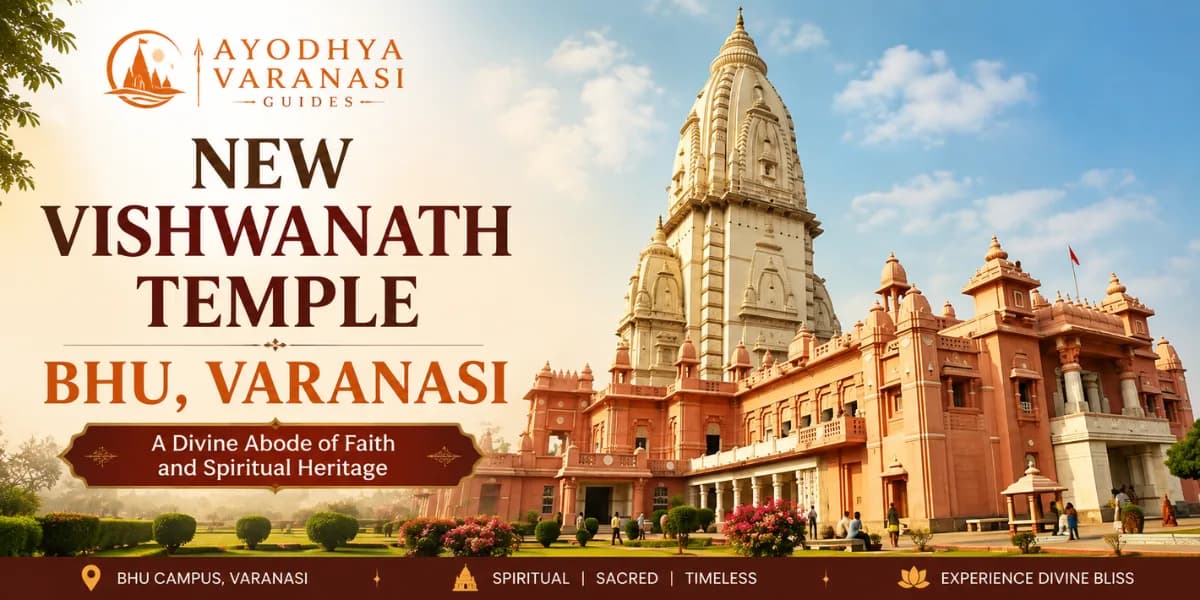
New Vishwanath Temple
BHU, Varanasi · The Birla Mandir
4.9 / 5 · Kashi Darshan Help
Temples · Ghats · Aarti
- Timings
- ~4:00 AM–12:00 PM & 1:00 PM–9:00 PM
- Deity
- Lord Shiva as Vishwanath
- Famous For
- The tallest temple shikhar in the world
- Built
- 1931–1966 by the Birla family
- Entry
- Free · open to all castes and faiths
- Location
- BHU campus, Lanka, Varanasi
What Are the New Vishwanath Temple BHU Timings?
The temple keeps long hours — generally around 4:00 AM to 12:00 PM and 1:00 PM to 9:00 PM — with only a short afternoon break rather than the long midday closure common in the old city. Entry is free and there is almost never a queue. Because it sits inside the BHU campus, campus gate rules apply, and access can occasionally be restricted during university events.
Early Morning (Best)
Quiet, cool, beautiful on white marble
Late Morning
Open; students and visitors about
Short Break
Much shorter than old-city temples
Afternoon & Evening
Useful when other temples are shut
Darshan
No queue on ordinary days
The Marble Inscriptions
The Gita etched on the walls
The Grounds & Shikhar
Step back to take in the tower
Total Visit
Easy to combine with the BHU campus
Tip: this temple stays open through most of the afternoon, when Kashi Vishwanath and the old-city shrines are closed or at their busiest. It is one of the most useful stops in a Varanasi itinerary between about 1 and 4 PM. WhatsApp us and we will slot it in.
When Is the Best Month to Visit the BHU Temple? (2026)
The temple sits in open, landscaped campus grounds, so weather matters more than any festival calendar here. October to March is the comfortable window across Varanasi.
Mahashivratri and Sawan bring the largest devotional crowds. The temple is on a working university campus, so term-time weekdays feel busier than holidays.
Why Was a Second Vishwanath Temple Built at BHU?
What Is the New Vishwanath Temple?
The New Vishwanath Temple, known throughout Varanasi as the Birla Mandir, stands at the heart of the Banaras Hindu University campus. It is a deliberate replica of the original Kashi Vishwanath temple, built in white marble on a far grander scale, and it is the visual centrepiece of the entire university.
Whose Idea Was It?
It was conceived by Pandit Madan Mohan Malaviya, the founder of BHU, who wanted a Vishwanath temple within his university. The Birla family undertook the building, laying the foundation in 1931. It took 35 years to complete, opening in 1966 — long after Malaviya himself had died.
Why Does Malaviya’s Vision Matter?
This is the part that gives the building its meaning. Malaviya intended the temple to be open to people of every caste and every faith, at a time when many temples in India were not. Building a Vishwanath temple that nobody could be turned away from, on the campus of a university founded on the same principle, was a deliberate statement — not an architectural afterthought.
Is the Shikhar Really the Tallest in the World?
Yes, and by a clear margin. The white marble shikhar rises about 77 metres — roughly 250 feet — which makes it the tallest temple tower in the world, and taller than the Qutub Minar in Delhi. Standing at the base and looking up is the single most impressive moment of the visit.
What Is Written on the Walls?
The entire Bhagavad Gita is etched into the marble walls, along with passages from other scriptures. You can walk the interior reading the Gita verse by verse, cut into stone — a rare thing anywhere, and a deliberate echo of the university’s scholarly purpose sitting alongside its devotional one.
How Is It Different From Kashi Vishwanath?
Completely, in every way except the deity. Kashi Vishwanath is the ancient Jyotirlinga in the dense lanes of the old city, with heavy queues and profound antiquity. The BHU temple is a 20th-century marble replica on an open university campus, with no crowds, no queue and space to breathe. Visiting one does not replace the other — pilgrims should do both, for entirely different reasons.
Did you know? The BHU temple’s shikhar is taller than the Qutub Minar — about 77 metres against roughly 73. Most visitors to Varanasi walk past the tallest temple tower on earth without ever being told what they are looking at.
What Do You See at the BHU Vishwanath Temple?
A calm, spacious visit with no queue — the opposite of the old-city experience, and worth an unhurried hour.
- 1
Enter the BHU Campus
The temple is inside the Banaras Hindu University campus at Lanka. Autos and taxis reach the campus gates, and it is a short ride or walk in.
- 2
Approach From the Front
Do not go straight in. Stop at a distance first and look up at the shikhar — from close to the wall you lose all sense of its height.
- 3
Leave Footwear at the Entrance
Racks are provided. The marble floors are cool underfoot in winter and hot in May, so mind the hour.
- 4
Have Darshan of Vishwanath
The sanctum holds Lord Shiva as Vishwanath, in a replica of the arrangement at the original Kashi Vishwanath temple.
- 5
Walk the Marble Inscriptions
The entire Bhagavad Gita is etched into the walls. Take the time to walk the circuit and read a few verses rather than passing straight through.
- 6
See the Smaller Shrines
The complex holds several shrines besides the main sanctum, spread across the temple structure.
- 7
Sit in the Grounds
The landscaped campus surroundings are quiet and green — a genuine rarity for a temple in Varanasi.
- 8
Continue Around BHU
The Bharat Kala Bhavan museum and the wider campus are worth an hour if you have time, and the Durgakund temple cluster is close by.
When Should You Visit the New Vishwanath Temple?
It is open longer than almost any temple in the old city, which makes it flexible — and especially useful at the hours when everything else shuts.
Best Time of Day — Early Morning
Come between 4 and 8 AM for the calmest visit and the best light on white marble. The campus is quiet and the temple almost empty.
Most Useful — Early Afternoon
The temple reopens at about 1 PM, when Kashi Vishwanath and the old-city shrines are closed or heaving. This is the smart slot in a Varanasi itinerary.
Most Devotional — Mahashivratri & Sawan
Mahashivratri and the Sawan Mondays bring large crowds to every Shiva temple in Kashi, including this one — though it handles them far more comfortably than the old city.
What Can You See at the New Vishwanath Temple?
A large complex with several things worth your attention beyond the sanctum.
The 77-Metre Shikhar
Top PickTallest in the World
The white marble tower that rises higher than any other temple shikhar on earth, and higher than the Qutub Minar.
The Bhagavad Gita in Marble
Top PickThe Whole Text
The entire Gita etched into the temple walls, alongside passages from other scriptures — readable verse by verse as you walk.
The Vishwanath Sanctum
The Darshan
Lord Shiva as Vishwanath, in a replica of the original Kashi Vishwanath arrangement, with no queue on ordinary days.
The White Marble Structure
35 Years in the Building
Begun in 1931 and completed in 1966, entirely in white marble — one of the great 20th-century temple projects in India.
The BHU Campus Grounds
Space and Green
Landscaped surroundings on one of India's most beautiful university campuses — space and quiet you will find nowhere in the old city.
Should You Visit BHU Temple If You Have Seen Kashi Vishwanath?
Yes — and the two are not substitutes for one another. Here is what this one gives you.
The Tallest Temple Tower on Earth
Seventy-seven metres of white marble, taller than the Qutub Minar. There is nothing else like it in India.
Darshan Without a Queue
The same deity, no jostling and no wait. For elderly pilgrims who cannot manage the Dham queues, this matters enormously.
The Gita on the Walls
The complete Bhagavad Gita cut into marble, readable as you walk the temple — an unusual thing to encounter anywhere.
Malaviya's Open Temple
Built explicitly to be open to every caste and faith, on the campus of a university founded on the same idea.
Is There an Entry Fee at the BHU Vishwanath Temple? (2026)
Entry and darshan are completely free — no ticket, no queue and no VIP line. The temple is open to visitors of every caste and faith, exactly as Malaviya intended.
The temple costs nothing. What we add is timing and context — using the BHU temple to fill the early afternoon when the old city shuts, combining it with the Durgakund and Sankat Mochan cluster nearby, and a guide who can explain Malaviya, the Birlas and why the shikhar matters. Pricing confirmed in writing.
Auto fares are indicative and vary with traffic and time of day. Agree the fare before setting off.
What Do Visitors Say About the BHU Vishwanath Temple?
1,246 verified reviews
I studied at BHU forty years ago and still come back to this temple whenever I am in Varanasi. Nobody tells visitors it has the tallest shikhar in the world. Stand back at the gate and look up — that is the moment.
Dr. Suresh Chandra Joshi
Dehradun
My mother is 82 and could not manage the Vishwanath Dham queue. Our guide brought us here instead in the afternoon — same deity, no queue, cool marble, somewhere to sit. She was so grateful.
Rekha Pillai
Kochi
The whole Bhagavad Gita etched on the walls is remarkable. We spent nearly an hour just walking and reading. Completely different atmosphere from the old city — quiet, spacious and green.
Amitabh Ghosh
Kolkata
Went at 1:30 PM when everything else in Varanasi was shut. Clever suggestion from the team. The campus itself is beautiful and the temple is genuinely impressive up close.
Vikram Chauhan
Jodhpur
Worth visiting, but do not treat it as a replacement for Kashi Vishwanath — they are entirely different experiences. Free entry, easy access by auto, and a lovely calm hour.
Nandita Sen
Bhubaneswar
How Do You Fit the BHU Temple Into a Varanasi Day?
It sits in the Lanka and Durgakund quarter and stays open through the afternoon, which makes it the natural anchor for the southern half of your day.
Sunrise boat ride on the Ganga. Begin on the water for first light along the ghats.
Kashi Vishwanath darshan. Darshan of the Jyotirlinga at Shri Kashi Vishwanath Dham. We assist with VIP darshan to save you the queue.
Vishalakshi & Mrityunjay Mahadev. The Shakti Peetha at Mir Ghat and the healing well at Daranagar, both close to the Dham.
Kal Bhairav & Batuk Bhairav. Bhairav darshan, which tradition says completes a Kashi yatra.
New Vishwanath Temple, BHU. The perfect early-afternoon stop, open when the old city closes. Allow an hour for the Gita walls and the shikhar.
Durga Kund, Sankat Mochan & Tridev. The southern temple cluster, minutes from the BHU campus.
Ganga Aarti at Dashashwamedh Ghat. Close the day with the great evening aarti on the riverfront.
Which Tour Package Covers New Vishwanath Temple?
New Vishwanath Temple is best seen as part of a planned Kashi darshan rather than a single stop — the old-city temples keep different hours and the ghats reward proper sequencing. These are the itineraries our guests book most, each with Kashi Vishwanath VIP darshan assistance, a certified local guide and transport, priced in writing before you travel.
- 1 Day1 Day Varanasi Tour PackageKashi Vishwanath darshan, a sunrise boat ride and the evening Ganga Aarti.
- 2 Days2 Days Varanasi Tour PackageKashi Vishwanath, the ghats, Sarnath and the old-city temple circuit.
- 3 Days3 Days Varanasi Tour PackageKashi at a proper pace — the Dham, the Bhairavs, the Durgakund cluster and the aarti.
- 4 Days4 Days Varanasi Tour PackageEverything in Kashi plus Sarnath, with time for the temples most itineraries skip.
- 2 Days2 Days Ayodhya Varanasi Tour PackageRam Mandir and Kashi Vishwanath across two cities, with the Ganga Aarti.
- 3 Days3 Days Ayodhya Varanasi Tour PackageThe classic pairing — Ram Mandir, Kashi Vishwanath and the ghats.
- 3 Days3 Days Varanasi Prayagraj Tour PackageKashi and the confluence, with time for the ghats and the Sangam boat ride.
- 4 Days4 Days Ayodhya Varanasi Prayagraj Tour PackageAll three cities — Ram Mandir, Kashi Vishwanath and the Triveni Sangam.
- 5 Days5 Days Ayodhya Varanasi Prayagraj Tour PackageThe complete sacred circuit at a comfortable, senior-friendly pace.
Want New Vishwanath Temple built into a custom itinerary? We plan around your dates, your pace and what you actually want to see.
See all Varanasi & Ayodhya tour packagesHow Do You Reach the New Vishwanath Temple at BHU?
The temple is inside the Banaras Hindu University campus at Lanka, in the south of Varanasi. Unlike the old-city temples, vehicles reach the campus directly.
By Road / Taxi
The simplest option. Taxis and autos reach the BHU main gate at Lanka, and you can drive or take an e-rickshaw within the campus to the temple.
By Train
Banaras station is about 3 km away and Varanasi Junction (Cantt) roughly 8 km. Both connect to Delhi, Lucknow, Prayagraj and Ayodhya.
By Air
Lal Bahadur Shastri International Airport, Babatpur is around 32 km away, with taxis at the terminal. Allow over an hour in traffic.
The Last Mile
E-rickshaws run constantly through Lanka and into the campus. Ask for BHU Vishwanath Mandir or the Birla Mandir — both names are understood.
Where Is the New Vishwanath Temple Located?
The New Vishwanath Temple stands inside the Banaras Hindu University campus at Lanka, about 6 km south of Kashi Vishwanath. Use the map below to navigate to the campus.
Varanasi
- Area: BHU campus, Lanka, Varanasi
- PIN: Varanasi 221005
- From Kashi Vishwanath: ~6 km
- From Assi Ghat: ~2.5 km
- Also known as: Birla Mandir · Shri Vishwanath Mandir
Where Should You Stay Near the BHU Temple?
Lanka and Assi are the natural bases for the southern half of Varanasi, and both put the campus within minutes.
Lanka & Naria
Guesthouses and mid-range hotels right beside BHU, walking distance from the temple and close to Tridev Mandir and the Durgakund cluster.
Assi Ghat & Ravidas Gate
The calmer southern end of the ghats, about 10 minutes away, with cafés and its own sunrise boat boarding point.
Godowlia & Dashashwamedh
The heart of Kashi, walking distance from Kashi Vishwanath and the evening Ganga Aarti, roughly 30 minutes from BHU.
What Else Can You Visit Near the BHU Temple?
The campus sits beside the most walkable temple cluster in Varanasi.
Tridev Temple
The temple to Brahma, Vishnu and Mahesh near Tulsi Manas Mandir, with shrines of Maa Sati and Khatu Shyam. ~1.5 km.
ISKCON Temple, Varanasi
Sri Sri Radha Gopal Bihari on Durgakund Road — calm, welcoming, with daily kirtan and free prasadam.
Kashi Vishwanath Temple
The ancient Jyotirlinga in the old city, ~6 km away. We assist with VIP darshan to skip the main queue.
Kashi Vishwanath VIP Darshan
Skip-the-queue Sugam darshan assistance at Shri Kashi Vishwanath Dham, arranged in advance.
Tilbhandeshwar Mahadev Temple
The swayambhu Shivling at Bhelupur believed to grow by the measure of a sesame seed.
Ganga Aarti, Dashashwamedh Ghat
The world-famous evening aarti on the riverfront — the unmissable Varanasi experience.
Mahashivratri & Sawan at the BHU Vishwanath Temple
Mahashivratri brings devotion to every Shiva temple in Kashi, and the BHU temple fills with students, staff and city residents through the night. Because the complex is large and the grounds open, it handles a festival crowd far more comfortably than the lanes of the old city — which makes it a genuinely good option on the busiest nights of the year.
Through Sawan, and especially on the Sawan Mondays, the temple sees long queues for jalabhishek. Dev Deepawali in November lights the whole city. For families who want the atmosphere of a Kashi festival without the crush, this is where we send them.
What Should You Know Before Visiting the BHU Temple?
Easy to visit, and a few things will help you get more from it.
It is not a substitute for Kashi Vishwanath
This is a 20th-century marble replica, not the ancient Jyotirlinga. Do both — they offer completely different experiences of the same deity.
Use it for the early afternoon
It reopens around 1 PM, when the old-city temples are closed or at their worst. This is the single most useful thing to know about it.
Step back to see the shikhar
From close to the wall you lose all sense of the height. Stop at a distance on the way in and look up — 77 metres, taller than the Qutub Minar.
Allow an hour, not fifteen minutes
The darshan takes minutes; the Gita inscriptions and the grounds are what make the visit worthwhile.
Excellent for elderly pilgrims
No queue, level access, cool marble and space to sit. For anyone who cannot manage the Vishwanath Dham queues, this is the answer.
It is on a working university campus
Campus gate rules apply and access can occasionally be restricted during university events. Carry ID if you have it.
Mind the marble in summer
White marble underfoot gets genuinely hot between April and June. Visit early morning or after 5 PM in those months.
Combine it with the Durgakund cluster
Tridev, ISKCON, Sankat Mochan and Durga Kund are all within a few kilometres. One southern outing covers the lot.
Photography rules vary inside
Exterior photography of the shikhar is fine and is the shot worth taking. Follow staff guidance inside the sanctum.
Dress modestly
Standard temple etiquette applies, with footwear removed at the entrance.
New Vishwanath Temple BHU — Frequently Asked Questions
The questions visitors ask us most about the BHU temple — the shikhar, timings, entry, and how it compares with the original Kashi Vishwanath.
It is a white marble replica of the original Kashi Vishwanath temple, standing on the Banaras Hindu University campus. Known locally as the Birla Mandir, it was conceived by Pandit Madan Mohan Malaviya and built by the Birla family between 1931 and 1966.
Still have a question?
Our local team replies within 30 minutes.
Written & verified by the local Varanasi guide team at Ayodhya Varanasi Guides
Our government-certified Kashi guides bring visitors to the BHU temple through the year, and use its afternoon hours to solve the gap when the old-city shrines close. Last updated: July 2026. The temple sits on a working university campus, so access can occasionally be affected by events — message us for the position on your travel date.
Stand Beneath the Tallest Temple Tower on Earth at BHU Vishwanath
Let Ayodhya Varanasi Guides plan your Kashi darshan — the BHU Vishwanath temple in the afternoon when the old city closes, Kashi Vishwanath with VIP darshan assistance, the Bhairav temples and the evening Ganga Aarti — with a certified local guide and comfortable transport. Confirmed in writing.