
Ganga Aarti in Varanasi — Timings, Ghats & Boat Ride Guide
The Ganga Aarti in Varanasi is performed every evening at Dashashwamedh Ghat, just after sunset — around 6:45 PM in summer and 6:00 PM in winter — and lasts about 45 minutes. It is free to watch from the ghat steps; the best, unobstructed view is from a boat on the Ganga (₹100–₹2,500 by boat type). A calmer morning aarti (Subah-e-Banaras) is held at Assi Ghat around 5:30 AM. Arrive 45–60 minutes early, or book a boat for the perfect spot.
- Location
- Dashashwamedh Ghat, Varanasi
- Timing
- Daily · ~6:45 PM summer / 6:00 PM winter
- Morning Aarti
- Subah-e-Banaras, Assi Ghat · ~5:30 AM
- Entry
- Free from ghat · Boat ₹100–₹2,500
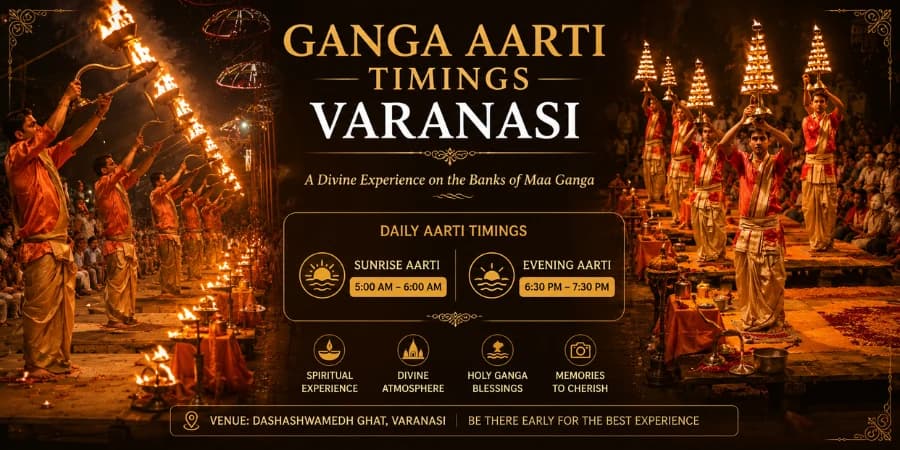
The Grand Evening Ganga Aarti
Dashashwamedh Ghat · Daily after sunset
4.9 / 5 · Boat Rides
Fixed price · Life jackets
- Timing
- Daily after sunset — ~6:45 PM summer, ~6:00 PM winter
- Duration
- About 45 minutes
- Location
- Dashashwamedh Ghat, Varanasi (Kashi)
- Entry / Cost
- Free from the ghat · Boat ₹100–₹2,500
- Best View
- From a boat on the Ganga
- Held On
- Every day of the year
Ganga Aarti Timings in Varanasi (2026)
The famous Ganga Aarti at Dashashwamedh Ghat is held every single day of the year, just after sunset. Because it follows the sun, the exact start time shifts with the season — earlier in winter and later in summer. There is also a serene morning Ganga Aarti (Subah-e-Banaras) at Assi Ghat performed at dawn. Use the timings below as your guide, and always reach early on weekends, full-moon (Purnima) days and during festivals when the crowd swells dramatically.
Summer (Apr – Oct)
Begins shortly after sunset
Winter (Nov – Mar)
Earlier sunset, earlier aarti
Duration
Arrive 45–60 min early for a seat
Summer (Apr – Oct)
Subah-e-Banaras at Assi Ghat
Winter (Nov – Mar)
Begins around sunrise
Duration
Calmer, far less crowded
Tip: timings are approximate and follow sunset — they can change by 15–20 minutes through the year. On Dev Deepawali, Kartik Purnima and Mahashivratri the aarti is grander and far busier. WhatsApp us for the exact time on your travel date.
Ganga Aarti Timing Today & Month-by-Month (Varanasi 2026)
Because the evening Ganga Aarti at Dashashwamedh Ghat begins just after sunset, the exact start time changes through the year — earliest in December–January and latest in May–June. Use this month-wise table as a quick reference for the approximate aarti time, and always reach 45–60 minutes early.
Times are indicative and follow the sunset; they can vary by 10–20 minutes. WhatsApp us for the exact aarti time on your travel date.
The History & Spiritual Significance of the Ganga Aarti
What Is the Ganga Aarti?
The Ganga Aarti is a centuries-old Vedic ritual of worship offered to Maa Ganga, the river revered in Hinduism as a living goddess who purifies the soul and grants moksha. An aarti is a devotional offering of light: priests circle flaming lamps before the deity — here, the sacred river itself — while mantras, bells and conch fill the air. In Varanasi (Kashi), the eternal city of Lord Shiva and one of the oldest living cities on earth, this nightly ritual has become the most famous Ganga Aarti in the world.
Why Dashashwamedh Ghat?
The grand aarti is performed at Dashashwamedh Ghat, the most central and sacred of Varanasi's 84+ ghats. Its name comes from the legend that Lord Brahma performed the Dasha-Ashwamedha (ten-horse) sacrifice here to welcome Lord Shiva. For pilgrims it is profoundly auspicious to take a holy dip (snan), offer prayers, and witness the aarti at this very ghat — which is why thousands gather on its steps and in boats every single evening.
How the Grand Aarti Began
While riverside worship of the Ganga is ancient, the grand choreographed Ganga Aarti you see today was organised in its present form in the early 1990s by the Ganga Seva Nidhi and the Dashashwamedh Ghat Aarti Samiti. What began as a devotional initiative has grown into a globally recognised spectacle that draws travellers, photographers and pilgrims from every corner of the world.
What Happens During the Aarti
Every evening, a row of young priests (archaks) in saffron and maroon robes perform in perfect synchrony — lighting towering multi-tiered brass lamps (deep), swinging incense and camphor, blowing the conch (shankh), ringing bells and waving chamars — as Sanskrit mantras and the rhythmic beat of drums roll across the river. The ceremony lasts about 45 minutes, and as the flames, smoke and chants rise together into the night, the whole riverfront glows. Devotees float tiny leaf-lamps (diyas) on the water, carrying their prayers downstream.
Why It Matters for Pilgrims
Beyond its visual grandeur, the aarti is a daily act of gratitude — thanking the river that has sustained Kashi for millennia. Witnessing it is considered spiritually cleansing, and combining the aarti with a Ganga snan and a diya offering is a deeply cherished part of any Varanasi pilgrimage. It is this rare blend of living faith, ancient ritual and breathtaking spectacle that makes the Varanasi Ganga Aarti one of the most unforgettable spiritual experiences in India.
Did you know? On Dev Deepawali (the full moon of Kartik, Nov), all 84+ ghats of Varanasi are lit with millions of earthen lamps and the Ganga Aarti becomes a once-in-a-lifetime sight — the single most spectacular night to witness the aarti.
What Happens During the Ganga Aarti — Step by Step
The Ganga Aarti is a carefully choreographed ritual that unfolds in a precise sequence over about 45 minutes. Knowing what to expect helps you follow along and appreciate each moment. Here is exactly how the ceremony progresses, from the first conch to the final diya on the water.
- 1
Sankalp & Setup
Just before dusk, the priests (archaks) take their positions on raised wooden platforms (chaukis) lined up at the ghat, each set with lamps, flowers, incense and a conch. A sankalp (sacred intention) is taken to begin the worship of Maa Ganga.
- 2
Shankh Naad (Conch)
The aarti opens with the deep, resonant sound of conch shells (shankh) blown in unison, signalling the start of the ceremony and inviting the divine presence to the riverfront.
- 3
Dhoop & Incense
Large smoking incense holders (dhoop) are swung in rhythmic circles to purify the air, filling the ghat with fragrant smoke as Vedic mantras and the beat of drums build the atmosphere.
- 4
Agni Aarti (Fire Lamps)
The centrepiece: towering multi-tiered brass lamps (deep) are lit and circled in perfect synchrony before the Ganga. The rising flames, reflected on the dark river, are the moment most visitors remember forever.
- 5
Camphor & Chamar
Camphor (kapoor) flames and yak-tail whisks (chamar) and peacock feathers are waved in offering, accompanied by the continuous ringing of bells — a multi-sensory crescendo of light, sound and devotion.
- 6
Pushpa & Final Offering
Flowers (pushpa) are offered to the river, the conch sounds a final time, and devotees float their own diyas (leaf-lamps) on the water, carrying their prayers downstream as the aarti draws to a close.
- 7
Prasad & Charanamrit
After about 45 minutes the ceremony ends; devotees receive prasad and charanamrit (holy water), and many take a moment by the river before returning through the lantern-lit lanes of Kashi.
Best Time to Visit the Ganga Aarti in Varanasi
Because the Ganga Aarti happens every evening, you can experience it on any day of your Varanasi trip — but the season, time of day and festival calendar make a big difference to the weather, the crowd and the sheer atmosphere. Here is exactly when to plan your visit for the best experience.
Best Season — October to March
The ideal time to visit the Ganga Aarti is winter (October–March), when the weather is cool and pleasant for sitting on the ghat steps or boating. Skies are clear and the riverfront is at its most photogenic. Summer (April–June) is hot and humid, while the monsoon (July–September) can raise the river so high that the aarti shifts to a higher platform.
Best Time of Day — Dusk & Dawn
The grand evening aarti at Dashashwamedh Ghat (around 6:00–6:45 PM) is the headline event. For a quieter, more meditative experience, the morning Subah-e-Banaras aarti at Assi Ghat at sunrise is magical and far less crowded — pair it with a sunrise boat ride for the best of both.
Most Spectacular — Festivals
For the grandest experience, time your visit with Dev Deepawali (Kartik Purnima, Nov), when lakhs of diyas light every ghat. Mahashivratri, Sawan Mondays, Ganga Dussehra and Kartik Purnima also draw huge, devout crowds — unforgettable, but book transport, boats and stay well in advance.
Ganga Aarti in Varanasi by Boat
The single best way to experience the Ganga Aarti is from a boat on the river. While the ghat steps fill up an hour before the ceremony, a boat gives you a calm, front-row, panoramic view of the entire spectacle — the rows of lamps, the priests in motion and the glowing reflection on the water. Boats line up just off Dashashwamedh Ghat as dusk falls, and a shared or private ride is the most comfortable, photogenic and family-friendly way to witness the aarti.
- An unobstructed, front-facing view of all the priests and lamps — impossible to get from the packed ghat steps.
- A cool breeze on the river and the reflection of the flames on the Ganga — the most photogenic vantage point.
- You can float your own diya (lamp) on the water during the aarti.
- Combine it with a sunrise boat ride past the historic ghats the next morning.
- Safer and calmer for families, senior citizens and children than the crowded ghat.
Best Ghats for Ganga Aarti in Varanasi
Varanasi has 84+ ghats along the Ganga, but only a few host the aarti — and each offers a different experience. Here are the best ghats to watch the Ganga Aarti, from the grand main ceremony to quieter alternatives and the unbeatable view from the river.
Dashashwamedh Ghat
Top PickThe Main Grand Aarti
The most famous and spectacular Ganga Aarti in the world is performed here every evening — the choreographed ceremony with 5–7 priests, towering lamps and thousands of devotees. This is the one to see if you visit only one. Arrive 45–60 minutes early for a ghat seat, or watch from a boat.
Assi Ghat
Subah-e-Banaras (Morning)
The southernmost main ghat, famous for the dawn 'Subah-e-Banaras' aarti with yoga, classical music and a sunrise ceremony. A smaller, peaceful evening aarti is also held here. Ideal if you want a calmer, less crowded experience than Dashashwamedh.
Rajendra Prasad Ghat
Best Alternate View
Located right next to Dashashwamedh Ghat, this ghat offers an excellent side view of the main aarti with noticeably smaller crowds. A smart choice when Dashashwamedh is overflowing on weekends and festival nights.
Manikarnika & Other Ghats
From the River
A boat lets you glide past several ghats and view the Dashashwamedh aarti from the water. Note: Manikarnika and Harishchandra are cremation ghats — observe in respectful silence and avoid photography there.
Best Place & Seating to Watch the Ganga Aarti
Where you sit completely changes your experience of the Ganga Aarti. From the unbeatable view from the river to the immersive front rows on the steps, here are the best places to watch the aarti and how early to arrive for each.
From a Boat (Best Overall)
A boat anchored just off Dashashwamedh Ghat gives the clearest, front-facing, panoramic view of the lamps and priests — with the flames reflecting on the water. The most comfortable and photogenic option, ideal for families and seniors. Book in advance to secure the front row.
Front Rows on the Ghat Steps
Sitting on the steps directly facing the platforms is the most immersive way to feel the energy, chanting and bells up close. You must arrive 60–90 minutes early to claim a front spot, especially on weekends and festival nights.
Rooftop & Balcony Cafés
A few cafés and guesthouses overlooking the ghat offer an elevated, calmer view (sometimes with a small minimum order). Great if you prefer to avoid the densest crowd while still seeing the spectacle.
Rajendra Prasad Ghat (Side View)
The adjacent Rajendra Prasad Ghat gives an excellent angled view of the main aarti with noticeably smaller crowds — a smart backup when Dashashwamedh is overflowing.
Ganga Aarti Cost & Boat Ride Price in Varanasi (2026)
The Ganga Aarti itself is completely free to watch from the ghat — there is no entry ticket. The only cost involved is if you choose to watch from a boat, which is highly recommended for the best view. Boat prices vary by season, demand, boat type and your bargaining — below are realistic 2026 price ranges so you are not overcharged at the ghat.
Prices are indicative and rise on weekends, Purnima and festival nights. To avoid touts and last-minute overcharging, book a fixed-price boat in advance with us — including life jackets and an experienced boatman.
All prices in INR. No entry fee for the aarti itself.
Ganga Aarti Boat Ride — Reviews from Our Guests
2,147 verified reviews
We booked a private boat for the Ganga Aarti through Ayodhya Varanasi Guides and it was the highlight of our Kashi trip. The view of the lamps from the river was breathtaking and far better than the crowded steps. Fair fixed price, life jackets, and a polite boatman.
Sunita Sharma
Nagpur
Reached Dashashwamedh Ghat 45 minutes early as advised and the boat was already arranged. The team guided us through the whole evening — aarti, diya offering and a calm ride back. Highly recommend pre-booking the boat to avoid touts.
Rajesh Iyer
Chennai
Travelling with my elderly parents, the boat was so much more comfortable than sitting on the steps. We could see everything clearly and float our lamps on the Ganga. Truly a once-in-a-lifetime experience, beautifully organised.
Meera Joshi
Pune
The sunrise boat ride the next morning was bundled with our aarti booking — gliding past the ghats at dawn was magical. Transparent pricing and great local knowledge. Will book again on our next visit to Varanasi.
Arvind Reddy
Hyderabad
Visited during Dev Deepawali and the team handled the huge crowd perfectly — they had our boat reserved well in advance. Watching lakhs of diyas light up every ghat from the water was unforgettable. Thank you for a flawless evening.
Priya Nair
Bengaluru
A Perfect Ganga Aarti Evening Itinerary
Make the most of your evening in Varanasi by pairing the Ganga Aarti with a temple darshan and a boat ride. Here is a simple, time-tested plan our guests love — easily customised to your pace.
Kashi Vishwanath darshan. Begin with a relaxed darshan at the Kashi Vishwanath Dham before the evening rush, a short walk from Godowlia.
Walk down to the ghat. Stroll through the old-city galis to Dashashwamedh Ghat, soaking in the riverfront atmosphere as it fills up.
Board your boat. Take your reserved boat from the ghat. Settle in for an unobstructed, front-row view of the river and the aarti platforms.
The Ganga Aarti. Witness the full ceremony — conch, lamps, bells and chanting — and float your own diya on the Ganga.
Evening on the ghats. Glide back, then enjoy a walk along the lantern-lit ghats or a traditional Banarasi dinner near Godowlia.
Which Tour Package Covers The Grand Evening Ganga Aarti?
The Grand Evening Ganga Aarti is best seen as part of a planned Kashi darshan rather than a single stop — the old-city temples keep different hours and the ghats reward proper sequencing. These are the itineraries our guests book most, each with Kashi Vishwanath VIP darshan assistance, a certified local guide and transport, priced in writing before you travel.
- 1 Day1 Day Varanasi Tour PackageKashi Vishwanath darshan, a sunrise boat ride and the evening Ganga Aarti.
- 2 Days2 Days Varanasi Tour PackageKashi Vishwanath, the ghats, Sarnath and the old-city temple circuit.
- 3 Days3 Days Varanasi Tour PackageKashi at a proper pace — the Dham, the Bhairavs, the Durgakund cluster and the aarti.
- 4 Days4 Days Varanasi Tour PackageEverything in Kashi plus Sarnath, with time for the temples most itineraries skip.
- 2 Days2 Days Ayodhya Varanasi Tour PackageRam Mandir and Kashi Vishwanath across two cities, with the Ganga Aarti.
- 3 Days3 Days Ayodhya Varanasi Tour PackageThe classic pairing — Ram Mandir, Kashi Vishwanath and the ghats.
- 3 Days3 Days Varanasi Prayagraj Tour PackageKashi and the confluence, with time for the ghats and the Sangam boat ride.
- 4 Days4 Days Ayodhya Varanasi Prayagraj Tour PackageAll three cities — Ram Mandir, Kashi Vishwanath and the Triveni Sangam.
- 5 Days5 Days Ayodhya Varanasi Prayagraj Tour PackageThe complete sacred circuit at a comfortable, senior-friendly pace.
Want The Grand Evening Ganga Aarti built into a custom itinerary? We plan around your dates, your pace and what you actually want to see.
See all Varanasi & Ayodhya tour packagesHow to Reach the Ganga Aarti in Varanasi
The grand evening aarti is at Dashashwamedh Ghat, deep inside Varanasi's old city. Because the lanes (galis) around the ghat are a pedestrian-only maze, no vehicle can drive right up to it — you reach Godowlia Crossing and walk the last 500–600 metres, or take a boat in from the river. Here is how to get there from every arrival point.
By Air
Fly into Lal Bahadur Shastri International Airport, Babatpur (~25 km). Take a prepaid taxi or app cab towards Godowlia / Dashashwamedh Ghat (45–60 min).
By Train
Varanasi Junction (Cantt) is the main station, ~5 km from the ghat; Banaras (Manduadih) is ~8 km. Hire an auto or e-rickshaw and ask for Godowlia.
By Road / Taxi
Varanasi is well connected via NH-19 & NH-31 from Prayagraj (~120 km) and Ayodhya (~200 km). A private AC cab is the most comfortable option.
The Last Mile
No car can reach the ghat — the old city is a pedestrian zone. Vehicles stop at Godowlia Crossing; from there it is a 5–10 minute walk to Dashashwamedh Ghat.
Ganga Aarti Location — Dashashwamedh Ghat, Varanasi
The grand evening Ganga Aarti takes place at Dashashwamedh Ghat, in the heart of Varanasi's old city by the Ganga. Vehicles cannot reach it directly — they stop at Godowlia Crossing, a 500–600 m walk away. Use the map below to navigate.
Varanasi
- Area: Old City, near Godowlia
- PIN: Varanasi 221001
- From Cantt station: ~5 km
- From airport: ~25 km
- Last vehicle point: Godowlia (~600 m walk)
Where to Stay Near the Ganga Aarti (Dashashwamedh Ghat)
Staying close to the ghats lets you reach the aarti easily and soak in the riverfront atmosphere. Here are the best areas to stay for the Ganga Aarti, from Ganga-view heritage hotels to comfortable stays near the station — our team can recommend and book the right option for your budget.
On the Ghats (Ganga-view)
Heritage hotels and guesthouses right on Dashashwamedh, Assi and the riverfront ghats offer balcony views of the Ganga and the aarti. Best for atmosphere and walking access — book early, as these are limited and popular.
Godowlia & Old City
Budget to mid-range stays a short walk from Dashashwamedh Ghat. Ideal if you want to be steps from the aarti, the galis and street food — though lanes are narrow and vehicle-free.
Cantt & Sigra
Branded mid-range and luxury hotels near Varanasi Cantt railway station, ~5 km from the ghat. More comfort, parking and easy transfers — take an auto/taxi to Godowlia in the evening.
Places to Visit Near the Ganga Aarti in Varanasi
The Ganga Aarti pairs perfectly with the rest of Kashi's sacred sites. Here are the top attractions near Dashashwamedh Ghat to combine into your Varanasi itinerary — most are within a short walk or a quick boat ride.
Kashi Vishwanath Temple
The 12th Jyotirlinga of Lord Shiva — a 10-minute walk from Dashashwamedh Ghat. Pair its darshan with the evening aarti.
Sankat Mochan & Kaal Bhairav
The beloved Hanuman temple and the fierce guardian (kotwal) of Kashi — both essential stops on a Varanasi temple tour.
Assi Ghat (Subah-e-Banaras)
The southern ghat famous for the dawn aarti with yoga and music — perfect for a sunrise boat ride the next morning.
Sarnath
Where Lord Buddha gave his first sermon, ~10 km away — the Dhamek Stupa and museum make a serene half-day trip.
Manikarnika Ghat
The most sacred cremation ghat, viewed respectfully from a boat — a profound glimpse into Kashi's view of life and death.
All Varanasi Temples
Explore the complete list of must-visit temples and ghats across Varanasi, Ayodhya and Prayagraj.
Dev Deepawali — The Grandest Ganga Aarti of the Year
On Dev Deepawali — the full moon of Kartik (Kartik Purnima), 15 days after Diwali, usually in November — Varanasi witnesses its most spectacular night. All 84+ ghats are lit with millions of earthen lamps (diyas), and a grand, extended Ganga Aarti is performed simultaneously across the riverfront as the gods are believed to descend to bathe in the Ganga.
It is, without question, the best time to witness the Ganga Aarti — but also the busiest. Boats, hotels and the best viewing spots are booked weeks in advance, and crowd management becomes essential. Other grand occasions include Ganga Dussehra, Mahashivratri and the Sawan month.
Things to Know Before Going to the Ganga Aarti
A little preparation makes the Ganga Aarti far more enjoyable. Keep these practical, locally-verified tips in mind so your evening on the ghats is smooth, safe and truly memorable.
Arrive 45–60 minutes early
Ghat seats and good boat spots fill up fast — reach by ~5:30 PM in winter and ~6 PM in summer, earlier on weekends and festivals.
A boat gives the best view
From the steps the crowd blocks the view; a boat offers an unobstructed, front-facing vantage. Book in advance to avoid touts.
Dress modestly & comfortably
This is a religious ceremony — cover shoulders and knees. Wear easy-to-remove footwear as you'll walk the ghats and galis.
Carry small cash
Keep ₹200–500 in change for boats, diyas and autos. Mobile signal/UPI can be patchy in the old-city lanes near the ghat.
Photography is allowed
You can freely photograph the aarti. But never photograph the cremation ghats (Manikarnika, Harishchandra) — observe in respectful silence.
Mind your belongings
The ghat gets very crowded. Carry a small bag, keep phones/wallets secure and stay with your group; avoid large luggage.
Beware of touts & overcharging
Decline unsolicited 'guides' and fix any boat price before boarding. Pre-booking a fixed-rate boat is the safest, stress-free option.
Monsoon & high water
In the monsoon (Jul–Sep) the river can rise and the aarti may move to a raised platform — check the day's arrangement before you go.
Float a diya
Buying and floating a small leaf-lamp (diya) on the Ganga during the aarti is a beautiful, auspicious ritual — a memorable keepsake of the evening.
Ganga Aarti Varanasi — Frequently Asked Questions
The questions travellers most often ask about the Ganga Aarti — timings, ghats, boat rides, cost and tips.
The grand Ganga Aarti at Dashashwamedh Ghat starts just after sunset — around 6:45 PM in summer (April–October) and around 6:00 PM in winter (November–March). It lasts about 45 minutes. There is also a morning aarti (Subah-e-Banaras) at Assi Ghat around 5:00–5:45 AM.
Still have a question?
Our local team replies within 30 minutes.
Written & verified by the local Varanasi guide team at Ayodhya Varanasi Guides
Our government-certified Kashi guides attend the Ganga Aarti and arrange boats every day. This guide is based on first-hand, on-ground experience and is reviewed regularly. Last updated: June 2026. Timings follow the sunset and may vary — message us for the exact time on your travel date.
Witness the Ganga Aarti from the best seat on the river
Skip the crowded steps and the touts. Let Ayodhya Varanasi Guides arrange a clean, safe boat at a fair fixed price — shared, private or sunrise rides — for the perfect view of the Ganga Aarti at Dashashwamedh Ghat. We confirm everything in writing before your visit.