
Adi Keshava Temple, Varanasi — Where Vishnu First Set Foot in Kashi
Adi Keshav Temple stands at Rajghat, near the confluence of the Ganga and the Varuna in north Varanasi. Tradition holds that this is the spot where Lord Vishnu first set foot in Kashi — adi meaning first, Keshav meaning Vishnu — when Lord Shiva left the city for Mount Mandarachal and asked him to guard its sanctity. It is the fifth and final tirtha of the Kashi Panchtirthi Yatra, and its sanctum holds the rare Adi Keshav–Sangameshwar linga, in which Vishnu and Shiva are worshipped as one. Darshan is free, and it is about 6 km north of Dashashwamedh Ghat.
- Timings
- ~6 AM–12 PM & 4 PM–8 PM
- Significance
- 5th tirtha of the Panchtirthi Yatra
- Setting
- Ganga–Varuna Sangam, Rajghat
- Entry
- Free · no ticket
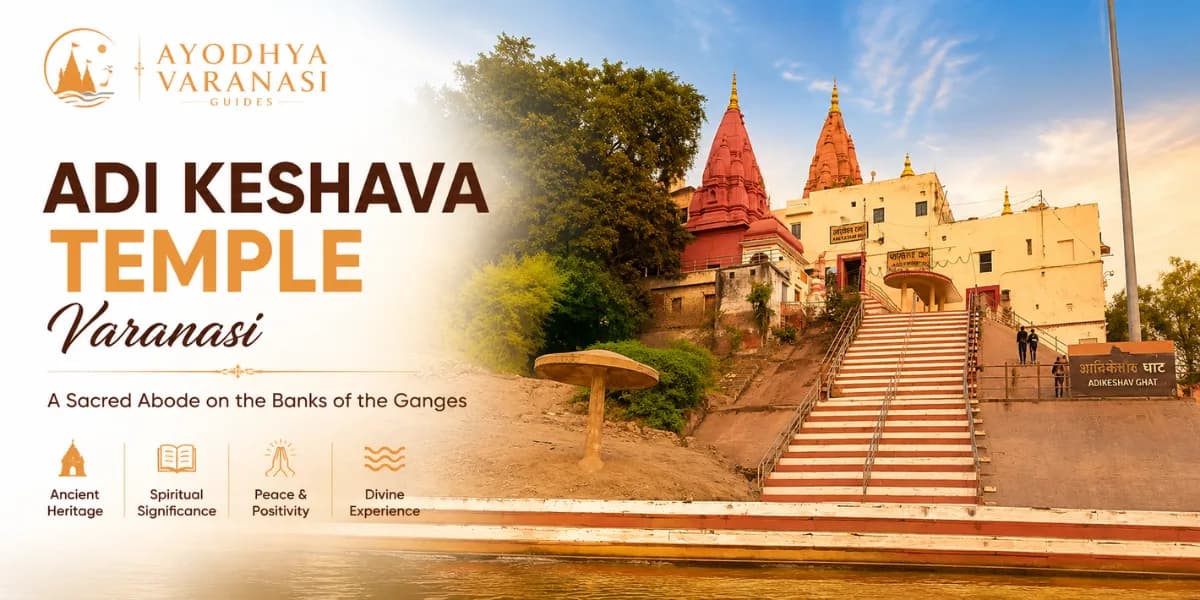
Adi Keshav Temple
Rajghat, Varanasi · Vishnu's First Step in Kashi
4.9 / 5 · Kashi Darshan Help
Panchtirthi · Vishwanath
- Timings
- ~6:00 AM–12:00 PM & 4:00 PM–8:00 PM
- Deity
- Lord Vishnu as Adi Keshav (north-facing)
- In the Sanctum
- The rare Adi Keshav–Sangameshwar linga
- Significance
- Final tirtha of the Kashi Panchtirthi Yatra
- Entry
- Free · no ticket required
- Location
- Rajghat, at the Ganga–Varuna confluence
What Are the Adi Keshav Temple Timings?
Adi Keshav follows the usual Varanasi pattern of morning and evening sessions with a midday break — roughly 6:00 AM to 12:00 PM and 4:00 PM to 8:00 PM. Darshan is free and there is almost never a queue, because so few visitors come this far north. Timings extend on Ekadashi, Kartik Purnima and during Kartik month, when Vaishnava observance is at its height.
Morning Session
The quietest and coolest darshan
Midday Break
Temple usually closed
Evening Session
Aarti and sunset at the sangam
Morning Aarti
Vaishnava puja of Adi Keshav
Evening Aarti
The most atmospheric hour
Ekadashi
Especially auspicious at a Vishnu temple
Panchtirthi Yatra
Pilgrims finish their circuit here
Tip: Adi Keshav is 6 km north of the main ghats and is not a walk-up-and-see temple like the ones near Dashashwamedh. Confirm the session timing before you set out — a wasted trip to Rajghat costs the better part of an hour each way. WhatsApp us and we will check for your date.
When Is the Best Month to Visit Adi Keshav Temple? (2026)
Varanasi’s weather runs to extremes, and the Vaishnava calendar matters here more than at most Kashi temples. October to March is comfortable throughout, and Kartik is the traditional month for the Panchtirthi Yatra.
Kartik is the traditional month for the Panchtirthi Yatra, and Kartik Purnima brings the biggest crowds. For most of the year this is one of the quietest major temples in Varanasi.
Why Is Adi Keshav Called the First Temple of Kashi?
What Is Adi Keshav Temple?
Adi Keshav is an ancient temple of Lord Vishnu at Rajghat, near the point where the Varuna flows into the Ganga at the northern edge of Varanasi. Its name says what it is: adi, the first, and Keshav, a name of Vishnu. This is held to be the spot where Vishnu first set foot in Kashi.
What Is the Legend?
Tradition tells that when Lord Shiva left Kashi for a time to reside on Mount Mandarachal, he asked Lord Vishnu to come and guard the sanctity of the city. Vishnu descended and set his feet down at this spot, at the confluence of the Ganga and the Varuna. The place where his feet were washed is remembered as Padodaka, and the temple that grew there became Adi Keshav.
Why Does It Matter That Kashi Was Once a Vaishnava Kshetra?
This is the part visitors find most striking. Adi Keshav preserves the memory of a time when Varanasi was a Vaishnava kshetra — a city of Vishnu — before it became the Shiva kshetra the world knows. The temple houses an Uttar-mukhi (north-facing) Vishnu, and tradition holds that when Vishnu departed for Badrinath, Kashi passed decisively to Shiva. Standing here, you are at the hinge of that story.
What Is the Kashi Panchtirthi Yatra?
The Panchtirthi Yatra is the classical pilgrimage of Kashi’s five holiest bathing places, performed in order along the river: Asi, Dashashwamedh, Manikarnika, Panchganga and finally Adi Keshav. Pilgrims bathe at each in turn. Adi Keshav is where the yatra ends — which is why a temple so few tourists reach is one of the five most important shrines in the city.
What Is the Adi Keshav–Sangameshwar Linga?
The sanctum holds something genuinely rare — the Adi Keshav–Sangameshwar linga, a four-faced form in which Vishnu and Shiva are worshipped as one. In a city where the Vaishnava and Shaiva traditions have coexisted for millennia, this single object says more about Kashi than any amount of explanation. The Rangamandap, the temple porch, rests on finely worked red stone pillars.
How Old Is the Temple?
Belief places the shrine at more than four thousand years old. In recorded terms, the temple built in the Gahadavala period was destroyed in 1194 by Qutub-ud-din Aibak, and what stands today is later. The Adi Keshav Ghat below was made pucca in 1790 by a Diwan of the Scindia state — one of the many Maratha-era works that shaped the Varanasi riverfront we see now.
Did you know? Most visitors to Varanasi complete only two or three of the five tirthas without ever knowing there is a sequence. The Panchtirthi Yatra ends at Adi Keshav — so the pilgrimage almost nobody finishes ends at the temple almost nobody visits.
How Do You Have Darshan at Adi Keshav Temple?
There is no queue, no ticket and no crowd. What there is, is a sense of arriving somewhere very old and very quiet.
- 1
Travel North to Rajghat
The temple is about 6 km north of Dashashwamedh Ghat, near the Rajghat bridge. Take an auto or taxi — it is too far to walk from the main ghats.
- 2
Reach the Ganga–Varuna Sangam
The temple sits close to where the Varuna joins the Ganga. The confluence itself is part of the sanctity of the place.
- 3
Take a Dip at Adi Keshav Ghat
Pilgrims completing the Panchtirthi Yatra bathe here as the fifth and final tirtha. The ghat was made pucca in 1790.
- 4
Climb to the Temple
Steps lead up from the ghat to the temple. Leave footwear outside as at any shrine.
- 5
Notice the Rangamandap
Take a moment in the porch, with its finely carved red stone pillars, before entering the sanctum.
- 6
Have Darshan of Adi Keshav
Stand before the north-facing Vishnu — at the spot where tradition says he first set foot in Kashi.
- 7
See the Sangameshwar Linga
Look for the rare four-faced Adi Keshav–Sangameshwar linga, in which Vishnu and Shiva are worshipped as a single deity.
- 8
Sit by the Confluence
The northern reach of the Ganga here is quiet and open — nothing like the crowded ghats downstream.
When Should You Visit Adi Keshav Temple?
It is a trip out of the tourist zone, so it pays to plan around the session hours, the season and the Vaishnava calendar.
Best Season — October to March
Varanasi's cool months make the journey north comfortable and the confluence pleasant to sit beside. Kartik (October–November) is the traditional season for the Panchtirthi Yatra.
Best Time of Day — Early Morning
Come between 6 and 9 AM. The temple is at its calmest, the light on the Ganga–Varuna sangam is beautiful, and you avoid the midday closure entirely.
Most Special — Kartik Purnima & Ekadashi
Kartik Purnima brings pilgrims to the ghat for the holy dip and Dev Deepawali lights the whole riverfront. Ekadashi is especially auspicious at a Vishnu temple.
What Can You See at Adi Keshav Temple?
A small temple carrying an enormous amount of Kashi's history. Here is what to look for.
The Uttar-Mukhi Vishnu
Top PickThe Main Darshan
The north-facing image of Lord Vishnu as Adi Keshav, at the spot where tradition holds he first set foot in Kashi.
The Adi Keshav–Sangameshwar Linga
Top PickVishnu & Shiva as One
A rare four-faced form in which Vishnu and Shiva are worshipped together — an object that sums up Kashi's whole religious history.
The Ganga–Varuna Sangam
The Confluence
The meeting of the Varuna and the Ganga at the northern edge of the city — one of the two rivers that gave Varanasi its name.
Adi Keshav Ghat
The Fifth Tirtha
The ghat below the temple, made pucca in 1790 by a Diwan of the Scindia state, where the Panchtirthi Yatra concludes.
The Red Stone Rangamandap
The Architecture
The temple porch, carried on finely worked red stone pillars — worth pausing over before you enter the sanctum.
The Quiet Northern Ganga
Away From the Crowds
This stretch of the river is open, calm and almost empty of visitors — the opposite of Dashashwamedh.
Why Should You Travel North to Adi Keshav?
Six kilometres out of the tourist zone puts most visitors off. Here is what they miss.
It Completes the Panchtirthi Yatra
The fifth and final tirtha of Kashi's classical pilgrimage. Very few visitors are ever told the sequence exists, let alone finish it.
The Vaishnava Memory of Kashi
A reminder that Varanasi was once a city of Vishnu before it became Shiva's. That is a side of Kashi almost no itinerary touches.
Vishnu and Shiva in One Form
The Sangameshwar linga is genuinely rare, and it makes a point about Kashi that no guidebook paragraph can.
Real Quiet on the Ganga
No touts, no boat hawkers, no crowds. Just the confluence, the old stone and the river.
Is There an Entry Fee at Adi Keshav Temple? (2026)
Darshan is completely free — there is no ticket and no paid queue. Your only real cost is getting to Rajghat, since the temple is well north of the main ghats.
The darshan is free. What we arrange is the Panchtirthi Yatra — Asi, Dashashwamedh, Manikarnika, Panchganga and Adi Keshav, in the correct order, with transport between them and a guide who can explain what each one is. Almost nobody does this circuit properly, and it is one of the most rewarding days you can spend in Kashi. Pricing confirmed in writing.
Auto fares are indicative and vary with traffic, season and time of day. Agree the fare before setting off.
What Do Pilgrims Say About Adi Keshav Temple?
1,042 verified reviews
We asked for a Vishnu temple in Kashi and our guide took us to Adi Keshav. Learning that Varanasi was once a Vaishnava kshetra, standing at the very spot, was worth the whole trip. Hardly anyone there.
Krishnamurthy Iyer
Chennai
We did the full Panchtirthi Yatra over one day, ending here at the Varuna sangam. Nobody had ever told us the five tirthas were a sequence. Completely changed how we understood the city.
Radhika Pathak
Bhopal
Very old temple, beautifully peaceful. The four-faced linga where Vishnu and Shiva are worshipped together is something I have not seen anywhere else. Do go in the morning session.
Sudhir Kumar Jha
Patna
It is far from the main ghats, which is exactly why it is so calm. Our driver waited while we bathed at the ghat below. A completely different Varanasi from the one everyone photographs.
Uma Maheshwari
Bengaluru
Worth the ride north if you have half a morning. Check the timings — it shuts at midday and we nearly went at the wrong hour. Free entry and no commercialisation whatsoever.
Amit Ranjan
Delhi
How Do You Do the Kashi Panchtirthi Yatra in a Day?
Adi Keshav is the last of the five tirthas, so it belongs at the end. This is the yatra we plan for guests who want to do it properly.
Asi Ghat — the first tirtha. Begin at the southern end of the ghats, where the Asi meets the Ganga, for sunrise and the first snan.
Dashashwamedh Ghat — the second tirtha. The great central ghat of Kashi, where the ten-horse sacrifice is said to have been performed.
Kashi Vishwanath darshan. Darshan of the Jyotirlinga. We assist with VIP darshan so the queue does not consume your morning.
Manikarnika Ghat — the third tirtha. The great cremation ghat and the sacred kund, at the heart of the Kashi tradition.
Panchganga Ghat — the fourth tirtha. Where five rivers are said to meet, beneath the Bindu Madhav shrine.
Adi Keshav — the fifth and final tirtha. North to Rajghat and the Ganga–Varuna sangam, to complete the yatra where Vishnu first set foot in Kashi.
Ganga Aarti at Dashashwamedh Ghat. Close the day with the great evening aarti on the riverfront.
Which Tour Package Covers Adi Keshav Temple?
Adi Keshav Temple is best seen as part of a planned Kashi darshan rather than a single stop — the old-city temples keep different hours and the ghats reward proper sequencing. These are the itineraries our guests book most, each with Kashi Vishwanath VIP darshan assistance, a certified local guide and transport, priced in writing before you travel.
- 1 Day1 Day Varanasi Tour PackageKashi Vishwanath darshan, a sunrise boat ride and the evening Ganga Aarti.
- 2 Days2 Days Varanasi Tour PackageKashi Vishwanath, the ghats, Sarnath and the old-city temple circuit.
- 3 Days3 Days Varanasi Tour PackageKashi at a proper pace — the Dham, the Bhairavs, the Durgakund cluster and the aarti.
- 4 Days4 Days Varanasi Tour PackageEverything in Kashi plus Sarnath, with time for the temples most itineraries skip.
- 2 Days2 Days Ayodhya Varanasi Tour PackageRam Mandir and Kashi Vishwanath across two cities, with the Ganga Aarti.
- 3 Days3 Days Ayodhya Varanasi Tour PackageThe classic pairing — Ram Mandir, Kashi Vishwanath and the ghats.
- 3 Days3 Days Varanasi Prayagraj Tour PackageKashi and the confluence, with time for the ghats and the Sangam boat ride.
- 4 Days4 Days Ayodhya Varanasi Prayagraj Tour PackageAll three cities — Ram Mandir, Kashi Vishwanath and the Triveni Sangam.
- 5 Days5 Days Ayodhya Varanasi Prayagraj Tour PackageThe complete sacred circuit at a comfortable, senior-friendly pace.
Want Adi Keshav Temple built into a custom itinerary? We plan around your dates, your pace and what you actually want to see.
See all Varanasi & Ayodhya tour packagesHow Do You Reach Adi Keshav Temple in Varanasi?
Adi Keshav is at Rajghat, near the Ganga–Varuna confluence in the north of Varanasi, about 6 km from Dashashwamedh Ghat. You will need a vehicle rather than a walk.
By Road / Taxi
The practical option. An auto or taxi from the main ghats takes 25 to 40 minutes depending on traffic. Ask for Adi Keshav Mandir, Rajghat.
By Train
Varanasi Junction (Cantt) is about 6 km away and Banaras station roughly 8 km. Both are well connected to Delhi, Lucknow, Prayagraj and Ayodhya.
By Air
Lal Bahadur Shastri International Airport, Babatpur is around 28 km away, with taxis at the terminal. Allow an hour in traffic.
The Last Mile
The temple sits above the ghat near the Rajghat bridge. Vehicles drop you close by and steps lead down towards the confluence.
Where Is Adi Keshav Temple Located in Varanasi?
Adi Keshav Temple stands at Rajghat, near the confluence of the Ganga and the Varuna at the northern edge of Varanasi. Use the map below to navigate.
Varanasi
- Area: Rajghat, near the Ganga–Varuna Sangam
- PIN: Varanasi 221001
- From Dashashwamedh Ghat: ~6 km north
- From Kashi Vishwanath: ~5 km
- Significance: Fifth tirtha of the Panchtirthi Yatra
Where Should You Stay to Visit Adi Keshav Temple?
Adi Keshav is north of the tourist belt, so almost everyone visits it as a trip out from a central base.
Cantt & Sigra
Hotels near the railway station, about 6 km from the temple, with parking and easy taxi access northwards.
Godowlia & Dashashwamedh
The heart of Kashi, walking distance from Kashi Vishwanath and the evening Ganga Aarti, roughly 30 minutes from Adi Keshav by road.
Assi Ghat & Ravidas Gate
The calmer southern end of the ghats — and the starting point of the Panchtirthi Yatra, if you plan to do the full circuit.
What Else Can You Visit Near Adi Keshav Temple?
Adi Keshav belongs with the wider Kashi pilgrimage circuit rather than with any one neighbourhood.
Kashi Vishwanath Temple
The Jyotirlinga of Kashi, ~5 km away. We assist with VIP darshan to skip the main queue.
Kashi Vishwanath VIP Darshan
Skip-the-queue Sugam darshan assistance at Shri Kashi Vishwanath Dham, arranged in advance.
Ganga Aarti, Dashashwamedh Ghat
The world-famous evening aarti on the riverfront — the second tirtha of the Panchtirthi Yatra.
Ratneshwar Mahadev Temple
The leaning temple of Varanasi at Manikarnika Ghat, submerged in the Ganga for much of the year.
Batuk Bhairav Temple
Bhairav in his child form at Kamachha, famed for its centuries-old eternal lamp and oil prasad.
How to Commute in Varanasi
Autos, e-rickshaws, boats and taxis — how to get around the city and out to sites like Rajghat.
Kartik Purnima & the Panchtirthi Yatra at Adi Keshav
The month of Kartik (October–November) is the traditional season for the Panchtirthi Yatra, and pilgrims arrive at Adi Keshav to complete the circuit at the fifth and final tirtha. On Kartik Purnima the ghat below fills for the holy dip, and Dev Deepawali lights the entire Varanasi riverfront with lamps.
Ekadashi, Janmashtami and Dev Uthani Ekadashi are the other significant days at a Vishnu temple such as this. Outside these occasions Adi Keshav remains one of the quietest of Kashi’s major shrines.
What Should You Know Before Visiting Adi Keshav Temple?
A rewarding visit, but it needs a little more planning than the temples near the main ghats.
You will need a vehicle
Rajghat is about 6 km north of Dashashwamedh. This is not a temple you stumble upon while walking the ghats.
Confirm the session timing first
The temple closes for a midday break. Arriving at 2 PM after a 40-minute ride across the city is a genuinely wasted trip.
Do it as part of the Panchtirthi Yatra
Adi Keshav is the fifth and final tirtha. Visiting it in sequence after Asi, Dashashwamedh, Manikarnika and Panchganga makes far more sense of it.
Ask about the Sangameshwar linga
The four-faced form where Vishnu and Shiva are worshipped as one is easy to walk past without realising what you are looking at.
Go in the morning
Cooler, quieter, better light on the confluence, and no risk of hitting the midday closure.
Carry a change of clothes for a snan
If you plan to bathe at the ghat as part of the yatra, bring dry clothes — facilities are basic.
It is a quiet local temple, not a monument
Do not expect the scale of the Vishwanath Dham. The value here is antiquity, significance and calm.
Mind the riverbank in the monsoon
Both the Ganga and the Varuna run high in July and August, and the ghat steps can be slippery or partly submerged.
Combine it with Panchganga Ghat
The fourth tirtha is only about 3 km south, so the two go naturally together on the same northern run.
Dress modestly
Standard temple etiquette applies, with footwear removed at the entrance.
Adi Keshava Temple Varanasi — Frequently Asked Questions
The questions pilgrims ask us most about Adi Keshav — the Vishnu legend, the Panchtirthi Yatra, timings, location and how to reach Rajghat.
Adi Keshav is an ancient temple of Lord Vishnu at Rajghat, near the confluence of the Ganga and the Varuna in north Varanasi. Tradition holds that it stands where Lord Vishnu first set foot in Kashi — 'adi' meaning first and 'Keshav' being a name of Vishnu.
Still have a question?
Our local team replies within 30 minutes.
Written & verified by the local Varanasi guide team at Ayodhya Varanasi Guides
Our government-certified Kashi guides plan the full Panchtirthi Yatra through the year and take pilgrims north to Adi Keshav at Rajghat, a temple most visitors to Varanasi never reach. Last updated: July 2026. Session timings shift on Ekadashi and through Kartik — message us and we will confirm for your travel date before you make the journey north.
Complete the Kashi Panchtirthi Yatra at Adi Keshav
Let Ayodhya Varanasi Guides plan the full five-tirtha yatra — Asi, Dashashwamedh, Manikarnika, Panchganga and Adi Keshav in the correct order — with Kashi Vishwanath VIP darshan assistance, the evening Ganga Aarti, transport throughout and a guide who knows what each tirtha means. Confirmed in writing.