
Ratneshwar Mahadev Temple — The Leaning Temple of Varanasi
Ratneshwar Mahadev is the famous leaning temple of Varanasi, standing beside Manikarnika Ghat. It tilts at roughly nine degrees — more than twice the lean of the Tower of Pisa — and its sanctum sits below the waterline of the Ganga for most of the year, emerging only for a few months in summer. It is also called Matri-rin Mahadev, “the Shiva of a mother’s debt”, after the legend that it bowed because a mother’s debt can never be repaid. There is no entry ticket and usually no way inside — this is a temple you view, and the best view is from a boat. Come between April and June to see it fully exposed.
- The Lean
- ~9 degrees (Pisa is ~4)
- Submerged
- Most of the year; visible in summer
- Entry
- Free · viewed from outside
- Location
- Manikarnika Ghat, Varanasi
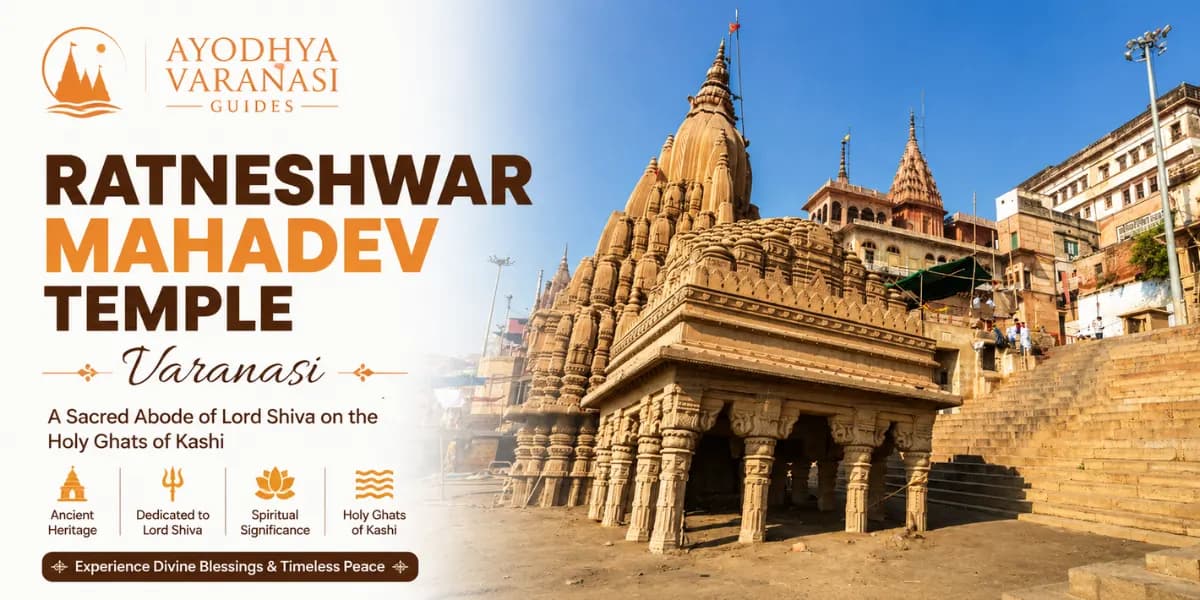
Ratneshwar Mahadev
Manikarnika Ghat · The Leaning Temple
4.9 / 5 · Boat Rides & Guides
Ghats · Ganga Aarti
- Famous For
- The leaning temple of Varanasi (~9°)
- Water Level
- Sanctum submerged most of the year
- Best Time to See
- April–June, when the river is lowest
- Also Known As
- Matri-rin Mahadev · Kashi Karvat
- Entry
- Free · normally no interior access
- Location
- Beside Manikarnika Ghat, Varanasi
When Can You Actually See Ratneshwar Mahadev Temple?
This is the question that matters here, and it has nothing to do with opening hours. Ratneshwar Mahadev is viewed from the ghat or from a boat, so it is “open” whenever there is daylight. What changes through the year is how much of the temple is above water. In the monsoon and after, the Ganga swallows most of the structure. By April to June the river drops and the temple stands fully exposed, right down to its plinth.
April – June (Best)
River at its lowest; the whole temple visible
July – September
Monsoon; sometimes only the top shows
October – December
Water falling slowly after the rains
January – March
Good views; base may still be wet
Sunrise (Best)
Golden light from a boat; the classic shot
Morning
Clear light, easy boat availability
Late Afternoon
Warm light on the stone
Evening
Too dark; view before the Ganga Aarti
Tip: the single best view is from the water at sunrise, not from the ghat steps — from a boat you can see the full extent of the tilt against the vertical lines of the ghat behind it. We include it on our sunrise boat route. WhatsApp us to book.
Which Month Is Best to See the Leaning Temple? (2026)
Unusually for a Varanasi temple, the river level matters more than the weather. The hottest months are the ones that show you the most temple — a genuine trade-off between comfort and the view.
For the best combination of comfortable weather and a full view, aim for February, March, November or December. For the absolute maximum exposure, come in May — and accept the heat.
Why Does Ratneshwar Mahadev Temple Lean?
What Is Ratneshwar Mahadev Temple?
Ratneshwar Mahadev is a Shiva temple standing at the water’s edge beside Manikarnika Ghat, the great cremation ghat of Varanasi. It is instantly recognisable, and it is probably the most photographed building in the city after the ghats themselves — because it leans, dramatically, towards the river.
How Far Does It Actually Lean?
The temple tilts at roughly nine degrees towards the north-west. For comparison, the Leaning Tower of Pisa leans about four — so Varanasi’s leaning temple is more than twice as far out of true as the world’s most famous leaning building, and almost nobody outside India has heard of it.
What Is the Matri-rin Legend?
The best-known story tells of a servant of Raja Man Singh who built the temple in honour of his mother, Ratna Bai. When she saw it, she is said to have told him that a mother’s debt can never be repaid — and the temple, unable to bear the weight of that truth, bowed. That is why it is also called Matri-rin Mahadev, the Shiva of the mother’s debt. Another version attributes it to a maid of Ahilyabai Holkar, also named Ratna.
What Do Historians Say?
Scholars generally place the structure rather later than the legend suggests — most likely around the 19th century, in the great period of ghat and temple building along the Varanasi riverfront. The tilt itself is usually explained by the ground it stands on: soft riverbank soil, seasonal flooding and uneven settling over decades. Both explanations, the legend and the engineering, tend to get told side by side here — and most visitors are glad of that.
Why Is the Temple Underwater So Much of the Year?
Because it was built extremely low, right at the river’s edge. For much of the year the garbhagriha — the sanctum — sits below the waterline, and in a strong monsoon only the upper portion of the shikhar remains visible. Nineteenth-century accounts record that priests had to swim out to perform the daily worship, which tells you how normal this condition has always been.
Why Is It Also Called Kashi Karvat?
Karvat means to turn on one’s side, and the name captures exactly what the temple appears to be doing — leaning over as if turning towards the river. The name is used locally alongside Ratneshwar Mahadev and Matri-rin Mahadev, so do not be confused if your boatman calls it something different from your guidebook.
Did you know? Ratneshwar Mahadev leans about nine degrees — well over twice the tilt of the Leaning Tower of Pisa — and it does it while standing in a river that covers it for most of the year.
How Do You Actually Visit Ratneshwar Mahadev Temple?
This is not a darshan in the usual sense. It is a viewing, and how you approach it makes all the difference.
- 1
Decide: Boat or Ghat
The temple can be seen from the ghat steps, but the full extent of the lean only reads properly from the water. If you can take a boat, take a boat.
- 2
Come at Sunrise
Board at Dashashwamedh or Assi Ghat for the classic sunrise ride. The golden light on the stone is what makes the photograph.
- 3
Approach Manikarnika Ghat
The temple sits at the water's edge beside the great cremation ghat. Your boatman will slow as you come alongside it.
- 4
Look at the Angle Against the Ghat
The trick to seeing the lean is to compare the temple against the vertical lines of the buildings behind it. That is when nine degrees becomes obvious.
- 5
Check How Much Is Above Water
How much of the plinth is showing tells you exactly where the river stands this season — in May you will see the whole thing.
- 6
Hear the Matri-rin Story
Ask your guide for the legend of Ratna Bai and the debt that could not be repaid, right there on the water.
- 7
Be Respectful at Manikarnika
You are alongside an active cremation ghat. Photography of the cremations is not permitted — point your camera at the temple only.
- 8
Continue Along the Ghats
Carry on by boat past Manikarnika towards Panchganga, or return for the evening Ganga Aarti at Dashashwamedh.
When Is the Best Time to See the Leaning Temple?
Two decisions shape your visit — which month determines how much temple you see, and which hour determines how it looks.
For the Fullest View — April to June
The Ganga is at its lowest and the temple stands completely exposed down to the plinth. It is also punishingly hot, so plan a sunrise boat ride and be off the water by nine.
Best Overall — February, March, November, December
The sweet spot. Cool, comfortable weather and the river low enough that most of the temple is above water. This is what we recommend to most guests.
Best Hour — Sunrise From a Boat
First light from the water is the definitive view. The lean reads clearly against the ghat behind, the stone turns gold, and the river is calm. Avoid the monsoon months if seeing the temple is your priority.
What Can You See at Ratneshwar Mahadev?
The temple sits in one of the most extraordinary stretches of the Varanasi riverfront. Here is what to take in.
The Nine-Degree Lean
Top PickThe Reason to Come
The tilt that makes this the leaning temple of India — more than twice the angle of Pisa, and best appreciated from the water.
The Submerged Plinth
Top PickThe River's Mark
How much of the base is showing tells you exactly where the Ganga stands. In May the whole structure is out; in August it may be nearly gone.
Manikarnika Ghat
The Great Cremation Ghat
The temple stands beside the most sacred cremation ground in the Hindu world, where the fires are said never to go out.
The Shikhar and Stonework
19th-Century Riverfront
The carved tower and stone detailing belong to the great period of ghat building along the Varanasi waterfront.
The View From the Water
The Classic Photograph
The single most photographed structure in Varanasi after the ghats themselves — and the shot only works from a boat.
Why Is the Leaning Temple Worth Seeking Out?
Thousands of visitors photograph this temple every week without knowing what they are looking at. Here is what makes it remarkable.
India's Leaning Tower
Nine degrees off vertical, more than twice Pisa's tilt — and virtually unknown outside India.
A Temple That Lives Underwater
Its sanctum spends most of the year beneath the Ganga. Priests once swam out to perform the daily worship.
The Mother's Debt
One of the most affecting legends attached to any building in Varanasi — a temple that bowed because a debt could not be repaid.
The Best Shot on the River
At sunrise from a boat, with Manikarnika behind it, this is the photograph people remember from their Varanasi trip.
Is There an Entry Fee at Ratneshwar Mahadev Temple? (2026)
There is no entry fee — and normally no way inside either. The sanctum is below the waterline for much of the year and the structure is not open for regular darshan. What you are paying for, if anything, is the boat that gives you the view.
The temple itself costs nothing to see. What we arrange is the sunrise boat ride that actually shows it to you properly, with a guide who can tell you the Matri-rin legend on the water and explain what you are looking at as you pass Manikarnika. Fixed pricing, life jackets, confirmed in writing.
Boat fares are indicative and vary with season, river level and demand. Always agree the fare and the route before boarding.
What Do Visitors Say About the Leaning Temple?
1,316 verified reviews
I had seen this temple in photographs for years without knowing anything about it. Hearing the mother's debt story from our boatman at sunrise, right in front of it, gave me goosebumps. Best twenty minutes of the trip.
Nikhil Deshmukh
Mumbai
We came in February and most of the temple was above water. Our guide explained that in August you can barely see it. Extraordinary that a building this remarkable is so little known internationally.
Emily Carter
London
Went specifically to photograph it. Take the boat, not the ghat — from the water the tilt is unmistakable against the buildings behind. Our boatman positioned us perfectly for the light.
Ramesh Chandra Sahu
Bhubaneswar
Very glad we asked before booking. We were originally planning an August trip and were told the temple would be mostly underwater, so we moved to November. Honest advice, which we appreciated.
Fatima Sheikh
Hyderabad
Visited in May — brutally hot, but the entire temple was out of the water, right down to the base. If seeing the whole structure matters to you, that is the month. Go at sunrise.
Girish Menon
Kochi
How Do You Fit the Leaning Temple Into a Varanasi Day?
Ratneshwar Mahadev belongs on the sunrise boat ride — it is a stop on the river rather than a destination. Here is the classic Kashi day.
Board at Dashashwamedh or Assi Ghat. Set out on the water before first light for the classic Varanasi sunrise.
Sunrise on the Ganga. The ghats turn gold as the sun comes up behind the river — the defining hour in Varanasi.
Ratneshwar Mahadev at Manikarnika. Come alongside the leaning temple in the best light of the day, with the cremation ghat behind it.
Kashi Vishwanath darshan. Darshan of the Jyotirlinga at Shri Kashi Vishwanath Dham. We assist with VIP darshan to save you the queue.
Kal Bhairav & Batuk Bhairav. Bhairav darshan, which tradition says completes a Kashi yatra.
Sarnath (optional). Where the Buddha gave his first sermon, ~10 km away.
Ganga Aarti at Dashashwamedh Ghat. Close the day with the great evening aarti, best viewed from a boat.
Which Tour Package Covers Ratneshwar Mahadev?
Ratneshwar Mahadev is best seen as part of a planned Kashi darshan rather than a single stop — the old-city temples keep different hours and the ghats reward proper sequencing. These are the itineraries our guests book most, each with Kashi Vishwanath VIP darshan assistance, a certified local guide and transport, priced in writing before you travel.
- 1 Day1 Day Varanasi Tour PackageKashi Vishwanath darshan, a sunrise boat ride and the evening Ganga Aarti.
- 2 Days2 Days Varanasi Tour PackageKashi Vishwanath, the ghats, Sarnath and the old-city temple circuit.
- 3 Days3 Days Varanasi Tour PackageKashi at a proper pace — the Dham, the Bhairavs, the Durgakund cluster and the aarti.
- 4 Days4 Days Varanasi Tour PackageEverything in Kashi plus Sarnath, with time for the temples most itineraries skip.
- 2 Days2 Days Ayodhya Varanasi Tour PackageRam Mandir and Kashi Vishwanath across two cities, with the Ganga Aarti.
- 3 Days3 Days Ayodhya Varanasi Tour PackageThe classic pairing — Ram Mandir, Kashi Vishwanath and the ghats.
- 3 Days3 Days Varanasi Prayagraj Tour PackageKashi and the confluence, with time for the ghats and the Sangam boat ride.
- 4 Days4 Days Ayodhya Varanasi Prayagraj Tour PackageAll three cities — Ram Mandir, Kashi Vishwanath and the Triveni Sangam.
- 5 Days5 Days Ayodhya Varanasi Prayagraj Tour PackageThe complete sacred circuit at a comfortable, senior-friendly pace.
Want Ratneshwar Mahadev built into a custom itinerary? We plan around your dates, your pace and what you actually want to see.
See all Varanasi & Ayodhya tour packagesHow Do You Reach Ratneshwar Mahadev Temple?
The temple stands beside Manikarnika Ghat, in the heart of the old city riverfront. You can walk the ghats to it, but the view is far better from the water.
By Boat (Recommended)
The best approach by a wide margin. Board at Dashashwamedh or Assi Ghat and take the boat north past the ghats — the tilt only reads properly from the river.
On Foot Along the Ghats
You can walk the ghat path from Dashashwamedh to Manikarnika in about 20 minutes. Note that the route passes an active cremation ground.
By Train
Varanasi Junction (Cantt) is about 5 km from the ghats and Banaras station roughly 6 km. Both connect to Delhi, Lucknow, Prayagraj and Ayodhya.
By Air
Lal Bahadur Shastri International Airport, Babatpur is around 25 km away, with taxis at the terminal. Allow an hour in traffic.
Where Is Ratneshwar Mahadev Temple Located?
Ratneshwar Mahadev stands at the water’s edge beside Manikarnika Ghat on the Varanasi riverfront, about a kilometre north of Dashashwamedh Ghat. Use the map below to find the ghat.
Varanasi
- Area: Beside Manikarnika Ghat, Varanasi
- PIN: Varanasi 221001
- From Dashashwamedh Ghat: ~1 km along the ghats
- From Kashi Vishwanath: ~700 m
- Best viewed from: A boat on the Ganga at sunrise
Where Should You Stay to See the Leaning Temple?
Staying near the ghats makes the sunrise boat ride far easier — you want to be walking to the boat at 5 AM, not driving across the city.
Godowlia & Dashashwamedh
The heart of the old city, minutes from the boarding points and walking distance from Kashi Vishwanath and the evening Ganga Aarti.
Assi Ghat & Ravidas Gate
The quieter southern end of the ghats, popular with longer-staying visitors, with cafés and its own boat boarding point.
Cantt & Sigra
Branded and business hotels near the railway station with parking and dining — but a 20 to 30 minute drive to the ghats before dawn.
What Else Can You See Near Ratneshwar Mahadev?
The leaning temple sits in the middle of the greatest concentration of sacred sites in Varanasi.
Kashi Vishwanath Temple
The Jyotirlinga of Kashi, ~700 m through the galis. We assist with VIP darshan to skip the main queue.
Kashi Vishwanath VIP Darshan
Skip-the-queue Sugam darshan assistance at Shri Kashi Vishwanath Dham, arranged in advance.
Ganga Aarti, Dashashwamedh Ghat
The world-famous evening aarti, a kilometre south along the ghats — best viewed from a boat.
Adi Keshava Temple
The fifth and final tirtha of the Kashi Panchtirthi Yatra, at the Ganga–Varuna confluence north of here.
Nepali Temple, Lalita Ghat
The Nepalese wooden pagoda replica of Kathmandu's Pashupatinath, a few minutes south along the riverfront.
How to Commute in Varanasi
Autos, e-rickshaws, boats and taxis — how to get around the old city and the ghats without stress.
Dev Deepawali & the Low-Water Season at Ratneshwar Mahadev
Dev Deepawali, on Kartik Purnima in November, is the most spectacular night on the Varanasi riverfront, when every ghat is lit with thousands of earthen lamps. By then the Ganga has fallen enough that the leaning temple is largely out of the water again, and a boat ride along the illuminated ghats is unforgettable.
For the temple itself, though, the season that matters is April to June — the low-water months, when the river drops far enough that the entire structure stands exposed down to its plinth. If seeing the whole temple is your reason for coming, plan around the river rather than the festival calendar.
What Should You Know Before Visiting Ratneshwar Mahadev?
A few things that will save you disappointment — particularly around when you come and what you can photograph.
You usually cannot go inside
The sanctum is below the waterline for much of the year and there is no regular darshan. This is a temple you view from outside, not one you enter.
Check the season before you book
In August you may see only the top of the temple. If seeing the structure is a priority, avoid the monsoon and come between November and June.
Take a boat, not the ghat steps
The nine-degree lean only reads properly from the water, where you can compare it against the vertical buildings behind.
Sunrise is the hour
First light from the river is the definitive view and the definitive photograph. Book the boat the day before.
Do not photograph the cremations
The temple stands beside Manikarnika, an active cremation ghat. Photographing the pyres or mourners is strictly not permitted. Keep your camera on the temple.
Agree the boat fare before boarding
Rates vary with season and demand. Settle the price and the route with the boatman first, and check that life jackets are available.
It goes by several names
Ratneshwar Mahadev, Matri-rin Mahadev and Kashi Karvat all refer to this temple. Your boatman may use any of them.
Ask for the Matri-rin story
The legend of Ratna Bai and the debt that could not be repaid is what turns a photograph into something you remember.
Combine it with Kashi Vishwanath
The Dham is only about 700 m away through the galis — the boat ride and the darshan belong in the same morning.
It is a short stop
Ten to fifteen minutes on the water is enough. Treat it as part of a ghat boat ride rather than a destination in itself.
Ratneshwar Mahadev Temple — Frequently Asked Questions
The questions visitors ask us most about the leaning temple of Varanasi — why it leans, when you can see it, whether you can go inside and how to photograph it.
Ratneshwar Mahadev is the famous leaning temple of Varanasi, a Shiva temple standing at the water's edge beside Manikarnika Ghat. It tilts about nine degrees and its sanctum stays below the waterline of the Ganga for much of the year.
Still have a question?
Our local team replies within 30 minutes.
Written & verified by the local Varanasi guide team at Ayodhya Varanasi Guides
Our government-certified Kashi guides and boatmen pass Ratneshwar Mahadev every morning of the year and know exactly how much of it will be above water in any given season. Last updated: July 2026. River levels vary from year to year — message us before booking and we will tell you honestly what you are likely to see on your travel dates.
See the Leaning Temple From the Ganga at Ratneshwar Mahadev
Let Ayodhya Varanasi Guides arrange your sunrise boat ride along the ghats — Ratneshwar Mahadev in the best light of the day, Manikarnika, Kashi Vishwanath with VIP darshan assistance and the evening Ganga Aarti — with fixed pricing, life jackets and honest advice on what the river level will show you.