
Annapurna Temple, Varanasi — The Goddess Who Feeds Kashi
Maa Annapurna Mandir stands at Visheshwarganj, immediately beside Kashi Vishwanath, and is dedicated to Annapurna — the goddess of food and nourishment, shown with a golden ladle in one hand and a jewelled bowl of rice in the other. The temple holds two images of her: a brass icon for daily darshan, and a golden idol unveiled to the public only once a year, at Annakoot, just after Diwali. It was built in 1729 by the Maratha Peshwa Baji Rao I in Nagara style. Darshan is free, and tradition pairs her closely with Vishwanath.
- Timings
- ~4 AM–12 PM & 4 PM–9:30 PM
- Golden Idol
- Shown once a year, at Annakoot
- Built
- 1729, by Peshwa Baji Rao I
- Entry
- Free · beside the Vishwanath Dham
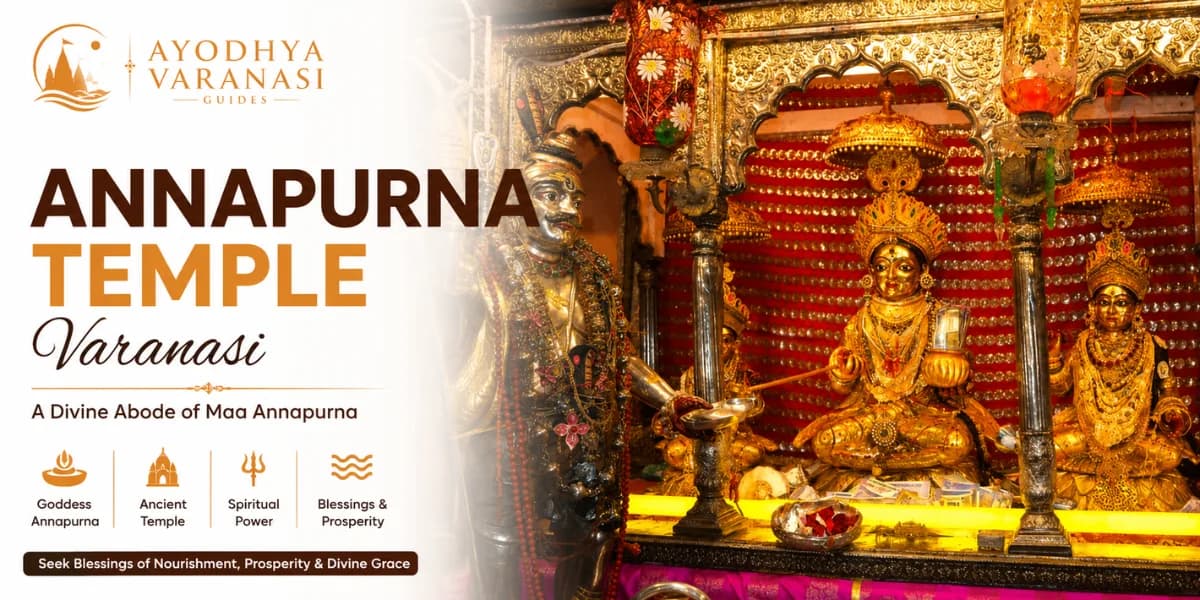
Maa Annapurna
Varanasi · The Goddess of Nourishment
4.9 / 5 · Kashi Darshan Help
Vishwanath · Devi temples
- Timings
- ~4:00 AM–12:00 PM & 4:00 PM–9:30 PM
- Deity
- Maa Annapurna, goddess of food and nourishment
- The Golden Idol
- Unveiled only at Annakoot, after Diwali
- Built
- 1729 by Maratha Peshwa Baji Rao I; Nagara style
- Entry
- Free · no ticket required
- Location
- Visheshwarganj, beside Kashi Vishwanath
When Can You See the Golden Annapurna?
The temple keeps hours close to those of the neighbouring Vishwanath Dham — roughly 4:00 AM to 12:00 PM and 4:00 PM to 9:30 PM — and darshan of the brass icon is available every day, free. The golden idol is different: it is unveiled to the public only once a year, at Annakoot, immediately after Diwali, and on that day the queues are among the largest in Varanasi.
Early Morning (Best)
Quietest; pairs with Vishwanath darshan
Late Morning
Busy with Dham pilgrims
Afternoon Break
Usually closed
Evening
Aarti; open late like the Dham
Annakoot
The day after Diwali; the only public darshan
Every Other Day
Daily darshan of the brass image
On Annakoot
Among the largest in Varanasi
Entry
No ticket, even on Annakoot
Tip: if you want the golden idol darshan, you must be in Varanasi for Annakoot, the day after Diwali — and the date moves each year with the lunar calendar. WhatsApp us well ahead and we will confirm the date and plan the queue, because on that day the whole city is trying to get in.
When Is the Best Month to Visit Annapurna Temple? (2026)
Daily darshan of the brass icon is available all year. The month that matters is October or November, when Annakoot follows Diwali and the golden idol is shown.
Annakoot, the day after Diwali, is the one day the golden idol is shown and by far the biggest of the year. The date shifts with the lunar calendar between late October and mid-November.
Why Is Annapurna Worshipped Beside Kashi Vishwanath?
What Is Annapurna Temple?
Maa Annapurna Mandir stands at Visheshwarganj, immediately beside the Kashi Vishwanath temple. It is dedicated to Annapurna, the goddess of food and nourishment — anna meaning food and purna meaning full or complete. She is depicted with a golden ladle in one hand and a jewelled bowl of rice in the other, in the act of serving.
Why Does She Stand Next to Shiva?
Because in Kashi the two belong together. Annapurna is Parvati in the aspect that feeds the world, and the tradition holds that in this city no one goes hungry because she is present here. Shiva may be the lord of Kashi, but it is Annapurna who feeds it. Pilgrims who have darshan at the Vishwanath Dham traditionally come here as well — the two shrines are steps apart.
What Is the Golden Idol?
The temple holds two images of the goddess. A brass icon receives daily worship and is available for darshan all year round. The second is a golden idol — the Swarna Annapurna — which is unveiled to the public only once a year. For the remaining days it is not shown at all.
When Is the Golden Darshan?
At Annakoot, the festival immediately following Diwali. On that day the golden idol is revealed, the temple is heaped with countless offerings of food — annakoot means a mountain of food — and devotees queue in enormous numbers for a single glimpse. It is one of the great days of the Varanasi religious year.
Who Built the Temple?
The temple as it stands today was constructed in 1729 by the Maratha Peshwa Baji Rao I, in the Nagara style with a large pillared sanctum and detailed carving. It belongs to the same wave of Maratha patronage that rebuilt much of sacred Kashi in the eighteenth century — the Vishwanath temple next door was rebuilt by Ahilyabai Holkar a few decades later.
Why Does Food Matter So Much Here?
Because it is the goddess’s entire character. The story of Kashi holds that when Shiva sought alms, it was Annapurna who filled his begging bowl — the ascetic lord of the universe receiving food from the goddess. Devotees come here to ask that their households never lack, and prasad and food distribution are central to how the temple works.
Did you know? The word annakoot means a mountain of food — and on that one day the temple is heaped with offerings while the golden Annapurna, unseen for the rest of the year, is finally revealed.
How Do You Have Darshan at Annapurna Temple?
On an ordinary day this is a short, easy darshan a few steps from the Vishwanath Dham.
- 1
Come From Kashi Vishwanath
The temple is immediately beside the Dham at Visheshwarganj. Most pilgrims walk straight across after their Vishwanath darshan.
- 2
Leave Footwear at the Stands
Racks are provided. The lanes here are dense, so note where you leave them.
- 3
Have Darshan of the Brass Annapurna
The image worshipped daily — the goddess with a golden ladle and a jewelled bowl of rice, in the act of serving.
- 4
Understand What You Are Not Seeing
The golden idol is behind the daily worship, unveiled only at Annakoot. Knowing that makes the ordinary darshan read differently.
- 5
Offer at the Shrine
Food and grain offerings carry particular meaning here, given what the goddess represents.
- 6
Take Prasad
Prasad and food distribution are central to this temple, in keeping with a goddess whose whole nature is nourishment.
- 7
Note the Nagara Architecture
The pillared sanctum and carving date from the Peshwa Baji Rao construction of 1729.
- 8
Continue Through the Dham Corridor
The Vishwanath Dham, the Nepali Temple at Lalita Ghat and Vishalakshi at Mir Ghat are all within a short walk.
When Should You Visit Annapurna Temple?
It depends entirely on whether you want the daily darshan or the golden one.
For the Golden Idol — Annakoot Only
The day after Diwali, in late October or November. This is the single occasion the Swarna Annapurna is shown, and the queues are among the largest in Varanasi.
For Daily Darshan — Early Morning
Between 4 and 8 AM the lanes are quiet and you can pair it naturally with a Kashi Vishwanath darshan a few steps away.
Best Season — October to March
Comfortable weather in the old city. December brings Annapurna Jayanti, another significant day for the goddess.
What Can You See at Annapurna Temple?
A short darshan with one thing held back for a single day each year.
The Brass Annapurna
Top PickDaily Darshan
The image worshipped every day — the goddess with a golden ladle and a jewelled bowl of rice, shown in the act of serving.
The Golden Idol
Top PickOnce a Year at Annakoot
The Swarna Annapurna, unveiled to the public only on Annakoot, the day after Diwali, and unseen for the rest of the year.
The Annakoot Offerings
A Mountain of Food
On that one day the temple is heaped with countless offerings of food, which is what gives the festival its name.
The 1729 Nagara Architecture
Peshwa Baji Rao's Temple
A large pillared sanctum with detailed carving, from the great period of Maratha rebuilding in Kashi.
Position Beside the Dham
Steps From Vishwanath
Immediately beside Kashi Vishwanath, which is why tradition pairs the two darshans so closely.
Why Should You Visit Annapurna After Vishwanath?
The temple is steps away and takes fifteen minutes. Here is why it belongs in the same visit.
The Goddess Who Feeds Kashi
Tradition holds that no one in this city goes hungry because Annapurna is present here. Shiva is its lord; she is its provision.
A Golden Darshan Once a Year
The Swarna Annapurna is shown on a single day. Knowing that changes how the daily darshan feels.
Where Shiva Received Alms
The story of Annapurna filling the begging bowl of the lord of the universe is one of the defining images of Kashi.
Steps From the Dham
You are already there. Adding Annapurna to a Vishwanath darshan costs almost nothing in time.
Is There an Entry Fee at Annapurna Temple? (2026)
Darshan is completely free — there is no ticket, and that holds even on Annakoot when the golden idol is shown. Only offerings carry a cost.
The darshan is free and the temple is steps from the Dham. What we add is the Annakoot planning — confirming the date, which moves each year, and managing the queue on the one day the golden idol is shown — plus sequencing the Vishwanath, Annapurna and Vishalakshi darshans properly. Pricing confirmed in writing.
Accommodation in Varanasi books out around Diwali and Annakoot. Plan well ahead if the golden darshan is your reason for travelling.
What Do Devotees Say About Annapurna Temple?
1,341 verified reviews
We planned our whole Varanasi trip around Annakoot to see the golden Annapurna. The queue was enormous and the temple was buried in offerings of food. One glimpse, once a year — I will never forget it.
Shobha Deshpande
Pune
We came straight across from the Vishwanath Dham. Our guide explained that Shiva rules Kashi but Annapurna feeds it, and that no one here goes hungry because she is present. Fifteen minutes, and it stayed with me.
Ram Kumar Agarwal
Kolkata
Beautiful old temple right beside Vishwanath. Very few people realise the golden idol exists at all because it is shown only at Annakoot. Worth knowing before you go.
Lakshmi Narayanan
Chennai
Visited on Annapurna Jayanti in December. Lovely atmosphere and much calmer than Annakoot. Free darshan and the prasad tradition here is central rather than an afterthought.
Neelam Bhatia
Delhi
Steps from the Dham so there is no excuse to skip it. Mind the afternoon closure. If you want the golden darshan you must come at Annakoot specifically — the date changes each year.
Ganesh Pillai
Kochi
How Do You Fit Annapurna Into a Kashi Darshan?
It belongs in the same walk as Kashi Vishwanath, not as a separate stop. Here is the Kashi morning we plan.
Kaal Bhairav — the Kotwal's permission. Begin with the guardian of Kashi, as the city's own tradition asks, before entering the Dham.
Sunrise boat ride on the Ganga. First light along the ghats before the day begins in earnest.
Kashi Vishwanath darshan. Darshan of the Jyotirlinga at Shri Kashi Vishwanath Dham. We assist with VIP darshan to save you the queue.
Annapurna Temple. Steps across from the Dham — the goddess who feeds Kashi, in the same walk.
Vishalakshi Temple at Mir Ghat. The Shakti Peetha that tradition holds completes the Vishwanath darshan.
Nepali Temple at Lalita Ghat. The Nepalese wooden pagoda beside the Dham corridor.
Ganga Aarti at Dashashwamedh Ghat. Close the day with the great evening aarti on the riverfront.
Which Tour Package Covers Maa Annapurna?
Maa Annapurna is best seen as part of a planned Kashi darshan rather than a single stop — the old-city temples keep different hours and the ghats reward proper sequencing. These are the itineraries our guests book most, each with Kashi Vishwanath VIP darshan assistance, a certified local guide and transport, priced in writing before you travel.
- 1 Day1 Day Varanasi Tour PackageKashi Vishwanath darshan, a sunrise boat ride and the evening Ganga Aarti.
- 2 Days2 Days Varanasi Tour PackageKashi Vishwanath, the ghats, Sarnath and the old-city temple circuit.
- 3 Days3 Days Varanasi Tour PackageKashi at a proper pace — the Dham, the Bhairavs, the Durgakund cluster and the aarti.
- 4 Days4 Days Varanasi Tour PackageEverything in Kashi plus Sarnath, with time for the temples most itineraries skip.
- 2 Days2 Days Ayodhya Varanasi Tour PackageRam Mandir and Kashi Vishwanath across two cities, with the Ganga Aarti.
- 3 Days3 Days Ayodhya Varanasi Tour PackageThe classic pairing — Ram Mandir, Kashi Vishwanath and the ghats.
- 3 Days3 Days Varanasi Prayagraj Tour PackageKashi and the confluence, with time for the ghats and the Sangam boat ride.
- 4 Days4 Days Ayodhya Varanasi Prayagraj Tour PackageAll three cities — Ram Mandir, Kashi Vishwanath and the Triveni Sangam.
- 5 Days5 Days Ayodhya Varanasi Prayagraj Tour PackageThe complete sacred circuit at a comfortable, senior-friendly pace.
Want Maa Annapurna built into a custom itinerary? We plan around your dates, your pace and what you actually want to see.
See all Varanasi & Ayodhya tour packagesHow Do You Reach Annapurna Temple in Varanasi?
The temple stands at Visheshwarganj, immediately beside Kashi Vishwanath, in the heart of the old city. You arrive on foot through the lanes.
From Kashi Vishwanath
The simplest route by far — the temple is a few steps from the Dham, and most pilgrims walk straight across after their Vishwanath darshan.
By Road / Auto
Vehicles reach only as far as Godowlia. From there it is a walk of about fifteen minutes through the old-city lanes.
By Train
Varanasi Junction (Cantt) is about 5 km away and Banaras station roughly 6 km. Take an auto to Godowlia, then walk.
By Air
Lal Bahadur Shastri International Airport, Babatpur is around 25 km away, with taxis at the terminal. Allow an hour in traffic.
Where Is Annapurna Temple Located in Varanasi?
Maa Annapurna Mandir stands at Visheshwarganj, immediately beside the Kashi Vishwanath temple, in the old city. Use the map below to find the Dham area.
Varanasi
- Area: Visheshwarganj, beside Kashi Vishwanath
- PIN: Varanasi 221001
- From Kashi Vishwanath: Adjacent — a few steps
- Built: 1729, by Peshwa Baji Rao I
- Golden idol: Shown at Annakoot only
Where Should You Stay Near Annapurna Temple?
The temple is in the heart of the old city, so staying near the central ghats puts it within a short walk.
Godowlia & Dashashwamedh
The heart of Kashi, walking distance from Annapurna, the Vishwanath Dham and the evening Ganga Aarti. Books out around Diwali and Annakoot.
Assi Ghat & Ravidas Gate
The quieter southern end of the ghats, popular with longer-staying visitors, about 4 km along the riverfront.
Cantt & Sigra
Branded and business hotels near the railway station with parking and dining, 20 to 35 minutes from the old city.
What Else Is Near Annapurna Temple?
The temple sits at the very centre of the Kashi Vishwanath cluster, so everything is within a short walk.
Kashi Vishwanath Temple
The Jyotirlinga of Kashi, immediately adjacent. We assist with VIP darshan to skip the main queue.
Kashi Vishwanath VIP Darshan
Skip-the-queue Sugam darshan assistance at Shri Kashi Vishwanath Dham, arranged in advance.
Vishalakshi Temple
The Shakti Peetha at Mir Ghat that tradition holds completes the Vishwanath darshan. ~600 m.
Nepali Temple, Lalita Ghat
The Nepalese wooden pagoda replica of Kathmandu's Pashupatinath, ~300 m through the Dham corridor.
Kaal Bhairav Temple
The Kotwal of Kashi, whose permission tradition says you need to be in the city. ~2 km on foot.
Ganga Aarti, Dashashwamedh Ghat
The world-famous evening aarti on the riverfront, a short walk south along the ghats.
Annakoot & the Golden Idol at Annapurna Temple
Annakoot — the festival immediately following Diwali — is the one day of the year the golden idol of Annapurna is unveiled to the public. The temple is heaped with countless offerings of food, which is what gives the festival its name: a mountain of food. The queue for a single glimpse of the Swarna Annapurna is among the largest in Varanasi.
Annapurna Jayanti in December is the other significant day for the goddess, and far calmer. Note that the Annakoot date moves each year with the lunar calendar, falling between late October and mid-November — and Varanasi books out around Diwali, so plan far ahead.
What Should You Know Before Visiting Annapurna Temple?
An easy darshan on an ordinary day, and a major undertaking on one.
The golden idol is shown only at Annakoot
One day a year, immediately after Diwali. On every other day you see the brass icon, which is what daily darshan means here.
The Annakoot date moves each year
It follows the lunar calendar and falls between late October and mid-November. Confirm it before booking if the golden darshan is your reason for travelling.
Book far ahead for Diwali and Annakoot
Varanasi fills completely around Diwali. Accommodation in the old city goes months in advance.
Do it in the same walk as Vishwanath
The temple is steps from the Dham. There is genuinely no reason to make it a separate trip.
Mind the afternoon closure
The temple generally shuts between about noon and 4 PM, much as the Dham does. Come morning or evening.
Food offerings carry particular meaning
Given what the goddess represents, grain and food offerings are especially apt here, and prasad distribution is central to the temple.
No vehicle reaches the door
You arrive on foot through the old-city lanes from Godowlia or the Dham corridor.
Expect crowds whenever the Dham is busy
Sawan, Mahashivratri and Navratri fill the whole Vishwanath area, and this temple with it.
Photography rules vary
Follow the temple staff's guidance, particularly around the sanctum.
Dress modestly
Standard temple etiquette applies, with footwear removed at the entrance.
Annapurna Temple Varanasi — Frequently Asked Questions
The questions devotees ask us most about Maa Annapurna — the golden idol, Annakoot, timings and how it pairs with Kashi Vishwanath.
Maa Annapurna Mandir stands at Visheshwarganj, immediately beside Kashi Vishwanath, and is dedicated to Annapurna, the goddess of food and nourishment. It was built in 1729 by the Maratha Peshwa Baji Rao I in Nagara style.
Still have a question?
Our local team replies within 30 minutes.
Written & verified by the local Varanasi guide team at Ayodhya Varanasi Guides
Our government-certified Kashi guides bring visitors across from the Vishwanath Dham to Annapurna every day of the year, and plan Annakoot darshans when the golden idol is unveiled. Last updated: July 2026. The Annakoot date shifts annually with the lunar calendar — message us and we will confirm it for your travel year before you book.
Meet the Goddess Who Feeds Kashi at Annapurna Temple
Let Ayodhya Varanasi Guides plan your Kashi darshan — Kaal Bhairav for the Kotwal’s permission, Kashi Vishwanath with VIP darshan assistance, Annapurna and Vishalakshi in the same walk, and the evening Ganga Aarti. Annakoot dates confirmed if you want the golden darshan.