
Someshwar Mahadev Temple, Arail — The Moon God's Linga at Prayagraj
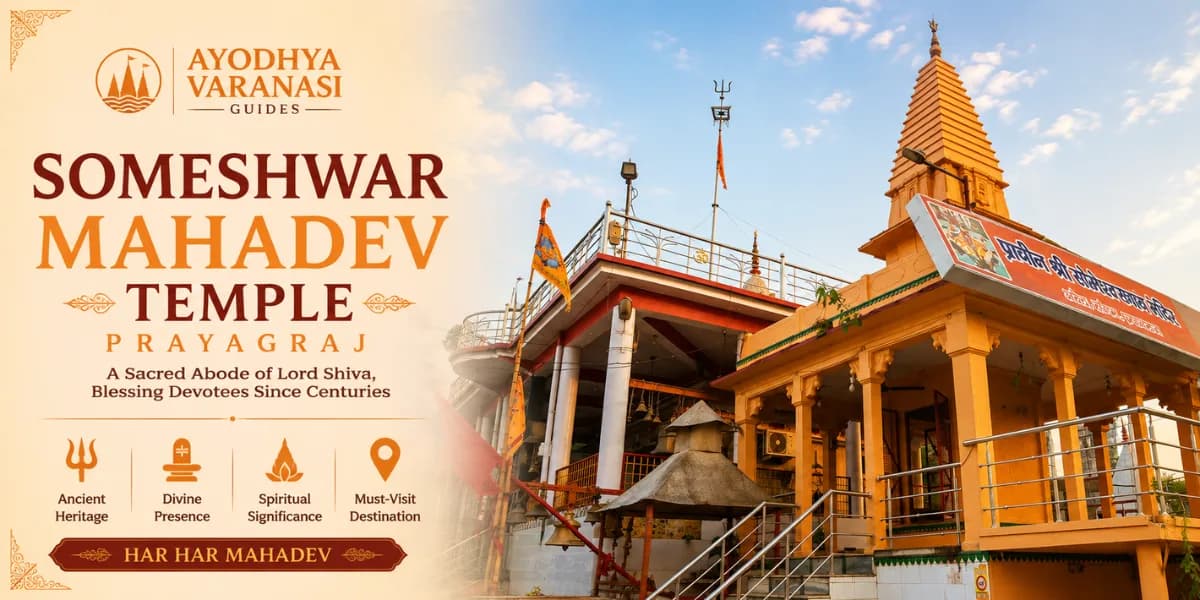
Someshwar Mahadev Temple — also called Someshwar Nath — stands at Arail, across the Yamuna from the Prayagraj Fort and the Sangam. It is one of the eight great tirthsthalas of Prayag and among the oldest temples in the city, mentioned in both the Padma Purana and the Shiva Purana. The name comes from Som, the moon: tradition holds the linga was consecrated by Chandra, the Moon God, who worshipped Shiva here to be freed from a curse. Devotees point to the trishul atop the temple, said to turn with the movement of the moon. Darshan is free, and Sawan and Mahashivratri are the great seasons.
- Timings
- ~5 AM–12 PM & 3 PM–9 PM
- Legend
- Linga consecrated by the Moon God
- Mentioned In
- Padma Purana & Shiva Purana
- Entry
- Free · no ticket
Someshwar Mahadev
Arail, Prayagraj · The Moon God's Linga
4.9 / 5 · Prayagraj Darshan Help
Sangam · Shiva temples
- Timings
- ~5:00 AM–12:00 PM & 3:00 PM–9:00 PM
- Deity
- Lord Shiva as Someshwar Mahadev
- Legend
- Consecrated by Chandra, the Moon God
- Significance
- One of the eight tirthsthalas of Prayag
- Entry
- Free · no ticket required
- Location
- Arail, across the Yamuna from the Fort
What Are the Someshwar Mahadev Temple Timings?
Someshwar Mahadev keeps the usual pattern of a major Shiva temple in this region — early morning through midday, a break, then afternoon into the evening, roughly 5:00 AM to 12:00 PM and 3:00 PM to 9:00 PM. Darshan is free. Because the temple lies across the Yamuna at Arail, you will need transport and should confirm the session before setting out.
Early Morning (Best)
Cool, quiet, ideal for jalabhishek
Late Morning
Open through to the midday break
Afternoon Break
Usually closed
Evening
Aarti and a calm evening darshan
Jalabhishek
Water and milk on the linga
Rudrabhishek
Arranged with the temple priests
Evening Aarti
The most atmospheric hour
Somvar (Mondays)
The moon's day — apt at a Someshwar temple
Tip: Monday is Somvar — the day of Som, the moon — which makes it the most fitting day of the week to visit a temple consecrated by the Moon God. WhatsApp us and we will plan the Arail crossing around the session timings for your date.
When Is the Best Month to Visit Someshwar Mahadev? (2026)
This is a Shiva temple, so Sawan and Mahashivratri dominate the calendar. October to March is the comfortable window, and Arail also fills during the mela season when the tent city rises here.
Mahashivratri and the Sawan Mondays bring the largest crowds. During Magh Mela and Kumbh, Arail hosts a large part of the tent city and access changes considerably.
Why Is Someshwar Mahadev Called the Moon God's Temple?
What Is Someshwar Mahadev Temple?
Someshwar Mahadev, also known as Someshwar Nath, is one of the oldest temples in Prayagraj, standing at Arail on the far bank of the Yamuna, directly opposite the Prayagraj Fort and the Sangam. It is counted among the eight great tirthsthalas of Prayag, and it finds mention in both the Padma Purana and the Shiva Purana.
What Does the Name Mean?
Som is the moon, and Someshwar is the Lord of the Moon — the same name borne by the great Somnath Jyotirlinga in Gujarat. It carries the same story: that Chandra, the Moon God, established and worshipped a linga at this spot. In Prayagraj that linga is the one you stand before at Arail.
What Is the Legend of Chandra?
Tradition tells that Chandra was afflicted by a curse that caused him to wane away, losing his light and his strength. He turned to Lord Shiva, performing severe penance and consecrating a linga in worship. Shiva relieved him — not by cancelling the curse but by tempering it into the cycle of waxing and waning that the moon has followed ever since. Devotees who come here with an affliction that will not lift come for exactly that reason.
What Is the Story of the Moving Trishul?
The detail visitors remember most. Devotees hold that the trishul mounted on top of the temple turns in accordance with the movement of the moon around the earth. It is the kind of claim that draws people out to Arail specifically to look up at a roof — and whatever you make of it, it is the local belief, told with complete conviction.
How Old Is the Temple?
Very. Tradition places its founding thousands of years ago, when Arail lay in dense jungle on the bank of the Yamuna, far from any settlement. The city has since grown around it, but the temple’s Puranic references and its place among the eight tirthsthalas of Prayag mark it as belonging to the oldest layer of this sacred landscape.
What Is Arail?
Arail lies across the Yamuna from the fort and the confluence, on the Naini side. Once forest, it is now one of the principal areas where the Magh Mela and Kumbh tent cities are laid out, which means that for a few weeks each winter this quiet temple sits at the edge of the largest gathering on earth.
Did you know? Monday — Somvar — is literally the day of Som, the moon, and it is also the traditional day of Lord Shiva. At a temple where the Moon God consecrated the linga, the two meanings meet.
How Do You Have Darshan at Someshwar Mahadev?
A straightforward Shiva darshan, with a river crossing to get there. Here is how a visit unfolds.
- 1
Cross the Yamuna to Arail
The temple is on the far bank from the Sangam and the fort, reached by road across the bridge — about 20 to 30 minutes from the confluence.
- 2
Check the Session Timing
The temple closes for a few hours around midday. Confirm before you cross, or you will make the journey for nothing.
- 3
Buy Bel Patra and Milk
Stalls near the temple sell bel patra, flowers, milk and Ganga jal — the traditional offerings for a Shivling.
- 4
Leave Footwear and Enter
Footwear comes off outside. Outside Sawan and the mela season there is rarely any queue at all.
- 5
Offer Jalabhishek on the Linga
Pour water and milk over the linga that tradition says Chandra himself consecrated to be freed from his curse.
- 6
Look Up at the Trishul
Step outside and look at the trident on the temple roof — the one devotees say turns with the movement of the moon.
- 7
Take In the Setting
Arail looks back across the Yamuna towards the Prayagraj Fort and the Sangam — a view of the confluence most visitors never get.
- 8
Return for the Sangam or the Aarti
Cross back for a boat ride at the confluence, or for the evening Ganga Aarti at Saraswati Ghat.
When Should You Visit Someshwar Mahadev Temple?
It is a river crossing out of the main city, so plan around the session hours, the season and the Shiva calendar.
Best Season — October to March
Comfortable weather for the crossing and for time at the temple. February brings Mahashivratri, spectacular here but extremely crowded, and Arail is busy through the whole Magh Mela.
Best Time of Day — Early Morning
Come between 5 and 8 AM for the calmest darshan and the practical window for an abhishek, before the day heats up and before the midday closure.
Most Special — Mondays, Sawan & Mahashivratri
Monday is Somvar, the day of the moon and of Shiva — the most fitting day of the week here. Sawan and Mahashivratri bring the largest crowds of the year.
What Can You See at Someshwar Mahadev Temple?
An ancient temple in a setting that has changed completely around it. Here is what to look for.
The Moon God's Linga
Top PickThe Main Darshan
The ancient Shivling that tradition holds was consecrated by Chandra, the Moon God, when he sought release from his curse.
The Trishul on the Roof
Top PickThe Local Wonder
The trident atop the temple that devotees say turns in accordance with the movement of the moon around the earth.
One of the Eight Tirthsthalas
Sacred Geography
The temple's place among the eight great tirthsthalas of Prayag, alongside its references in the Padma and Shiva Puranas.
The View Across the Yamuna
The Confluence From Afar
Arail looks back towards the Prayagraj Fort and the Sangam — a perspective on the confluence that visitors on the city side never get.
The Mela Ground
Winter Transformation
For a few weeks each winter, Arail becomes part of the Magh Mela and Kumbh tent city, and this quiet temple sits at the edge of an extraordinary gathering.
Why Cross the Yamuna for Someshwar Mahadev?
Almost every visitor stays on the city side of the rivers. Here is what is on the other bank.
One of Prayagraj's Oldest Temples
Referenced in the Padma Purana and the Shiva Purana, and counted among the eight tirthsthalas of Prayag — this is bedrock, not a later addition.
The Somnath Story, at Prayag
The Moon God's penance and release, the same legend that stands behind the great Somnath Jyotirlinga, attached to a linga you can stand in front of here.
The Turning Trishul
A claim you will hear nowhere else — the trident that follows the moon. Worth going to look at, whatever you conclude.
A Quiet Side of the Sangam
Outside the mela weeks, Arail is calm and open, with the confluence visible across the water and none of the crowds.
Is There an Entry Fee at Someshwar Mahadev Temple? (2026)
Darshan is completely free — there is no ticket and no paid queue. Your real cost is the crossing to Arail, plus offerings and any abhishek you arrange.
The darshan is free. What we arrange is the crossing and the timing — Arail is on the far side of the Yamuna and most visitors never get there simply because nobody plans it for them. We build it into your Sangam day with transport, and can book a Rudrabhishek in advance. Pricing confirmed in writing.
Taxi fares are indicative and vary with vehicle, season and mela-time traffic diversions.
What Do Devotees Say About Someshwar Mahadev Temple?
1,113 verified reviews
This is one of the oldest temples in our city and outsiders almost never come. We visit every Monday. The story of Chandra's curse and his release is why people bring their troubles here.
Jagdish Narayan Pandey
Prayagraj
Our guide suggested crossing the Yamuna to Arail and we nearly said no because of the distance. So glad we went. Ancient, peaceful, and the view back towards the fort and Sangam was unexpected.
Vaishali Kulkarni
Pune
Came during Magh Mela when the tent city was up all around Arail. Extraordinary contrast — this very old quiet temple at the edge of that enormous gathering. Darshan was smooth even then.
Ravindra Nath Mishra
Gorakhpur
We had our Rudrabhishek arranged in advance which made everything easy. The priests explained the Moon God legend and pointed out the trishul on the roof. A genuinely memorable morning.
Latha Venkatesan
Chennai
Worth the crossing if you have a car. Do check the timings — it closes midday and we nearly went at the wrong hour. Free entry, no touts, and far quieter than anything near the confluence.
Sandeep Kumar
Delhi
How Do You Fit Someshwar Mahadev Into a Prayagraj Day?
Arail is a short crossing rather than a long trip, so it fits comfortably into a full Sangam day. Here is the plan we use.
Sunrise at the Triveni Sangam. Begin at the confluence for first light on the water.
Sangam boat ride & snan. The holy dip at the meeting of the Ganga, Yamuna and the invisible Saraswati.
Veni Madhav darshan, Daraganj. Complete the yatra at the chief of the twelve Madhavs, a kilometre from the water.
Akshayavat & Patalpuri Temple. Darshan of the immortal banyan inside Prayagraj Fort. Carry photo ID for every adult.
Cross the Yamuna to Arail. Over the bridge to the far bank, with the fort and the confluence behind you.
Someshwar Mahadev darshan. Jalabhishek at the Moon God's linga, and a look at the trishul on the roof.
Evening Ganga Aarti at Saraswati Ghat. Return to the city and close the day on the riverfront.
Which Tour Package Covers Someshwar Mahadev?
Someshwar Mahadev sits within the wider Prayagraj circuit, and the Sangam, the temples and the sites out of town need a vehicle and a sensible order to do properly. These are the itineraries our guests book most — each with the Triveni Sangam snan and boat ride, a certified local guide, transport and pricing confirmed in writing.
- 1 Day1 Day Prayagraj Tour PackageTriveni Sangam snan and boat ride with the main temples of the confluence.
- 2 Days2 Days Prayagraj Tour PackageThe Sangam, Akshayavat and the Daraganj temples without rushing any of them.
- 2 Days2 Days Varanasi Prayagraj Tour PackageKashi Vishwanath and the Ganga Aarti with the Triveni Sangam.
- 2 Days2 Days Ayodhya Prayagraj Tour PackageRam Mandir and the Sangam, tightly planned for a short trip.
- 3 Days3 Days Varanasi Prayagraj Tour PackageKashi and the confluence, with time for the ghats and the Sangam boat ride.
- 4 Days4 Days Ayodhya Varanasi Prayagraj Tour PackageAll three cities — Ram Mandir, Kashi Vishwanath and the Triveni Sangam.
- 5 Days5 Days Ayodhya Varanasi Prayagraj Tour PackageThe complete sacred circuit at a comfortable, senior-friendly pace.
Want Someshwar Mahadev built into a custom itinerary? We plan around your dates, your pace and what you actually want to see.
See all Prayagraj, Ayodhya & Varanasi packagesHow Do You Reach Someshwar Mahadev Temple at Arail?
The temple is at Arail, across the Yamuna from the Prayagraj Fort and the Sangam, on the Naini side. You will need a vehicle to cross the bridge.
By Road / Taxi
The practical option. A taxi from the Sangam area takes 20 to 30 minutes across the Yamuna bridge. Ask for Someshwar Mahadev or Someshwar Nath, Arail.
By Train
Naini Junction is the nearest station on this side of the river, and Prayagraj Junction is about 12 km away across the city.
By Air
Prayagraj Airport (Bamrauli) is roughly 20 km away, with taxis at the terminal. Varanasi (~125 km) and Lucknow (~205 km) are the larger airports.
During the Mela
Arail hosts a large part of the Magh Mela and Kumbh tent city. Expect traffic diversions, pontoon-bridge routing and much longer journey times in those weeks.
Where Is Someshwar Mahadev Temple Located?
Someshwar Mahadev stands at Arail, on the far bank of the Yamuna, opposite the Prayagraj Fort and the Sangam. Use the map below to navigate across the bridge.
Prayagraj
- Area: Arail, across the Yamuna, Naini side
- PIN: Prayagraj 211008
- From the Triveni Sangam: ~12 km by road
- Significance: One of the eight tirthsthalas of Prayag
- Also known as: Someshwar Nath Mandir
Where Should You Stay to Visit Someshwar Mahadev?
Most visitors stay on the city side and cross for the morning. Arail itself has limited accommodation outside the mela season.
Civil Lines
Prayagraj's main hotel district, with branded and mid-range properties, restaurants and easy taxi access across the Yamuna bridge.
Near the Sangam & Daraganj
Dharamshalas and guesthouses close to the confluence, ideal for a sunrise snan before crossing to Arail.
Naini & Arail
Limited but growing options on this side of the Yamuna, including mela-season tented accommodation during Magh Mela and Kumbh.
What Else Can You Visit Near Someshwar Mahadev?
Arail sits across the water from the heart of the Prayagraj pilgrimage circuit, so everything is a short crossing away.
Triveni Sangam
The sacred confluence of the Ganga, Yamuna and the invisible Saraswati, visible across the water from Arail.
Veni Madhav Temple
The chief of the twelve Dwadash Madhav at Daraganj, whose darshan traditionally completes a Sangam snan.
Akshayavat
The immortal banyan inside the underground Patalpuri Temple at Prayagraj Fort. Photo ID required.
Sankat Har Madhav Temple
One of the twelve Dwadash Madhav, across the Ganga at Jhunsi — the Madhav who removes troubles.
Hanumat Niketan
The great Hanuman temple complex in Civil Lines, with its library, akhara and weaponry museum.
Shringverpur Dham
The kingdom of Nishadraj Guha where Lord Ram crossed the Ganga in exile, about 45 km away.
Mahashivratri, Sawan & the Magh Mela at Someshwar Mahadev
Mahashivratri is the greatest night of the year at Someshwar Mahadev, with darshan running late and devotees arriving from across Prayagraj and Naini. Through Sawan, and especially on the Sawan Mondays, the queue for jalabhishek runs long — and Monday carries a double meaning here, as Somvar, the day of the moon.
During Magh Mela and the Kumbh, Arail hosts a large part of the tent city, and this ancient, ordinarily quiet temple finds itself at the edge of the largest gathering on earth. Access and routes change completely in those weeks — confirm before you travel.
What Should You Know Before Visiting Someshwar Mahadev?
Simple to visit once you are across the river — the crossing is where planning matters.
You will need a vehicle
Arail is across the Yamuna, about 12 km by road from the Sangam. It is not walkable and public transport on that side is thin.
Confirm the session before crossing
The temple closes for a few hours around midday. Making the crossing to find locked doors is a genuinely wasted hour each way.
Monday is the day to come
Somvar is the day of Som, the moon, and of Lord Shiva. At a temple consecrated by the Moon God, no other day carries the same weight.
Look up at the trishul
The trident on the roof — said to turn with the moon — is the detail everyone talks about, and most visitors forget to step outside and look.
Mela season changes everything
During Magh Mela and Kumbh, Arail becomes part of the tent city. Expect diversions, pontoon routing and much longer journeys.
Book any Rudrabhishek in advance
Walk-in slots are limited, and effectively unavailable during Sawan and the mela weeks.
Go early in the morning
Between 5 and 8 AM gives you the calmest darshan and the practical window for an abhishek, before the heat and before the closure.
Buy offerings at the temple stalls
Bel patra, flowers, milk and Ganga jal are all sold nearby — no need to carry them across the river.
There is little shade
Carry water between April and June, and restrict your visit to early morning in those months.
Combine it with the Sangam side
Cross once and do it properly — Someshwar at Arail pairs naturally with a Sangam morning rather than a separate trip.
Someshwar Mahadev Temple Prayagraj — Frequently Asked Questions
The questions devotees ask us most about Someshwar Mahadev at Arail — the Moon God legend, the turning trishul, timings and how to cross the Yamuna.
Someshwar Mahadev, also called Someshwar Nath, is one of the oldest temples in Prayagraj, standing at Arail across the Yamuna from the Prayagraj Fort and the Sangam. It is counted among the eight great tirthsthalas of Prayag and is mentioned in the Padma Purana and the Shiva Purana.
Still have a question?
Our local team replies within 30 minutes.
Written & verified by the local Prayagraj guide team at Ayodhya Varanasi Guides
Our government-certified guides take pilgrims across the Yamuna to Someshwar Mahadev through the year, including during the Magh Mela when Arail becomes part of the tent city. Last updated: July 2026. Access routes across the river change considerably in mela season — message us and we will confirm the position for your travel date.
Offer Jalabhishek at the Moon God's Linga at Someshwar Mahadev
Let Ayodhya Varanasi Guides plan your Prayagraj darshan — the Triveni Sangam snan and boat ride, Veni Madhav at Daraganj, Akshayavat and the crossing to Someshwar Mahadev at Arail — with a certified local guide, transport across the Yamuna and a Rudrabhishek booked in advance. Confirmed in writing.