
Sankat Har Madhav Temple, Prayagraj — Dwadash Madhav Darshan & Guide
Sankat Har Madhav Temple is one of the Dwadash Madhav — the twelve ancient temples of Lord Vishnu that stand guard around Prayag, the king of pilgrimage places. It is located at Jhunsi, across the Ganga from the Sangam. The name means “the Madhav who removes troubles”, and devotees come here to have their difficulties lifted. Tradition holds that a Prayag yatra is incomplete without Madhav darshan after the Sangam snan. Darshan is free, with morning and evening sessions, and the temple sits about 7 km from the confluence.
- Timings
- Two sessions · ~6 AM – 8 PM
- Deity
- Lord Vishnu as Sankat Har Madhav
- Significance
- One of the 12 Dwadash Madhav
- Entry
- Free · no ticket
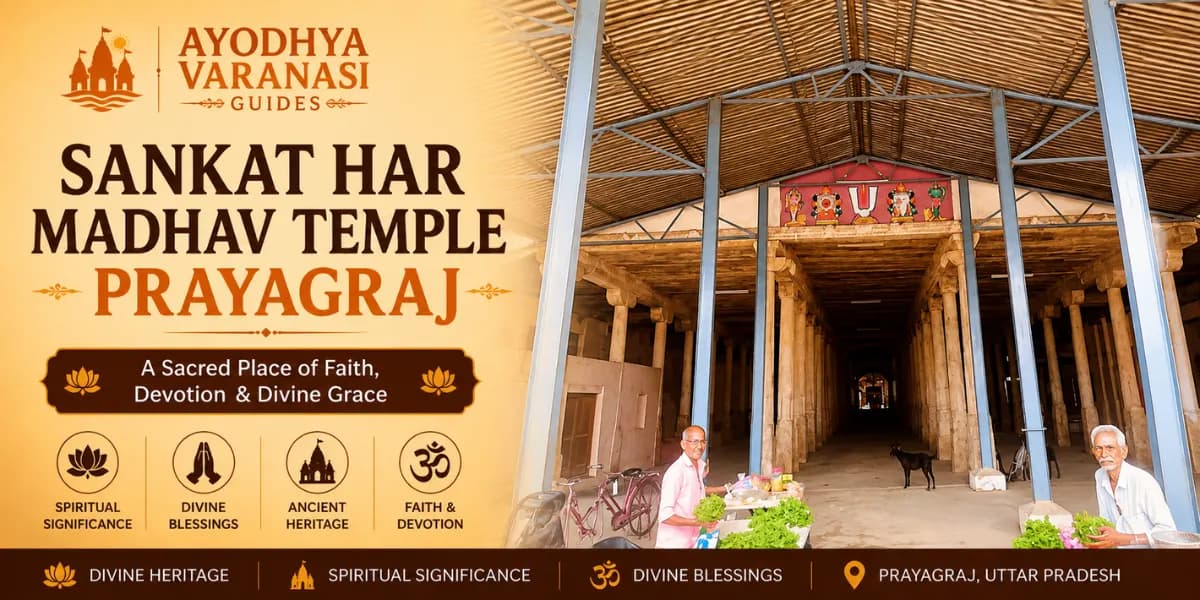
Sankat Har Madhav
Jhunsi, Prayagraj · Remover of Troubles
4.9 / 5 · Prayagraj Darshan Help
Sangam · Dwadash Madhav
- Timings
- ~6:00 AM–12:00 PM & 4:00 PM–8:00 PM
- Deity
- Lord Vishnu as Sankat Har (Sankashthar) Madhav
- Significance
- One of the twelve Dwadash Madhav of Prayag
- Scriptural Source
- Praised in the Puranic Prayag Mahatmya
- Entry
- Free · no ticket required
- Location
- Jhunsi (ancient Pratishthanpur), across the Ganga
What Are the Sankat Har Madhav Temple Timings?
Like most temples in the Prayag region, Sankat Har Madhav opens in two sessions — morning and evening — with a midday break when the deity rests. Darshan is free, and the temple is rarely crowded outside the mela season, so you will usually have an unhurried darshan. Timings can shift on Ekadashi, Kartik Purnima and during the Magh Mela.
Morning Session
Opens after the morning puja
Midday Break
Temple usually closed
Evening Session
The most pleasant time to visit
Morning Aarti
Shringar of the deity
Evening Aarti
Sandhya aarti with lamps
Ekadashi Puja
Special for a Vishnu temple
Tulsi Offering
The traditional offering to Madhav
Tip: the temple is at Jhunsi, across the Ganga from the Sangam — allow 20 to 30 minutes each way via the bridge. Message us on WhatsApp and we will confirm the current darshan timing and combine it with your Sangam snan so you are not crossing the river twice.
When Is the Best Month for Madhav Darshan? (2026)
Prayagraj’s pilgrimage calendar shapes this visit more than the weather does. October to March is comfortable throughout, while the Magh Mela and Kumbh seasons are when the Dwadash Madhav circuit truly comes alive.
Kartik and Magh are the traditional months for the Prayag yatra and the Dwadash Madhav circuit. Ordinary weekdays are quiet and unhurried.
What Are the Dwadash Madhav — and Why Does Sankat Har Madhav Matter?
What Is Sankat Har Madhav Temple?
Sankat Har Madhav — also written Sankashthar Madhav — is a temple of Lord Vishnu at Jhunsi, on the far bank of the Ganga from the Sangam. It is one of the Dwadash Madhav, the twelve forms of Madhav who, in the Puranic tradition, stand guard over Prayag. The name is plain in its promise: sankat har, the remover of troubles.
Who Are the Twelve Madhavs of Prayag?
The Dwadash Madhav are twelve ancient Vishnu temples ringed around the Prayag region — among them Adi Venimadhav at Daraganj, Bindu Madhav, Shankh Madhav, Chakra Madhav, Gada Madhav, Padma Madhav, Ananta Madhav, Manohar Madhav and Sankat Har Madhav. Tradition holds that they were established to protect Tirtharaj Prayag, the king among pilgrimage places, and that Lord Vishnu is eternally present in each of these twelve forms.
Why Is Madhav Darshan Part of the Prayag Yatra?
This is the part most visitors never hear. In the traditional understanding, a Prayag yatra is not complete with the Sangam snan alone — the holy dip should be followed by darshan of Madhav. The rivers purify; the Madhav shrines complete. Millions bathe at the confluence every year without ever learning this, which is precisely why these temples remain so quiet.
Why Is He Called the Remover of Troubles?
Devotees come to Sankat Har Madhav with exactly the kind of difficulties people carry to a temple — illness, debt, family trouble, obstacles that will not shift. The deity’s name is his function. It has made this one of the most personally sought-after of the twelve, visited less for ritual completeness than because someone needs help.
What Is Special About Jhunsi?
Jhunsi is not an ordinary suburb. It is ancient Pratishthanpur, described in tradition as the capital of the Chandravanshi king Pururava, and it is one of the oldest inhabited parts of the Prayag region. Crossing the Ganga to Jhunsi means crossing into a much older layer of the city than the one visitors usually see.
What Is the Dwadash Madhav Parikrama?
The Dwadash Madhav Parikrama is a walking pilgrimage that visits all twelve Madhav temples, traditionally taking about three days on foot. It fell into neglect for long stretches and was revived in 1991 by Swami Harichaitanya Brahmachari of Jhunsi, then more decisively at the Kumbh of 2019, when Mahant Hari Giri led a large organised parikrama. It has been performed with growing regularity since.
Did you know? The twelve Madhav temples are scattered widely — some minutes from the Sangam, others 20 to 40 km out. Walking the full Dwadash Madhav Parikrama takes about three days, which is why most pilgrims visit two or three of the shrines and leave the rest for a future yatra.
How Do You Have Darshan at Sankat Har Madhav?
There is no queue system, no VIP pass and no crowd to fight. A darshan here is simple and unhurried.
- 1
Cross the Ganga to Jhunsi
The temple is on the far bank from the Sangam, reached by bridge — about 20 to 30 minutes by road from the confluence.
- 2
Check the Session Timing
Arrive during the morning or evening session. The temple closes for a midday break, as most Prayag temples do.
- 3
Leave Footwear and Enter
Footwear comes off outside, as at any temple. The compound is small and easy to find your way around.
- 4
Have Darshan of Madhav
Stand before Lord Vishnu in his form as Sankat Har Madhav — the Madhav who lifts troubles. There is usually no rush here.
- 5
Offer Tulsi
Tulsi is the traditional offering to Madhav. It is the one thing worth carrying with you, or buy it at the stalls nearby.
- 6
Ask About the Dwadash Madhav
If the priests have time, ask about the other eleven Madhav temples. Most visitors leave without realising this shrine is part of a circuit.
- 7
Return for the Sangam or the Aarti
Head back across the river for a Sangam boat ride, or for the evening Ganga Aarti at Saraswati Ghat.
When Should You Visit Sankat Har Madhav Temple?
The temple is open all year and never charges. What matters is the session timing, the season and whether you want the mela atmosphere.
Best Season — October to March
Prayagraj's winter is right for the whole Sangam and Madhav circuit. Kartik (October–November) is the traditional month for the Prayag yatra and carries particular merit for Vishnu darshan.
Best Time of Day — Morning or Evening Session
Come between 6 and 11 AM or after 4 PM. The midday break catches out visitors who cross the bridge at the wrong hour and find the doors shut.
Most Special — Magh Mela & Ekadashi
During the Magh Mela the Dwadash Madhav circuit comes alive and the parikrama is performed. Ekadashi, Kartik Purnima and Janmashtami are the most auspicious individual days at a Vishnu temple.
What Can You See at Sankat Har Madhav Temple?
It is an intimate temple rather than a grand complex — here is what to look for while you are there.
The Madhav Sanctum
Top PickThe Main Darshan
The sanctum of Lord Vishnu as Sankat Har Madhav, the remover of troubles — the reason devotees cross the river to come here.
The Dwadash Madhav Tradition
Top PickLiving Heritage
One of the twelve Madhav shrines that guard Tirtharaj Prayag, part of a Puranic tradition that most Sangam visitors never encounter.
The Temple Compound
Quiet Devotion
A modest, well-tended compound where darshan is unhurried and the priests still have time to explain what you are looking at.
Ancient Jhunsi (Pratishthanpur)
The Older City
The surrounding area is ancient Pratishthanpur, linked in tradition to King Pururava — among the oldest inhabited ground in the Prayag region.
The Ganga Bank at Jhunsi
River Views
The far bank gives you a different view of the Sangam and the river, away from the press of the main ghats.
Why Should You Add a Madhav Temple to Your Sangam Trip?
Most pilgrims do the snan and go home. Here is what a Madhav darshan adds.
It Completes the Prayag Yatra
Tradition holds that the Sangam snan should be followed by Madhav darshan. Very few visitors are ever told this — and it takes an hour to put right.
A Deity Named for Your Difficulties
Sankat Har Madhav is the remover of troubles. People come here carrying something specific, and that gives the temple a very different feeling from a sightseeing stop.
A Puranic Circuit Few Know About
The twelve Madhav temples of Prayag are an ancient tradition hiding in plain sight around one of India's busiest pilgrimage cities.
Genuine Quiet
After the crowds at the confluence, a temple where nobody is hurrying you through is worth the crossing on its own.
Is There an Entry Fee at Sankat Har Madhav Temple? (2026)
Darshan at Sankat Har Madhav is completely free — there is no ticket and no paid queue. Your only costs are the crossing to Jhunsi and any offering you choose to make.
Darshan is free. What we arrange is the circuit — because the twelve Madhav temples are scattered across the Prayag region, seeing three or four of them in a day takes local knowledge and a vehicle. We combine Sankat Har Madhav with the Sangam snan, Akshayavat and the other Madhav shrines, with pricing confirmed in writing.
Taxi fares are indicative and vary with vehicle, season and traffic across the bridge.
What Do Devotees Say About Sankat Har Madhav Temple?
1,071 verified reviews
My family has come to Sankat Har Madhav for three generations, always when something is weighing on us. Very few outsiders know the Dwadash Madhav tradition. I am glad to see someone writing about it properly.
Girish Chandra Pandey
Prayagraj
Our guide told us the Sangam snan should be followed by Madhav darshan — we had no idea. We crossed to Jhunsi that same evening. Quiet, beautiful temple and the priest explained everything patiently.
Lalita Krishnan
Chennai
Visited during Magh Mela. While everyone else was at the confluence, we did three of the Madhav temples. Completely different side of Prayagraj and far more peaceful. Well planned by the team.
Devendra Singh
Agra
Went specifically because of the name — we were going through a difficult time. Whatever else, the hour we spent there gave us a great deal of peace. Simple temple, very sincere atmosphere.
Shobha Rani
Bhopal
Worth crossing the river for. Do check the timings — we arrived at 2 PM on our first attempt and it was shut for the midday break. Second visit in the evening was lovely.
Ajay Kulkarni
Pune
How Do You Combine Madhav Darshan With the Sangam?
The traditional sequence is snan first, Madhav darshan after. This is the Prayagraj day our guests find most complete.
Sunrise at the Triveni Sangam. Reach the confluence for first light — the finest hour on the water.
Sangam boat ride & snan. The holy dip at the meeting of the Ganga, Yamuna and the invisible Saraswati.
Akshayavat & Patalpuri Temple. Darshan of the immortal banyan inside Prayagraj Fort. Carry photo ID for every adult.
Adi Venimadhav, Daraganj. Begin the Madhav circuit at the shrine closest to the Sangam.
Cross to Jhunsi. Over the bridge to ancient Pratishthanpur on the far bank of the Ganga.
Sankat Har Madhav darshan. Darshan of the Madhav who removes troubles, in the morning session before the midday break.
Evening Ganga Aarti at Saraswati Ghat. Close the day back on the riverfront with lamps and bells.
Which Tour Package Covers Sankat Har Madhav?
Sankat Har Madhav sits within the wider Prayagraj circuit, and the Sangam, the temples and the sites out of town need a vehicle and a sensible order to do properly. These are the itineraries our guests book most — each with the Triveni Sangam snan and boat ride, a certified local guide, transport and pricing confirmed in writing.
- 1 Day1 Day Prayagraj Tour PackageTriveni Sangam snan and boat ride with the main temples of the confluence.
- 2 Days2 Days Prayagraj Tour PackageThe Sangam, Akshayavat and the Daraganj temples without rushing any of them.
- 2 Days2 Days Varanasi Prayagraj Tour PackageKashi Vishwanath and the Ganga Aarti with the Triveni Sangam.
- 2 Days2 Days Ayodhya Prayagraj Tour PackageRam Mandir and the Sangam, tightly planned for a short trip.
- 3 Days3 Days Varanasi Prayagraj Tour PackageKashi and the confluence, with time for the ghats and the Sangam boat ride.
- 4 Days4 Days Ayodhya Varanasi Prayagraj Tour PackageAll three cities — Ram Mandir, Kashi Vishwanath and the Triveni Sangam.
- 5 Days5 Days Ayodhya Varanasi Prayagraj Tour PackageThe complete sacred circuit at a comfortable, senior-friendly pace.
Want Sankat Har Madhav built into a custom itinerary? We plan around your dates, your pace and what you actually want to see.
See all Prayagraj, Ayodhya & Varanasi packagesHow Do You Reach Sankat Har Madhav Temple?
The temple is at Jhunsi, across the Ganga from the Sangam, about 7 km by road via the bridge. It is an easy trip, but you will need a vehicle rather than a walk.
By Road / Taxi
The simplest option. A taxi or auto from the Sangam takes 20 to 30 minutes across the bridge to Jhunsi. Ask for Sankat Har Madhav or Sankashthar Madhav Mandir.
By Train
Prayagraj Junction is about 12 km away and Jhunsi railway station is much closer. Prayagraj is well connected to Delhi, Varanasi, Lucknow and Ayodhya.
By Air
Prayagraj Airport (Bamrauli) is roughly 25 km away with taxis at the terminal. Varanasi (~120 km) and Lucknow (~200 km) are the larger airports.
The Last Mile
Autos and e-rickshaws run within Jhunsi. During Magh Mela, expect traffic diversions on the bridge and allow extra time for the crossing.
Where Is Sankat Har Madhav Temple Located?
Sankat Har Madhav Temple stands at Jhunsi, ancient Pratishthanpur, on the far bank of the Ganga from the Triveni Sangam. Use the map below to navigate across the bridge.
Prayagraj
- Area: Jhunsi (ancient Pratishthanpur), Prayagraj
- PIN: Prayagraj 211019
- From the Triveni Sangam: ~7 km via the bridge
- From Prayagraj Junction: ~12 km
- Tradition: One of the twelve Dwadash Madhav
Where Should You Stay for a Dwadash Madhav Darshan?
The Madhav temples are spread across the Prayag region, so a central base with a vehicle works better than staying close to any one shrine.
Civil Lines
Prayagraj's main hotel district, with branded and mid-range properties, restaurants and easy taxi access to both banks of the river.
Near the Sangam & Daraganj
Dharamshalas and guesthouses close to the confluence — convenient for a sunrise snan before crossing to Jhunsi for Madhav darshan.
Jhunsi
Simple guesthouses and ashram accommodation on the far bank, quieter than the city and handy if you plan a longer Dwadash Madhav circuit.
What Else Should You Visit Near Sankat Har Madhav?
The temple fits neatly into the wider Prayagraj pilgrimage circuit — here is what to pair it with.
Veni Madhav Temple
The chief of the twelve Dwadash Madhav at Daraganj — the presiding deity of Prayagraj and the essential Madhav darshan.
Triveni Sangam
The sacred confluence of the Ganga, Yamuna and the invisible Saraswati — the snan that Madhav darshan traditionally completes.
Akshayavat
The immortal banyan inside the underground Patalpuri Temple at Prayagraj Fort. Photo ID required for entry.
Shringverpur Dham
The kingdom of Nishadraj Guha where Lord Ram crossed the Ganga in exile, about 45 km away.
Kashi Vishwanath Temple, Varanasi
The Jyotirlinga of Kashi, ~120 km away — the natural next leg of a Prayagraj–Varanasi yatra.
Ganga Aarti, Varanasi
The world-famous evening aarti at Dashashwamedh Ghat, easily combined on a two-city trip.
Ram Mandir, Ayodhya
The temple of Ram Lalla, ~165 km away. We assist with Sugam (VIP) Darshan on the Ayodhya leg.
Magh Mela & the Dwadash Madhav Parikrama at Prayag
During the Magh Mela and the Kumbh, the ancient Dwadash Madhav Parikrama is performed — a walking pilgrimage of all twelve Madhav temples that traditionally takes about three days. Long neglected, it was revived in 1991 and again at the Kumbh of 2019, and has been observed with growing regularity since.
Kartik Purnima, Dev Uthani Ekadashi and Janmashtami are the most auspicious individual days at a Vishnu temple such as this. If you want to walk any part of the parikrama, plan ahead — the routes and dates are announced close to the mela.
What Should You Know Before Visiting Sankat Har Madhav?
A straightforward darshan, but a few local details will save you a wasted crossing.
Mind the midday break
The temple closes roughly between 12 and 4 PM. Crossing the bridge to find locked doors is the most common mistake visitors make here.
You will need a vehicle
Jhunsi is across the Ganga, about 7 km from the Sangam by road. Book an auto or taxi for the round trip rather than hoping for a ride back.
Do the snan first, then Madhav darshan
The traditional sequence is the Sangam bath followed by darshan of Madhav. It is worth following the order if you can.
Carry tulsi if you can
Tulsi is the traditional offering to Madhav. Stalls near the temple sell it, but bringing your own is considered especially good.
Ask about the other eleven Madhavs
This shrine is one of twelve. The priests can tell you which others are close by, and a guide can build two or three into one afternoon.
Allow extra time during Magh Mela
Bridge traffic and diversions during the mela can double the crossing time. Build slack into your schedule in January and February.
Dress modestly
Standard temple etiquette — modest clothing, footwear removed outside. This is a working temple, not a monument.
It is a small, quiet shrine
Do not arrive expecting the scale of Kashi Vishwanath. The value here is the tradition and the calm, not the architecture.
Confirm timings on Ekadashi and festivals
Hours shift on Ekadashi, Kartik Purnima, Janmashtami and through the mela season.
Combine it with Jhunsi's older sites
You are in ancient Pratishthanpur. Ask your guide what else on this bank is worth twenty minutes while you are across the river.
Sankat Har Madhav Temple Prayagraj — Frequently Asked Questions
The questions pilgrims ask us most about Sankat Har Madhav — the Dwadash Madhav tradition, timings, location and how to fit it around a Sangam snan.
Sankat Har Madhav, also called Sankashthar Madhav, is a temple of Lord Vishnu at Jhunsi in Prayagraj. It is one of the Dwadash Madhav — the twelve ancient Madhav temples that, in the Puranic tradition, stand guard over Tirtharaj Prayag. The name means 'the Madhav who removes troubles'.
Still have a question?
Our local team replies within 30 minutes.
Written & verified by the local Prayagraj guide team at Ayodhya Varanasi Guides
Our government-certified guides take pilgrims across to Jhunsi for Madhav darshan throughout the year, including during the Magh Mela when the Dwadash Madhav Parikrama is performed. Last updated: July 2026. Darshan hours shift on Ekadashi and festival days — message us for the timing on your travel date before you cross the river.
Complete Your Prayag Yatra at Sankat Har Madhav
Let Ayodhya Varanasi Guides plan a complete Prayagraj darshan — the Triveni Sangam snan and boat ride, Akshayavat, and the Dwadash Madhav temples including Sankat Har Madhav at Jhunsi — with a certified local guide who knows the tradition and comfortable transport across the river. Confirmed in writing.