
Shringverpur Dham, Prayagraj — Where Ram Crossed the Ganga
Shringverpur Dham (Shringaverapura) sits on the Ganga about 35–40 km from Prayagraj on the Lucknow road. This was the kingdom of Nishadraj Guha, the boatman-king and friend of Lord Ram — and the place where Ram, Sita and Lakshman crossed the Ganga at the start of their exile. It is the setting of the beloved Kevat prasang, when the boatman insisted on washing Ram’s feet before ferrying him across. You can visit Ram Chaura Ghat, the Shringi Rishi temple, the Nishadraj temple, Ram Sayan Ashram and Nishadraj Park. Entry is free, and the site is best visited as a half-day trip from Prayagraj.
- Timings
- Open daily · ~6 AM – 7 PM
- Distance
- ~35–40 km from Prayagraj
- Entry
- Free · no ticket
- Famous For
- Ram & Nishadraj — the Kevat prasang
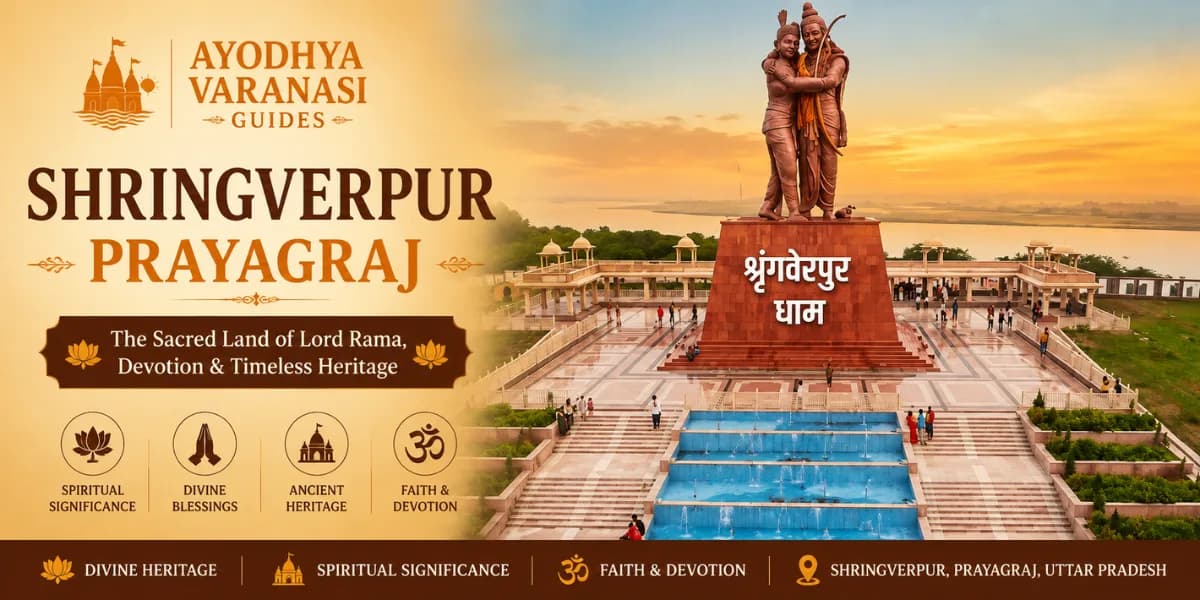
Shringverpur Dham
Prayagraj · The Kingdom of Nishadraj
4.9 / 5 · Prayagraj Tours
Ram Van Gaman Path
- Timings
- Open daily, ~6:00 AM – 7:00 PM
- Significance
- Where Lord Ram crossed the Ganga in exile
- Named After
- Sage Shringi (Rishyashringa)
- Key Sites
- Ram Chaura, Shringi Rishi & Nishadraj temples
- Entry
- Free · no ticket required
- Distance
- ~35–40 km from Prayagraj, on the Ganga
What Are the Shringverpur Timings — and How Long Should You Plan?
Shringverpur is an open dham spread along the Ganga rather than a single walled temple, so the ghat and the park are accessible through daylight hours. The temples keep morning and evening darshan hours with a midday break, as is usual in this region. Because it is 35–40 km from Prayagraj, treat it as a half-day trip: roughly an hour each way plus two hours on site.
Morning (Best)
Cool, temples open, quiet ghat
Midday
Site open; temples often closed
Evening (Best)
Sunset on the Ganga at Ram Chaura
Drive From Prayagraj
Each way, on the Lucknow road
Temples & Ghat
Ram Chaura, Shringi Rishi, Nishadraj
Nishadraj Park
The colossal Ram–Nishadraj statue
Total Half-Day Trip
Comfortable morning or afternoon block
Tip: Shringverpur has no train station of its own and local transport is thin, so book a taxi for the round trip rather than hoping to find a return ride. WhatsApp us and we will build it into your Prayagraj day with the driver waiting on site.
When Is the Best Month to Visit Shringverpur? (2026)
Shringverpur is largely open ground beside the Ganga, so the season shapes the visit. October to March is the comfortable window, and the dham stays refreshingly uncrowded for most of the year.
Ram Navami and Kartik Purnima bring the biggest gatherings. On ordinary weekdays Shringverpur is remarkably peaceful for a site of this importance.
Why Is Shringverpur So Important in the Ramayana?
What Is Shringverpur Dham?
Shringverpur — Shringaverapura in its older form — is an ancient settlement on the bank of the Ganga, about 35 to 40 km upstream of Prayagraj. In the Ramayana it is the capital of the Nishad kingdom, and it marks one of the most tender moments in the entire epic: the point where Lord Ram left the world he knew and crossed the river into exile.
Who Was Nishadraj Guha?
Nishadraj Guha was the king of the Nishads, a community of boatmen and forest dwellers, and he was Lord Ram’s friend. When Ram, Sita and Lakshman arrived at his territory on their way to the forest, Guha received them not as subjects receive a prince but as a friend receives a friend. He offered them everything he had, sat with them through the night, and personally arranged their crossing of the Ganga.
What Is the Kevat Prasang?
This is the story people come here for. Before ferrying Ram across, the boatman — the kevat — refused to let him board until he had washed his feet, saying that the dust of those feet had once turned a stone into a woman, and he was not about to risk his boat becoming one. It is a moment of humour, devotion and enormous tenderness, and it has been sung in the Ramcharitmanas for centuries. Shringverpur is where it happened.
Why Is It Named After Shringi Rishi?
The name comes from Sage Shringi (Rishyashringa), whose ashram stood here. He is the sage who performed the Putrakameshti Yagna for King Dashrath — the very ritual that led to the birth of Lord Ram and his brothers. There is a striking symmetry to it: the place that made Ram’s birth possible is also the place from which he departed into exile.
What Did Archaeologists Find Here?
Shringverpur is not only a place of faith. Excavations led by B. B. Lal uncovered a remarkable brick-built water tank and hydraulic system dating to around the first century BCE — a sophisticated ancient waterworks that points to a substantial, well-organised township here in antiquity. The site is protected, and it gives the tradition a solid archaeological footing.
What Is the Ram Van Gaman Path?
Shringverpur is a key station on the Ram Van Gaman Path, the route traced from Ayodhya through Shringverpur to Chitrakoot and beyond, following Lord Ram’s journey into exile. Substantial development has come to the dham in recent years, including Nishadraj Park with its towering statue of Ram embracing Nishadraj — an image of friendship across every line of birth and status.
Did you know? The statue at Nishadraj Park shows Lord Ram embracing Nishadraj Guha — not blessing him from above, but holding him as an equal. For many visitors that single image is the most moving thing at Shringverpur.
What Do You Actually Do at Shringverpur Dham?
The dham is spread out along the river, so there is a natural sequence to the visit. This is how our guides take guests around.
- 1
Arrive at Shringverpur Dham
The drive from Prayagraj takes about an hour on the Lucknow road. Your vehicle can reach the main sites; the distances between them are short.
- 2
Begin at Ram Chaura Ghat
Stand at the ghat identified as the point where Lord Ram crossed the Ganga into exile. This is the heart of the whole site.
- 3
Hear the Kevat Prasang at the River
Take a moment here for the story of the boatman who washed Ram's feet. Told at the actual riverbank, it lands very differently.
- 4
Visit the Nishadraj Temple
The shrine honouring Nishadraj Guha, the boatman-king whose friendship with Lord Ram is the reason this place is remembered.
- 5
Have Darshan at the Shringi Rishi Temple
The temple of the sage who performed the Putrakameshti Yagna for King Dashrath, and after whom the dham is named.
- 6
See Ram Sayan Ashram
The spot identified as the place where Lord Ram spent the night at Shringverpur before crossing the river the next morning.
- 7
Walk Through Nishadraj Park
The developed park with its colossal statue of Ram embracing Nishadraj — the newest and most photographed part of the dham.
- 8
Stay for Sunset on the Ganga
If you have come in the afternoon, do not rush away. The river here at dusk is quiet in a way the Sangam never is.
When Should You Visit Shringverpur?
It is a half-day trip in open country by the river, so weather and light matter. Here is how we plan it for guests.
Best Season — October to March
Cool, dry weather makes the ghat, the temples and the park genuinely pleasant to walk. November and February are the pick of the year. Avoid May and June, when there is very little shade.
Best Time of Day — Morning or Late Afternoon
Come in the morning for temple darshan and cool air, or set out around 3:30 PM to reach the ghat for sunset on the Ganga. Midday means closed temples and hard light.
Most Special — Ram Navami & Kartik Purnima
Ram Navami is the most fitting day to stand where Lord Ram crossed the river, while Kartik Purnima brings pilgrims to the Ganga for the holy dip. Both fill the dham with life.
What Are the Main Places to See at Shringverpur?
Shringverpur is a cluster of connected sites rather than one temple. These are the ones worth your time.
Ram Chaura Ghat
Top PickThe Crossing Point
The ghat on the Ganga identified as the place where Lord Ram, Sita and Lakshman crossed the river into exile — the reason Shringverpur exists on the pilgrim map.
Nishadraj Temple
Top PickThe Boatman King
The shrine to Nishadraj Guha, whose friendship with Lord Ram is one of the great human relationships of the Ramayana.
Shringi Rishi Temple
The Sage of the Yagna
Dedicated to Sage Shringi, who performed the Putrakameshti Yagna for King Dashrath that led to the birth of Lord Ram. The dham takes its name from him.
Ram Sayan Ashram
Where Ram Rested
The site identified with the night Lord Ram spent at Shringverpur before the crossing — traditionally on a simple bed of leaves.
Nishadraj Park
Top PickThe Great Statue
The developed park built around a towering statue of Lord Ram embracing Nishadraj Guha, part of the Ram Van Gaman Path works.
The Ancient Water Tank
Archaeology
Remains of a sophisticated brick water tank and hydraulic system from around the 1st century BCE, uncovered in excavations at the site.
Why Is Shringverpur Worth the Drive From Prayagraj?
It takes an hour each way, and visitors sometimes hesitate. Here is what makes it worth the trip.
The Kevat Story, Where It Happened
One of the most loved passages in the Ramcharitmanas belongs to this riverbank. Hearing it at the ghat itself is a genuinely different experience.
A Story About Friendship Across Status
A prince of Ayodhya and a boatman-king embracing as equals. Nishadraj Park makes that image impossible to miss.
A Key Stop on the Ram Van Gaman Path
If you are travelling Ayodhya to Chitrakoot, Shringverpur is the link in the chain — the point where the exile actually begins.
The Quiet Ganga
After the intensity of the Sangam, this stretch of river is calm, open and uncrowded. Many guests say it was their favourite hour in Prayagraj.
Is There an Entry Fee at Shringverpur? (2026 Costs)
There is no entry fee at Shringverpur Dham — the ghat, the temples and the park are all free. Your real cost is transport, because the dham is 35 to 40 km from Prayagraj. Here is what to budget.
The dham itself is free. What we arrange is the transport and the timing — a vehicle that waits on site so you are not stranded, a guide who can tell the Kevat prasang properly at the ghat, and a schedule that gets you back to Prayagraj for the evening aarti. All confirmed in writing.
Taxi fares are indicative and depend on vehicle type, season and waiting time. Always agree the round-trip fare including waiting before you set out.
What Do Visitors Say About Shringverpur Dham?
1,097 verified reviews
I have recited the Kevat prasang all my life. To stand at Ram Chaura and hear it at the actual river was something else entirely. My wife was in tears. Worth every minute of the drive.
Om Prakash Tripathi
Lucknow
We are locals and had never been. Nishadraj Park is beautifully done and the statue is enormous. Took our children and they understood the story properly for the first time.
Rekha Saxena
Prayagraj
Did this as part of an Ayodhya to Chitrakoot trip. Shringverpur is the missing link most people skip. Our guide explained the Shringi Rishi connection to Ram's birth, which I had never known.
Mahesh Agrawal
Raipur
Went for the history as much as the faith. The ancient water tank excavation is fascinating and hardly anyone talks about it. Peaceful, uncrowded and very well organised by the team.
Fatima Ansari
Mumbai
Lovely site, especially at sunset. Do book a taxi that waits — we saw a family struggling to find a ride back to Prayagraj. Temples close in the afternoon so plan around that.
Suresh Yadav
Varanasi
How Do You Fit Shringverpur Into a Prayagraj Trip?
Shringverpur needs a half-day block. This is the two-part day our guests find works best.
Sunrise at the Triveni Sangam. Begin at the confluence for first light and the most beautiful hour on the water.
Sangam boat ride & snan. The holy dip at the meeting of the Ganga, Yamuna and the invisible Saraswati.
Akshayavat & Patalpuri Temple. Darshan of the immortal banyan inside Prayagraj Fort. Carry photo ID for every adult.
Drive to Shringverpur Dham. About an hour on the Lucknow road, out of the city and along the Ganga.
Ram Chaura, temples & Nishadraj Park. The crossing point, the Nishadraj and Shringi Rishi temples, Ram Sayan Ashram and the great statue.
Return to Prayagraj. Back to the city for a late lunch and rest through the hottest part of the day.
Evening Ganga Aarti at Saraswati Ghat. Close the day on the riverfront with lamps and bells.
Which Tour Package Covers Shringverpur Dham?
Shringverpur Dham sits within the wider Prayagraj circuit, and the Sangam, the temples and the sites out of town need a vehicle and a sensible order to do properly. These are the itineraries our guests book most — each with the Triveni Sangam snan and boat ride, a certified local guide, transport and pricing confirmed in writing.
- 1 Day1 Day Prayagraj Tour PackageTriveni Sangam snan and boat ride with the main temples of the confluence.
- 2 Days2 Days Prayagraj Tour PackageThe Sangam, Akshayavat and the Daraganj temples without rushing any of them.
- 2 Days2 Days Varanasi Prayagraj Tour PackageKashi Vishwanath and the Ganga Aarti with the Triveni Sangam.
- 2 Days2 Days Ayodhya Prayagraj Tour PackageRam Mandir and the Sangam, tightly planned for a short trip.
- 3 Days3 Days Varanasi Prayagraj Tour PackageKashi and the confluence, with time for the ghats and the Sangam boat ride.
- 4 Days4 Days Ayodhya Varanasi Prayagraj Tour PackageAll three cities — Ram Mandir, Kashi Vishwanath and the Triveni Sangam.
- 5 Days5 Days Ayodhya Varanasi Prayagraj Tour PackageThe complete sacred circuit at a comfortable, senior-friendly pace.
Want Shringverpur Dham built into a custom itinerary? We plan around your dates, your pace and what you actually want to see.
See all Prayagraj, Ayodhya & Varanasi packagesHow Do You Reach Shringverpur From Prayagraj?
Shringverpur lies about 35 to 40 km north-west of Prayagraj on the Lucknow road, beside the Ganga. There is no railway station at the dham, so plan on road transport.
By Road / Taxi
The only practical option. A taxi from Prayagraj takes about an hour each way on a good road. Book it for the round trip with waiting time — return transport from the dham is unreliable.
By Train
Prayagraj Junction is the nearest major railhead, roughly 40 km away, with connections to Delhi, Varanasi, Lucknow and Ayodhya. Take a taxi onward from there.
By Air
Prayagraj Airport (Bamrauli) is about 30 km away and is the closest. Varanasi (~150 km) and Lucknow (~170 km) are the larger airports.
Coming From Ayodhya
Shringverpur sits naturally on the Ram Van Gaman Path between Ayodhya and Chitrakoot — around 160 km from Ayodhya, and easy to include as a stop rather than a detour.
Where Exactly Is Shringverpur Dham?
Shringverpur Dham stands on the bank of the Ganga about 35 to 40 km north-west of Prayagraj, on the road towards Lucknow. Use the map below for door-to-door directions.
Prayagraj
- Area: Shringverpur, on the Ganga, Prayagraj district
- PIN: Prayagraj 212108
- From Prayagraj / Sangam: ~35–40 km
- From Ayodhya: ~160 km (Ram Van Gaman Path)
- Best for: Ram Chaura Ghat, temples & Nishadraj Park
Where Should You Stay to Visit Shringverpur?
Shringverpur is a day trip rather than an overnight stop — accommodation at the dham itself is very limited. Stay in Prayagraj and drive out.
Civil Lines, Prayagraj
The city's main hotel district, with branded and mid-range properties and good restaurants. About 75 minutes from the dham by taxi.
Near the Sangam & Daraganj
Dharamshalas and simple guesthouses close to the confluence, ideal if you want a sunrise snan before driving out to Shringverpur.
Near Prayagraj Junction
Convenient if you are continuing to Ayodhya, Varanasi or Chitrakoot by train, with plenty of budget and mid-range options.
What Else Can You See Around Shringverpur?
Shringverpur pairs naturally with the Prayagraj circuit and with the wider Ram Van Gaman Path.
Triveni Sangam
The sacred confluence of the Ganga, Yamuna and the invisible Saraswati — boat ride and snan, ~35 km away.
Akshayavat
The immortal banyan inside the underground Patalpuri Temple at Prayagraj Fort. Carry photo ID.
Bharadwaj Ashram
The next station on the Ram Van Gaman Path — where Bharadwaj received Lord Ram and directed him onward to Chitrakoot.
Padila Mahadev Temple
The stone Shiva temple said to be established by the Pandavas, ~25 km back towards Prayagraj on the same road.
Koteshwar Mahadev (Shivkuti)
The ancient Shiva temple on the Ganga whose Shivling tradition says Lord Ram established, ~30 km on the return route.
Sankat Har Madhav Temple
One of the twelve Dwadash Madhav temples of Prayag, across the Ganga at Jhunsi.
Ram Mandir, Ayodhya
The temple of Ram Lalla, ~160 km away — the start of the Ram Van Gaman Path. We assist with Sugam Darshan.
Kashi Vishwanath Temple, Varanasi
The Jyotirlinga of Kashi, ~150 km away, on the classic Prayagraj–Varanasi route.
Ganga Aarti, Varanasi
The famous evening aarti at Dashashwamedh Ghat, easily added to a multi-city yatra.
Ram Navami & Kartik Purnima at Shringverpur Dham
On Ram Navami, standing at the ghat where Lord Ram crossed into exile takes on a particular weight, and the dham fills with devotees, kirtan and processions. Kartik Purnima brings pilgrims to the Ganga here for the holy dip, away from the crush of the Sangam.
The dham also comes alive through the Magh Mela season, when pilgrims travelling to Prayagraj add Shringverpur to their circuit, and during Deepotsav when the Ram Van Gaman Path sites are lit. Book transport early for these dates — vehicles get scarce across the whole district.
What Should You Know Before Visiting Shringverpur?
The dham is straightforward to visit, but it is out of town — and that is where most trips go wrong.
Book a taxi that waits
There is no reliable return transport from Shringverpur. Hire the vehicle for the round trip including waiting time, and confirm the fare before you set out.
Avoid arriving at midday
The temples close for a midday break. Reaching the dham at 1 PM means a long drive for a locked door.
Allow four to five hours in total
About an hour each way, plus two hours or more on site. Trying to squeeze it into a spare ninety minutes does not work.
The sites are spread out
Ram Chaura, the temples and Nishadraj Park are not all in one compound. Keep your vehicle with you to move between them comfortably.
Carry water and a hat
There is little shade at the ghat and in the park, and few shops. Come prepared, especially between April and June.
Check river levels in the monsoon
During July and August the Ganga runs high and parts of the ghat may be under water. Ask before planning a monsoon visit.
Ask for the Kevat prasang at the ghat
The story is the whole reason to come. A guide who tells it properly, standing at Ram Chaura, transforms the visit.
Do not miss Ram Sayan Ashram
Many visitors do the ghat and the park and leave. The spot where Lord Ram spent the night is quieter and, for many, more moving.
Dress modestly for the temples
Standard temple etiquette applies — modest clothing and footwear removed before entering the shrines.
Combine it with the Ram Van Gaman Path
If you are travelling between Ayodhya and Chitrakoot, Shringverpur belongs on the route rather than as a separate excursion.
Shringverpur Dham Prayagraj — Frequently Asked Questions
The questions travellers ask us most about Shringverpur — the Nishadraj story, distance from Prayagraj, timings, what to see and how to get there.
Shringverpur, or Shringaverapura, is an ancient site on the Ganga about 35 to 40 km from Prayagraj. In the Ramayana it is the capital of Nishadraj Guha, the boatman-king, and the place where Lord Ram, Sita and Lakshman crossed the Ganga at the start of their fourteen-year exile.
Still have a question?
Our local team replies within 30 minutes.
Written & verified by the local Prayagraj guide team at Ayodhya Varanasi Guides
Our government-certified guides run Shringverpur trips from Prayagraj and along the Ram Van Gaman Path through the year, and this guide is written from that first-hand experience rather than copied from listings. Last updated: July 2026. Temple hours and river conditions change with the season — message us for the position on your travel date.
Stand Where Lord Ram Crossed the Ganga at Shringverpur Dham
Let Ayodhya Varanasi Guides plan your Prayagraj darshan — Shringverpur Dham with a vehicle that waits on site, the Triveni Sangam snan and boat ride, Akshayavat and the evening Ganga Aarti — with a certified local guide who can tell the Kevat prasang at the ghat itself. Everything confirmed in writing.