
Padila Mahadev Temple, Prayagraj — Pandeshwar Nath, Timings & Sawan Guide
Padila Mahadev Temple — also known as Pandeshwar Nath — is a Shiva temple built entirely of stone at Padila village in Soraon tehsil, about 16 km from Prayagraj and 3 km north-east of Phaphamau. Tradition holds that the five Pandavas established the Shivling here during their exile, under the guidance of Sage Bhardwaj — which is where the name Pandeshwar comes from. It was renovated by Raja Nain Singh of Parikshitgarh in 1798. Devotees believe that offering jalabhishek here every day through the month of Sawan causes their wishes to be granted. The temple is part of Prayagraj’s Panchkosi Parikrama, and entry is free.
- Timings
- ~5:00 AM – 9:00 PM daily
- Legend
- Shivling established by the Pandavas
- Distance
- ~16 km from Prayagraj
- Entry
- Free · no ticket
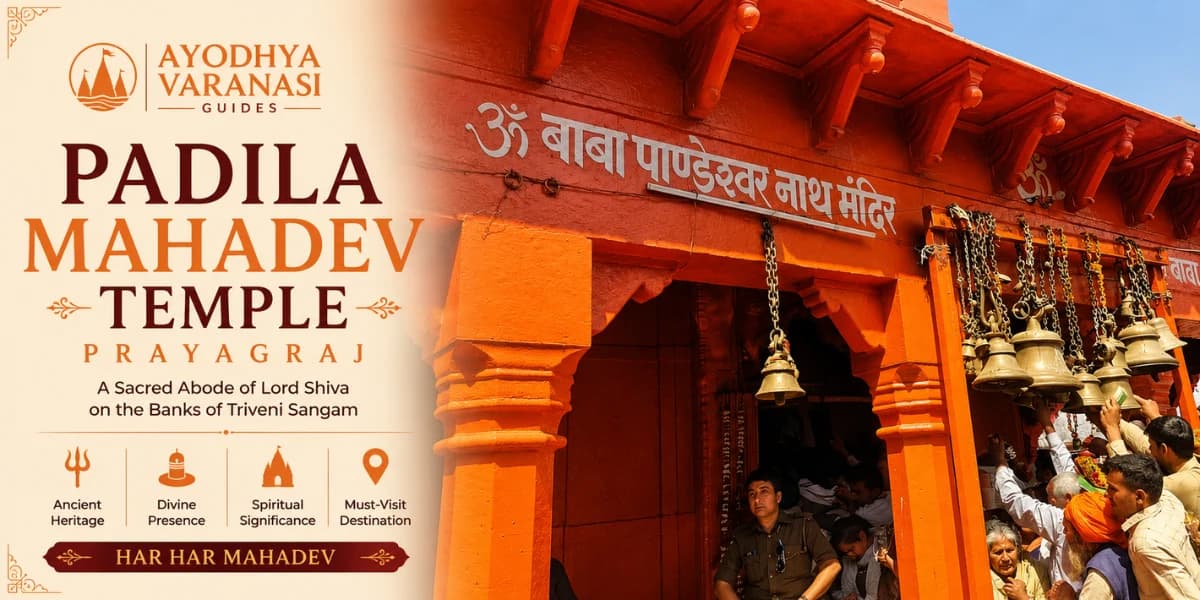
Padila Mahadev
Prayagraj · The Temple of the Pandavas
4.9 / 5 · Prayagraj Darshan Help
Shiva temples · Sangam
- Timings
- ~5:00 AM – 9:00 PM, daily
- Deity
- Lord Shiva as Padila / Pandeshwar Mahadev
- Legend
- Established by the Pandavas in exile
- Built Of
- Entirely of stone; renovated 1798
- Entry
- Free · no ticket required
- Location
- Padila, Soraon tehsil, ~16 km from Prayagraj
What Are the Padila Mahadev Temple Timings?
Padila Mahadev keeps long hours, generally around 5:00 AM to 9:00 PM, without the extended midday closure common at city temples — which matters when you are driving 16 km to get there. Darshan is free. During Sawan the temple effectively runs day and night to handle the crowds, and on Mahashivratri darshan continues through the night.
Early Morning (Best)
Cool, calm, ideal for jalabhishek
Daytime
Open through the day
Evening (Best)
Aarti and a pleasant drive back
Sawan & Shivratri
Extended hours for the crowds
Jalabhishek
The central offering at this temple
Rudrabhishek
Booked with the temple priests
Sawan Mondays
The great days of the year here
Panchkosi Parikrama
The temple is a stop on the circuit
Tip: the temple is 16 km out of the city with no reliable return transport, so book a taxi for the round trip with waiting time. WhatsApp us and we will combine it with Koteshwar Mahadev at Shivkuti on the same northern run.
When Is the Best Month to Visit Padila Mahadev? (2026)
Everything here revolves around Sawan. October to March is the comfortable window for an ordinary visit, but July and August are when this temple truly comes into its own — and when it is at its most crowded.
Sawan and Mahashivratri bring enormous crowds from across the Prayagraj region. On ordinary days the temple is calm and the drive out is easy.
Did the Pandavas Really Build Padila Mahadev Temple?
What Is Padila Mahadev Temple?
Padila Mahadev is a Shiva temple at Padila village in Soraon tehsil, about 16 km north of Prayagraj and roughly 3 km north-east of Phaphamau. The temple is built entirely of stone, which gives it a solidity and austerity quite unlike the painted, plastered shrines of the city.
What Is the Pandava Legend?
Tradition holds that during the Dwapar Yuga, while the five Pandavas were in exile, they resolved to establish a Shivling and raise a temple — and did so at this spot under the guidance of Sage Bhardwaj, whose great ashram stood at Prayag. The temple that grew from that act came to be known as Pandeshwar — the Shiva of the Pandavas — which over centuries of local speech became Padila.
Why Is Sage Bhardwaj Part of the Story?
Because Prayag was his. Maharishi Bhardwaj’s ashram at Prayag is one of the most celebrated in Indian tradition — it appears in the Ramayana, where Lord Ram was received there on his way into exile. Placing the Pandavas under his guidance ties Padila Mahadev into the deepest layer of Prayag’s sacred geography, connecting the Mahabharata and the Ramayana at a single spot.
Who Renovated the Temple?
The stone temple standing today owes its condition to Raja Nain Singh of Bahishuma Fort, Parikshitgarh, who undertook its renovation in 1798. It is a useful, dateable anchor in a history otherwise made of legend — proof that this temple already mattered enough two and a quarter centuries ago for a ruler to invest in restoring it.
What Is the Sawan Vow at Padila Mahadev?
This is what draws the crowds. Devotees believe that if you come to Padila Mahadev and offer jalabhishek every single day for the whole month of Sawan, your wish is granted. It is a demanding vow — a daily journey out of the city for thirty days — and the sight of thousands keeping it through the monsoon is one of the more remarkable things in the Prayagraj religious year.
Is It Part of the Panchkosi Parikrama?
Yes. Padila Mahadev is included in Prayagraj’s Panchkosi Parikrama, the circumambulation of the sacred region around the Sangam. That places it not on the tourist trail but on the pilgrim trail — part of the formal sacred geography of Prayag rather than an optional excursion.
Did you know? The name Padila is thought to be a worn-down form of Pandeshwar — “the Shiva of the Pandavas”. Centuries of local speech smoothed the word down, but the legend survived inside the name.
What Do You Do at Padila Mahadev Temple?
A straightforward village-temple darshan, with the jalabhishek at its centre. Here is how a visit goes.
- 1
Drive Out to Padila
About 16 km north of Prayagraj via Phaphamau, roughly 35 to 45 minutes. Keep your vehicle with you — local transport back is unreliable.
- 2
Buy Puja Samagri
Stalls near the temple sell bel patra, flowers, milk and Ganga jal — everything you need for the abhishek.
- 3
Join the Darshan Queue
Outside Sawan there is rarely any wait. On Sawan Mondays and Mahashivratri the queue can run far beyond the complex.
- 4
Offer Jalabhishek on the Shivling
Pour water and milk over the Shivling that tradition says the Pandavas themselves established in exile.
- 5
Perform Rudrabhishek (If Booked)
The fuller ritual is conducted by the temple priests and should be arranged in advance, particularly during Sawan.
- 6
Look at the Stonework
The temple is built entirely of stone, restored by Raja Nain Singh in 1798. Take a moment to look at what you are standing in.
- 7
Walk the Complex
The grounds are open and rural, a complete change from the density of Prayagraj city.
- 8
Return via Koteshwar Mahadev
The Shivkuti temple lies on the road back to the city — most visitors do the two together.
When Should You Visit Padila Mahadev Temple?
It is a half-day trip out of the city, so plan it around the season, the hour and above all the Sawan calendar.
Best Season — October to March
Comfortable weather for the drive and for time in the open temple grounds. November and February are ideal. May and June are punishing, with little shade at the complex.
Best Time of Day — Early Morning
Arrive between 5 and 8 AM for the calmest darshan and the practical window for an abhishek. An evening visit works well too, with a pleasant drive back into the city.
Most Special — Sawan Mondays & Mahashivratri
Sawan is what this temple is famous for, with devotees keeping the month-long daily jalabhishek vow. Mahashivratri brings night-long darshan. Both mean enormous crowds and a very early start.
What Can You See at Padila Mahadev Temple?
A rural stone temple with a long history. These are the things worth noticing.
The Pandava Shivling
Top PickThe Main Darshan
The Shivling that tradition holds the five Pandavas established during their exile, under the guidance of Sage Bhardwaj.
The All-Stone Temple
Top Pick1798 Restoration
A temple built entirely of stone, restored by Raja Nain Singh of Parikshitgarh in 1798 — austere and solid in a way city temples rarely are.
The Sawan Jalabhishek
The Month-Long Vow
The daily water offering that devotees keep for the whole month of Sawan in the belief that their wishes will be granted.
The Panchkosi Parikrama Link
Sacred Geography
The temple's place on Prayagraj's Panchkosi Parikrama, the circumambulation of the sacred region around the Sangam.
The Rural Setting
Village Prayagraj
Open grounds and countryside near Soraon — a complete change of pace and scenery from the city and the Sangam.
Why Is Padila Mahadev Worth the Drive?
Sixteen kilometres out of the city puts some visitors off. Here is what makes the trip worthwhile.
The Mahabharata in Prayagraj
Almost everything in Prayagraj points to the Ramayana or the Puranas. This temple belongs to the Pandavas — a rarer connection entirely.
A Temple with a Dateable History
The 1798 restoration by Raja Nain Singh anchors the legend in real, recorded history — unusual for a village Shiva temple.
The Sawan Devotion
The month-long daily jalabhishek vow, kept by thousands through the monsoon, is one of the most striking sights in the Prayagraj religious calendar.
On the Pilgrim Trail, Not the Tourist Trail
Its place on the Panchkosi Parikrama means this is part of Prayag's formal sacred geography — not a sightseeing add-on.
Is There an Entry Fee at Padila Mahadev Temple? (2026)
Darshan is completely free — there is no entry ticket. Your real cost is transport from Prayagraj, since the temple is 16 km out with no reliable return service.
The temple costs nothing. What we arrange is the route — Padila Mahadev, Koteshwar Mahadev at Shivkuti and Shringverpur Dham all lie on the same road north of Prayagraj. Done together with one vehicle it is a comfortable day; done separately it is three wasted half-days. Pricing confirmed in writing.
Taxi fares are indicative and depend on vehicle, season and waiting time. Always agree the round-trip fare including waiting before setting out.
What Do Devotees Say About Padila Mahadev Temple?
1,128 verified reviews
I have kept the full Sawan jalabhishek here three times. Thirty days, every single morning, whatever the rain. There is nothing else like it. My family has come to Padila Mahadev for four generations.
Ram Naresh Tiwari
Prayagraj
We came on Mahashivratri and darshan was going on through the night. Enormous crowd but well handled. Our guide had us there before 5 AM which made all the difference.
Vandana Agnihotri
Kanpur
Fascinating temple — I had no idea there was a Pandava connection at Prayagraj. All stone, restored in 1798, and completely off the tourist route. We combined it with Shivkuti on the way back.
Sanjay Pratap Singh
Delhi
Peaceful, rural and very old. The priests were welcoming and arranged a Rudrabhishek for us without any fuss. Do book a car that waits — there is nothing out there to get you back.
Rekha Pandey
Gorakhpur
Worth the 16 km if you have half a day. Go early. Not much shade at the complex so avoid the middle of the day in summer. Free entry and no commercialisation at all, which was refreshing.
Alok Verma
Bhopal
How Do You Fit Padila Mahadev Into a Prayagraj Trip?
Padila sits north of the city on the same road as Shivkuti and Shringverpur, so one northern run covers all three. This is the day we plan.
Sunrise at the Triveni Sangam. Begin at the confluence for first light on the water.
Sangam boat ride & snan. The holy dip at the meeting of the Ganga, Yamuna and the invisible Saraswati.
Akshayavat & Patalpuri Temple. Darshan of the immortal banyan inside Prayagraj Fort. Carry photo ID for every adult.
Koteshwar Mahadev, Shivkuti. Head north to the Ganga bend for jalabhishek at the Shivkuti temple.
Padila Mahadev Temple. On to the Pandava temple near Phaphamau for darshan and abhishek.
Shringverpur Dham (optional). Continue north to the ghat where Lord Ram crossed the Ganga into exile, ~25 km further.
Evening Ganga Aarti at Saraswati Ghat. Return to the city and close the day on the riverfront.
Which Tour Package Covers Padila Mahadev?
Padila Mahadev sits within the wider Prayagraj circuit, and the Sangam, the temples and the sites out of town need a vehicle and a sensible order to do properly. These are the itineraries our guests book most — each with the Triveni Sangam snan and boat ride, a certified local guide, transport and pricing confirmed in writing.
- 1 Day1 Day Prayagraj Tour PackageTriveni Sangam snan and boat ride with the main temples of the confluence.
- 2 Days2 Days Prayagraj Tour PackageThe Sangam, Akshayavat and the Daraganj temples without rushing any of them.
- 2 Days2 Days Varanasi Prayagraj Tour PackageKashi Vishwanath and the Ganga Aarti with the Triveni Sangam.
- 2 Days2 Days Ayodhya Prayagraj Tour PackageRam Mandir and the Sangam, tightly planned for a short trip.
- 3 Days3 Days Varanasi Prayagraj Tour PackageKashi and the confluence, with time for the ghats and the Sangam boat ride.
- 4 Days4 Days Ayodhya Varanasi Prayagraj Tour PackageAll three cities — Ram Mandir, Kashi Vishwanath and the Triveni Sangam.
- 5 Days5 Days Ayodhya Varanasi Prayagraj Tour PackageThe complete sacred circuit at a comfortable, senior-friendly pace.
Want Padila Mahadev built into a custom itinerary? We plan around your dates, your pace and what you actually want to see.
See all Prayagraj, Ayodhya & Varanasi packagesHow Do You Reach Padila Mahadev Temple From Prayagraj?
Padila Mahadev is at Padila village in Soraon tehsil, about 16 km from Prayagraj and roughly 3 km north-east of Phaphamau. There is no station at the temple, so plan on road transport.
By Road / Taxi
The practical option. A taxi from Prayagraj takes 35 to 45 minutes via Phaphamau. Book the round trip with waiting — return transport from the village is unreliable.
By Train
Phaphamau Junction is the nearest station, about 3 km away. Prayagraj Junction, roughly 16 km south, is the major railhead for Delhi, Varanasi, Lucknow and Ayodhya.
By Air
Prayagraj Airport (Bamrauli) is about 25 km away with taxis at the terminal. Varanasi (~140 km) and Lucknow (~180 km) are the larger airports.
During Sawan
Expect traffic diversions, kanwar processions and heavy congestion on the Sawan Mondays and Mahashivratri. Leave far earlier than you think necessary.
Where Exactly Is Padila Mahadev Temple?
Padila Mahadev Temple stands at Padila village, Soraon tehsil, about 3 km north-east of Phaphamau and 16 km from Prayagraj city. Use the map below for door-to-door directions.
Prayagraj
- Area: Padila village, Soraon tehsil, Prayagraj
- PIN: Prayagraj 212503
- Also known as: Pandeshwar Nath Mahadev
- From Prayagraj city: ~16 km
- From Phaphamau: ~3 km north-east
Where Should You Stay to Visit Padila Mahadev?
Padila is a half-day trip rather than an overnight stop — accommodation at the village is very limited. Stay in Prayagraj and drive out.
Teliyarganj & Shivkuti
North Prayagraj near the university area, which shortens the drive to both Padila Mahadev and Koteshwar Mahadev.
Civil Lines
The city's main hotel district, with branded and mid-range properties, restaurants and easy taxi access in every direction.
Near the Sangam & Daraganj
Dharamshalas and guesthouses close to the confluence, ideal for a sunrise snan before heading north to the Shiva temples.
What Else Can You Visit Near Padila Mahadev?
Padila sits on the northern road out of Prayagraj, which puts several major sites on the same run.
Koteshwar Mahadev (Shivkuti)
The ancient Shiva temple on the Ganga whose Shivling tradition says Lord Ram established, ~10 km back towards the city.
Shringverpur Dham
The kingdom of Nishadraj Guha where Lord Ram crossed the Ganga in exile, ~25 km further north.
Triveni Sangam
The sacred confluence of the Ganga, Yamuna and the invisible Saraswati — boat ride and snan, ~16 km south.
Akshayavat
The immortal banyan inside the underground Patalpuri Temple at Prayagraj Fort. Photo ID required.
Sankat Har Madhav Temple
One of the twelve Dwadash Madhav temples of Prayag, across the Ganga at Jhunsi.
Kashi Vishwanath Temple, Varanasi
The Jyotirlinga of Kashi, ~140 km away, on the classic Prayagraj–Varanasi route.
The Month-Long Sawan Vow at Padila Mahadev
Through Sawan, devotees come to Padila Mahadev to keep one of the most demanding vows in the Prayagraj religious calendar — offering jalabhishek here every single day for the entire month, in the belief that their wishes will then be granted. Thousands make the journey out of the city daily through the monsoon rain, and the Sawan Mondays bring the largest crowds of all.
Mahashivratri sees darshan continuing through the night, and the temple is also a station on Prayagraj’s Panchkosi Parikrama. If you plan to visit on any of these occasions, arrange transport well in advance and start before dawn.
What Should You Know Before Visiting Padila Mahadev?
The temple is simple to visit — the distance and the Sawan crowds are where trips come unstuck.
Book a taxi that waits
Padila is 16 km out in village country with no reliable return transport. Hire the vehicle for the round trip including waiting time.
Combine it with Koteshwar Mahadev
The Shivkuti temple is 10 km back towards the city on the same road. Doing them together turns two half-days into one comfortable morning.
Go early in the morning
Arrive between 5 and 8 AM for the calmest darshan and the practical window for an abhishek, before the day heats up.
Sawan means hours, not minutes
On the Sawan Mondays and Mahashivratri the queue runs far beyond the complex. Start before dawn and treat it as a full day.
Book any Rudrabhishek in advance
Walk-in slots are limited and effectively unavailable during Sawan. Arrange it with the priests beforehand.
Buy puja samagri at the temple stalls
Bel patra, flowers, milk and Ganga jal are all sold outside — no need to carry them from the city.
There is little shade
The complex is open. Between April and June, restrict your visit to early morning and carry water and a hat.
Check the road in the monsoon
Sawan falls in the rains and rural roads can be affected. Ask before setting out in heavy weather.
Allow three to four hours in total
About 40 minutes each way plus an hour or more on site. It does not compress into a quick detour.
Ask for the Pandava story at the shrine
The temple looks like an ordinary village shrine until someone tells you the five Pandavas raised it in exile under Sage Bhardwaj.
Padila Mahadev Temple — Frequently Asked Questions
The questions devotees ask us most about Padila Mahadev — the Pandava legend, timings, distance, the Sawan vow and how to plan the trip.
Padila Mahadev, also called Pandeshwar Nath, is a Shiva temple built entirely of stone at Padila village in Soraon tehsil, about 16 km north of Prayagraj. Tradition holds that the five Pandavas established the Shivling here during their exile, under the guidance of Sage Bhardwaj.
Still have a question?
Our local team replies within 30 minutes.
Written & verified by the local Prayagraj guide team at Ayodhya Varanasi Guides
Our government-certified guides run trips to the Shiva temples north of Prayagraj throughout the year, including through the Sawan season when devotees keep the month-long jalabhishek vow at Padila Mahadev. Last updated: July 2026. Puja slots, road conditions and crowds change sharply with the season — message us for the position on your travel date.
Offer Jalabhishek at the Pandavas' Shivling of Padila Mahadev
Let Ayodhya Varanasi Guides plan your northern Prayagraj darshan — Padila Mahadev, Koteshwar Mahadev at Shivkuti and Shringverpur Dham in a single run with a vehicle that waits, plus the Triveni Sangam snan and Akshayavat. Rudrabhishek booked in advance and everything confirmed in writing.