
Nag Vasuki Temple, Daraganj — Kaal Sarp Dosh Puja & Visitor Guide
Shri Nag Vasuki Temple stands on the bank of the Ganga at Daraganj, Prayagraj, and is dedicated to Vasuki, the king of serpents. Tradition holds that after the Samudra Manthan — where Vasuki served as the rope that churned the ocean and was left wounded and exhausted — he came here to rest and recover. It is one of the few temples in India where Kaal Sarp Dosh nivaran puja is performed, alongside Rudrabhishek and Mahabhishek. Darshan is free, and the great day is Nag Panchami in Sawan, when a fair is held at the temple.
- Timings
- ~5:30 AM – 10:30 PM (confirm)
- Known For
- Kaal Sarp Dosh nivaran puja
- Deity
- Nag Vasuki, king of serpents
- Entry
- Free · puja by arrangement
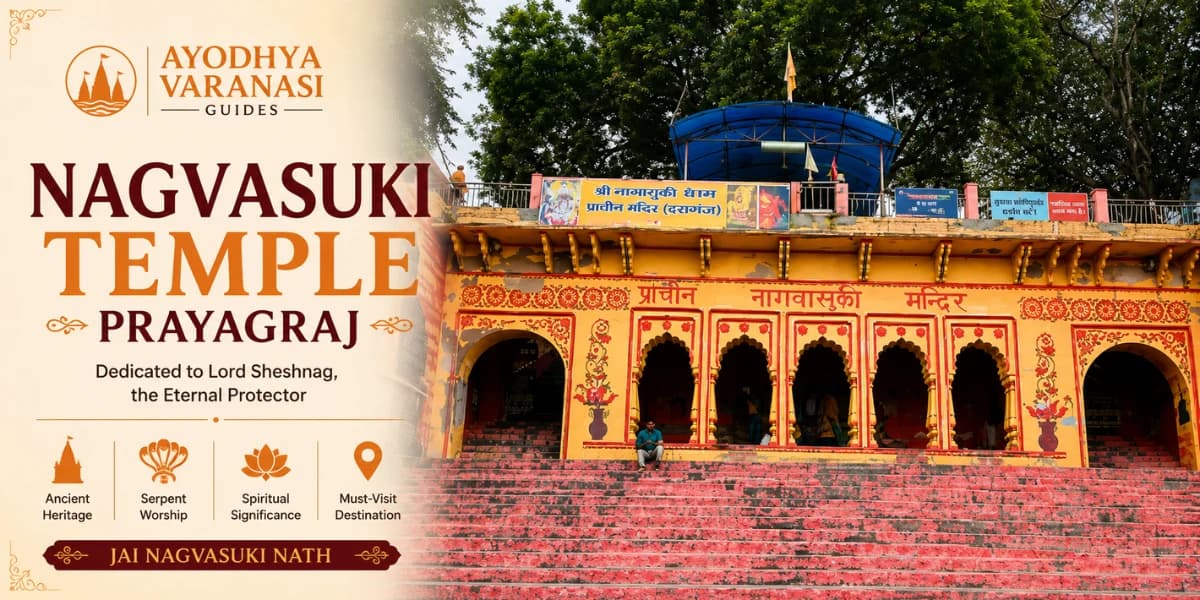
Nag Vasuki Temple
Daraganj, Prayagraj · Where Vasuki Rested
4.9 / 5 · Puja & Darshan Help
Sangam · Daraganj temples
- Timings
- Reported ~5:30 AM–10:30 PM; confirm before visiting
- Deity
- Lord Vasuki, the serpent king
- Famous For
- Kaal Sarp Dosh nivaran puja
- Legend
- Vasuki rested here after the Samudra Manthan
- Entry
- Free · pujas arranged separately
- Location
- Daraganj, on the Ganga bank, Prayagraj
What Are the Nag Vasuki Temple Timings?
Reported timings for Nag Vasuki vary between sources — some list a full day from around 5:30 AM to 10:30 PM, others a shorter window of roughly 10:30 AM to 4:30 PM. In practice the temple is reliably open through the morning and the evening, with hours extending greatly around Nag Panchami and the mela season. Darshan is free. If you are coming specifically for a Kaal Sarp Dosh puja, the time is fixed with the priests in advance anyway.
Morning (Best)
Calm; the usual hour for pujas
Midday
Generally open; confirm on the day
Evening
Aarti and a quieter darshan
Nag Panchami
Fair at the temple; extended hours
Kaal Sarp Dosh Nivaran
The temple's best-known ritual
Rudrabhishek
Booked with the temple priests
Mahabhishek
The fuller ritual; needs notice
Nag Panchami Puja
After a snan at the Triveni Sangam
Tip: because reported hours differ, and because a Kaal Sarp Dosh puja must be booked with the priests in advance, do not simply turn up hoping. WhatsApp us with your travel date and we will confirm the timing and fix the puja slot for you.
When Is the Best Month to Visit Nag Vasuki Temple? (2026)
Two calendars matter here — the Sawan and Nag Panchami season, and the Magh Mela, when all of Daraganj fills with pilgrims. October to March is the most comfortable window otherwise.
Nag Panchami in Sawan is the temple's own festival, with a fair held nearby. During Magh Mela and Kumbh, Daraganj becomes one of the busiest quarters in Prayagraj.
Why Did Vasuki, King of Serpents, Rest at Prayag?
What Is Nag Vasuki Temple?
Shri Nag Vasuki Temple stands on the bank of the Ganga in Daraganj, the old pilgrim quarter of Prayagraj between the city and the Sangam. It is dedicated to Vasuki, the king of the Nagas — a temple to the serpent king rather than to any of the great gods, which makes it unusual from the outset.
Who Is Vasuki?
Vasuki is the king of serpents, the great naga who coils around Lord Shiva’s neck. His most famous act was at the Samudra Manthan, the churning of the ocean of milk: the gods and the asuras used Mount Mandara as the churning rod and Vasuki himself as the rope, pulling him back and forth for aeons to draw out the nectar of immortality.
What Happened After the Churning?
Vasuki was left exhausted, burned and wounded by what had been done to him. Tradition holds that he came to Prayag, to the bank of the Ganga, to rest and recover — and that this spot is where he lay. The temple has stood at that place ever since, and its carvings depict the Samudra Manthan and other episodes from the scriptures.
What Is Kaal Sarp Dosh?
Kaal Sarp Dosh is an astrological condition said to arise when all the planets in a horoscope fall between Rahu and Ketu, the serpent nodes. It is held to bring obstruction, delay and repeated difficulty across a person’s life. Because it is a serpent affliction, relief is sought from the king of serpents himself.
Why Do People Come Here for That Puja?
Because Nag Vasuki is one of the very few temples in India where Kaal Sarp Dosh nivaran puja is properly performed. People travel from across the country specifically for it, often after years of being told by astrologers that they carry the dosh. Rudrabhishek and Mahabhishek are also performed here. It gives the temple a purposeful, almost clinical atmosphere — most people present have come for a reason.
What Happens on Nag Panchami?
Nag Panchami, the festival of serpent worship in the month of Sawan (July or August), is the great day here. Devotees traditionally take a dip at the Triveni Sangam first and then come to Nag Vasuki for darshan, and a fair is held near the temple. It is the busiest and most vivid day in the temple’s year.
Did you know? Vasuki is the serpent who coils around Lord Shiva’s neck — and the same serpent who served as the rope in the churning of the ocean. Few figures in Hindu tradition are so central and so rarely given a temple of their own.
How Does a Visit to Nag Vasuki Temple Work?
A straightforward darshan — unless you are here for a puja, in which case the arrangement matters more than the arrival.
- 1
Take the Sangam Snan First
The traditional order, particularly on Nag Panchami, is a dip at the Triveni Sangam before coming to Nag Vasuki. The temple is close by.
- 2
Reach Daraganj
The temple is in the Daraganj quarter on the Ganga bank. Autos and e-rickshaws reach the area; the last stretch is through narrow lanes.
- 3
Confirm Your Puja Slot
If you have booked a Kaal Sarp Dosh puja, Rudrabhishek or Mahabhishek, check in with the priests on arrival — these are timed rituals.
- 4
Leave Footwear and Enter
Footwear comes off outside. Outside Sawan and the mela season, there is rarely any queue.
- 5
Have Darshan of Nag Vasuki
Stand before the king of serpents, at the spot where tradition says he rested after the churning of the ocean.
- 6
Look at the Carvings
The temple's sculptures depict the Samudra Manthan and other scriptural episodes — worth a few minutes rather than a glance.
- 7
Sit by the Ganga
The temple is on the riverbank. The stretch of Ganga here is quieter than the Sangam and a good place to pause.
- 8
Continue to Veni Madhav
Also in Daraganj, the chief of the twelve Dwadash Madhav is a short walk away — the two belong on the same visit.
When Should You Visit Nag Vasuki Temple?
Plan around whether you are coming for darshan or for a puja — the two need very different amounts of notice.
Best Time of Day — Morning
Come between 6 and 11 AM. This is the calmest window and the usual hour for Kaal Sarp Dosh pujas, Rudrabhishek and Mahabhishek.
Best Season — October to March
Comfortable weather across Prayagraj. April is unusually good here — quiet enough for an unhurried puja, before the Sawan crowds arrive.
Most Special — Nag Panchami
Nag Panchami in Sawan is the temple's own festival, with a fair held nearby and devotees arriving from the Sangam snan. Vivid, crowded and worth planning around.
What Can You See at Nag Vasuki Temple?
A riverside temple with an unusual dedication and a very specific purpose.
The Nag Vasuki Sanctum
Top PickThe Serpent King
The image of Vasuki, king of the nagas, at the spot where tradition says he rested and recovered after the churning of the ocean.
The Kaal Sarp Dosh Puja
Top PickWhy Most People Come
One of the few places in India where the nivaran puja for Kaal Sarp Dosh is properly performed, drawing devotees from across the country.
The Samudra Manthan Carvings
Scripture in Stone
Sculptures and carvings depicting the churning of the ocean and other episodes from the scriptures.
The Ganga Bank at Daraganj
The Setting
A quieter stretch of the river than the Sangam, in the old pilgrim quarter of Prayagraj.
The Nag Panchami Fair
Sawan
The annual fair held near the temple on Nag Panchami, when devotees come straight from a Sangam snan.
Why Do People Travel Across India to Nag Vasuki?
This is not a sightseeing temple. Here is what actually brings people here.
One of the Few Kaal Sarp Dosh Temples
Very few temples in India perform this nivaran puja properly. People come after years of being told they carry the dosh.
A Temple to the Serpent King Himself
Vasuki is central to the Samudra Manthan and coils around Shiva's neck, yet has almost no temples of his own. This is his.
A Purposeful Atmosphere
Almost nobody here is a tourist. Most visitors have come with a specific difficulty and a specific ritual in mind.
Minutes From the Sangam
In Daraganj, close to the confluence and to Veni Madhav — no reason to make it a separate trip.
Is There an Entry Fee at Nag Vasuki Temple? (2026)
Darshan is completely free — there is no ticket. What is charged, and what most visitors actually come for, is the Kaal Sarp Dosh puja and the other rituals, arranged with the temple priests.
The darshan costs nothing. What we arrange is the part that is genuinely difficult from outside — booking the Kaal Sarp Dosh puja with the priests in advance, confirming the timing on your date, and sequencing it with the Sangam snan that traditionally comes first. Pricing confirmed in writing before you travel.
Puja costs vary with the ritual chosen, the number of participants and the season. Always confirm the total in advance rather than on arrival.
What Do Devotees Say About Nag Vasuki Temple?
1,231 verified reviews
We had been told for years that my son has Kaal Sarp Dosh. Very few temples do this puja properly. The team booked the priests in advance and everything was explained clearly. We left with real peace of mind.
Mahesh Kulkarni
Pune
Beautiful old temple right on the Ganga in Daraganj, and far quieter than anywhere near the Sangam. The Samudra Manthan carvings are lovely. Our guide told the Vasuki story properly.
Renu Bhardwaj
Delhi
Came during Magh Mela. Daraganj was extremely crowded but darshan was smooth. Do not just turn up for a puja — book ahead. We learned that the hard way on a previous trip.
S. Krishnamoorthy
Chennai
Visited on Nag Panchami. The fair, the crowd, the atmosphere — completely different from an ordinary day. We did the Sangam snan first as tradition says, then came here.
Ajay Kumar Yadav
Gorakhpur
Important temple and worth visiting. Timings seem to vary depending on who you ask, so do confirm before going. Combined it with Veni Madhav which is close by — sensible planning by the team.
Nirmala Joshi
Ahmedabad
How Do You Combine Nag Vasuki With the Sangam?
Nag Vasuki and Veni Madhav are both in Daraganj, minutes from the confluence. One morning covers the lot.
Sunrise at the Triveni Sangam. Begin at the confluence for first light on the water.
Sangam boat ride & snan. The holy dip at the meeting of the Ganga, Yamuna and the invisible Saraswati — the traditional first step.
Veni Madhav darshan, Daraganj. The chief of the twelve Dwadash Madhav, whose darshan completes the Sangam snan.
Nag Vasuki Temple. Darshan of the serpent king, and the Kaal Sarp Dosh puja if you have booked one.
Akshayavat & Patalpuri Temple. Darshan of the immortal banyan inside Prayagraj Fort. Carry photo ID for every adult.
Kalyani Devi Temple. One of the three Shakti Peeths of Prayagraj, where three fingers of Sati are believed to have fallen.
Evening Ganga Aarti at Saraswati Ghat. Close the day on the riverfront with lamps and bells.
Which Tour Package Covers Nag Vasuki Temple?
Nag Vasuki Temple sits within the wider Prayagraj circuit, and the Sangam, the temples and the sites out of town need a vehicle and a sensible order to do properly. These are the itineraries our guests book most — each with the Triveni Sangam snan and boat ride, a certified local guide, transport and pricing confirmed in writing.
- 1 Day1 Day Prayagraj Tour PackageTriveni Sangam snan and boat ride with the main temples of the confluence.
- 2 Days2 Days Prayagraj Tour PackageThe Sangam, Akshayavat and the Daraganj temples without rushing any of them.
- 2 Days2 Days Varanasi Prayagraj Tour PackageKashi Vishwanath and the Ganga Aarti with the Triveni Sangam.
- 2 Days2 Days Ayodhya Prayagraj Tour PackageRam Mandir and the Sangam, tightly planned for a short trip.
- 3 Days3 Days Varanasi Prayagraj Tour PackageKashi and the confluence, with time for the ghats and the Sangam boat ride.
- 4 Days4 Days Ayodhya Varanasi Prayagraj Tour PackageAll three cities — Ram Mandir, Kashi Vishwanath and the Triveni Sangam.
- 5 Days5 Days Ayodhya Varanasi Prayagraj Tour PackageThe complete sacred circuit at a comfortable, senior-friendly pace.
Want Nag Vasuki Temple built into a custom itinerary? We plan around your dates, your pace and what you actually want to see.
See all Prayagraj, Ayodhya & Varanasi packagesHow Do You Reach Nag Vasuki Temple in Prayagraj?
The temple is at Daraganj, on the Ganga bank in the old pilgrim quarter of Prayagraj, very close to the Triveni Sangam.
By Road / Auto
Autos and e-rickshaws reach Daraganj easily. The lanes are narrow, so expect a short walk at the end rather than a car to the door.
By Train
Prayagraj Sangam station is very close and Prayagraj Junction about 7.5 km. Both connect to Delhi, Varanasi, Lucknow and Ayodhya.
On Foot From the Sangam
The confluence is close enough to walk from, and this is the traditional route on Nag Panchami — snan first, then the temple.
By Air
Prayagraj Airport (Bamrauli) is roughly 18 km away, with taxis at the terminal. Varanasi (~120 km) and Lucknow (~200 km) are the larger airports.
Where Is Nag Vasuki Temple Located in Prayagraj?
Shri Nag Vasuki Temple stands on the bank of the Ganga at Daraganj, the old pilgrim quarter of Prayagraj, close to the Triveni Sangam and Veni Madhav.
Prayagraj
- Area: Daraganj, on the Ganga bank, Prayagraj
- PIN: Prayagraj 211006
- From the Triveni Sangam: ~2 km
- From Veni Madhav: ~700 m
- Known for: Kaal Sarp Dosh nivaran puja
Where Should You Stay Near Nag Vasuki Temple?
Daraganj is the traditional pilgrim quarter, which makes it the natural base if you are here for a puja and the Sangam.
Daraganj
The old riverside quarter with dharamshalas and simple guesthouses, walking distance from Nag Vasuki, Veni Madhav and the Sangam.
Civil Lines
Prayagraj's main hotel district, with branded and mid-range properties and good restaurants, about 20 minutes from Daraganj.
Near Prayagraj Junction
Convenient if you are continuing to Varanasi, Ayodhya or Chitrakoot by train, with plenty of budget options.
What Else Can You Visit Near Nag Vasuki Temple?
Daraganj sits between the city and the confluence, so the whole Sangam circuit is within easy reach.
Veni Madhav Temple
The chief of the twelve Dwadash Madhav, also in Daraganj — the darshan that traditionally completes a Sangam snan.
Triveni Sangam
The sacred confluence of the Ganga, Yamuna and the invisible Saraswati — the snan that precedes a Nag Panchami visit.
Akshayavat
The immortal banyan inside the underground Patalpuri Temple at Prayagraj Fort. Photo ID required.
Kalyani Devi Temple
One of the three Shakti Peeths of Prayagraj, where three fingers of Goddess Sati are believed to have fallen.
Bharadwaj Ashram
The ashram of Maharishi Bharadwaj at Colonelganj, where Lord Ram stayed on his way to Chitrakoot.
Someshwar Mahadev Temple
The ancient Shiva temple at Arail across the Yamuna, consecrated by the Moon God.
Nag Panchami & Magh Mela at Nag Vasuki
Nag Panchami, the festival of serpent worship in the month of Sawan, is the great day at Nag Vasuki. Devotees traditionally take a dip at the Triveni Sangam first and then come to the temple, and a fair is held nearby. It is the busiest, most colourful day of the temple’s year and the most powerful time to seek relief from a serpent affliction.
Through Magh Mela and the Kumbh, Daraganj becomes one of the busiest quarters in Prayagraj and the temple sees pilgrims all day. If you want a Kaal Sarp Dosh puja during either season, book far in advance — the priests fill up quickly.
What Should You Know Before Visiting Nag Vasuki Temple?
Most visitors here are coming for a puja rather than a look around, and that changes what you need to plan.
Book the Kaal Sarp Dosh puja in advance
This is the main reason people come, and it cannot be arranged reliably on arrival. Fix it with the priests before you travel, especially during Sawan or the mela.
Confirm the timings for your date
Reported hours vary between sources. A quick check the day before avoids a wasted trip into Daraganj.
Do the Sangam snan first
The traditional order, and the expected one on Nag Panchami, is a dip at the confluence before darshan here.
Combine it with Veni Madhav
Both are in Daraganj, about 700 metres apart. Doing them together is obvious once you know, and almost nobody does.
The lanes are narrow
Daraganj is an old quarter. Autos reach the area but not the temple door — expect a short walk at the end.
Nag Panchami is very busy
The fair and the crowds transform the temple in Sawan. Go early on that day and allow far more time.
Look at the carvings
The Samudra Manthan sculptures are easy to walk past. Give them a few minutes — they are the story you came for, in stone.
Ask what the puja involves
A Kaal Sarp Dosh nivaran is a substantial ritual. Ask the priests beforehand how long it takes and what you need to bring.
Magh Mela changes access
During the mela, Daraganj sees diversions and enormous footfall. Build extra time into your schedule in January and February.
Dress modestly
Standard temple etiquette applies, with footwear removed at the entrance.
Nag Vasuki Temple Prayagraj — Frequently Asked Questions
The questions devotees ask us most about Nag Vasuki — the Kaal Sarp Dosh puja, the Samudra Manthan legend, timings and how to reach Daraganj.
Shri Nag Vasuki Temple stands on the bank of the Ganga at Daraganj, Prayagraj, and is dedicated to Vasuki, the king of serpents. Tradition holds that Vasuki came here to rest and recover after the churning of the ocean, in which he served as the rope.
Still have a question?
Our local team replies within 30 minutes.
Written & verified by the local Prayagraj guide team at Ayodhya Varanasi Guides
Our government-certified guides arrange Kaal Sarp Dosh pujas at Nag Vasuki with the temple priests throughout the year, and take pilgrims from the Sangam snan to the temple in the traditional order. Last updated: July 2026. Reported darshan hours vary and puja slots fill fast in Sawan and the mela season — message us and we will confirm and book ahead.
Seek Relief From Kaal Sarp Dosh at Nag Vasuki
Let Ayodhya Varanasi Guides arrange your Kaal Sarp Dosh nivaran puja with the Nag Vasuki priests, sequenced after the Triveni Sangam snan as tradition asks, alongside Veni Madhav, Akshayavat and the evening Ganga Aarti. Timings confirmed and pricing in writing before you travel.