
Lalita Devi Temple, Prayagraj — The Shakti Peeth at Meerapur
Shri Maa Lalita Devi Mandir at Meerapur, in the old city of Prayagraj, is one of the 51 Shakti Peethas. Tradition holds that the fingers of Goddess Sati’s right hand fell at this spot. The Devi is worshipped here in the Tantrik tradition and in three forms — Lalita Devi, Saraswati and Kali. The temple is named in the Devi Purana, and it is said that Maharshi Bharadwaj himself worshipped the goddess here. Darshan is free. It is one of the three Shakti Peeths of Prayagraj, with Alopi Devi and Kalyani Devi.
- Timings
- ~5 AM–12 PM & 4 PM–9 PM
- Significance
- Shakti Peeth — Sati's right-hand fingers
- Worshipped As
- Lalita, Saraswati and Kali
- Entry
- Free · no ticket
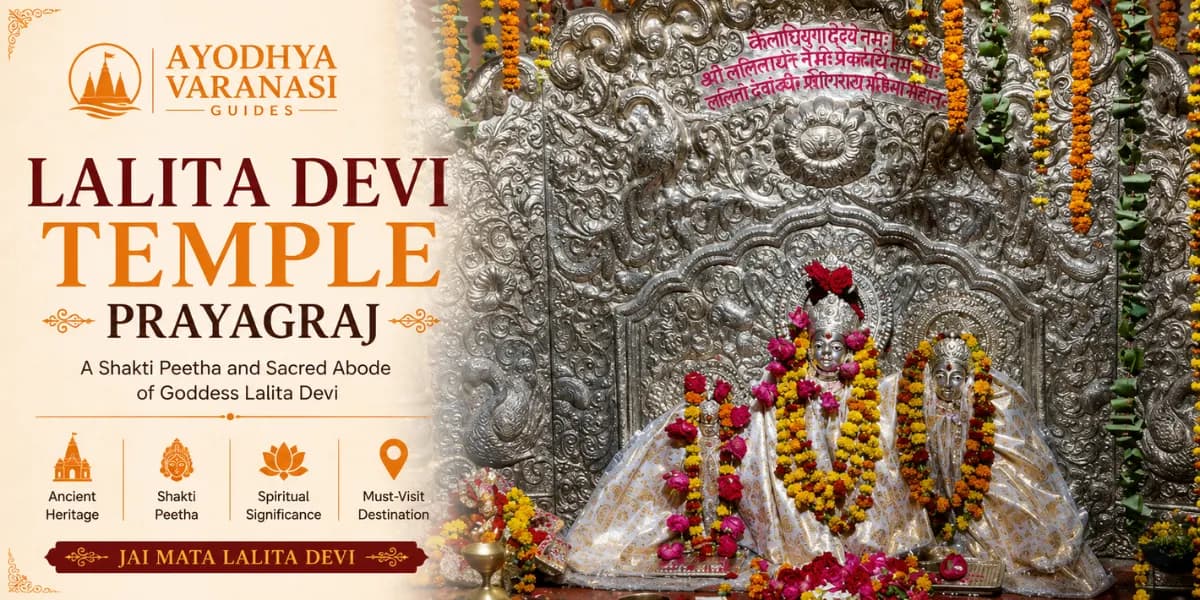
Lalita Devi Mandir
Meerapur, Prayagraj · Shakti Peeth of Prayag
4.9 / 5 · Prayagraj Darshan Help
Shakti Peeths · Sangam
- Timings
- ~5:00 AM–12:00 PM & 4:00 PM–9:00 PM
- Deity
- Maa Lalita Devi, worshipped in three forms
- Significance
- Shakti Peeth; Sati's right-hand fingers fell here
- Named In
- The Devi Purana
- Entry
- Free · no ticket required
- Location
- Meerapur, old city, Prayagraj
What Are the Lalita Devi Temple Timings?
Lalita Devi opens in two sessions like most Prayagraj temples — roughly 5:00 AM to 12:00 PM and 4:00 PM to 9:00 PM — with a break through the middle of the day. Darshan is free and unhurried on ordinary days. Hours extend considerably during both Navratris and through the Magh Mela and Kumbh, when the temple sees pilgrims from across India.
Early Morning (Best)
The calmest darshan of the day
Late Morning
Busier with local devotees
Midday Break
Temple usually closed
Evening
Aarti; good for families
Morning Aarti
Shringar of the Devi
Evening Aarti
The most atmospheric hour
Lalita Panchami
The Devi's own day
Both Navratris
Extended hours; long queues
Tip: Lalita Devi is one of three Shakti Peeths in Prayagraj, with Alopi Devi at Daraganj and Kalyani Devi near Chowk. Visiting one alone misses the point — the three together are the Devi pilgrimage of Prayag, and they take about half a day with a vehicle. WhatsApp us and we will route the circuit.
When Is the Best Month to Visit Lalita Devi Temple? (2026)
This is a Devi temple, so the Navratri calendar shapes everything, with the Magh Mela season on top of it. October to March is comfortable across Prayagraj.
Lalita Panchami, the fifth day of Navratri, is the Devi's own day and the most significant date in the temple's year. Both Navratris and the Magh Mela bring the largest crowds.
Why Is Lalita Devi One of the 51 Shakti Peethas?
What Is Lalita Devi Temple?
Shri Maa Lalita Devi Mandir stands at Meerapur in the old city of Prayagraj. It is one of the 51 Shakti Peethas — the seats of the Goddess scattered across the subcontinent — and one of the three great Devi shrines that make Prayagraj a centre of Shakti worship as much as a city of rivers.
What Fell Here?
When Sati immolated herself at Daksha’s yagna and Lord Shiva carried her body across the world in grief, Lord Vishnu’s Sudarshan Chakra severed it, and the pieces fell to earth. At this spot, tradition holds that the fingers of Sati’s right hand came to rest — and each place where a part of her fell became a Shakti Peetha, a seat of the Goddess.
Why Is She Worshipped in Three Forms?
The Devi here is honoured as Lalita Devi, Saraswati and Kali — three aspects in one shrine. It is an unusual arrangement, and it reflects the completeness with which the Goddess is approached at this Peetha: as beauty and grace, as knowledge, and as the fierce power that destroys what must be destroyed.
What Does Tantrik Worship Mean Here?
Lalita Devi is a powerful deity worshipped in the Tantrik tradition. Lalita — Tripura Sundari — is one of the great Mahavidyas, and her worship follows its own disciplined ritual forms rather than ordinary temple practice. Visitors are entirely welcome, but it is worth knowing that for some of the people beside you this is serious sadhana rather than a temple visit.
What Is the Bharadwaj Connection?
A striking one. Tradition holds that Maharshi Bharadwaj — the great sage of Prayag — worshipped the goddess at this very shrine. His ashram, where Lord Ram was received on the way into exile, stands a few kilometres away at Colonelganj. It ties the Devi tradition of Prayagraj directly into the city’s oldest layer of learning and its Ramayana history.
What Are the Three Shakti Peeths of Prayagraj?
Prayagraj holds three great Devi shrines: Lalita Devi at Meerapur, Alopi Devi (Alopshankari) at Daraganj and Kalyani Devi near Chowk. Together they form the Devi circuit of Prayag, performed particularly during Navratri. Millions come to the city for the Sangam each year; a very small fraction complete the three.
Did you know? The fifth day of Navratri is Lalita Panchami — dedicated to Lalita Devi specifically. At a temple bearing her name, it is the single most significant day of the year.
How Do You Have Darshan at Lalita Devi Temple?
A straightforward darshan on an ordinary day, with one detail worth noticing while you are there.
- 1
Reach Meerapur
The temple is in the Meerapur quarter of the old city. Autos and e-rickshaws reach the area; the last stretch is through older, narrower lanes.
- 2
Buy Flowers and a Chunri
Stalls outside sell flowers, chunris and prasad — the traditional offerings at a Devi shrine.
- 3
Leave Footwear and Enter
Footwear comes off outside. The temple is compact and, outside Navratri, unhurried.
- 4
Have Darshan of Maa Lalita
Stand before the Devi at one of the 51 Shakti Peethas, where the fingers of Sati's right hand are believed to have fallen.
- 5
Notice the Three Forms
The Devi is honoured here as Lalita, Saraswati and Kali. Most visitors see only the central image without realising all three are present.
- 6
Observe the Tantrik Tradition
Worship here follows Tantrik ritual forms. Watch quietly and follow the priests' guidance rather than assuming ordinary temple practice.
- 7
Ask About the Other Two Peeths
Alopi Devi at Daraganj and Kalyani Devi near Chowk complete the triad. A guide can route all three in one outing.
- 8
Continue the Devi Circuit
With a vehicle, the three Shakti Peeths of Prayagraj can be covered comfortably in about half a day.
When Should You Visit Lalita Devi Temple?
The temple is open all year and free. What shapes the visit is the session timing and where Navratri falls.
Best Time of Day — Early Morning
Come between 5 and 8 AM for the calmest darshan, before the local devotees arrive and well ahead of the midday closure.
Best Season — October to March
Comfortable weather for the full Devi circuit across the city. November and February are ideal if you want the three Peeths without festival crowds.
Most Special — Lalita Panchami & Navratri
The fifth day of Navratri is Lalita Panchami, dedicated to this Devi specifically. Both Navratris fill the temple, and the Magh Mela season brings pilgrims from across India.
What Can You See at Lalita Devi Temple?
A compact shrine carrying a great deal of scriptural and devotional weight.
The Lalita Devi Sanctum
Top PickThe Shakti Peetha
The seat of the Goddess where the fingers of Sati's right hand are believed to have fallen — one of the 51 Shakti Peethas.
The Three Forms of the Devi
Top PickLalita, Saraswati & Kali
An unusual arrangement in which the Goddess is honoured in three aspects within one shrine.
The Tantrik Tradition
Living Practice
Worship here follows Tantrik ritual forms, and Lalita as Tripura Sundari is one of the great Mahavidyas.
The Bharadwaj Association
Prayag's Great Sage
Tradition holds that Maharshi Bharadwaj himself worshipped the goddess at this shrine, tying it to the oldest layer of Prayag's history.
The Meerapur Quarter
Old Prayagraj
A working residential quarter of the old city, well away from the tourist routes around the Sangam.
Why Should You Complete the Devi Circuit of Prayag?
Everyone comes for the confluence. Almost nobody knows the city holds three Shakti Peethas.
One of the 51 Shakti Peethas
Pilgrims spend lifetimes seeking these out. Prayagraj has three, and the overwhelming majority of visitors complete none of them.
Three Devis in One Shrine
Lalita, Saraswati and Kali honoured together — grace, knowledge and fierce power in a single sanctum.
Named in the Devi Purana
And associated with Maharshi Bharadwaj, whose ashram stands a few kilometres away. This is not a minor local shrine.
A Half-Day Pilgrimage
Lalita, Alopi and Kalyani Devi together turn Prayagraj from a confluence stop into a proper Shakti pilgrimage.
Is There an Entry Fee at Lalita Devi Temple? (2026)
Darshan is completely free — there is no ticket and no paid queue, even during Navratri or the Magh Mela. Only offerings and any special puja carry a cost.
The darshan is free. What we arrange is the circuit — the three Shakti Peeths are spread across the city and doing all three properly needs a vehicle and someone who knows the route and the sequence. It turns a single temple stop into a Devi pilgrimage. Pricing confirmed in writing.
Auto fares are indicative and vary with traffic, season and the mela calendar.
What Do Devotees Say About Lalita Devi Temple?
1,168 verified reviews
We come every Lalita Panchami. Outsiders visit the Sangam and go home without knowing our city holds three Shakti Peethas. Good to see someone writing about the Devi side of Prayag properly.
Uma Shankar Pandey
Prayagraj
As South Indians we came specifically for the Shakti Peetha. Learning that Lalita is worshipped here alongside Saraswati and Kali, in the Tantrik tradition, was fascinating. Our guide explained the sadhana properly.
Meenakshi Sundaram
Madurai
Visited during Chaitra Navratri. Very crowded but beautifully managed, and the atmosphere on Lalita Panchami was extraordinary. Do go at first light on those days.
Ritu Saxena
Lucknow
We did all three Peeths in one morning with the team — Lalita, Alopi and Kalyani. It completely changed how we understood Prayagraj. Everyone thinks it is only about the rivers.
Devendra Nath Mishra
Varanasi
Old temple in a residential quarter, peaceful outside festival days. Mind the midday closure — we arrived at 2 PM and had to come back in the evening. Free darshan and no touts.
Kavita Bhargava
Jaipur
How Do You Do the Three Shakti Peeths of Prayagraj?
The Devi circuit takes about half a day with a vehicle, leaving the early morning for the Sangam. Here is how we plan it.
Sunrise at the Triveni Sangam. Begin at the confluence for first light on the water.
Sangam boat ride & snan. The holy dip at the meeting of the Ganga, Yamuna and the invisible Saraswati.
Veni Madhav & Nag Vasuki, Daraganj. The chief of the twelve Madhavs, and the temple of the serpent king.
Alopi Devi Temple, Daraganj. The first of the three Shakti Peeths, in the same quarter.
Lalita Devi Temple, Meerapur. The second Peetha — where the fingers of Sati's right hand fell, worshipped as Lalita, Saraswati and Kali.
Kalyani Devi Temple. The third, completing the Devi circuit of Prayagraj.
Evening Ganga Aarti at Saraswati Ghat. Close the day on the riverfront with lamps and bells.
Which Tour Package Covers Lalita Devi Mandir?
Lalita Devi Mandir sits within the wider Prayagraj circuit, and the Sangam, the temples and the sites out of town need a vehicle and a sensible order to do properly. These are the itineraries our guests book most — each with the Triveni Sangam snan and boat ride, a certified local guide, transport and pricing confirmed in writing.
- 1 Day1 Day Prayagraj Tour PackageTriveni Sangam snan and boat ride with the main temples of the confluence.
- 2 Days2 Days Prayagraj Tour PackageThe Sangam, Akshayavat and the Daraganj temples without rushing any of them.
- 2 Days2 Days Varanasi Prayagraj Tour PackageKashi Vishwanath and the Ganga Aarti with the Triveni Sangam.
- 2 Days2 Days Ayodhya Prayagraj Tour PackageRam Mandir and the Sangam, tightly planned for a short trip.
- 3 Days3 Days Varanasi Prayagraj Tour PackageKashi and the confluence, with time for the ghats and the Sangam boat ride.
- 4 Days4 Days Ayodhya Varanasi Prayagraj Tour PackageAll three cities — Ram Mandir, Kashi Vishwanath and the Triveni Sangam.
- 5 Days5 Days Ayodhya Varanasi Prayagraj Tour PackageThe complete sacred circuit at a comfortable, senior-friendly pace.
Want Lalita Devi Mandir built into a custom itinerary? We plan around your dates, your pace and what you actually want to see.
See all Prayagraj, Ayodhya & Varanasi packagesHow Do You Reach Lalita Devi Temple in Prayagraj?
The temple stands at Meerapur, in the old city of Prayagraj, about 3 km from Prayagraj Junction and 7 km from the Triveni Sangam.
By Road / Auto
The simplest option. Autos and e-rickshaws reach the Meerapur quarter directly. The lanes are older and narrower, so expect a short walk at the end.
By Train
Prayagraj Junction is about 3 km away, which makes this a practical stop on an arrival or departure day. Prayagraj Sangam station is roughly 6 km.
By Air
Prayagraj Airport (Bamrauli) is roughly 14 km away, with taxis at the terminal. Varanasi (~125 km) and Lucknow (~195 km) are the larger airports.
The Devi Circuit
Alopi Devi is at Daraganj and Kalyani Devi near Chowk. With a vehicle, all three Shakti Peeths can be done comfortably in half a day.
Where Is Lalita Devi Temple Located in Prayagraj?
Shri Maa Lalita Devi Mandir stands at Meerapur in the old city of Prayagraj, about 3 km from Prayagraj Junction. Use the map below to navigate.
Prayagraj
- Area: Meerapur, old city, Prayagraj
- PIN: Prayagraj 211003
- From Prayagraj Junction: ~3 km
- From the Triveni Sangam: ~7 km
- Significance: One of the three Shakti Peeths of Prayag
Where Should You Stay Near Lalita Devi Temple?
The temple is in the older part of the city, close to the railway station and Civil Lines.
Civil Lines
Prayagraj's main hotel district with branded and mid-range properties and good restaurants, about 15 to 20 minutes from the temple.
Near Prayagraj Junction
About 3 km away, convenient if you are arriving or leaving by train, with plenty of budget and mid-range options.
Near the Sangam & Daraganj
Dharamshalas and guesthouses close to the confluence and to Alopi Devi, if the Sangam and the Devi circuit are your focus.
What Else Can You Visit Near Lalita Devi Temple?
The temple sits in the older city, within easy reach of the other Devi shrines and the Sangam circuit.
Alopi Devi Temple
The Shakti Peeth nearest the Sangam, where a wooden cradle is worshipped in place of an idol.
Kalyani Devi Temple
The third of the three Shakti Peeths of Prayagraj, where three fingers of Sati are believed to have fallen. ~3 km.
Bharadwaj Ashram
The ashram of the sage who tradition says worshipped Lalita Devi here, and where Lord Ram stayed on his way to Chitrakoot.
Triveni Sangam
The sacred confluence of the Ganga, Yamuna and the invisible Saraswati — boat ride and snan, ~7 km away.
Nag Vasuki Temple
The temple of the serpent king at Daraganj, one of the few places performing Kaal Sarp Dosh nivaran puja.
Veni Madhav Temple
The chief of the twelve Dwadash Madhav at Daraganj, whose darshan completes a Sangam snan.
Hanumat Niketan
The great Hanuman complex in Civil Lines, with its akhara, library and weaponry museum.
Lalita Panchami & Navratri at Lalita Devi
Lalita Panchami — the fifth day of Navratri, dedicated to Lalita Devi specifically — is the single most significant date of the year at this temple. Devotees arrive from across India, the queue runs well outside the compound and the shrine is at its most powerful.
Both Navratris bring extended hours and enormous devotion, with Ashwin Navratri culminating in Vijayadashami. Through the Magh Mela and the Kumbh, pilgrims arriving in Prayagraj add the three Shakti Peeths to their circuit. Arrive at first light on any of these dates.
What Should You Know Before Visiting Lalita Devi Temple?
An easy darshan, and one that becomes far more meaningful done as part of the circuit.
Do all three Shakti Peeths together
Lalita at Meerapur, Alopi at Daraganj and Kalyani near Chowk. Visiting one alone misses the point — the three together are the Devi pilgrimage of Prayag.
Mind the midday closure
The temple shuts for roughly four hours in the middle of the day. Come in the morning session or after 4 PM.
Lalita Panchami is the day
The fifth day of Navratri is dedicated to this Devi specifically. Extraordinary atmosphere, but arrive at first light — the queue builds early.
Worship follows Tantrik forms
This is a Tantrik shrine and some visitors are engaged in serious sadhana. Watch quietly and follow the priests' guidance.
Look for the three forms
The Devi is honoured here as Lalita, Saraswati and Kali. Most visitors notice only the central image.
It is in the older city
The Meerapur quarter has narrow lanes. Autos reach the area, but expect a short walk at the end.
Ask about the Bharadwaj connection
Tradition holds the great sage of Prayag worshipped here, and his ashram is only a few kilometres away — the two visits belong together.
Combine it with a station day
At about 3 km from Prayagraj Junction, it is a practical stop if you have a few hours before a train.
It is a local temple, not a monument
This is where Prayagraj comes to pray. The value here is the Shakti Peetha status and the living tradition, not architecture.
Dress modestly
Standard temple etiquette applies, with footwear removed at the entrance.
Lalita Devi Temple Prayagraj — Frequently Asked Questions
The questions devotees ask us most about Lalita Devi — the Shakti Peetha, the three forms, Lalita Panchami, timings and the Devi circuit of Prayag.
Shri Maa Lalita Devi Mandir at Meerapur is one of the 51 Shakti Peethas, where the fingers of Goddess Sati's right hand are believed to have fallen. It is one of the three great Devi shrines of Prayagraj, alongside Alopi Devi and Kalyani Devi.
Still have a question?
Our local team replies within 30 minutes.
Written & verified by the local Prayagraj guide team at Ayodhya Varanasi Guides
Our government-certified guides run the three Shakti Peeth circuit of Prayagraj through the year, including on Lalita Panchami and through both Navratris. Last updated: July 2026. Darshan hours extend during Navratri and the Magh Mela — message us for the timing on your travel date.
Complete the Devi Circuit of Prayag at Lalita Devi
Let Ayodhya Varanasi Guides plan the three Shakti Peeths of Prayagraj — Lalita Devi, Alopi Devi and Kalyani Devi in a single half-day — alongside the Triveni Sangam snan, Veni Madhav and Nag Vasuki, with a certified local guide and transport. Confirmed in writing.