
Alopi Devi Temple, Prayagraj — The Shakti Peeth With No Idol
Alopi Devi Mandir at Alopibagh, close to the Triveni Sangam, is a Shakti Peeth unlike any other: there is no idol of the goddess. In her place, a wooden cradle — a doli — is worshipped, suspended above a small sacred kund. The reason is in the name. When the last part of Sati fell here, tradition holds it vanished — alop — and so the Devi is worshipped as Alopshankari, the goddess who disappeared. The temple was built around 1772 under the Maratha commander Mahadji Shinde and later developed by the Scindias. Darshan is free.
- Timings
- ~5 AM–12 PM & 4 PM–9 PM
- Unique
- No idol — a wooden cradle is worshipped
- The Name
- Alop — the goddess who vanished
- Entry
- Free · no ticket
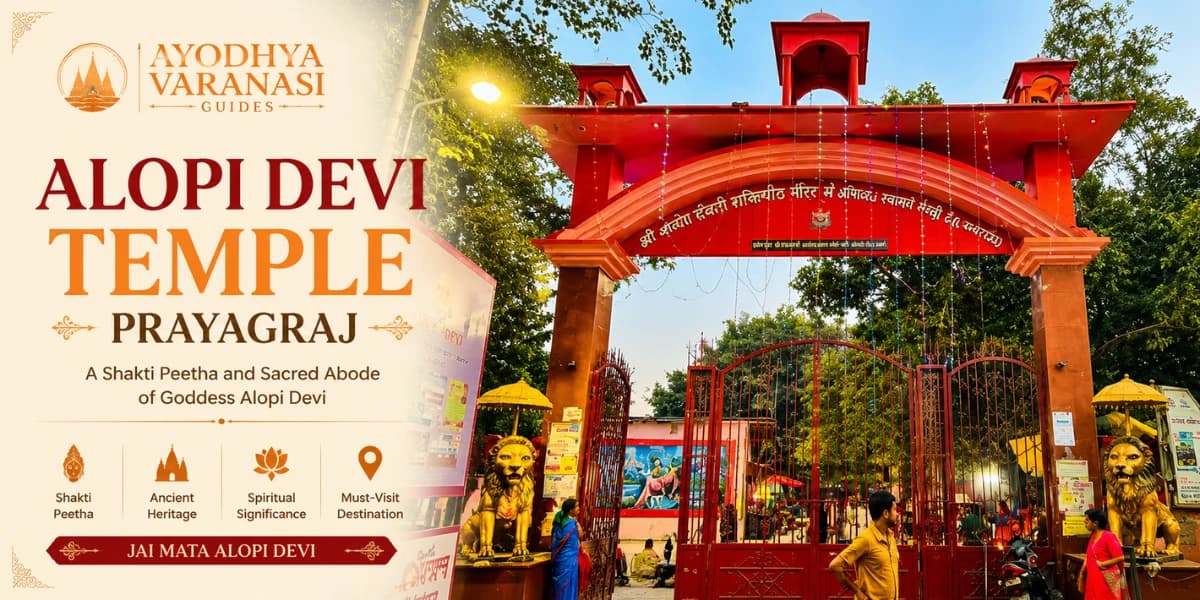
Alopi Devi Mandir
Alopibagh, Prayagraj · The Vanished Goddess
4.9 / 5 · Prayagraj Darshan Help
Shakti Peeths · Sangam
- Timings
- ~5:00 AM–12:00 PM & 4:00 PM–9:00 PM
- What Is Worshipped
- A wooden cradle (doli) above a kund
- The Devi
- Alopshankari — the goddess who vanished
- Built
- c. 1772 under Mahadji Shinde; developed by the Scindias
- Entry
- Free · no ticket required
- Location
- Alopibagh, near Daraganj and the Sangam
What Are the Alopi Devi Temple Timings?
Alopi Devi opens in two sessions — roughly 5:00 AM to 12:00 PM and 4:00 PM to 9:00 PM — with a break through the middle of the day. Darshan is free. Because the temple sits close to the Sangam, it is busy through the Magh Mela and Kumbh seasons, and hours extend considerably during both Navratris, when the queue runs well outside the compound.
Early Morning (Best)
The calmest darshan of the day
Late Morning
Busy with pilgrims from the Sangam
Midday Break
Temple usually closed
Evening
Aarti; a calmer time to visit
Morning Aarti
Before the doli
Evening Aarti
The most atmospheric hour
Both Navratris
Extended hours; very long queues
Magh Mela season
Pilgrims arrive from the Sangam snan
Tip: Alopi Devi is one of the three Shakti Peeths of Prayagraj, with Lalita Devi at Meerapur and Kalyani Devi near Chowk. It is the closest of the three to the Sangam, which makes it the natural place to begin the Devi circuit. WhatsApp us and we will route all three.
When Is the Best Month to Visit Alopi Devi Temple? (2026)
Two calendars converge here — the Navratri season and the Magh Mela, since the temple sits so close to the Sangam. October to March is comfortable throughout.
Both Navratris and the Magh Mela bring the largest crowds. Because Alopi Devi is so close to the Sangam, it fills whenever the confluence does.
Why Is There No Idol at Alopi Devi Temple?
What Is Alopi Devi Mandir?
Alopi Devi Mandir, also called Alopshankari, stands at Alopibagh near Daraganj, very close to the Triveni Sangam. It is among the most visited Devi shrines in Prayagraj — and among the most unusual temples anywhere in India, because its sanctum holds no image of the goddess at all.
What Is Worshipped Instead?
A wooden cradle — a doli — suspended above a small sacred kund. Devotees offer their prayers to the cradle. There is no carved figure, no consecrated idol, nothing to look at in the ordinary sense: an empty cradle above water, and the absence itself is the deity.
Why Does the Goddess Have No Form Here?
The name explains it. When Lord Shiva carried Sati’s body across the world and Vishnu’s chakra severed it, the places where parts fell became Shakti Peethas. Tradition holds that the last portion — the palm of her right hand — fell here and immediately vanished. Alop means disappeared. The goddess is worshipped as Alopshankari, the one who vanished, and the cradle stands as a symbol of what is no longer visible.
Why a Cradle?
Because a doli — a palanquin or cradle — is what carries something precious, and here it carries nothing you can see. It is a remarkably subtle piece of theology for a working temple: a vessel for a presence that has withdrawn from form. Visitors who arrive expecting an idol are often thrown by it, and then find it stays with them.
Who Built the Temple?
The temple was raised around 1772, during the stay of the Maratha commander Mahadji Shinde in Prayagraj, built at the request of the queen. It was later renovated and developed by Maharani Baizabai Scindia in the 1800s. It belongs to the same wave of Maratha patronage that reshaped sacred sites across northern India in that period.
Where Does It Sit Among Prayag’s Devi Temples?
Alopi Devi is one of the three great Devi shrines of Prayagraj, with Lalita Devi at Meerapur and Kalyani Devi near Chowk. It is the closest of the three to the Sangam and by far the most visited, which makes it the natural starting point for the Devi circuit of Prayag.
Did you know? Of the many Shakti Peethas across India, Alopi Devi may be the only one where nothing at all is enshrined — an empty wooden cradle above a kund, worshipped precisely because the goddess vanished from this spot.
What Is Darshan at Alopi Devi Like?
Short, busy and genuinely disorienting the first time — because there is nothing in the sanctum to look at.
- 1
Reach Alopibagh
The temple is at Alopibagh near Daraganj, very close to the Triveni Sangam. Autos and e-rickshaws reach it directly.
- 2
Buy Flowers and a Chunri
Stalls outside sell flowers, chunris and prasad — the traditional offerings at a Devi shrine.
- 3
Leave Footwear and Enter
Footwear comes off outside. Outside Navratri and the mela, the queue moves quickly.
- 4
Look for the Cradle, Not an Idol
This is the moment that surprises people. There is no image of the goddess — only a wooden doli suspended above a small kund.
- 5
Offer Your Prayers to the Doli
Devotees pray to the cradle itself. The absence of a form is the point, not an omission.
- 6
Hear the Alop Story
Ask your guide why the goddess has no image here — the last part of Sati falling and vanishing is what gives the temple its name and its character.
- 7
Note the Kund Below
The cradle hangs above a small sacred pond, which is part of the arrangement rather than incidental to it.
- 8
Continue to the Sangam or Daraganj
The confluence is close, and Veni Madhav and Nag Vasuki are a short ride away in Daraganj.
When Should You Visit Alopi Devi Temple?
The temple is open all year and free. What shapes the visit is the session timing and how close you are to Navratri or the mela.
Best Time of Day — Early Morning
Come between 5 and 8 AM for the calmest darshan, before the pilgrims from the Sangam snan begin arriving and well ahead of the midday closure.
Best Season — October to March
Comfortable weather for the full Devi circuit across the city. November and December are quieter than the Navratri and mela months.
Most Devotional — Both Navratris
Chaitra and Ashwin Navratri fill the temple completely, with queues running outside the compound and the whole Alopibagh quarter in celebration. Arrive at first light.
What Can You See at Alopi Devi Temple?
Less than you expect, and that is precisely the point.
The Wooden Doli
Top PickWorshipped in Place of an Idol
A wooden cradle suspended above a small sacred kund, worshipped as the goddess herself — there is no image in the sanctum.
The Sacred Kund
Top PickBelow the Cradle
The small pond over which the doli hangs, forming the heart of the shrine's unusual arrangement.
The Alop Tradition
The Vanished Goddess
The Shakti Peeth where the last part of Sati is said to have fallen and immediately disappeared, giving the temple its name.
The Maratha History
1772 & the Scindias
Built during Mahadji Shinde's stay in Prayagraj and later developed by Maharani Baizabai Scindia in the 1800s.
The Alopibagh Quarter
Near the Sangam
A busy pilgrim quarter close to Daraganj and the confluence, at its most alive during the mela seasons.
Why Is Alopi Devi Unlike Any Other Shakti Peeth?
Pilgrims visit Shakti Peethas across India. This one asks something different of them.
A Temple With Nothing to Look At
No idol, no image, no carved figure — only an empty cradle above water. Very few temples anywhere are built around an absence.
The Goddess Who Vanished
The last part of Sati fell here and disappeared. Alopshankari is worshipped precisely as the one who is no longer present in form.
The Closest Peeth to the Sangam
Of Prayagraj's three Shakti Peeths, this is the one nearest the confluence — the natural place to begin the Devi circuit.
Maratha Patronage at Prayag
Built under Mahadji Shinde and developed by the Scindias, part of the great wave of Maratha temple building across the north.
Is There an Entry Fee at Alopi Devi Temple? (2026)
Darshan is completely free — there is no ticket and no paid queue, even during Navratri or the Magh Mela. Only offerings and any special puja carry a cost.
The darshan is free and the temple is minutes from the Sangam. What we arrange is the full Devi circuit — Alopi, Lalita and Kalyani Devi in one half-day with transport — and a guide who can explain why this Shakti Peeth has no idol, which is the thing everyone wants to know. Pricing confirmed in writing.
Auto fares are indicative and vary with traffic, season and the mela calendar.
What Do Devotees Say About Alopi Devi Temple?
1,298 verified reviews
Alopi Devi is our city's own. People arrive expecting an idol and stand confused in front of the cradle until someone explains. Then they understand, and it stays with them. That is the whole temple.
Shashi Kant Tiwari
Prayagraj
I have visited many Shakti Peethas and never one with no image at all. A wooden doli above a kund, worshipped because the goddess vanished. Genuinely unlike anything else.
Geeta Ramachandran
Chennai
Went during Ashwin Navratri. The queue ran far outside and the whole Alopibagh area was celebrating. Extraordinary energy. Go at first light on those days or accept a very long wait.
Ashok Kumar Jain
Indore
We did all three Shakti Peeths in one morning with our guide — Alopi, Lalita and Kalyani. Starting here, closest to the Sangam, was the right order. Completely changed our sense of Prayagraj.
Vidya Menon
Kochi
Very important and very busy temple, close to the confluence. Mind the midday closure. Free darshan, and the Maratha history was new to me — built under Mahadji Shinde in 1772.
Devendra Pratap Singh
Varanasi
How Do You Do the Three Shakti Peeths of Prayagraj?
Alopi Devi is closest to the Sangam, so the Devi circuit begins here. This is the day we plan.
Sunrise at the Triveni Sangam. Begin at the confluence for first light on the water.
Sangam boat ride & snan. The holy dip at the meeting of the Ganga, Yamuna and the invisible Saraswati.
Bade Hanuman Ji darshan. The reclining Hanuman, minutes from the confluence.
Alopi Devi Temple, Alopibagh. The first of the three Shakti Peeths — the wooden cradle where the goddess vanished.
Lalita Devi Temple, Meerapur. The second Peetha, where the fingers of Sati's right hand fell.
Kalyani Devi Temple. The third, completing the Devi circuit of Prayagraj.
Evening Ganga Aarti at Saraswati Ghat. Close the day on the riverfront with lamps and bells.
Which Tour Package Covers Alopi Devi Mandir?
Alopi Devi Mandir sits within the wider Prayagraj circuit, and the Sangam, the temples and the sites out of town need a vehicle and a sensible order to do properly. These are the itineraries our guests book most — each with the Triveni Sangam snan and boat ride, a certified local guide, transport and pricing confirmed in writing.
- 1 Day1 Day Prayagraj Tour PackageTriveni Sangam snan and boat ride with the main temples of the confluence.
- 2 Days2 Days Prayagraj Tour PackageThe Sangam, Akshayavat and the Daraganj temples without rushing any of them.
- 2 Days2 Days Varanasi Prayagraj Tour PackageKashi Vishwanath and the Ganga Aarti with the Triveni Sangam.
- 2 Days2 Days Ayodhya Prayagraj Tour PackageRam Mandir and the Sangam, tightly planned for a short trip.
- 3 Days3 Days Varanasi Prayagraj Tour PackageKashi and the confluence, with time for the ghats and the Sangam boat ride.
- 4 Days4 Days Ayodhya Varanasi Prayagraj Tour PackageAll three cities — Ram Mandir, Kashi Vishwanath and the Triveni Sangam.
- 5 Days5 Days Ayodhya Varanasi Prayagraj Tour PackageThe complete sacred circuit at a comfortable, senior-friendly pace.
Want Alopi Devi Mandir built into a custom itinerary? We plan around your dates, your pace and what you actually want to see.
See all Prayagraj, Ayodhya & Varanasi packagesHow Do You Reach Alopi Devi Temple in Prayagraj?
The temple is at Alopibagh, near Daraganj, very close to the Triveni Sangam — the most accessible of the three Shakti Peeths of Prayagraj.
By Road / Auto
The simplest option. Autos and e-rickshaws reach Alopibagh directly, and the temple is well known to every driver in the city.
By Train
Prayagraj Sangam station is close and Prayagraj Junction about 5 km. Both connect to Delhi, Varanasi, Lucknow and Ayodhya.
From the Sangam
The confluence is nearby, and many pilgrims come straight here after the snan — the natural order for the Devi circuit.
By Air
Prayagraj Airport (Bamrauli) is roughly 16 km away, with taxis at the terminal. Varanasi (~120 km) is the larger alternative.
Where Is Alopi Devi Temple Located in Prayagraj?
Alopi Devi Mandir stands at Alopibagh, near Daraganj in Prayagraj, close to the Triveni Sangam. Use the map below to navigate.
Prayagraj
- Area: Alopibagh, near Daraganj, Prayagraj
- PIN: Prayagraj 211006
- From the Triveni Sangam: ~3 km
- Significance: One of the three Shakti Peeths of Prayag
- In the sanctum: A wooden cradle — no idol
Where Should You Stay Near Alopi Devi Temple?
Alopibagh sits close to the Sangam and Daraganj, the traditional pilgrim quarters of Prayagraj.
Alopibagh & Daraganj
Dharamshalas and simple guesthouses in the pilgrim quarter, walking distance from the temple and close to the Sangam.
Civil Lines
Prayagraj's main hotel district with branded and mid-range properties and good restaurants, about 20 minutes away.
Near Prayagraj Junction
About 5 km away, convenient if you are continuing to Varanasi, Ayodhya or Chitrakoot by train.
What Else Can You Visit Near Alopi Devi Temple?
Alopibagh sits between the city and the Sangam, so the whole confluence circuit is close.
Lalita Devi Temple
The second of the three Shakti Peeths of Prayagraj, at Meerapur, where the fingers of Sati's right hand fell.
Kalyani Devi Temple
The third Shakti Peeth, near Chowk, with three deities formed from three fingers of Sati.
Triveni Sangam
The sacred confluence of the Ganga, Yamuna and the invisible Saraswati — boat ride and snan, ~3 km away.
Veni Madhav Temple
The chief of the twelve Dwadash Madhav at Daraganj, whose darshan completes a Sangam snan.
Nag Vasuki Temple
The temple of the serpent king at Daraganj, one of the few performing Kaal Sarp Dosh nivaran puja.
Bade Hanuman Temple
The only reclining Hanuman in the world, near the Sangam — submerged by the rivers each monsoon.
Navratri & the Magh Mela at Alopi Devi
Both Navratris transform Alopi Devi. Through Chaitra Navratri (March or April) and Ashwin Navratri (September or October), the queue runs far outside the compound, the Alopibagh quarter is decorated and the temple stays open extended hours from before dawn until late.
Because Alopi Devi sits so close to the confluence, it also fills through the Magh Mela and Kumbh, when pilgrims coming for the Sangam snan add the Devi circuit to their yatra. On any of these dates, arrive at first light.
What Should You Know Before Visiting Alopi Devi Temple?
One thing surprises almost every first-time visitor, and it is worth knowing in advance.
There is no idol — do not be thrown by it
The sanctum holds a wooden cradle above a small kund, and nothing else. This is deliberate: the goddess vanished here, and the absence is the point.
Ask why before you go in
The Alop story — the last part of Sati falling and disappearing — is what makes sense of the empty cradle. Without it the darshan is baffling.
Start the Devi circuit here
Of the three Shakti Peeths, Alopi Devi is closest to the Sangam. Beginning here and moving to Lalita and Kalyani is the sensible order.
Mind the midday closure
The temple shuts for roughly four hours in the middle of the day. Come in the morning session or after 4 PM.
Navratri means very long queues
Both Navratris fill the temple completely, with the queue running outside the compound. Arrive at first light on those days.
It fills during the Magh Mela too
Being close to the confluence, this temple gets Sangam crowds in January and February as well as the Navratri ones.
It is a busy working shrine
This is among the most visited Devi temples in Prayagraj. Expect crowds, movement and a brisk darshan rather than a contemplative one.
Buy offerings outside
Flowers, chunris and prasad are all sold at the stalls by the entrance — no need to carry anything.
Combine it with Daraganj
Veni Madhav and Nag Vasuki are about 2 km away, so the Devi darshan and the Daraganj temples fit into one outing.
Dress modestly
Standard temple etiquette applies, with footwear removed at the entrance.
Alopi Devi Temple Prayagraj — Frequently Asked Questions
The questions devotees ask us most about Alopi Devi — why there is no idol, the cradle, timings and the three Shakti Peeths of Prayag.
Alopi Devi Mandir, also called Alopshankari, is a Shakti Peeth at Alopibagh near Daraganj in Prayagraj, close to the Triveni Sangam. It is among the most unusual temples in India because its sanctum holds no idol of the goddess.
Still have a question?
Our local team replies within 30 minutes.
Written & verified by the local Prayagraj guide team at Ayodhya Varanasi Guides
Our government-certified guides run the three Shakti Peeth circuit of Prayagraj through the year, and spend a good deal of time explaining to first-time visitors why the sanctum at Alopi Devi is empty. Last updated: July 2026. Darshan hours extend during Navratri and the Magh Mela — message us for the timing on your travel date.
Begin the Devi Circuit of Prayag at Alopi Devi
Let Ayodhya Varanasi Guides plan the three Shakti Peeths of Prayagraj — Alopi, Lalita and Kalyani Devi in a single half-day — alongside the Triveni Sangam snan, Bade Hanuman and the Daraganj temples, with a guide who can explain the empty cradle. Confirmed in writing.