
Bharat Mata Temple, Varanasi — The Marble Map of Mother India
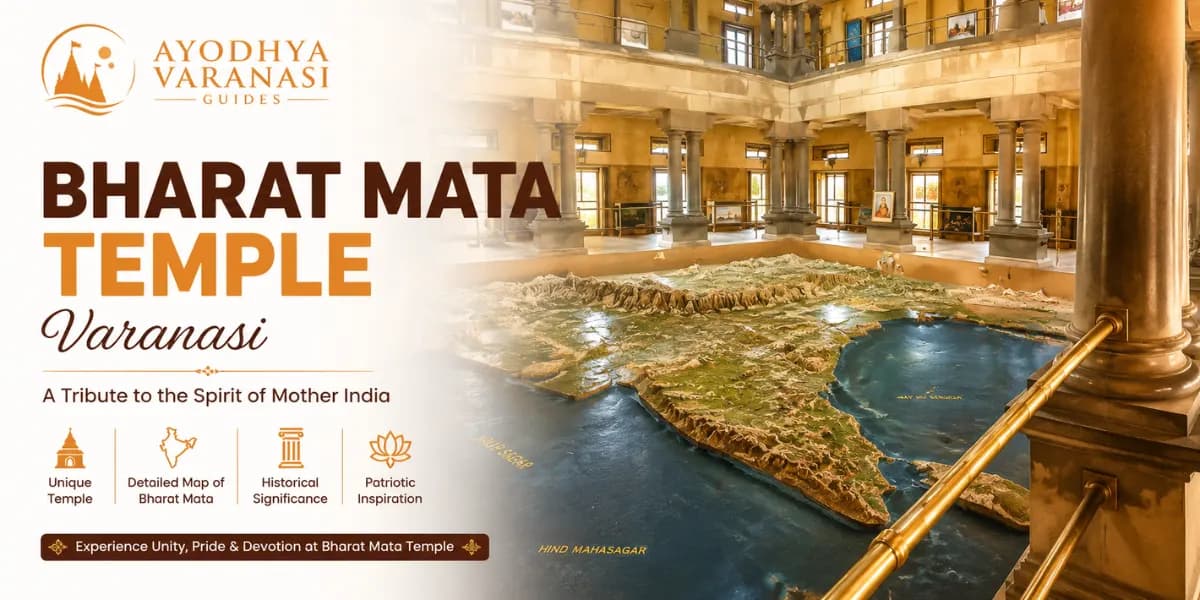
Bharat Mata Mandir, on the Mahatma Gandhi Kashi Vidyapith campus in Varanasi, is a temple unlike any other in India: it holds no idol of any god or goddess. In place of a deity there is a vast relief map of undivided India carved in Makrana marble — Afghanistan, Baluchistan, Pakistan, Bangladesh, Burma and Ceylon included — with around 450 mountain ranges, peaks, plains and water bodies rendered to scale. It was built by the freedom fighter Babu Shiv Prasad Gupta and inaugurated by Mahatma Gandhi on 25 October 1936. Open 9:30 AM to 8:00 PM, entry free.
- Timings
- 9:30 AM – 8:00 PM daily
- The Deity
- A marble map — no idol at all
- Inaugurated By
- Mahatma Gandhi, 25 Oct 1936
- Entry
- Free · no ticket
Bharat Mata Mandir
Varanasi · A Temple to the Nation
4.9 / 5 · Kashi Tours & Guides
Heritage · Temples · Ghats
- Timings
- 9:30 AM – 8:00 PM, daily
- What's Inside
- A Makrana marble relief map of undivided India
- Built By
- Babu Shiv Prasad Gupta
- Inaugurated
- By Mahatma Gandhi, 25 October 1936
- Entry
- Free · no ticket required
- Location
- MG Kashi Vidyapith campus, Varanasi
What Are the Bharat Mata Mandir Timings?
Bharat Mata Mandir keeps straightforward daytime hours — 9:30 AM to 8:00 PM, without the long midday closure that shuts most Varanasi temples between noon and four. That makes it one of the most useful stops in the middle of the day, when the Ram-and-Shiva temples of the old city are shut and visitors have nowhere to go. Entry is free. Allow 30 to 45 minutes.
Morning
Opens at 9:30; quiet and cool
Midday (Useful)
Open when most Kashi temples are closed
Evening
Pleasant; combine with the Ganga Aarti
The Marble Map
Walk the gallery and find your own region
The Building
The pentagonal structure and five pillars
Total Visit
Easy to combine with the Cantt area
Tip: this is the best midday stop in Varanasi. Between noon and 4 PM almost every temple in the old city is closed, and Bharat Mata Mandir is open, indoors and genuinely interesting. We use it to fill exactly that gap. WhatsApp us and we will slot it into your day.
When Is the Best Month to Visit Bharat Mata Mandir? (2026)
The temple is indoors and comfortable throughout the year, so the season barely affects the visit itself — only how pleasant the rest of your Varanasi day is. October to March is the comfortable window.
Independence Day, Republic Day and Gandhi Jayanti carry particular meaning here. The temple was inaugurated by Gandhi on 25 October 1936, which makes late October especially apt.
Why Does Bharat Mata Temple Have No Idol?
What Is Bharat Mata Mandir?
Bharat Mata Mandir — the temple of Mother India — stands on the campus of Mahatma Gandhi Kashi Vidyapith in Varanasi. It is built as a pentagon carried on five pillars, and inside there is no image of Vishnu, Shiva, Durga or any other deity. There is a map. That is the whole point.
What Exactly Is the Marble Map?
The floor of the temple holds a vast relief map of undivided India carved in Makrana marble — the same marble used for the Taj Mahal. It shows the subcontinent as it was: Afghanistan, Baluchistan, Pakistan, Bangladesh, Burma and Ceylon all included. Around 450 geographical features are rendered in three dimensions — mountain ranges, individual peaks, plateaus, plains, rivers and seas — carved to scale, with their measurements marked alongside.
Who Built It?
The temple was the work of Babu Shiv Prasad Gupta, a Varanasi philanthropist and freedom fighter who founded Kashi Vidyapith and the newspaper Aaj, and who put a great deal of his fortune into the national movement. He had the temple constructed in the years around 1918 to 1924, and it was inaugurated by Mahatma Gandhi on 25 October 1936.
Why Did Gandhi Inaugurate It?
Because the idea suited him exactly. A temple with no idol could belong to everyone — every religion, every caste, and pointedly including those excluded from other temples. Gandhi expressed the hope that it would serve as a common platform for people of all faiths and communities. In 1936, in a city of a thousand shrines, opening a temple that no one could be turned away from was a deliberate and pointed act.
What Does It Mean to Worship a Map?
The conceit is simple and, once you are standing over it, quietly powerful. If the land itself is the mother, then the map is her image and the temple needs nothing else. Visitors walk the gallery around the relief, find the mountains they have travelled through and the rivers they were born beside, and trace a country with their eyes. Children usually go looking for their own town.
Why Is It Worth Visiting Today?
Partly because it is unique — there is nothing else like it in India. Partly because it is a rare piece of freedom-movement heritage in a city defined by its antiquity, from a period of Varanasi’s history that visitors almost never encounter. And partly for the simple pleasure of looking at the subcontinent carved in marble, mountain by mountain.
Did you know? The map is carved in Makrana marble — the same Rajasthani stone used to build the Taj Mahal — and the mountains, plateaus and ocean depths are cut to scale in three dimensions, not merely drawn on a flat surface.
What Do You Actually Do at Bharat Mata Mandir?
There is no queue, no ritual and no priest directing you. It is closer to a monument than a temple in practice — and it rewards taking your time.
- 1
Reach the Kashi Vidyapith Campus
The temple stands on the Mahatma Gandhi Kashi Vidyapith campus. Autos and taxis reach the gate directly.
- 2
Leave Footwear at the Entrance
Shoes come off as at any temple, and the marble floor inside is cool underfoot.
- 3
Take In the Building First
Note the pentagonal plan and the five pillars supporting the structure before you turn to the map.
- 4
Walk the Gallery Around the Map
The relief fills the floor and you move around its edge. Circle it fully — the country reads differently from each side.
- 5
Find the Himalayas
The mountain ranges are the most striking part of the carving, cut in three dimensions with their heights marked.
- 6
Look for Your Own Region
This is what everyone ends up doing. Find your city, your river, the hills you grew up near. Children take to it immediately.
- 7
Notice What the Map Includes
Afghanistan, Baluchistan, Burma and Ceylon are all there — the subcontinent as it was understood when the temple was built.
- 8
Read About Gandhi's Inauguration
Take a moment with the history: a temple opened in 1936 that anybody, of any faith or caste, could enter.
When Should You Visit Bharat Mata Mandir?
Indoors, air-cooled by marble and open straight through the day — this is the most flexible stop in Varanasi, and most useful at exactly the hour everything else closes.
Best Time of Day — Midday
The smart slot. Between noon and 4 PM nearly every temple in the old city is shut, but Bharat Mata Mandir is open. It fills the dead hours of a Varanasi itinerary better than anything else in the city.
Best Season — October to March
Comfortable weather for the rest of your day. The temple itself is pleasant year-round, which is more than can be said for the ghats in May and June.
Most Meaningful — Independence Day & Gandhi Jayanti
15 August, 26 January and 2 October carry obvious significance here. Late October is especially apt — Gandhi inaugurated the temple on 25 October 1936.
What Can You See at Bharat Mata Mandir?
One extraordinary object, and a building designed entirely around it.
The Marble Relief Map
Top PickThe Whole Subcontinent
Undivided India carved in Makrana marble across the temple floor, with around 450 mountain ranges, peaks, plains and water bodies rendered to scale in three dimensions.
A Temple With No Idol
Top PickUnique in India
No image of any god or goddess. The land itself is the deity — an idea with no real parallel anywhere else in the country.
The Himalayan Range in Relief
The Best Detail
The mountains are the most striking part of the carving, cut in three dimensions with their measurements marked alongside.
The Pentagonal Structure
The Architecture
The temple is built as a pentagon carried on five pillars — a deliberate departure from conventional temple form.
The Freedom Movement Connection
1936 Heritage
Built by the freedom fighter Babu Shiv Prasad Gupta and inaugurated by Mahatma Gandhi — a piece of national history in a city known for ancient ones.
Why Should You Visit a Temple With No God in It?
It is the question everyone asks, and there are four good answers.
There Is Nothing Else Like It
A temple where the deity is a marble map of the country. Not rare — genuinely unique in India.
Freedom-Movement Varanasi
A side of the city visitors never see. Kashi Vidyapith, Shiv Prasad Gupta and Gandhi belong to a Varanasi that is not about antiquity at all.
Open When Everything Else Is Shut
The single most useful midday stop in the city, when the old-city temples close and there is nothing to do until four.
Children Actually Enjoy It
Finding your own town on a marble map is a game. This is one of the few stops in Varanasi that genuinely holds a child's attention.
Is There an Entry Fee at Bharat Mata Mandir? (2026)
Entry is free — there is no ticket and no queue. The only cost is getting there, and the temple is on a main campus that any auto can reach.
The visit costs nothing. What we add is sequencing and context — using Bharat Mata Mandir to fill the midday hours when the old city shuts, and a guide who can explain Shiv Prasad Gupta, Kashi Vidyapith and why Gandhi opened a temple with no idol in it. Pricing confirmed in writing.
Auto fares are indicative and vary with traffic and time of day. Agree the fare before setting off.
What Do Visitors Say About Bharat Mata Mandir?
1,091 verified reviews
I served thirty years in the army and I was not prepared for how this affected me. Standing over a marble map of the whole undivided subcontinent, in a temple with no idol, opened by Gandhi. Every Indian should see it once.
Colonel R. K. Saxena (Retd.)
Dehradun
Our guide brought us at 1 PM when everything else in the old city was closed — very clever planning. My son spent twenty minutes finding our city and tracing the Narmada. He talked about it for days.
Neha Chaturvedi
Indore
Fascinating and completely unexpected. A temple with no deity, dedicated to the country itself. The relief carving is remarkable, and the 1936 history was well explained by our guide.
Thomas Berger
Berlin
Quiet, cool and thoughtful. Very different from the rest of Varanasi and a welcome change of pace midway through a heavy temple day. Free entry and no crowds at all when we went.
Lakshmi Subramanian
Madurai
Worth thirty minutes, especially if you like history. It opens at 9:30, not earlier, so do not plan it before your morning ghat visit. Close to Cantt station, which was convenient for us.
Arjun Kapoor
Chandigarh
How Do You Fit Bharat Mata Mandir Into a Varanasi Day?
Because it stays open through the midday closure, this temple solves the hardest hour of a Varanasi itinerary. Here is the day we plan around it.
Sunrise boat ride on the Ganga. Begin on the water for first light along the ghats — the classic Varanasi opening.
Kashi Vishwanath darshan. Darshan of the Jyotirlinga at Shri Kashi Vishwanath Dham. We assist with VIP darshan to save you the queue.
Kal Bhairav & Batuk Bhairav. Bhairav darshan, which tradition says completes a Kashi yatra.
Sankat Mochan & Durga Kund. The temple cluster in the south of the city, before the afternoon closures begin.
Bharat Mata Mandir. The ideal midday stop — open, indoors, cool, and open when nothing else is.
Lunch & rest. A break through the hottest part of the afternoon.
Ganga Aarti at Dashashwamedh Ghat. Close the day with the great evening aarti on the riverfront.
Which Tour Package Covers Bharat Mata Mandir?
Bharat Mata Mandir is best seen as part of a planned Kashi darshan rather than a single stop — the old-city temples keep different hours and the ghats reward proper sequencing. These are the itineraries our guests book most, each with Kashi Vishwanath VIP darshan assistance, a certified local guide and transport, priced in writing before you travel.
- 1 Day1 Day Varanasi Tour PackageKashi Vishwanath darshan, a sunrise boat ride and the evening Ganga Aarti.
- 2 Days2 Days Varanasi Tour PackageKashi Vishwanath, the ghats, Sarnath and the old-city temple circuit.
- 3 Days3 Days Varanasi Tour PackageKashi at a proper pace — the Dham, the Bhairavs, the Durgakund cluster and the aarti.
- 4 Days4 Days Varanasi Tour PackageEverything in Kashi plus Sarnath, with time for the temples most itineraries skip.
- 2 Days2 Days Ayodhya Varanasi Tour PackageRam Mandir and Kashi Vishwanath across two cities, with the Ganga Aarti.
- 3 Days3 Days Ayodhya Varanasi Tour PackageThe classic pairing — Ram Mandir, Kashi Vishwanath and the ghats.
- 3 Days3 Days Varanasi Prayagraj Tour PackageKashi and the confluence, with time for the ghats and the Sangam boat ride.
- 4 Days4 Days Ayodhya Varanasi Prayagraj Tour PackageAll three cities — Ram Mandir, Kashi Vishwanath and the Triveni Sangam.
- 5 Days5 Days Ayodhya Varanasi Prayagraj Tour PackageThe complete sacred circuit at a comfortable, senior-friendly pace.
Want Bharat Mata Mandir built into a custom itinerary? We plan around your dates, your pace and what you actually want to see.
See all Varanasi & Ayodhya tour packagesHow Do You Reach Bharat Mata Mandir in Varanasi?
The temple stands on the Mahatma Gandhi Kashi Vidyapith campus, in the Cantt area of Varanasi. Unlike the old-city temples, vehicles reach it directly.
By Road / Taxi
The simplest option. Taxis and autos reach the Kashi Vidyapith campus gate directly — no walking through galis required.
By Train
Varanasi Junction (Cantt) is only about 2 km away, which makes this an excellent stop on an arrival or departure day. Banaras station is roughly 6 km.
By Air
Lal Bahadur Shastri International Airport, Babatpur is around 23 km away, with taxis at the terminal. Allow around an hour in traffic.
The Last Mile
E-rickshaws run constantly through the Cantt and Sigra area. Ask for Kashi Vidyapith and the temple is on the campus.
Where Is Bharat Mata Mandir Located in Varanasi?
Bharat Mata Mandir stands on the Mahatma Gandhi Kashi Vidyapith campus, about 2 km from Varanasi Junction (Cantt). Use the map below to navigate to the campus.
Varanasi
- Area: MG Kashi Vidyapith campus, Varanasi
- PIN: Varanasi 221002
- From Varanasi Junction (Cantt): ~2 km
- From Dashashwamedh Ghat: ~4.5 km
- Timings: 9:30 AM – 8:00 PM, no midday closure
Where Should You Stay Near Bharat Mata Mandir?
The temple is in the Cantt area, close to the railway station and the city's main hotel district.
Cantt & Sigra
Branded and business hotels near the railway station, about 2 km from Kashi Vidyapith, with parking and dining. The most convenient base for this side of the city.
Godowlia & Dashashwamedh
The heart of the old city, walking distance from Kashi Vishwanath and the evening Ganga Aarti, about 25 minutes from the temple.
Assi Ghat & Ravidas Gate
The quieter southern end of the ghats, popular with longer-staying visitors, with cafés and easy boat access.
What Else Can You Visit Near Bharat Mata Mandir?
The temple sits in the Cantt area, which puts it on the natural route between the station, Sarnath and the ghats.
Kashi Vishwanath Temple
The Jyotirlinga of Kashi, ~4.5 km away. We assist with VIP darshan to skip the main queue.
Kashi Vishwanath VIP Darshan
Skip-the-queue Sugam darshan assistance at Shri Kashi Vishwanath Dham, arranged in advance.
Ganga Aarti, Dashashwamedh Ghat
The world-famous evening aarti on the riverfront — the unmissable Varanasi experience.
Tridev Temple
The temple to Brahma, Vishnu and Mahesh near Tulsi Manas Mandir, with shrines of Maa Sati and Khatu Shyam.
Batuk Bhairav Temple
Bhairav in his child form at Kamachha, famed for its centuries-old eternal lamp and oil prasad.
How to Commute in Varanasi
Autos, e-rickshaws, boats and taxis — how to get around the city without stress.
Independence Day & Gandhi Jayanti at Bharat Mata Mandir
Where every other temple in Varanasi marks the religious calendar, Bharat Mata Mandir marks the national one. Independence Day on 15 August and Republic Day on 26 January are observed here with flag hoisting and gatherings of students from Kashi Vidyapith, and they are the most fitting days of the year to stand over the marble map.
Gandhi Jayanti on 2 October carries obvious meaning at a temple Gandhi himself opened, and 25 October marks the anniversary of that inauguration in 1936. If you are in Varanasi on any of these dates, this is the place to spend an hour.
What Should You Know Before Visiting Bharat Mata Mandir?
An easy visit — but a few things will help you get more out of it.
It opens at 9:30 AM, not earlier
Unlike the ghat temples there is no dawn darshan. Do not plan it before your morning boat ride and Vishwanath visit.
Use it for the midday gap
It stays open right through the 12 to 4 PM window when almost every other temple in Varanasi closes. This is the single best reason to know about it.
There is no idol — that is the point
Some visitors arrive expecting a deity and are briefly confused. The marble map of the country is what is worshipped here.
Walk the full circuit of the map
The relief reads differently from each side. Circling it properly is the difference between five minutes and half an hour.
Look for the mountains
The Himalayan ranges are carved in three dimensions with their heights marked, and they are the most impressive part of the work.
Great for children
Finding your own town on a marble map holds a child's attention far better than another sanctum. One of the few kid-friendly stops in Varanasi.
Footwear off at the entrance
It is still a temple in form and observance, even without a deity. Shoes come off and the marble is cool underfoot.
Check photography rules on the day
Photography is generally permitted, but follow the staff's guidance inside.
It is close to Cantt station
Only about 2 km, which makes it an excellent stop on an arrival or departure day when you have a few hours to fill.
Allow 30 to 45 minutes
Long enough to take in the map, the building and the history without rushing. It is not an all-morning stop.
Bharat Mata Temple Varanasi — Frequently Asked Questions
The questions visitors ask us most about Bharat Mata Mandir — the marble map, why there is no idol, timings, entry and how to reach Kashi Vidyapith.
It is a temple dedicated to Mother India, on the Mahatma Gandhi Kashi Vidyapith campus. Instead of an idol of any god or goddess, it holds a large relief map of undivided India carved in Makrana marble. It was inaugurated by Mahatma Gandhi in 1936.
Still have a question?
Our local team replies within 30 minutes.
Written & verified by the local Varanasi guide team at Ayodhya Varanasi Guides
Our government-certified Kashi guides bring visitors to Bharat Mata Mandir through the year, and use it to solve the midday gap in a Varanasi itinerary when the old-city temples close. Last updated: July 2026. Campus access and timings can vary on university holidays and national days — message us for the position on your travel date.
See India Carved in Marble at Bharat Mata Mandir
Let Ayodhya Varanasi Guides plan your Kashi day — Bharat Mata Mandir in the midday hours when everything else is shut, Kashi Vishwanath with VIP darshan assistance, the Bhairav temples and the evening Ganga Aarti — with a certified local guide who can tell you the story behind a temple with no god in it.