
Ram Janaki Birla Temple, Ayodhya — Timings, Marble Architecture & Guide
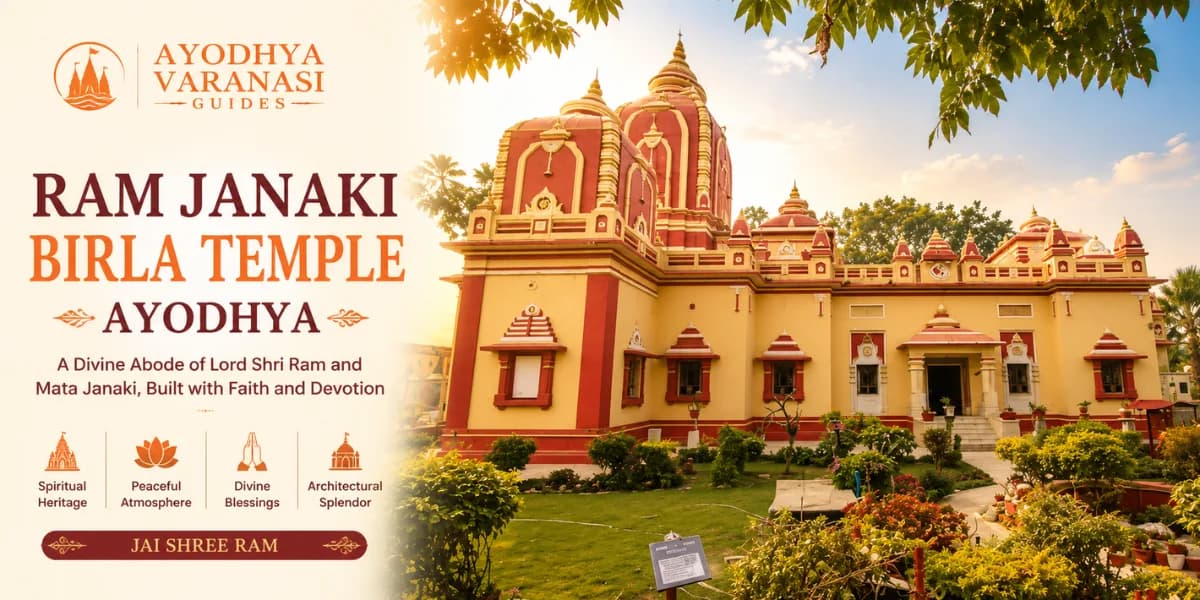
Shri Ram Janaki Birla Temple — known throughout Ayodhya simply as the Birla Mandir — is a white marble temple built by the Birla family in 1984, set on about 2.5 acres at Sai Nagar. It is built in the Nagara style, with a shikhar of roughly 15.5 metres and a distinctive chariot-shaped design. The sanctum holds Lord Ram and Goddess Sita (Janaki) together with Lord Hanuman. Entry is free, there is no queue, and the grounds are spacious and calm — a complete contrast to the Ram Janmabhoomi.
- Timings
- ~6 AM–12 PM & 4 PM–9 PM
- Built
- 1984 by the Birla family
- Deities
- Ram & Janaki, with Hanuman
- Entry
- Free · no queue
Birla Mandir
Ayodhya · Shri Ram Janaki Temple
4.9 / 5 · Ayodhya Darshan Help
Temples · Ram Mandir
- Timings
- ~6:00 AM–12:00 PM & 4:00 PM–9:00 PM
- Deities
- Lord Ram, Goddess Sita (Janaki) & Hanuman
- Built
- 1984 by the Birla family; ~2.5 acres
- Architecture
- Nagara style; ~15.5 m shikhar
- Entry
- Free · no ticket required
- Location
- Sai Nagar, near Birla Dharamshala, Ayodhya
What Are the Birla Temple Ayodhya Timings?
The Birla Mandir follows the usual Ayodhya pattern of morning and evening sessions — roughly 6:00 AM to 12:00 PM and 4:00 PM to 9:00 PM — with a break through the middle of the day. Darshan is free, and unlike the Ram Janmabhoomi there is no queue, no pass and no security screening. Most visitors are in and out in half an hour, or stay far longer simply because it is peaceful.
Morning Session
Cool marble; the quietest darshan
Midday Break
Temple usually closed
Evening Session
Aarti; pleasant in the grounds
Queue
No pass, no screening, no wait
Darshan
Unhurried, even on busy days
The Grounds
2.5 acres of marble and gardens
Total Visit
Easy to combine with Ram Ki Paidi
Tip: if anyone in your group cannot manage the Ram Janmabhoomi queues — elderly parents, someone unwell, small children — this is where we bring them. Same darshan of Ram and Sita, no queue, level access and somewhere to sit. WhatsApp us and we will build it into your day.
When Is the Best Month to Visit the Birla Temple? (2026)
The temple is spacious, shaded and rarely crowded, so it is comfortable year-round. October to March is the pleasant window across Ayodhya, and this is one of the few places in the city that stays manageable even in peak season.
Even during Ram Navami and Deepotsav, when the Janmabhoomi and Ramkot temples are overwhelmed, the Birla Mandir stays comparatively calm. That is much of its practical value.
Why Did the Birlas Build a Temple in Ayodhya?
What Is the Ram Janaki Birla Temple?
Shri Ram Janaki Birla Temple, also called the Birla Shree Sita Ram Mandir, is a white marble temple built in 1984 at Sai Nagar in Ayodhya. It stands on about 2.5 acres and is dedicated to Lord Ram and Goddess Sita — Janaki being Sita’s name as the daughter of King Janak — with Lord Hanuman alongside them.
Who Are the Birlas?
The Birla family, one of India’s great industrial houses, built temples across the country through the twentieth century — the Lakshmi Narayan Temple in Delhi, temples at Jaipur, Bhopal, Hyderabad and Kolkata, and the New Vishwanath Temple at Banaras Hindu University. Their temples share a recognisable character: white marble, generous grounds, open access and no commercial pressure.
How Did This One Come About?
Accounts hold that the temple was raised after a member of the family saw the Lord in a dream. Whatever the origin, the result is characteristic of the Birla approach — a substantial, carefully finished temple built and then simply left open to everybody, free of charge, without ticketing or queues.
What Is the Architecture Like?
The temple is built in the Nagara style — the classical north Indian temple form — with a shikhar rising about 15.5 metres. Its most distinctive feature is a chariot-shaped design element, along with detailed marble carving throughout. It reads as traditional in form and modern in finish, which is exactly what it is.
Who Is Worshipped Here?
The sanctum holds Lord Ram and Goddess Sita together, with Lord Hanuman. The pairing matters: many Ayodhya temples focus on Ram Lalla, the infant Ram, whereas here it is Ram and Janaki as the divine couple — which is why families, and newly married couples in particular, come for darshan.
How Does It Compare With the Ram Mandir?
They serve entirely different purposes. The Ram Janmabhoomi is the birthplace, the reason people come to Ayodhya, and it involves queues, passes and security. The Birla Mandir is a modern temple where you walk in, have an unhurried darshan of Ram and Sita and sit in the grounds. It does not replace the Janmabhoomi — but on a heavy darshan day, it is the place people are most grateful to be taken.
Did you know? The Birla family also built the New Vishwanath Temple at Banaras Hindu University — the one with the tallest temple shikhar in the world. If you are travelling the Ayodhya–Varanasi circuit, you can see two Birla temples on the same trip.
What Is a Visit to the Birla Temple Like?
The simplest darshan in Ayodhya — no queue, no pass, no rush. Here is how it goes.
- 1
Reach Sai Nagar
The temple is at Sai Nagar, near the Birla Dharamshala. Taxis and autos reach the gate directly — no lanes to walk.
- 2
Leave Footwear at the Entrance
Racks are provided. The marble is cool in winter and hot in May, so mind the hour if you are barefoot.
- 3
Walk Up Through the Grounds
The approach across 2.5 acres of marble and garden is part of the experience — take it slowly rather than heading straight in.
- 4
Have Darshan of Ram & Janaki
The sanctum holds Lord Ram and Goddess Sita together with Hanuman. There is no queue, so you can stand as long as you wish.
- 5
Look at the Marble Carving
The detail work throughout the temple, and the chariot-shaped design, reward a proper look rather than a glance.
- 6
Note the Nagara Shikhar
Step back outside to see the tower properly — about 15.5 metres, in the classical north Indian form.
- 7
Sit in the Grounds
This is what most visitors remember. Space, shade and quiet, in a city where those are in short supply.
- 8
Continue to Ram Ki Paidi
The Saryu ghats and the evening aarti are a short ride away, and make a natural next stop.
When Should You Visit the Birla Temple in Ayodhya?
Comfortable in any season and never crowded — so this is really about where it fits in your day.
Best Time of Day — Early Morning
Between 6 and 9 AM the marble is cool, the grounds are quiet and the light is beautiful. It also pairs well with an early Ram Lalla darshan.
Best for Tired Groups — Late Afternoon
After a morning of queues at the Janmabhoomi and the Ramkot temples, an unhurried evening darshan here is exactly what most families need.
Best Season — October to March
Comfortable across Ayodhya. Ram Navami in March or April and Deepotsav in October fill the city, but this temple stays calm even then.
What Can You See at the Birla Temple?
A modern temple built to a high standard, and worth more than the ten minutes most visitors give it.
The Ram & Janaki Sanctum
Top PickThe Main Darshan
Lord Ram and Goddess Sita worshipped together as the divine couple, with Lord Hanuman alongside — no queue, no hurry.
The White Marble Architecture
Top PickNagara Style
Detailed marble carving throughout, in the classical north Indian temple form, with a shikhar of about 15.5 metres.
The Chariot-Shaped Design
The Distinctive Feature
The temple's most recognisable architectural element, and the thing that sets it apart from other modern temples in the city.
The 2.5-Acre Grounds
Space and Quiet
Gardens and open marble courts — a rare amount of room in a city where most temples are pressed into narrow lanes.
The Absence of a Queue
Why Families Come
No pass, no screening, no wait. In Ayodhya that is genuinely unusual, and for some visitors it is the whole point.
Why Visit the Birla Temple When You Have Seen the Ram Mandir?
It is not ancient and does not pretend to be. Here is what it actually offers.
Darshan Without a Queue
The same Lord Ram, no pass and no wait. For elderly pilgrims who cannot manage the Janmabhoomi queues, this is the answer.
Ram and Janaki Together
Many Ayodhya temples focus on Ram Lalla. Here it is the divine couple, which is why families and newly married couples come.
Space to Sit and Breathe
Two and a half acres of marble and garden. After a heavy darshan morning, the room to simply sit is worth a great deal.
Fine Modern Marble Work
Nagara-style architecture, detailed carving and the chariot design — a well-built temple in its own right, not just a convenient one.
Is There an Entry Fee at the Birla Temple Ayodhya? (2026)
Entry and darshan are completely free — no ticket, no pass, no paid queue. Birla temples are built and then left open to everybody, and this one is no exception.
The temple costs nothing. What we add is knowing when to use it — bringing groups here when the Janmabhoomi queues are impossible, or when someone in the family simply cannot stand for two hours. It is the most useful temple in Ayodhya for exactly that, and hardly any itinerary includes it.
Auto and e-rickshaw fares are indicative and vary with season and distance.
What Do Visitors Say About the Birla Temple?
1,176 verified reviews
My mother is 79 and the Janmabhoomi queue was beyond her. Our guide brought us here instead. Same Ram and Sita, no queue at all, cool marble and a bench to sit on. She was in tears with gratitude.
Prabhakar Rao
Visakhapatnam
Beautiful white marble temple with lovely carving and so much open space. We came in the evening after a heavy morning of temples and it was exactly the break we needed.
Sneha Kulkarni
Pune
Ram and Janaki together rather than Ram Lalla, which is unusual in Ayodhya. We are newly married and came specifically for that darshan. Peaceful and unhurried.
Rajendra Prasad Gupta
Patna
We had seen the Birla temple at BHU in Varanasi and recognised the style immediately. Same white marble, same generosity — free entry and beautifully maintained grounds.
Meera Shah
Ahmedabad
Modern temple, not ancient, so do not come expecting history. But clean, calm and free, and vehicles reach the gate which helped with our elderly group. Mind the afternoon closure.
Anil Kumar Singh
Ranchi
How Do You Fit the Birla Temple Into an Ayodhya Day?
It works best as a calm counterweight to the heavy morning darshans. Here is the day we plan.
Hanuman Garhi darshan. Begin with the guardian of Ayodhya, as tradition asks, before Ram Lalla.
Ram Janmabhoomi (Ram Lalla). Darshan at the Ram Mandir. We assist with Sugam (VIP) Darshan so you are not queuing for hours.
Kanak Bhawan & Sita Ki Rasoi. The Ramkot cluster — the golden palace and the sacred kitchen of Goddess Sita.
Ram Janaki Birla Temple. An unhurried darshan of Ram and Janaki with no queue, and space to sit after a heavy morning.
Valmiki Bhawan. The midday stop, open when the Ramkot temples close — the whole Ramayana in marble.
Mani Parvat & Sugriv Qila. The ancient mounds, with the best panorama over Ayodhya from the top.
Saryu Aarti at Ram Ki Paidi. Close the day on the riverfront with the evening aarti.
Which Tour Package Covers Birla Mandir?
Most visitors reach Birla Mandir as part of a wider Ayodhya darshan rather than as a trip of its own. These are the itineraries our guests book most — each one includes Ram Mandir darshan with Sugam (VIP) assistance, a certified local guide, comfortable transport and pricing confirmed in writing before you travel.
- 1 Day1 Day Ayodhya Tour PackageRam Mandir darshan, Hanuman Garhi and the Saryu Aarti in a single day.
- 2 Days2 Days Ayodhya Tour PackageThe full Ramkot temple circuit at an unhurried pace, with an evening on the Saryu.
- 3 Days3 Days Ayodhya Tour PackageAyodhya in depth — the temples, the mounds, Guptar Ghat and the lesser-known shrines.
- 2 Days2 Days Ayodhya Varanasi Tour PackageRam Mandir and Kashi Vishwanath across two cities, with the Ganga Aarti.
- 3 Days3 Days Ayodhya Varanasi Tour PackageThe classic pairing — Ram Mandir, Kashi Vishwanath and the ghats.
- 3 Days3 Days Ayodhya Prayagraj Tour PackageRam Mandir darshan with the Triveni Sangam snan.
- 4 Days4 Days Ayodhya Varanasi Prayagraj Tour PackageAll three cities — Ram Mandir, Kashi Vishwanath and the Triveni Sangam.
- 5 Days5 Days Ayodhya Varanasi Prayagraj Tour PackageThe complete sacred circuit at a comfortable, senior-friendly pace.
Want Birla Mandir built into a custom itinerary? We plan around your dates, your pace and what you actually want to see.
See all Ayodhya & Varanasi tour packagesHow Do You Reach the Birla Temple in Ayodhya?
The Birla Mandir is at Sai Nagar, near the Birla Dharamshala, on a main road in Ayodhya. Vehicles reach the gate directly, which is not true of most temples here.
By Road / Taxi
The simplest option. The temple is on a main road with parking, so taxis and autos drop you at the gate — genuinely useful with elderly travellers.
By Train
Ayodhya Dham Junction is about 3 km away and Ayodhya Cantt roughly 7 km. Both are well connected to Lucknow, Varanasi, Prayagraj and Delhi.
By Air
Maharishi Valmiki International Airport, Ayodhya Dham is roughly 9 km away, with taxis at the terminal. Lucknow airport (~135 km) is the larger alternative.
The Last Mile
E-rickshaws run constantly through this part of Ayodhya. Ask for Birla Mandir — everyone knows it by that name.
Where Is the Birla Temple Located in Ayodhya?
Shri Ram Janaki Birla Temple stands at Sai Nagar, near the Birla Dharamshala in Ayodhya, about 3 km from Ayodhya Dham Junction. Use the map below to navigate to the gate.
Ayodhya
- Area: Sai Nagar, near Birla Dharamshala, Ayodhya
- PIN: Ayodhya 224123
- From Ram Ki Paidi: ~2 km
- From the Ram Mandir: ~3 km
- Built: 1984, by the Birla family
Where Should You Stay Near the Birla Temple?
The temple is on a main road in a quieter part of Ayodhya, close to the Birla Dharamshala.
Sai Nagar & Birla Dharamshala
Dharamshala accommodation and simple guesthouses right beside the temple, quieter than the Ramkot area and easy for vehicles.
Naya Ghat & Ram Ki Paidi
Riverside stays near the main ghats and the evening Saryu Aarti, about 10 minutes from the temple.
Ayodhya Dham / Faizabad
Branded and mid-range hotels with more space, parking and dining, 10–20 minutes away by taxi.
What Else Can You Visit Near the Birla Temple?
The temple sits centrally, within a short ride of Ayodhya's main sites.
Ram Mandir (Ram Janmabhoomi)
The grand temple of Ram Lalla, ~3 km away. We assist with Sugam (VIP) Darshan to skip the queue.
Ram Ki Paidi & Saryu Aarti
The riverfront steps on the Saryu and the evening aarti, about 2 km away.
Tulsi Smarak Bhawan
The Tulsidas memorial with a free Ramlila performed every evening from 6 to 9 PM.
Valmiki Ashram (Valmiki Bhawan)
The marble temple where all 24,000 verses of the Valmiki Ramayana are inscribed on the walls.
Kanak Bhawan
The 'Golden Palace' of Sita-Ram with gold-adorned idols, in Ramkot.
Bharat Kund, Nandigram
Where Bharat ruled for fourteen years with Ram's padukas on the throne, about 20 km away.
Ram Navami & Deepotsav at the Birla Mandir
Ram Navami in March or April and Vivah Panchami, which marks the marriage of Ram and Sita, both carry particular meaning at a temple where the divine couple are worshipped together. The temple is decorated and busier than usual, though nothing like the crush at the Janmabhoomi.
Deepotsav around Diwali lights all of Ayodhya with lakhs of lamps, and the marble grounds here look striking in the evening. This is one of the very few temples in the city that remains manageable even during peak festival season — which is exactly why we bring families here on those days.
What Should You Know Before Visiting the Birla Temple?
An easy visit, and useful to know about for a very specific reason.
This is where to bring anyone who cannot queue
Elderly parents, someone unwell, small children. Same darshan of Ram and Sita, no pass, no screening, no wait. It is the most practical temple in Ayodhya.
It is modern, not ancient
Built in 1984. Come for the marble, the calm and the ease of access, not for antiquity.
Mind the afternoon closure
The temple shuts for roughly four hours in the middle of the day. Come in the morning session or after 4 PM.
Vehicles reach the gate
It is on a main road with parking, unlike most Ayodhya temples where you walk the last stretch. This matters with a wheelchair or a walking stick.
The marble gets hot in summer
Between April and June the courtyards are uncomfortable barefoot at midday. Come early morning or in the evening.
Ram and Janaki, not Ram Lalla
The sanctum holds the divine couple together, which is why families and newly married couples often come here specifically.
Allow more than ten minutes
The darshan is quick, but the grounds and the marble carving are the reason to linger. Half an hour to forty-five minutes is realistic.
Good on festival days
When the Janmabhoomi and Ramkot temples are overwhelmed during Ram Navami or Deepotsav, this stays comparatively calm.
Photography rules vary
Exterior photography of the marble and shikhar is generally fine. Follow staff guidance inside the sanctum.
Dress modestly
Standard temple etiquette applies, with footwear removed at the entrance.
Ram Janaki Birla Temple Ayodhya — Frequently Asked Questions
The questions visitors ask us most about the Birla Mandir — timings, entry, the architecture and how it compares with the Ram Mandir.
It is a white marble temple at Sai Nagar, built by the Birla family in 1984 on about 2.5 acres, dedicated to Lord Ram and Goddess Sita (Janaki) along with Lord Hanuman. It is known locally simply as the Birla Mandir.
Still have a question?
Our local team replies within 30 minutes.
Written & verified by the local Ayodhya guide team at Ayodhya Varanasi Guides
Our government-certified guides bring visitors to the Birla Mandir through the year, and rely on it particularly for elderly guests and families who cannot manage the Ram Janmabhoomi queues. Last updated: July 2026. Darshan hours can shift on festival days — message us for the timing on your travel date.
Have an Unhurried Darshan of Ram and Janaki at the Birla Mandir
Let Ayodhya Varanasi Guides plan your Ayodhya darshan — the Ram Mandir with Sugam Darshan assistance, the Ramkot temples, and the Birla Mandir for a calm, queue-free darshan of Ram and Sita — with a certified local guide, comfortable transport and plans that work for elderly travellers. Confirmed in writing.