
Markandey Mahadev Temple, Kaithi — Timings, Sawan Darshan & Guide
Markandey Mahadev Temple stands at Kaithi, about 30 km from Varanasi, at the sacred confluence of the Ganga and the Gomti. This is where Sage Markandeya — destined to die at sixteen — clung to the Shivling and was granted victory over death itself, the episode behind the Mahamrityunjaya mantra. Devotees come for long life, healing and the wellbeing of their children, and Rudrabhishek here is especially sought after. Darshan is free, the temple opens from about 4 AM to 11 PM, and on Mahashivratri and through Sawan the crowds are enormous.
- Timings
- ~4:00 AM – 11:00 PM daily
- Location
- Ganga–Gomti confluence, Kaithi
- Famous For
- Victory over death · Mahamrityunjaya
- Distance
- ~30 km from Varanasi
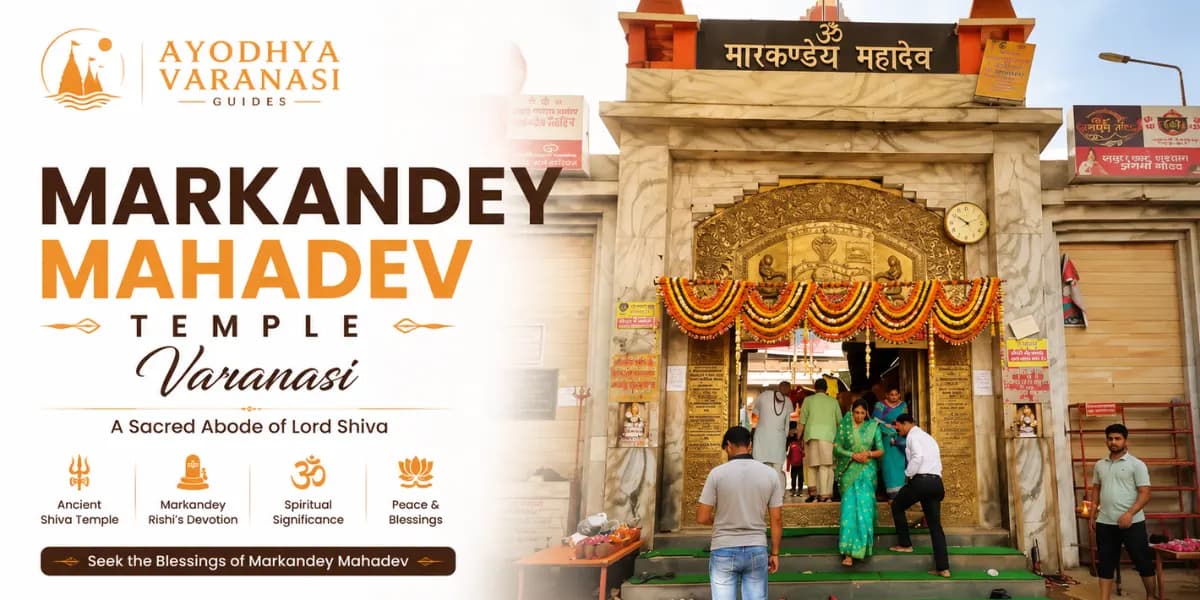
Markandey Mahadev
Kaithi · Where Death Was Conquered
4.9 / 5 · Varanasi Darshan Help
Kaithi · Kashi · Ghats
- Timings
- ~4:00 AM – 11:00 PM, daily
- Deity
- Lord Shiva as Markandey Mahadev
- Setting
- Confluence of the Ganga & Gomti
- Scriptural Source
- The Markandeya Purana
- Entry
- Free · Rudrabhishek by arrangement
- Distance
- ~30 km from Varanasi, Kaithi village
What Are the Markandey Mahadev Temple Timings?
Markandey Mahadev keeps unusually long hours for a temple outside the city — generally 4:00 AM to around 11:00 PM, without the long midday closure common elsewhere. The best darshan windows are early morning (5–7 AM) and evening (6–8 PM). Rudrabhishek is the signature ritual here and is booked through the temple priests, usually in the morning.
Early Morning (Best)
Cool, calm, ideal for abhishek
Daytime
Open through the day; hot in summer
Evening (Best)
Aarti and sunset on the sangam
Late Evening
Quiet; usually open until late
Rudrabhishek
The signature ritual at this temple
Jalabhishek
Ganga water offered on the Shivling
Evening Aarti
The most atmospheric darshan
Mondays & Sawan Mondays
The great days for Shiva darshan
Tip: if you want a Rudrabhishek, arrange it in advance — walk-in slots are scarce, and during Sawan they are nearly impossible. WhatsApp us and we will book the puja, the priest and the transport from Varanasi together.
When Is the Best Month to Visit Markandey Mahadev? (2026)
This is a Shiva temple, so the Sawan and Mahashivratri calendar matters more here than the weather. October to March is comfortable, while Sawan (July–August) turns Kaithi into one of the busiest pilgrimage sites in Purvanchal.
Mahashivratri and the Sawan Mondays are extraordinary here — locals say the crowd at Kaithi on Mahashivratri can exceed Kashi Vishwanath itself. Plan for long waits on those dates.
Why Is Markandey Mahadev the Temple Where Death Was Conquered?
What Is Markandey Mahadev Temple?
Markandey Mahadev is an ancient temple of Lord Shiva at Kaithi village, about 30 km from Varanasi, standing where the Gomti flows into the Ganga. The setting alone would make it sacred — a river confluence is always a tirtha — but its fame rests on one of the most powerful stories in Hindu tradition.
Who Was Sage Markandeya?
Markandeya was born to devout parents who were offered a choice: a gifted son who would die at sixteen, or an ordinary son with a long life. They chose the gifted child. As his sixteenth year approached, the boy — already a great devotee of Shiva — came to this spot and gave himself entirely to worship.
What Happened When Yama Came for Him?
On the appointed day Yama, the lord of death, arrived to claim him. Markandeya threw his arms around the Shivling and would not let go. When Yama cast his noose, it fell around the linga too — and Shiva appeared in fury, halting Yama and granting Markandeya deathlessness. It is from this episode that Shiva is invoked as Mrityunjaya, the conqueror of death, and the Mahamrityunjaya mantra takes its meaning.
Why Do Families Come Here for Their Children?
Because of that story, Markandey Mahadev has become the temple people visit for life itself. Parents come to pray for the long life and health of their children. Couples without children come seeking a child. Families facing serious illness come to perform Rudrabhishek and recite the Mahamrityunjaya mantra. It gives the temple a purposeful, deeply emotional atmosphere.
What Makes the Ganga–Gomti Sangam Special?
Kaithi sits at a genuine sangam — the meeting of the Ganga and the Gomti. Pilgrims bathe here before darshan, and the confluence is far quieter and more open than the ghats of Varanasi. Combining a snan at the sangam with abhishek at the temple is the traditional way to visit.
How Important Is This Temple Regionally?
Outside Varanasi it is not widely known; within Purvanchal it is enormous. It is referenced in the Markandeya Purana, and devotees of the region hold its spiritual standing very high indeed. On Mahashivratri, local accounts say the crowd at Kaithi can exceed the crowd at Kashi Vishwanath — which tells you everything about what this temple means here.
Did you know? The Mahamrityunjaya mantra, recited across the world for healing and protection, is bound up with what happened at this spot — which is why families facing serious illness travel to Kaithi specifically to have it recited here.
What Do You Do at Markandey Mahadev Temple?
There is a traditional order to a visit here, and following it makes the trip far more meaningful than simply seeing the shrine.
- 1
Drive Out to Kaithi
The journey from Varanasi takes about an hour by road. Keep your vehicle with you — local transport back is unreliable.
- 2
Take a Dip at the Sangam
Pilgrims bathe at the confluence of the Ganga and Gomti before darshan. Carry dry clothes; facilities are basic.
- 3
Buy Your Offerings
Stalls outside sell bel patra, flowers, milk and Ganga jal — the traditional offerings for a Shivling.
- 4
Join the Darshan Queue
Outside Sawan and Mahashivratri the queue moves quickly. On those days, expect a long and slow wait.
- 5
Offer Jalabhishek on the Shivling
Pour Ganga water and milk over the linga — the simplest and most direct act of worship at any Shiva temple.
- 6
Perform Rudrabhishek (If Booked)
The signature ritual here, conducted by the temple priests. It needs to be arranged in advance, especially in Sawan.
- 7
Recite the Mahamrityunjaya Mantra
Families come specifically to have this recited here, for long life and for recovery from illness.
- 8
Sit by the Confluence
Before you drive back, spend a little time where the Gomti meets the Ganga. It is open, quiet and completely unlike the ghats of Varanasi.
When Should You Visit Markandey Mahadev Temple?
It is an hour out of Varanasi, so the trip is worth planning properly around the season, the hour and the Shiva calendar.
Best Season — October to March
Comfortable weather for the drive and for time at the confluence. February brings Mahashivratri, which is spectacular but extremely crowded — go for the atmosphere, not for a quick darshan.
Best Time of Day — Early Morning
Arrive between 5 and 7 AM for the calmest darshan, the best light on the sangam and the practical window for a Rudrabhishek. Evening around 6 to 8 PM is the other good slot.
Most Special — Sawan Mondays & Mahashivratri
Sawan (July–August) is the great Shiva month and the Mondays here are extraordinary. Mahashivratri is the single biggest day of the year at Kaithi. Both mean enormous crowds and long waits.
What Can You See at Markandey Mahadev Temple?
Kaithi is a temple and a river confluence together, and both deserve your time.
The Markandey Mahadev Shivling
Top PickThe Main Darshan
The Shivling that Sage Markandeya is said to have clung to when Yama came for him — the spot where death itself was turned back.
The Ganga–Gomti Sangam
Top PickThe Confluence
The meeting of the Ganga and the Gomti beside the temple, where pilgrims bathe before darshan. Open, calm and beautiful at dawn.
Rudrabhishek at the Sanctum
The Signature Ritual
The abhishek performed by the temple priests, sought especially by families praying for health, long life and children.
The Temple Complex
Purvanchal's Great Shrine
A large, well-maintained complex that expands enormously in Sawan, when temporary arrangements handle the crowds.
The Riverside Approach
Rural Kashi
The drive out through village country and the open riverbank are a complete change of scene from the lanes of Varanasi.
Why Is Markandey Mahadev Worth the Drive From Varanasi?
An hour each way puts some visitors off. Here is what makes it worth going.
The Story of Victory Over Death
Standing where Markandeya held the linga against Yama is the reason to come — and it explains the Mahamrityunjaya mantra as no book can.
A Temple People Visit for Their Children
Parents pray here for the long life of their children and couples come seeking one. The atmosphere is unusually tender for a Shiva shrine.
A Genuine River Sangam
The Ganga meets the Gomti here — quiet, open and free of the crowds and commerce of the Varanasi ghats.
Rudrabhishek Where It Matters Most
For families facing illness, an abhishek at this particular temple carries a significance no other Shiva shrine near Varanasi does.
Is There an Entry Fee at Markandey Mahadev Temple? (2026)
Darshan is completely free — there is no entry ticket. Your real costs are transport from Varanasi and, if you want one, the Rudrabhishek. Here is a realistic guide.
The darshan is free. What we arrange is the part that is genuinely hard from outside — booking the Rudrabhishek and the priest in advance, a vehicle that waits at Kaithi, and timing that avoids the worst of the Sawan crush. All confirmed in writing before you travel.
Puja and taxi costs are indicative and vary with the ritual chosen, the season and vehicle type. Confirm the round-trip fare including waiting before you set out.
What Do Devotees Say About Markandey Mahadev Temple?
1,207 verified reviews
We have come here every Sawan for twenty years. My father had his Rudrabhishek done here when he was ill and we have never stopped coming. Very glad to see the temple written about properly at last.
Brij Mohan Rai
Ghazipur
Went on Mahashivratri — I was warned it would be crowded and it was beyond anything I imagined, bigger than what we saw at Vishwanath. Our guide had us there by 4 AM which made all the difference.
Sunita Verma
Delhi
Came for a Rudrabhishek for my son's health. The team booked the priest in advance, which I later realised is not something you can just walk in and arrange. Very peaceful at the sangam afterwards.
Krishna Kumar Singh
Patna
We nearly skipped it because of the distance. I am so glad we did not. The confluence of the Ganga and Gomti at sunrise, and the Markandeya story told there, was the most memorable morning of our Varanasi trip.
Meera Iyer
Bengaluru
Local favourite and rightly so. Do go by car — public transport out to Kaithi is a struggle and getting back in the evening is worse. Temple is open long hours which helps.
Rajesh Chaurasia
Varanasi
How Do You Fit Markandey Mahadev Into a Varanasi Trip?
Kaithi needs a half-day block. This is the day our guests find works best, with the temple in the cool of the morning.
Drive out to Kaithi. Leave Varanasi early — about an hour on the road, arriving before the heat and the crowds.
Snan at the Ganga–Gomti sangam. Take a dip at the confluence before darshan, as tradition asks.
Darshan & Rudrabhishek. Jalabhishek on the Shivling, and the Rudrabhishek if you have booked one, in the calmest hours of the day.
Return to Varanasi. Back to the city for breakfast with the whole morning still ahead of you.
Kashi Vishwanath darshan. Darshan of the Jyotirlinga. We assist with VIP darshan to save you the queue.
Kal Bhairav & Batuk Bhairav. Bhairav darshan, which tradition says completes a Kashi yatra.
Ganga Aarti at Dashashwamedh Ghat. Close the day with the great evening aarti on the riverfront.
Which Tour Package Covers Markandey Mahadev?
Markandey Mahadev is best seen as part of a planned Kashi darshan rather than a single stop — the old-city temples keep different hours and the ghats reward proper sequencing. These are the itineraries our guests book most, each with Kashi Vishwanath VIP darshan assistance, a certified local guide and transport, priced in writing before you travel.
- 1 Day1 Day Varanasi Tour PackageKashi Vishwanath darshan, a sunrise boat ride and the evening Ganga Aarti.
- 2 Days2 Days Varanasi Tour PackageKashi Vishwanath, the ghats, Sarnath and the old-city temple circuit.
- 3 Days3 Days Varanasi Tour PackageKashi at a proper pace — the Dham, the Bhairavs, the Durgakund cluster and the aarti.
- 4 Days4 Days Varanasi Tour PackageEverything in Kashi plus Sarnath, with time for the temples most itineraries skip.
- 2 Days2 Days Ayodhya Varanasi Tour PackageRam Mandir and Kashi Vishwanath across two cities, with the Ganga Aarti.
- 3 Days3 Days Ayodhya Varanasi Tour PackageThe classic pairing — Ram Mandir, Kashi Vishwanath and the ghats.
- 3 Days3 Days Varanasi Prayagraj Tour PackageKashi and the confluence, with time for the ghats and the Sangam boat ride.
- 4 Days4 Days Ayodhya Varanasi Prayagraj Tour PackageAll three cities — Ram Mandir, Kashi Vishwanath and the Triveni Sangam.
- 5 Days5 Days Ayodhya Varanasi Prayagraj Tour PackageThe complete sacred circuit at a comfortable, senior-friendly pace.
Want Markandey Mahadev built into a custom itinerary? We plan around your dates, your pace and what you actually want to see.
See all Varanasi & Ayodhya tour packagesHow Do You Reach Markandey Mahadev Temple From Varanasi?
Markandey Mahadev is at Kaithi village, roughly 30 km from Varanasi, at the Ganga–Gomti confluence. There is no station at the temple, so plan on road transport.
By Road / Taxi
The practical option. A taxi from Varanasi takes about an hour each way. Book the round trip with waiting — return transport from Kaithi is unreliable, especially after dark.
By Train
Varanasi Junction (Cantt) is about 30 km away and is the nearest major railhead, well connected to Delhi, Lucknow, Prayagraj and Ayodhya. Take a taxi onward.
By Air
Lal Bahadur Shastri International Airport, Babatpur is roughly 45 km away. Allow around 90 minutes to Kaithi by taxi.
During Sawan
Traffic diversions and kanwar processions apply on the Sawan Mondays and on Mahashivratri. Leave far earlier than you think you need to.
Where Exactly Is Markandey Mahadev Temple?
Markandey Mahadev Temple stands at Kaithi, about 30 km from Varanasi, where the Gomti flows into the Ganga. Use the map below for door-to-door directions.
Kaithi, Varanasi
- Area: Kaithi village, at the Ganga–Gomti sangam
- PIN: Varanasi 221116
- From Varanasi city: ~30 km (about an hour)
- From Sarnath: ~25 km
- Best for: Rudrabhishek, Sawan darshan & the sangam
Where Should You Stay to Visit Markandey Mahadev?
Kaithi is a half-day trip rather than an overnight stop — accommodation at the temple itself is very limited. Stay in Varanasi and drive out early.
Cantt & Sigra
Branded and business hotels near the railway station with parking, and the easiest starting point for an early departure to Kaithi.
Assi Ghat & Ravidas Gate
The calmer end of the ghats, popular with longer-staying visitors, with cafés and easy boat access.
Godowlia & Dashashwamedh
Right in the heart of Kashi, walking distance from Kashi Vishwanath and the evening Ganga Aarti, though traffic makes early departures slower.
What Else Can You Visit Around Markandey Mahadev?
Kaithi pairs naturally with the Varanasi temple circuit — most guests do the temple at dawn and the city afterwards.
Kashi Vishwanath Temple
The Jyotirlinga of Kashi, ~30 km away. We assist with VIP darshan to skip the main queue.
Kashi Vishwanath VIP Darshan
Skip-the-queue Sugam darshan assistance at Shri Kashi Vishwanath Dham, arranged in advance.
Ganga Aarti, Dashashwamedh Ghat
The world-famous evening aarti on the Varanasi riverfront.
Batuk Bhairav Temple
The shrine of Bhairav in his child form at Kamachha, famed for its centuries-old eternal lamp.
Mrityunjay Mahadev Temple
The other great temple of victory over death, in the city at Daranagar, with the Dhanvantari healing well.
How to Commute in Varanasi
Autos, e-rickshaws, boats and taxis — how to get around the city and out to sites like Kaithi.
Sawan & Mahashivratri at Markandey Mahadev
Through the month of Sawan, and especially on the Sawan Mondays, Kaithi becomes one of the busiest pilgrimage sites in Purvanchal. Kanwariyas carry Ganga water for miles to offer here, and the queues stretch far beyond the temple complex.
Mahashivratri is the single greatest day of the year at Markandey Mahadev — local accounts say the crowd at Kaithi can exceed that at Kashi Vishwanath itself. If you plan to come on these dates, start before dawn, arrange transport well in advance, and be prepared for a long, slow and unforgettable darshan.
What Should You Know Before Visiting Markandey Mahadev?
The temple is straightforward — the distance and the Sawan crowds are where trips go wrong.
Book a taxi that waits
Kaithi is 30 km out and return transport is unreliable, particularly in the evening. Hire the vehicle for the round trip including waiting time.
Book any Rudrabhishek in advance
This is the signature ritual here and walk-in slots are scarce. During Sawan they are effectively impossible without prior arrangement.
Go early in the morning
Arriving between 5 and 7 AM gives you the calmest darshan, the best light at the sangam and the practical window for an abhishek.
Sawan and Mahashivratri mean hours, not minutes
On those dates the queue extends far outside the complex. Start before dawn and treat it as a full day, not a stop.
Carry dry clothes if you plan a snan
Pilgrims bathe at the confluence before darshan. Changing facilities are basic, so come prepared.
Buy puja samagri at the temple stalls
Bel patra, flowers, milk and Ganga jal are all available outside. There is no need to carry them from Varanasi.
Check the road during the monsoon
The rivers run high in July and August and the approach can be affected. Ask before setting out in heavy rain.
There is little at Kaithi besides the temple
Carry water and snacks, especially if you are travelling with children or elderly family members.
Allow four to five hours in total
About an hour each way plus two hours or more on site. It does not compress into a quick detour.
Ask for the Markandeya story at the shrine
Hearing how Yama's noose fell around the linga, told standing in front of it, is the whole point of coming this far.
Markandey Mahadev Temple — Frequently Asked Questions
The questions devotees ask us most about Markandey Mahadev at Kaithi — the Markandeya legend, timings, distance, Rudrabhishek and Sawan crowds.
Markandey Mahadev is an ancient temple of Lord Shiva at Kaithi, about 30 km from Varanasi, standing at the confluence of the Ganga and the Gomti. It marks the spot where Sage Markandeya is said to have conquered death by clinging to the Shivling when Yama came for him.
Still have a question?
Our local team replies within 30 minutes.
Written & verified by the local Varanasi guide team at Ayodhya Varanasi Guides
Our government-certified guides take devotees out to Kaithi through the year, including on the Sawan Mondays and Mahashivratri when the crowds are at their peak, and arrange Rudrabhishek with the temple priests. Last updated: July 2026. Puja slots and road conditions change with the season — message us for the position on your travel date.
Pray for Long Life and Health at Markandey Mahadev
Let Ayodhya Varanasi Guides plan your visit — a dawn darshan and snan at the Ganga–Gomti sangam, a Rudrabhishek booked in advance with the temple priests, and the full Kashi circuit afterwards with Kashi Vishwanath VIP darshan assistance and the evening Ganga Aarti. Confirmed in writing.