Buddhist Pilgrimage Guide for Thai Devotees Visiting India
Amit Deshwal
26 August 2026
Ready for your Ayodhya Varanasi Yatra?
Let us design the perfect pilgrimage package for you.
A Buddhist Pilgrimage Guide for Thai Devotees Visiting India should start with the four most sacred places associated with Lord Buddha’s life — Bodhgaya, Sarnath, Kushinagar and Lumbini in Nepal. For Thai devotees, it is important to plan the pilgrimage as a connected Buddhist Circuit with sufficient time spent at each site and suitable transport/ accommodation for the group. I am Amit deshwal from Ayodhya Varanasi Guides and have seen how an effective route planning can benefit the pilgrims who visit these sites in Bihar and Uttar Pradesh.
This guide covers where to go and how to get there as well as the best time to visit and what to do before arriving in India. I will talk about practical aspects of a Buddhist Circuit because itineraries should be tailored to the needs of families, elderly visitors and groups of pilgrims who explore several destinations. The Government of India continues to develop the Buddhist Circuit and sees Southeast Asia, including Thailand, as an emerging market for Buddhist tourism.
Why Do Thai Devotees Travel to India for a Buddhist Pilgrimage?
Thai devotees visit India because it is where most events in the life of Gautama Buddha took place. By visiting them, it is possible to follow his path from enlightenment to the first sermon and Mahaparinirvana. In addition, Thai visitors have a powerful religious motivation to learn more about the places connected to the history of Buddhism, including its birth in Nepal.
The Four Sacred Sites
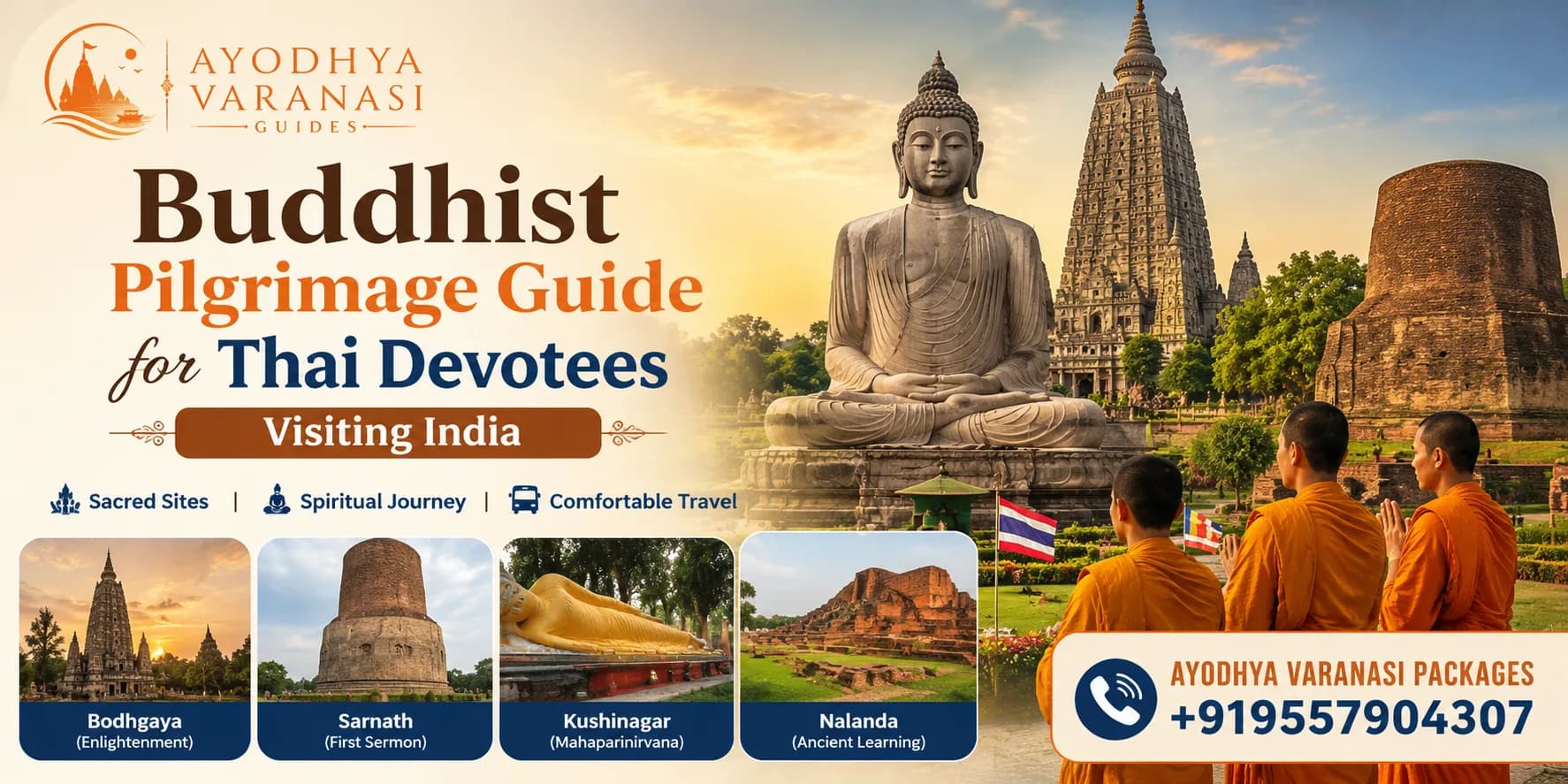
Bodhgaya is where Buddha attained enlightenment; Sarnath is where he delivered the first sermon, while Kushinagar is associated with his Mahaparinirvana. The Indian government’s Buddhist tourism guide also includes Rajgir, Nalanda, Vaishali, and Shravasti as important destinations connected to the life of Gautama Buddha. All of these sites should be viewed as a unified whole as a circuit-based pilgrimage that also respects the time spent in between traveling from one place to another.
Why Route Planning Matters
Each of the four sacred sites is located in a different city or state. For example, Bodhgaya is in Bihar, while Sarnath and Kushinagar are in Uttar Pradesh. This is why I advise my clients to plan their trips meticulously and decide in advance which hotels to choose. This is especially important when traveling with elderly people or groups of devotees who need extra time at each site for meditation and prayer.
In short, a circuit-based pilgrimage to India makes the most sense when it is centered around the four most important sites. At the same time, the route should ensure that the time spent in between is not wasted on unproductive travel.
Which Buddhist Pilgrimage Places Should Thai Devotees Visit in India?
As a first-time visitor, I would advise to plan a circuit-based pilgrimage around Bodhgaya, including a stop in Rajgir and Nalanda, followed by a visit to Sarnath and Kushinagar. If there is extra time, it would also be great to include Vaishali, Shravasti, and Lumbini in Nepal. This way, there would be enough time to spend in each place, including a few days in Bodhgaya to truly appreciate the local culture and history.
Bodhgaya – The Place of Enlightenment
Bodhgaya is the starting point of any Buddhist pilgrimage because it is where Gautama Buddha attained enlightenment. The Mahabodhi Temple Complex is one of the most famous and visited monasteries in the world that is recognized by UNESCO. Thai visitors should spend more than one day in Bodhgaya because it is a place where one can slow down and truly appreciate the scenery and history.
Sarnath – Where Buddha Gave His First Sermon
Sarnath Guide is a short drive away from Varanasi and is where Gautama Buddha gave his first sermon. Its most notable monument is the Dhamek Stupa, while other religious buildings also contribute to the local scenery. I advise my clients to spend as much time as possible in Sarnath because it helps to grasp the historical context of this significant event in the life of Buddha. At the same time, it is better not to rush back to Varanasi after arriving at this ancient city.
Kushinagar – The Place of Mahaparinirvana
Kushinagar is associated with the Mahaparinirvana of Gautama Buddha, which means his final death. The most famous local monument is the Mahaparinirvana Temple, while other religious buildings also dot the local landscape. Devotees from Thailand and other countries visit Kushinagar all year round. In fact, I find this place even more remarkable than Bodhgaya or Sarnath, which is why a pilgrimage should give enough time to explore this city.
Rajgir and Nalanda – Buddhist Learning and Teaching
Rajgir is linked to the spread of Buddhism as well as the life and teachings of Gautama Buddha. Together with Nalanda, this ruined fortress and ancient city have become popular with Buddhist pilgrims. This area is best explored from Bodhgaya, which is why a circuit-based route makes the most sense when visiting these cities. The government publication on Buddhist tourism also contains information on Rajgir, Nalanda, Sarnath, and Kushinagar as major centers associated with the life of Buddha.
Key takeaway: When exploring the major Buddhist pilgrimage sites, visitors should adopt a circuit-based approach that includes the four most important destinations. For Thai devotees, a trip to Bodhgaya, Sarnath, and Kushinagar should also involve a stop in Rajgir, Nalanda, and other places associated with the life of Gautama Buddha.
How Can Thai Devotees Plan the Best Buddhist Circuit Tour in India?
The best Buddhist Circuit tour follows a logical route that minimizes the time spent on the road. In my experience, it is best to advise my clients on this aspect in accordance with their arrival city, the number of days, and their general preferences. In a shorter version of this pilgrimage (around 7-8 days), I recommend to visit the four major sites of Bodhgaya, Sarnath, Kushinagar, and Rajgir. If there is more time (around 14-15 days), the Circuit can also include Nalanda, Vaishali, Shravasti, and Lumbini.
A Practical Buddhist Circuit Route
A recommended route for a circuit-based tour would be Bodhgaya, Rajgir, Nalanda, Varanasi, and Sarnath guide, followed by Kushinagar and other destinations if there is time. Government guides also mention a Sacred Circuit, which covers Gaya, Varanasi, Kushinagar, Kapilvastu, and other places with a longer itinerary also including Rajgir and Nalanda.
A Buddhist Circuit Tour for Thai Pilgrims with Thai Guide can be great for groups of visitors who seek a comprehensive understanding without language barriers.
How Many Days Should the Pilgrimage Take?
I recommend to spend at least 7-8 days on this kind of circuit-based tour, while a longer version (around 10-14 days) would also include other stops beyond the four major sites. The number of days directly affects the level of comfort, while the time spent in each place determines the quality of the experience.
In this regard, I advise my clients not to choose a longer version of this pilgrimage simply because it covers more places. Especially for elderly visitors, it is important to leave enough time for resting in between.
When Is the Best Time for Thai Buddhists to Visit India?
I advise my clients, including Thai devotees, to plan their visit to India between October and March. This way, they can avoid the extreme heat of summer and summer downpours. Naturally, the best time to visit India is a subjective question that depends on many factors.
Season | Travel Conditions | My Recommendation |
|---|---|---|
October–March | Cooler and generally comfortable | Best for most pilgrims |
April–June | Hot, especially during daytime | Suitable with careful planning |
July–September | Rainy and humid in many regions | Travel with flexibility |
In addition, winter months tend to be crowded at popular destinations, including major Buddhist sites. In this regard, I also advise my clients to book hotels and other services in advance.
Moreover, morning and evening temperatures across India tend to be lower than those during the day, which is especially relevant for Bihar and Uttar Pradesh. This is why I recommend to pack warm clothes even when visiting India during autumn and spring.
In short, the best time for a Buddhist pilgrimage to India is between October and March. Other months are more challenging in terms of weather conditions, which is why a circuit-based tour should be planned with this in mind.
What Travel Documents and Visa Requirements Should Thai Devotees Prepare?
Thai visitors should ensure their passports meet the entry requirements before making any non-refundable payments or finalizing the trip. At the same time, these regulations may change, which is why I always advise my clients to double-check the latest information with the relevant authorities. In particular, I discourage from relying on unofficial social media accounts.
Passport and Visa Preparation
When traveling abroad, it is essential to keep digital and paper copies of passports, visas, hotel bookings, and other documents. Thai group leaders should also have a list of emergency contacts as well as the addresses of the hotels booked for their followers. When visiting Nepal, it is also important to remember that it is a separate country, so transportation between Kathmandu and Indian destinations should also be planned accordingly.
Currency and Everyday Arrangements
It is a good idea to have some local currency for everyday expenses, even if digital payments are widely used in India. At the same time, I advise my clients to organize access to local mobile networks as soon as possible after arriving in the country.
Key takeaway: Before traveling to India, I always advise my clients and visitors to double-check their documents against the official regulations. In particular, it is essential to follow the latest guidelines provided by the relevant authorities.
How Do Thai Pilgrims Travel Between Buddhist Sites in India?
Thai devotees have several transportation options, including domestic flights, trains, and private vehicles. In particular, a private car is the best way to get around when visiting India with a family or a large group of pilgrims. With that said, trains can be a good option for specific routes, while domestic flights are ideal for longer distances with limited time.
Domestic Flights for Longer Distances
Flights are a good value for pilgrims who want to optimize their time, especially when they have limited time for a circuit-based tour. They also make sense when visiting multiple destinations located far from each other.
However, it is important to remember that extra time may be needed to get to the airport, especially when traveling with older people or many relatives. This is why flights are not always a viable option for families with children or elderly members.
Train Travel Through IRCTC
Indian Railways is a great way to travel between major destinations. In particular, there is a Buddhist Circuit Tourist train that covers many popular sites, including Bodhgaya, Rajgir, Nalanda, Vaishali, Shravasti, Sarnath, and Kushinagar. ([Incredible India][6])
It is possible to buy tickets online or at the station, but I still advise my clients to carefully research this type of transportation in advance.
Private Vehicles for Flexibility
When visiting India with family or a large group of devotees, I recommend to rent a private vehicle. It provides the best value for money in terms of flexibility, including the opportunity to stop anywhere for food or rest.
Transport | Best For | Main Advantage |
|---|---|---|
Domestic Flight | Limited travel time | Faster over long distances |
Train | Selected city-to-city routes | Comfortable scheduled travel |
Private Vehicle | Families and groups | Flexible stops and timing |
In my experience, it often makes the most sense to choose the type of transportation in accordance with the needs of the family or the group of pilgrims. For example, elderly visitors often benefit from a slower pace that a private vehicle can provide.
Where Can Thai Devotees Find Buddhist Communities and Comfortable Stays?
I recommend to visit the major pilgrimage sites with a hotel near or inside the city. In particular, Bodhgaya has many monasteries and is generally one of the most international places on the Buddhist pilgrimage route, with communities of monks from many countries. Sarnath and Kushinagar also have their own monasteries and accommodation options. When choosing a hotel, I advise my clients to prioritize convenience and value for money.
Staying Close to Major Pilgrimage Areas
In some cases, it may make more sense to choose a hotel closer to major attractions rather than right next to them. For example, this way, monks and devotees will have enough time to explore the local temple complex and return to the hotel for lunch and rest. This is especially true for Bodhgaya, which is why I also recommend spending more than one day in this place.
Respecting Temple Customs
Rules and etiquette vary from temple to temple, which is why visitors should always dress modestly. It is best to ask for permission before taking photos inside religious buildings and follow local rules. In some places, shoes may need to be taken off before entering certain areas, which is why it is a good idea to research this in advance. I also recommend to follow local guidelines rather than relying on what one may know about temples in Thailand.
In short, when staying in hotels during a Buddhist pilgrimage, it is best to choose value for money and convenience. At the same time, it is essential to respect different customs that apply to various monasteries and temples.
What Should Thai Devotees Know About Food, Weather and Local Customs?
India is famous for its vegetarian food, which is often spicier than what one can find elsewhere, including in Thailand. I advise my clients to specify their dietary preferences when making restaurant reservations, especially for larger groups of visitors. At the same time, I recommend to bring or buy bottled water for pilgrims who will be spending a lot of time on the road.
Clothing for Temples and Different Seasons
I advise my clients to bring clothes suitable for visiting temples, where visitors may have to sit for long periods of time. In addition, the weather in India varies greatly depending on the season, which is why it is important to pack warm clothes for winter evenings. Even in a country with a hot climate, I recommend to bring comfortable shoes for exploring temples, although they may need to be taken off in special areas.
Understanding Local Travel Conditions
I also advise my clients to understand local conditions, including the fact that the roads in India can often be quite challenging. In particular, I never recommend to plan trips in such a way that one has to leave one city for another directly after arriving at the former. This way, there will be enough time to explore the city and have lunch before heading to the next destination.
On the other hand, a circuit-based tour often requires more time on the road, which is why I also recommend to take regular breaks. In this regard, it is always helpful to know average distances between destinations to have realistic expectations about the time spent on the road.
Key takeaway: When visiting India, I recommend to consider local conditions rather than simply following a list of places to see. In particular, it is a good idea to bring comfortable and warm clothes for visiting temples and spending time outdoors during the day.
How Can I Plan a Comfortable Pilgrimage for Elderly Thai Devotees?
When organizing a Buddhist pilgrimage for elderly devotees, I recommend to minimize the number of hotels to be visited and optimize the time spent on the road. In particular, I advise my clients to leave more time for rest and plan their itinerary in accordance with their physical capabilities. In addition, it is important to remember that some sites require walking over long distances, while others offer more comfort.
Build Rest Time Into the Itinerary
I advise my clients not to leave too little time between one site and another. Particularly for older visitors, it is essential to have rest time, including an opportunity to sit and have lunch. This way, they can also have a break from the daytime heat in line with local weather conditions. I also recommend to leave more time for returning to hotels rather than leaving them.
Choose the Right Travel Pace
When organizing a circuit-based tour, I advise my clients to leave enough time for visits to each site. In many ways, it will depend on how many stops are planned, as well as how much time will be spent at each of them. As mentioned earlier, a longer version of the pilgrimage (up to 14-15 days) is more comfortable for elderly visitors.
Practical advice: When it comes to elderly devotees, I recommend to focus on a greater level of comfort, including a slower pace. In particular, I find that a circuit-based tour with enough time at each destination is perfect for this category of visitors.
Why Should Thai Devotees Consider a Local Guide for Their Buddhist Pilgrimage?
A local guide can help the pilgrims to appreciate each stop on the circuit-based tour. They can also provide practical advice on the best way to reach various destinations in terms of time and comfort. When a group of visitors needs to be accommodated across several hotels, local assistance can help them to optimize the route. I recommend to consider a Buddhist Circuit Tour for Thai Pilgrims with Thai Guide when language support is needed for a successful and memorable trip.
Thai devotees represent a growing market for India’s Buddhist tourism industry. In particular, the government has invested in developing language-specific resources to facilitate the experience of visitors from countries such as Thailand.
In my experience at Ayodhya Varanasi Guides, I find that local support makes the most difference when it comes to a multi-city circuit-based tour. It helps the pilgrims to fully concentrate on the spiritual aspects of their journey. I always recommend to choose between a local guide and support team accordingly.
At the same time, local help can be especially valuable around Sarnath and Varanasi, where my clients often need assistance with transport and other arrangements. In particular, I always recommend to plan the time spent in this area in detail.
Key takeaway: When organizing a circuit-based Buddhist pilgrimage, I recommend to consider local support as an option. In particular, a local guide and staff may be helpful for a multi-city tour that spans many destinations.
Conclusion: Planning Your Buddhist Pilgrimage from Thailand to India
A Buddhist Pilgrimage Guide for Thai Devotees Visiting India begins with a choice of sites following which a logical route is created. I recommend to plan a circuit-based tour that covers at least Bodhgaya, Sarnath, and Kushinagar, while also considering extra days that can be spent in Rajgir, Nalanda, Vaishali, Shravasti, or Lumbini. In addition to choosing the best time for a trip, it is also essential to pay attention to transport and general comfort.
I am and, with our Ayodhya Varanasi tour packages, I recommend planning the journey in accordance with the needs of the visitors, rather than aiming to visit as many places as possible within a short period of time. A Buddhist Circuit Tour for Thai Pilgrims with Thai Guide can also be beneficial in this regard, especially for those who want to receive support during their tour of India’s most sacred sites. Ultimately, the pilgrimage should be focused on the goal, with practical aspects tailored to the needs of the visitors.
Book now
Contact Ayodhya Varanasi Guides today for your booking.
Website: www.ayodhyavaranasiguide.com
We are always ready to make your Ayodhya journey comfortable, spiritual, and memorable.