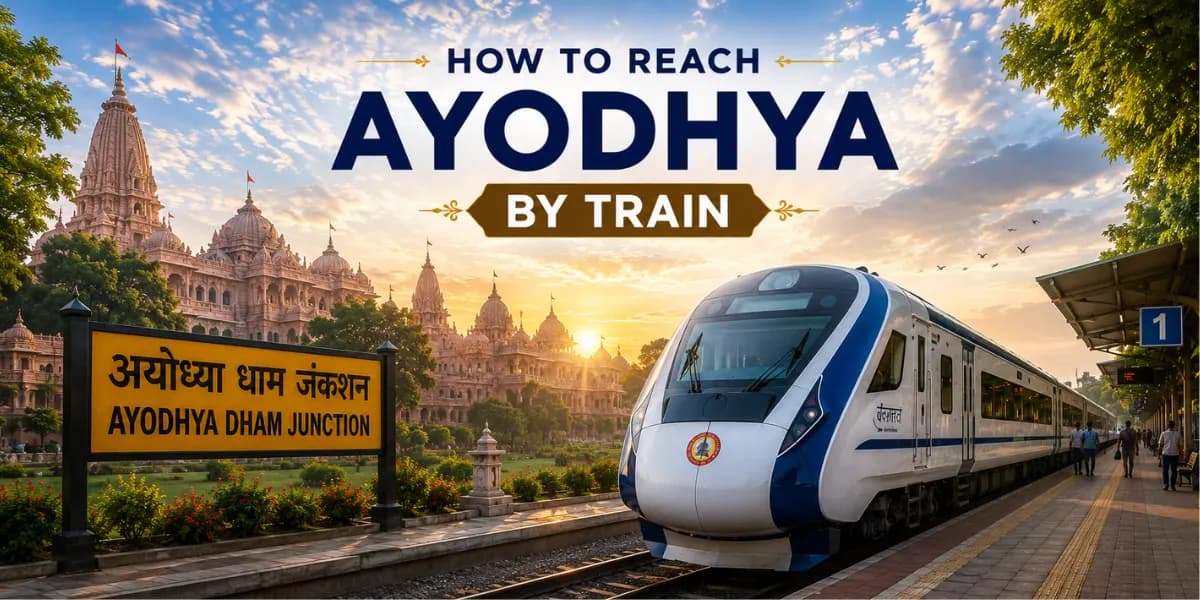
How to Reach Ayodhya by Train: Routes, Railway Stations, Timings & Booking Guide
PV SRINIVAS
16 July 2026
Ready for your Ayodhya Varanasi Yatra?
Let us design the perfect pilgrimage package for you.
Ayodhya Dham Junction (station code AY) is the nearest major railway station for visiting Ram Mandir, about 1.2–2 km from the temple complex. Direct trains connect Ayodhya with Delhi, Lucknow, Kanpur, Mumbai, Kolkata, Ahmedabad, Jaipur, Varanasi, and Bengaluru, with the Vande Bharat Express as the fastest option from Delhi. Train tickets are booked through the official IRCTC website or app, and autos, e-rickshaws, and taxis are available outside the station for the final stretch to Ram Mandir. Note that some long-distance trains, including the Vande Bharat and Ayodhya Express from Delhi, actually terminate at the farther Ayodhya Cantt station, so always confirm your specific train's arrival station before booking.
I'm PV Srinivas from Ayodhya Varanasi Guide. I've checked this against the official railway sources so you're planning your train journey to Ayodhya on accurate, current information rather than guesswork.
Ayodhya by Train: At a Glance
Information | Details |
|---|---|
Nearest station to Ram Mandir | Ayodhya Dham Junction |
Station code | AY |
Old station name | Ayodhya Junction |
Secondary station | Ayodhya Cantt (AYC), formerly Faizabad Junction |
Distance to Ram Mandir | About 1.2–2 km from Ayodhya Dham Junction |
Booking window | 120 days (Advance Reservation Period) |
Best local transport | Auto-rickshaw, e-rickshaw, taxi |
Booking platform | IRCTC |
Best season | October–March |
What Should You Know Before Travelling to Ayodhya by Train?
Confirm your train's exact arrival station, book within the 120-day IRCTC window, carry a government photo ID matching your booking, and plan for security checks near the temple that don't allow electronics or large bags.
Two stations serve the city — Ayodhya Dham Junction (AY), closest to Ram Mandir, and Ayodhya Cantt (AYC), farther out but used by several long-distance trains, including the Delhi Vande Bharat. Tickets open 120 days before departure; Tatkal opens at 10:00 AM for AC classes and 11:00 AM for Non-AC, one day before travel. Carry a valid government photo ID matching your IRCTC profile — it's checked at both the reservation counter and temple security. Use the free 24/7 cloak room at Platform 1 if you're heading straight to darshan, since bags aren't allowed inside Ram Mandir. Booking gets tight around Ram Navami and Deepotsav, so confirm your platform and arrival station on NTES a day or two before you travel.
Why Reach Ayodhya by Train?
Train travel is the most practical and budget-friendly way to reach Ayodhya, since it drops you within a few kilometres of the temple zone and offers every class from Sleeper to AC on the same route. It also saves the airport-transfer time you'd otherwise add by flying into Maharishi Valmiki International Airport and taking a cab. Senior citizens benefit from fewer vehicle changes, families get room for luggage, and budget travellers can pick Sleeper class while still landing close to the main temples. Once you arrive, our Ayodhya Varanasi Taxi Services page covers pre-arranged station pickups, so you're not negotiating a fare after a long journey.
Which Railway Station Is Best for Ayodhya?
Ayodhya Dham Junction (AY) is the station to book whenever it's offered on your route, since it's the newly redeveloped, temple-style terminal closest to Ram Mandir, while Ayodhya Cantt (AYC) sits considerably farther out.
Ayodhya Dham Junction (AY) is the primary arrival point for pilgrims, redeveloped with a temple-inspired facade under the Amrit Bharat Station Scheme, roughly 1.2–2 km from Ram Mandir — choose it first whenever it appears as an arrival option.
Ayodhya Cantt (AYC), earlier known as Faizabad Junction, sits well outside the temple zone. Several long-distance trains, including the Anand Vihar Vande Bharat and the Ayodhya Express, terminate here rather than at the main terminal, so budget extra time for the longer local transfer.
Station | Code | Distance from Ram Mandir | Best For |
|---|---|---|---|
Ayodhya Dham Junction | AY | About 1.2–2 km | Most pilgrims, Kaifiyat Express, and other trains that terminate here |
Ayodhya Cantt (formerly Faizabad Junction) | AYC | Several km farther — confirm local fare with your driver | Vande Bharat Express, Ayodhya Express, and other trains that terminate here |
How to Reach Ayodhya by Train from Major Cities?
Delhi, Lucknow, and Kanpur have the most frequent daily trains to Ayodhya, while Mumbai, Ahmedabad, Jaipur, Kolkata, and Bengaluru are generally served by weekly or a few-times-a-week trains. The Vande Bharat (22426) departs Anand Vihar at 06:10 and terminates at Ayodhya Cantt, running six days a week except Wednesday. The Ayodhya Express (14206) runs daily overnight from Old Delhi, also ending at Ayodhya Cantt, while the Kaifiyaat Express (12226) is one of the few Delhi trains that actually stop at Ayodhya Dham Junction. For the weekly services out of Mumbai, Ahmedabad, Jaipur, Kolkata, and Bengaluru, confirm the exact running days and duration on NTES, since multi-day journeys aren't fully captured by clock times alone.
City | Train (No.) | Departure | Arrival Station | Duration | Frequency |
|---|---|---|---|---|---|
Delhi (Anand Vihar) | Vande Bharat Exp (22426) | 06:10 | Ayodhya Cantt (AYC) | 8h 20m | 6 days/wk, except Wed |
Delhi (Old Delhi) | Ayodhya Express (14206) | 18:20 | Ayodhya Cantt (AYC) | 12h | Daily |
Delhi (Old Delhi) | Kaifiyaat Express (12226) | 20:25 | Ayodhya Dham Jn (AY) | 10h 28m | Daily |
Lucknow | Multiple daily trains | Varies | Ayodhya Dham Jn (AY) | 2–3 hrs | Daily |
Kanpur | CPR FBD Express (15083) | 00:40 | Confirm on NTES | ~6–7 hrs | Daily |
Prayagraj | Multiple trains | Varies | Confirm on NTES | 3–4 hrs | Daily/weekly |
Varanasi | Multiple trains | Varies | Confirm on NTES | 4–6 hrs | Daily/weekly |
Mumbai (LTT) | LTT Ayodhya SF Exp (22103) | Weekly | Confirm on NTES | ~24–26 hrs | Weekly |
Ahmedabad | Adi Ayodhya SF Exp (12833) | Weekly | Confirm on NTES | ~20–22 hrs | Weekly |
Jaipur | Marudhar Express (14854) | Weekly | Confirm on NTES | ~14–16 hrs | Mon, Thu, Sat |
Kolkata (Howrah) | Doon Express (13009) | 20:25 | Confirm on NTES | ~18–20 hrs | Daily |
Bengaluru (Yesvantpur) | YPR AYC SF Exp (22683) | Weekly | Ayodhya Cantt (AYC) | ~38–40 hrs | Weekly |
Railway Route to Ayodhya
Trains from Delhi generally run via Kanpur and Lucknow into Ayodhya. Trains from Mumbai and other western and southern cities join the Uttar Pradesh rail network further south before turning north toward Ayodhya, while Kolkata trains travel west through Bihar into eastern Uttar Pradesh. Lucknow sits directly on the Lucknow–Ayodhya–Varanasi line, which is why it has the shortest, most frequent connections of any major city. Exact routing varies by train, so it's worth checking NTES rather than assuming a fixed corridor.
How Much Does It Cost to Reach Ayodhya by Train?
Fares from Delhi start at roughly ₹500 in Sleeper and rise to about ₹2,900 for Vande Bharat Executive Chair Car, with other cities scaling by distance. The confirmed Vande Bharat fare from Ayodhya to Delhi is about ₹1,570 (AC Chair Car) and ₹2,915 (Executive Chair Car) in the general quota. The figures below are approximate distance-based bands — always confirm the exact fare for your date and quota on IRCTC.
City | Sleeper (SL) | 3AC | 2AC | Chair Car/EC |
|---|---|---|---|---|
Delhi | ₹450–550 | ₹1,150–1,350 | ₹1,650–1,950 | ₹1,570–2,915 (confirmed) |
Lucknow | ₹145–175 | ₹500–555 | ₹710–760 | ₹265–300 |
Mumbai | ₹650–800 | ₹1,700–2,000 | ₹2,400–2,800 | Confirm on IRCTC |
Kolkata | ₹550–700 | ₹1,450–1,700 | ₹2,050–2,400 | Confirm on IRCTC |
Bengaluru | ₹750–900 | ₹1,950–2,300 | ₹2,750–3,200 | Confirm on IRCTC |
Distance from Ayodhya Railway Station to Ram Mandir and Other Temples
From Ayodhya Dham Junction, all major temples fall within about 1.2 to 2.8 km — reachable by auto or taxi in under 15 minutes.
Destination | Distance | Walking Time | Auto-Rickshaw | Taxi/Cab |
|---|---|---|---|---|
Ram Mandir | 1.2–2 km | 15–25 min | 6–10 min | 5–8 min |
Hanuman Garhi | 1.2 km | 15–18 min | 5–7 min | 4–6 min |
Kanak Bhawan | 1.6 km | 20–22 min | 6–8 min | 5–7 min |
Dashrath Mahal | 1.4 km | 16–20 min | 5–7 min | 4–6 min |
Ram Ki Paidi | 2.5 km | 30–35 min | 10–12 min | 8–10 min |
Saryu Ghat | 2.8 km | 35–40 min | 12–15 min | 10–12 min |
How to Reach Ram Mandir from Ayodhya Railway Station?
E-rickshaws and auto-rickshaws are the backbone of local transport from the station, with fixed fares of roughly ₹20–50 shared and ₹100–200 for a private ride. App-based aggregators have limited availability near the station, though local e-rickshaw stands are well organised, and UPSRTC electric buses shuttle to the main bus terminal and outer parking lots. Private vehicles are restricted along Ram Path, Bhakti Path, and Janmabhoomi Path during peak hours, so you'll park at a designated hub and switch to an e-rickshaw or walk. Our taxi team can also arrange a pre-fixed station pickup if you'd rather skip the fare negotiation after a long journey.
How to Book Train Tickets for Ayodhya?
Book directly through the official IRCTC portal or app, using a profile that matches your government ID, up to 120 days before departure.
- Log into IRCTC using only the official Next Generation website or app, with your profile matching a government-issued ID.
- Enter your journey details and confirm whether your train's destination is Ayodhya Dham Junction (AY) or Ayodhya Cantt (AYC) — the Advance Reservation Period runs 120 days before departure.
- Choose your quota. Tatkal opens daily at 10:00 AM for AC classes (1A, 2A, 3A, CC) and 11:00 AM for Non-AC classes (SL, 2S).
- Check cancellation terms on IRCTC before you cancel, since fees and Tatkal refund rules are periodically revised by Indian Railways.
What Facilities Are Available at Ayodhya Dham Junction?
The station has been upgraded with lifts, escalators, AC waiting halls, a food court, free lockers, and wheelchair assistance.| Facility | Details ||---|---|| Mobility | Lifts and escalators; free wheelchairs at the assistance desk near Gate 1 || Waiting areas | AC waiting halls by class, executive lounges, infant feeding room || Baggage & security | 24/7 cloak room at Platform 1; luggage scanners; RPF monitoring || Stay options | Retiring rooms and a pod-hotel style accommodation block || Conveniences | Food court, ATMs, UP Tourism Help Desk || Parking | Multi-tier parking outside the main terminal |
What Is the Best Time to Travel to Ayodhya by Train?
October to March offers the most comfortable weather for train travel and temple queues in Ayodhya. Winter, November to February, is the best balance of weather and ambience, and March is very good too, with slightly fewer crowds. Summer, April to June, runs 38–45°C, so travel only if necessary, and monsoon, July to September, brings heavy rain that can disrupt movement near open ghat areas. Peak crowding hits during Ram Navami and Deepotsav, and mid-week arrivals generally see shorter queues than weekends.
What Should I Know About Ram Mandir Darshan and Security Rules?
General darshan is free and open 6:30 AM–12:00 PM and 2:00 PM–10:00 PM, but mobile phones, cameras, and all electronic devices are banned past the main security checkpoint. Aarti timings vary slightly across sources and can shift with the season, so confirm the exact schedule on the temple trust's website before you go — or on our Ayodhya & Varanasi Temple Darshan Timings page. Ram Mandir Sugam Darshan passes are free and bookable in advance with a valid photo ID, and a free digital locker near the entrance handles phones, footwear, and bags.
What Are the Nearby Temples and Attractions After Arriving?
The core circuit after Ram Mandir includes Hanuman Garhi, Kanak Bhawan, Dashrath Mahal, and Ram Ki Paidi with the evening Saryu Aarti. Hanuman Garhi is a cave temple reached by 76 steps, traditionally visited before Ram Mandir, open 5:00 AM–10:00 PM with free entry. Kanak Bhawan, the House of Gold, is open 8:00–11:30 AM and 4:30–9:30 PM, and Dashrath Mahal is open 6:00 AM–12:00 PM and 4:00–9:00 PM, with free entry. Ram Ki Paidi and the Saryu Ghat Aarti run around the clock, though the evening is when it's really worth being there.
What Is a Good One-Day Itinerary from Ayodhya Railway Station?
Arriving early lets you cover Hanuman Garhi, Ram Mandir, and Kanak Bhawan by late morning, with the evening free for Ram Ki Paidi and the Saryu Aarti.
Time | Stop |
|---|---|
6:00 AM | Arrive at Ayodhya Dham Junction, transfer to the hotel |
7:00 AM | Hanuman Garhi darshan |
8:00 AM | Ram Mandir darshan (or Sugam Darshan if pre-booked) |
10:00 AM | Kanak Bhawan visit |
5:00 PM | Evening at Ram Ki Paidi |
6:30 PM | Saryu Ghat Aarti |
People Also Ask
Which railway station is nearest to Ram Mandir? Ayodhya Dham Junction (AY), about 1.2–2 km away.
Which train is fastest? The Vande Bharat Express from Delhi, in 8 hours 20 minutes.
Is Vande Bharat available daily? It runs six days a week, except Wednesday, between Anand Vihar and Ayodhya Cantt.
Which station should I book? Ayodhya Dham Junction, whenever it's offered on your route — it's closer to Ram Mandir.
Why Choose Ayodhya Varanasi Guide?
Through Ayodhya Varanasi Guide, you get support built for train-based pilgrimages: pre-arranged taxi pickups so you're not haggling with drivers after a long journey, local Ayodhya Varanasi Guide Services who track current queue patterns, help with Sugam Darshan requests, and fully customised Ayodhya Varanasi Tour Packages that link your train arrival, hotel, and full temple circuit.
Official Sources
For the latest verified information, refer to Indian Railways and NTES, IRCTC for booking, the Shri Ram Janmabhoomi Teerth Kshetra Trust (srjbtkshetra.org) for darshan and Sugam Darshan rules, Uttar Pradesh Tourism (uptourism.gov.in), and the Ayodhya District Administration (ayodhya.nic.in) for local advisories.
Conclusion
Ayodhya Dham Junction is the closest and most convenient station for Ram Mandir, though several fast trains — including the Delhi Vande Bharat — actually terminate at Ayodhya Cantt, so always confirm your arrival station first. Delhi, Lucknow, and Kanpur offer the most frequent daily trains, while Mumbai, Ahmedabad, Jaipur, Kolkata, and Bengaluru run on weekly services worth planning around in advance. Booking your general quota on IRCTC as early as the 120-day window allows is the safest approach, especially on the weekly routes.
If you'd like one-to-one help matching a specific train, station pickup, and darshan slot to your travel dates, reach out through our Contact Us page or message us directly on WhatsApp.